What to Expect from an Advanced Leadership and Management Course

The Myth of the Passive Syllabus: Shifting Your Mental Approach
A common misconception among senior executives is that figuring out exactly what to expect from an advanced leadership and management course simply means preparing to take quiet notes on new delegation frameworks. Many managers enter these high-level training environments expecting a traditional, academic syllabus. They anticipate sitting in a comfortable chair, reviewing slide decks, and passively absorbing theoretical concepts that they can casually apply when they return to the office. The reality of high-level professional development requires entirely abandoning those comfortable habits and preparing for a rigorous behavioral crucible.
Making the mental shift to embrace vulnerability is the most critical decision a leader makes before day one. If you are ready to move beyond the theoretical and experience true behavioral change, exploring an advanced leadership course or enrolling in BOLD leadership training provides the immersive environment necessary for that transformation.
The Comfort Zone Fallacy
The underlying issue: Decades of career progression often build a false sense of security. Leaders assume that because they have reached a certain title, their foundational behaviors are flawless. However, understanding what an advanced program truly demands is the first step toward genuine professional transformation. You are not there to learn how to manage a spreadsheet or review a performance matrix; you are there to deconstruct how you react under pressure, how you communicate when frustrated, and how you lead when the path forward is ambiguous.
This mental preparation cannot be overstated. If a participant arrives expecting to be a passive observer, the initial shock of interactive, high-stakes exercises can be jarring. Shifting your approach from "What will the instructor teach me?" to "What ingrained habits must I unlearn?" sets the stage for maximum return on the time invested in the program.
Why Traditional Management Theory Falls Short for Senior Leaders
Traditional leadership development programs frequently fail to produce lasting behavioral change because they rely heavily on passive, classroom-style learning. When a curriculum is built entirely around lectures and reading materials, it creates a false sense of competence. A leader might be able to perfectly articulate the definition of emotional intelligence on a written test, but completely fail to demonstrate it during a tense board meeting.
Senior leaders typically already know the theory. They have read the books, attended the introductory seminars, and understand the basic mechanics of business operations. Their bottleneck is rarely a lack of information; it is ingrained behavioral patterns that prevent them from executing that theory effectively. The gap between knowing a leadership concept and actually executing it under pressure requires a fundamentally different training methodology.
The Execution Gap
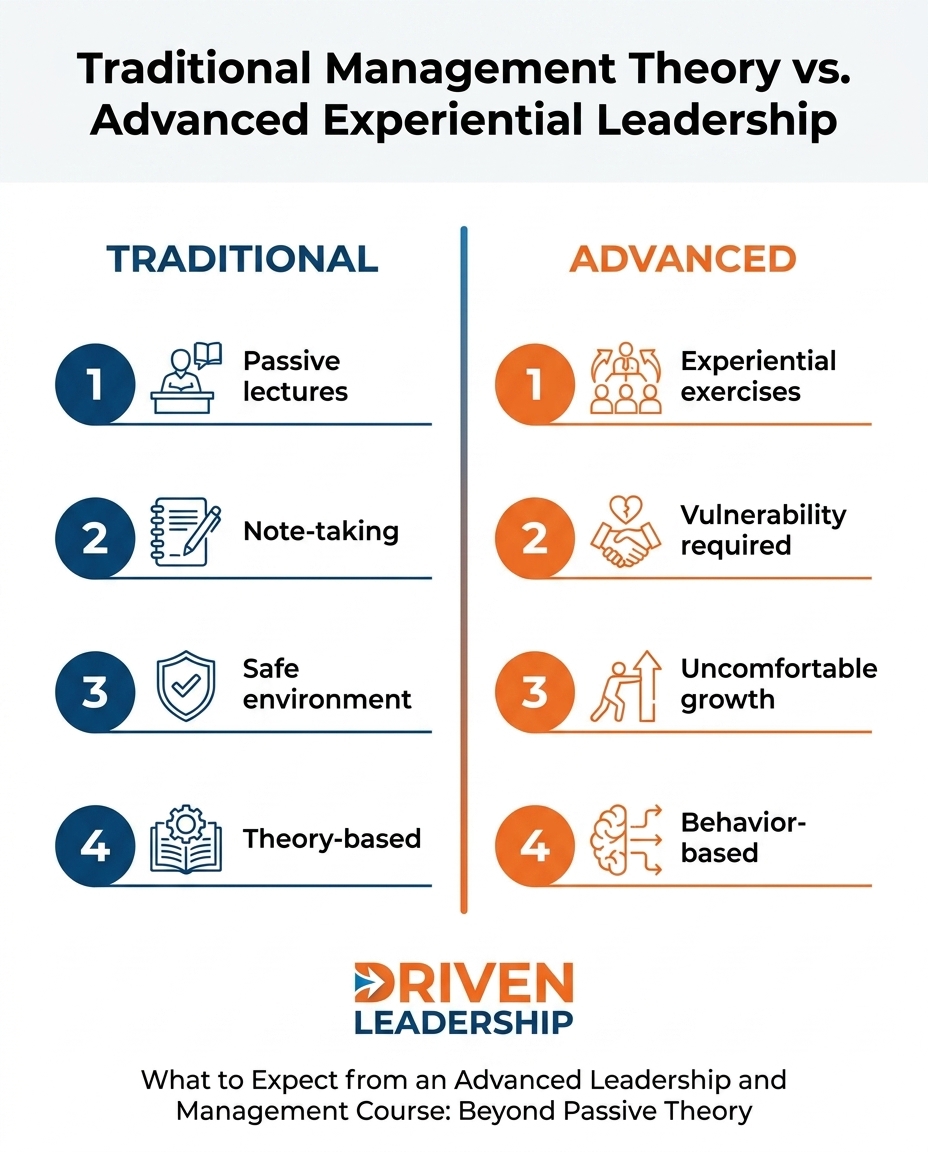
The critical disconnect: Passive learning does not test execution. It allows leaders to hide behind their intellect without ever having their emotional resilience challenged. To illustrate why advanced courses must be disruptive, consider the distinct differences between standard academic training and immersive behavioral development:
• Primary Focus — Traditional Management Theory: Memorizing frameworks and compliance rules — Advanced Experiential Leadership: Sustained behavioral change and emotional intelligence
• Learning Environment — Traditional Management Theory: Safe, passive, and predictable (lectures) — Advanced Experiential Leadership: Uncomfortable, active, and unpredictable (scenarios)
• Participant Role — Traditional Management Theory: Passive note-taker and observer — Advanced Experiential Leadership: Active participant requiring high vulnerability
• Feedback Mechanism — Traditional Management Theory: Standardized testing or written evaluations — Advanced Experiential Leadership: Real-time, unfiltered peer and facilitator critique
• End Goal — Traditional Management Theory: Acquiring new textbook knowledge — Advanced Experiential Leadership: Unlearning bad habits and improving execution
Understanding this contrast clarifies why traditional methods plateau. When the goal is to elevate a senior manager to an executive visionary, adding more theory to their plate is ineffective. The focus must shift to how they apply what they already know when the stakes are at their highest.
Expecting Experiential Discomfort: The Crucible of Real Growth
Advanced courses prioritize experiential growth over passive theory, demanding active, continuous participation. Participants should expect to be pushed out of their comfort zones through high-stakes, interactive scenarios designed to simulate real-world executive pressure. Growth inherently occurs in the space of discomfort, where leaders are forced to confront their blind spots head-on.
Driven Leadership's methodology demands this experiential discomfort and vulnerability, focusing strictly on real behavioral change rather than textbook theory. Instructors in these environments operate as passionate facilitators who actively challenge attendees, rather than professors who simply lecture at them. They create scenarios where leaders cannot rely on their usual defense mechanisms, forcing authentic reactions and exposing areas that require immediate development.
Navigating the Discomfort Zone
The catalyst for change: One professional, unable to acknowledge and overcome debilitating personal and professional roadblocks, attended the BOLD: Advanced Leadership Program seeking serious improvement. By leaning into the required discomfort and receiving guided, intensive support from the facilitators, they achieved profound personal and professional growth, ultimately elevating their career to new heights. This type of breakthrough is impossible in a passive learning environment.
• Simulated pressure: Exercises are designed to mimic the stress of a failing project or a team communication breakdown.
• Immediate reflection: After a scenario, facilitators guide leaders through a raw deconstruction of their actions, not just the outcome.
• Emotional stamina: Building the capacity to remain calm and decisive when the usual answers do not work.
Embracing this discomfort is non-negotiable. If a training session feels entirely comfortable and easy, it is likely only reinforcing what you already know rather than pushing you toward what you need to become.
The Role of Vulnerability in Unlearning Ingrained Habits
Decades of career experience can inadvertently build defensive habits that severely limit a leader's upward trajectory. These habits—such as micromanaging, avoiding difficult conversations, or dominating meetings—often develop as coping mechanisms during early career stages. Unlearning these ingrained behaviors requires a profound willingness to be vulnerable in front of both peers and instructors.
Advanced training provides a safe but highly demanding space to deconstruct these old methodologies. It asks leaders to strip away their titles and examine the raw mechanics of how they interact with others. For those managing teams or departments, an executive manager program serves as the ideal environment to safely dismantle these barriers and rebuild a more authentic leadership style.
The Process of Behavioral Unlearning
The daily application: A senior leader in their 50s, experiencing general career dissatisfaction and wishing they had found personal development decades earlier, completed the BOLD: Advanced Leadership training. By fully engaging in the vulnerable process of deconstructing their defensive habits, they changed their life and business trajectory, applying the learned tools daily for three years with lasting success. True unlearning follows a specific psychological progression:
1. Acknowledgment of the barrier: Recognizing that a long-held habit is actually a crutch holding the team back.
2. Public vulnerability: Admitting this flaw during an experiential exercise, allowing peers to see the authentic struggle.
3. Active deconstruction: Breaking down the trigger points that cause the defensive habit to surface under stress.
4. Deliberate replacement: Practicing a new, healthier leadership response in a simulated, high-stakes environment.
5. Daily integration: Committing to applying these new, vulnerable tools every single day upon returning to the organization.
Applying these tools daily is what ultimately changes the trajectory of a business. Vulnerability is not a weakness in this context; it is the fundamental prerequisite for unlearning the habits that stifle organizational growth.
Breaking the Routine: The Value of an Immersive Environment
Staying in familiar surroundings reinforces the very habits leaders are actively trying to break. The daily routine of commuting, answering emails, and putting out immediate fires keeps the brain locked in a reactive state. Removing executives from their standard environments disrupts these comfortable routines and serves as a powerful catalyst for change.
Highlighting the psychological benefit of stepping away from the familiar Pacific Northwest office routine into an immersive environment is crucial. When a leader is physically removed from their standard corporate setting, they can no longer rely on the physical cues that trigger their usual behaviors. This environmental shift forces them to be fully present and adaptable, entirely eliminating the distraction of daily operational emergencies.
Why the Office is the Enemy of Change
The power of separation: An immersive setting acts as a psychological reset button. When leaders are surrounded by the same walls, the same direct reports, and the same meeting schedules, their brains default to autopilot. Advanced courses require a level of deep introspection and active participation that is easily derailed by a vibrating smartphone or a quick check of the inbox.
• Mental bandwidth: Being off-site frees up the cognitive resources required to process intense emotional and behavioral feedback.
• Forced presence: Without the ability to step out and handle a minor crisis, leaders must sit with the discomfort of the training exercises.
• Accelerated adaptability: Unfamiliar surroundings force the brain to become hyper-aware, making it more receptive to adopting new methodologies.
The physical separation from the daily grind is not just a logistical choice; it is a strategic requirement for the deep psychological reset that advanced leadership development demands.
Aligning Your Behavioral Shift with the Q4 Strategic Push
Leadership development is most effective when it is intentionally timed ahead of critical business cycles. The late summer / back-to-school transition preparing for Q4 is widely considered the ideal time to realign behavioral habits. As organizations gear up for the most demanding quarter of the year, ensuring that the leadership team is operating with peak emotional intelligence and strategic clarity is paramount.
Preparing leadership capabilities before the high-pressure Q4 push ensures that strategic execution is not derailed by poor communication or reactive decision-making. When the pressure spikes in November and December, leaders will default to their highest level of training. If that training is recent and behaviorally focused, the entire organization benefits. To maintain this momentum, participating in a virtual management academy provides the ongoing support necessary to sustain these behavioral shifts as the year closes.
Metrics of Q4 Readiness
The seasonal advantage: Timing a behavioral reset during the late summer transition allows leaders to practice their new skills during a relatively stable period before the end-of-year chaos hits. A well-timed advanced course prepares leaders to handle specific seasonal pressures:
• High-stakes delegation: Trusting the team to execute end-of-year deliverables without micromanaging the process.
• Conflict resolution: Navigating the inevitable interpersonal friction that arises during budget finalizations and Q4 goal pushes.
• Strategic focus: Maintaining a clear vision for the upcoming year while simultaneously closing out current-year objectives.
• Resilience under fatigue: Managing personal and team energy levels during the most demanding weeks of the corporate calendar.
Aligning the timing of the course with the natural rhythm of the business year maximizes the immediate return on investment, ensuring that the behavioral shifts are tested and solidified when the company needs them most.
High-Stakes Interactions and Peer-Driven Accountability
Advanced courses rely heavily on peer-to-peer interaction rather than isolated study. The curriculum is built around collaborative exercises that are specifically designed to test trust, cooperation, and real-time decision-making under simulated stress. In these environments, you are not just learning from the facilitator; you are learning equally from the reactions and feedback of the other senior leaders in the room.
Peers serve as incredibly accurate mirrors. They provide the kind of unfiltered, objective feedback that traditional direct reports may withhold out of fear, and that superiors may miss because they only see the polished final results. Engaging in bold training exercises for trust and cooperation forces leaders to confront how their communication style is truly received by equals.
The Mirror Effect of Peer Feedback
The accountability network: Building a network of accountable peers is one of the most lasting benefits of immersive training. When a group of executives goes through a behavioral crucible together, it creates a unique bond rooted in shared vulnerability and mutual growth.
• Objective observation: Peers have no historical bias or organizational politics influencing their feedback; they react only to the behavior presented in the moment.
• Shared struggle: Watching other highly successful individuals struggle with their own blind spots normalizes the process of unlearning.
• Real-time adjustments: Collaborative exercises allow leaders to try a new communication tactic, fail, receive immediate peer feedback, and try again within minutes.
This peer-driven accountability extends far beyond the final day of the course. Leaders often leave with a trusted network of equals they can call upon for objective advice when facing complex organizational challenges in the future.
Frequently Asked Questions About Advanced Leadership Training
What makes advanced leadership courses different from basic management training?
Advanced leadership courses focus entirely on behavioral change, emotional intelligence, and experiential discomfort. While basic management training centers on foundational theories, delegation mechanics, and compliance rules, advanced programs assume you already know the basics. They push you into high-stakes scenarios designed to break down defensive habits and rebuild your capacity to lead under intense, ambiguous pressure.
How do I prepare for leadership training?
The most important preparation is arriving with an open mind and a genuine willingness to be vulnerable. You must expect to unlearn deeply ingrained habits rather than just taking quiet notes in the back of the room. Additionally, it is critical to completely clear your schedule and remove yourself from daily operational distractions so you can be fully immersed in the psychological reset the course demands.
Are executive leadership programs worth the time commitment?
Yes, but only when they focus on actual behavioral shifts rather than just passive, academic lectures. The true return on investment is measured in improved strategic execution, better conflict resolution, and tighter team alignment. This is especially critical when timed just before high-pressure periods like the Q4 strategic push, where leadership bottlenecks can severely impact the bottom line.
What is taught in an advanced leadership course?
Curriculums at this level move far beyond textbook frameworks and dive deeply into active listening, risk-taking, and peer accountability. The actual "teaching" does not happen through slide decks; it happens through high-stakes interactive exercises where leaders are forced to make decisions, fail safely, and receive immediate, unfiltered feedback from facilitators and peers.
How is behavioral change measured after the program?
Success is tracked through sustained, observable changes in communication, decision-making clarity under pressure, and direct feedback from the leader's team. It is not about passing a test, but about changing the daily operational dynamic. Ongoing coaching or participation in virtual academies often helps sustain this momentum, ensuring the new habits remain permanent.
Taking the Next Step Toward Authentic Leadership Growth
True leadership growth inherently requires stepping out of the comfort zone and leaving behind the passive note-taking of traditional management theory. Having a realistic expectation of the emotional demands and the required vulnerability prepares leaders to fully capitalize on the experience. The value of immersive, experiential learning lies in its ability to permanently alter how you handle pressure, communicate with your team, and execute strategy.
If you are ready to abandon the safety of the syllabus and embrace the crucible of real behavioral change, it is time to take action. Reach out today to discuss which immersive program aligns best with your current career trajectory and prepare to elevate your leadership capabilities before your next critical business cycle begins.