Improving Your Team's Internal Atmosphere Under High Pressure

When Q3 Deadlines Suffocate Your Team's Internal Air Quality
The August Q3 operational push is in full swing, and improving your team's internal atmosphere under high pressure feels harder than ever as back-to-school transitions collide with professional deadlines. This late-summer business cycle brings a unique kind of stress. Personal schedules shift rapidly, vacations end, and end-of-year goals suddenly loom large. When this external pressure builds up, the first thing to suffer is often the unseen environment within your organization.
Think of your company culture as your team's "internal air quality." It is an invisible but highly measurable environmental factor that dictates how well your people perform. When the air is clean, communication flows smoothly, and projects move forward. When the air becomes polluted with unspoken frustrations and mounting stress, every task feels heavy, and toxic communication spikes.
As a leader, you face a critical decision point during this seasonal crunch. You must differentiate between normal operational urgency—the healthy hustle required to meet deadlines—and a toxic atmosphere that requires immediate ventilation. Ignoring the tension and simply hoping it passes after the late-summer rush is a guaranteed recipe for burnout. At Driven Leadership, we've seen firsthand that proactive cultural development is the fastest way to clear the air, ensuring your team breathes easier and stays focused on the goals ahead.
Diagnosing the Atmosphere: Normal Stress vs. Toxic Friction
Before you can fix a polluted team environment, you have to know what you are looking at. Many leaders mistakenly treat all workplace tension as a negative issue. In our years of coaching executive teams, we've found that high-velocity work during the August Q3 operational push and back-to-school transition naturally generates friction. The key is understanding when that friction stops being productive.
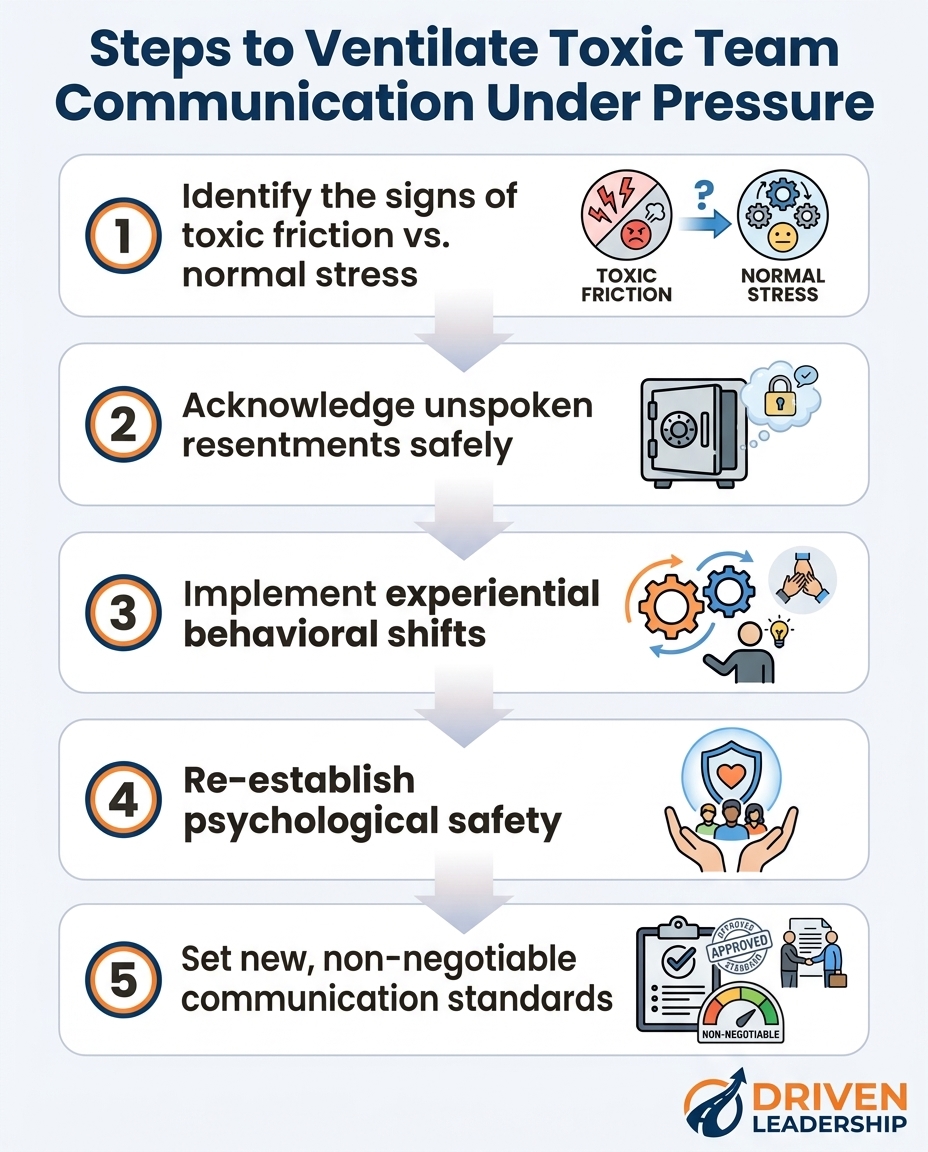
The root cause of the confusion: Normal stress happens when a team works hard but remains aligned, communicative, and mutually supportive. Toxic friction, on the other hand, is characterized by information hoarding, passive-aggressive remarks, and siloed workflows. When poor internal air quality takes hold, it acts as a leading predictor of employee turnover during high-stress periods. If you want to excel at leading an engaged culture, you must learn to spot the difference immediately.
• Communication Style — Normal Operational Stress: Direct, urgent, and focused on the problem. — Toxic Team Friction: Passive-aggressive, defensive, and focused on blame.
• Information Flow — Normal Operational Stress: Shared freely to speed up project completion. — Toxic Team Friction: Hoarded to protect individual status or avoid criticism.
• Post-Meeting Behavior — Normal Operational Stress: Immediate action on agreed-upon next steps. — Toxic Team Friction: Private complaining and back-channel disagreements.
• Reaction to Feedback — Normal Operational Stress: Accepted as necessary for rapid improvement. — Toxic Team Friction: Met with extreme defensiveness or withdrawal.
The Invisible Signs of Poor Team Communication
Sometimes the pollutants in your internal air are hard to spot until they cause serious damage. In our training sessions, we teach leaders to look for these subtle diagnostic markers that indicate your team's atmosphere is turning toxic:
• The silence of agreement: Meetings that end in total silence, only to be followed by private complaints in the hallway or over direct messages.
• The effort drop-off: A sudden, noticeable drop in discretionary effort and initiative, where team members only do the bare minimum required.
• The defensive wall: Increased defensiveness when routine feedback is given, turning minor corrections into major interpersonal conflicts.
Fortifying Morale Ahead of the Seasonal Shift
External environmental factors heavily compound internal operational stress. Working closely with companies in the Puyallup and Pacific Northwest business climate, our team at Driven Leadership frequently helps businesses navigate this transition. Teams are acutely aware that the short, vibrant summers are ending, and the shift into the region's long, grey, rainy season is just around the corner. This shift naturally dampens energy, making the internal team atmosphere even more critical to manage.
When you combine the pressure of Q3 deadlines with the impending change in weather, teams face a massive psychological hurdle. If the internal air quality is already poor, the shift to darker, gloomier months will completely drain whatever morale is left. Actively managing the internal weather right now prevents this massive drop in energy later in the year.
The proactive approach: Cultural resilience must be treated as a proactive strategy rather than a reactive HR fix. You cannot wait until November to wonder why your team is disengaged. By fortifying morale while the pressure is high in August and September, you build a resilient foundation. This means acknowledging the seasonal shift openly, checking in on mental bandwidth, and ensuring that the workplace remains a bright, supportive environment even when the skies outside start to turn grey.
Ventilating Passive-Aggressive Habits to Restore Alignment
Passive-aggressiveness is the most common and destructive pollutant in a high-pressure team environment. During the August Q3 operational push, tight deadlines often cause individuals to bite their tongues rather than address conflicts directly. Over time, this unspoken resentment builds up like carbon monoxide—silent, invisible, and deeply harmful to the entire group.
This toxic habit is usually exacerbated by a lack of confidence and poor listening skills. When team members do not feel equipped to handle healthy conflict, they resort to side comments and delayed sabotage. Bringing these unspoken resentments into the open safely is the only way to ventilate the room. Doing so directly impacts your ability to deliver projects on time, making open communication essential for flawless team execution.
Consider a recent scenario we facilitated: a management team noticed a distinct lack of confidence and effective communication during critical meetings. The associates were holding back, and progress stalled. By participating in our immersive advanced leadership training, the team gained the confidence to take charge. They learned how to communicate effectively, take real initiative, and ultimately transformed their meeting dynamics from silent and stagnant to highly productive.
To clear out passive-aggressive habits in your own ranks, follow these core steps we recommend to all our clients:
1. Name the behavior immediately: Do not let passive-aggressive comments slide. Address them calmly in the moment by asking for clarification.
2. Create a safe venting space: Dedicate the first five minutes of your weekly check-in to air out operational frustrations before they become personal resentments.
3. Require direct requests: Train your team to ask for exactly what they need from one another, rather than dropping hints or complaining about what they didn't get.
4. Model healthy conflict: As a leader, demonstrate how to disagree respectfully. When your team sees you handle pushback without ego, they will follow suit.
Experiential Tools to Shift Team Dynamics Immediately
When the internal air quality is suffocating your department, passive, cliché corporate training will not move the needle. Sitting your team down for a dry lecture on teamwork during a crisis only creates more resentment. Leaders need practical tools that force immediate shifts in perspective and behavior. This is where experiential learning fundamentally outperforms abstract leadership theory.
The power of doing over listening: Experiential learning techniques challenge a team's self-perception through active, sometimes uncomfortable exercises. By placing leaders and teams in scenarios that require real-time problem solving and vulnerability, you clear out stagnant air instantly. It forces individuals to drop their workplace masks and rely on one another, breaking down the silos that form under the pressure of the Puyallup and Pacific Northwest business climate.
This approach isn't just theoretical. During a recent Driven Leadership retreat, one manager drove up to our Wrightwood facility specifically to step entirely out of their comfort zone. By engaging in our intense experiential program, they broke through personal and professional limitations. They emerged not just as a better leader, but as a stronger person willing to take calculated risks. That kind of immediate, profound shift is the core of effective organizational development.
Applied concepts like these alter the trajectory of a struggling department. Instead of talking about trust, you put the team in a position where they must actively practice it. Whether it is a rapid-fire problem-solving drill or an exercise in giving unfiltered, real-time feedback, experiential tools shake up the environment enough to let fresh air in.
Rebuilding Psychological Safety During the Crunch
Once you have ventilated the toxic habits and shaken up the dynamic, you must rebuild the foundation. Under high operational velocity, psychological safety is often the first casualty. However, psychological safety in the context of high-stakes deadlines does not mean avoiding conflict. It means creating an environment for safe, respectful conflict where the best ideas can win.
The root cause of the breakdown: When deadlines loom during the August Q3 operational push and back-to-school transition, leaders often default to command-and-control management. This shuts down input. We consistently see this in our organizational assessments: Employees who feel their voice is heard are 4.6 times more likely to feel empowered to perform their best work. When you silence your team to save time, you actually destroy their productivity.
The solution for leaders: You must model vulnerability and empathy without lowering your performance standards. This is crucial for building trust and cooperation. Acknowledge the pressure everyone is under. Admit when you make a mistake or when a project timeline is exceptionally difficult. When you foster a cooperative environment, you give your team permission to take necessary risks and innovate, rather than hiding their mistakes out of fear.
To rebuild this safety quickly:
• Reward bad news: When a team member brings you a problem, thank them for catching it early instead of shooting the messenger.
• Separate the person from the problem: Critique the workflow, the process, or the outcome, but never attack the individual's character.
• Ask for pushback: Specifically ask your team, "What am I missing here?" or "Tell me why this plan might fail."
Setting New Communication Standards for the Remainder of the Year
Clearing the air is only half the battle; keeping it clean requires ongoing maintenance. Once the initial toxicity has been ventilated, you must provide a roadmap for maintaining a healthy internal atmosphere. This means establishing clear, non-negotiable communication standards for the team moving forward.
You must encourage every team member to take extreme ownership of their roles and their daily impact on the collective environment. This level of self-awareness is transformative. For example, during a recent Driven Leadership course, one professional realized they needed to challenge their own personal and professional ownership. By confronting their roadblocks and taking full accountability, they became the best version of themselves, proving that setting high standards always starts from within.
To sustain this new level of awareness through the end of the year and combat the gloomy Puyallup and Pacific Northwest business climate, we advise implementing regular "air quality checks." These are brief, structured check-ins designed to prevent pressure from building up again.
1. The Weekly Pulse: Dedicate 10 minutes at the end of the week to ask the team, "Where did we communicate poorly this week, and how do we fix it on Monday?"
2. The Boundary Reset: Clearly define working hours and response expectations to prevent burnout as the year-end push intensifies.
3. The Accountability Loop: When someone violates the new communication standards, address it privately but immediately. Do not let old habits creep back into the ecosystem.
4. The Wins Review: Highlight moments where team members handled conflict beautifully. What gets rewarded gets repeated.
Frequently Asked Questions About Managing Team Dynamics Under Stress
How do you handle a toxic team environment under pressure?
The first step is to address the behavior directly rather than hoping the pressure will pass. Treat the toxicity like poor internal air quality that requires immediate ventilation. Call a mandatory pause to openly discuss the friction without assigning personal blame. Implement experiential exercises to force a shift in perspective, and set strict, non-negotiable rules for respectful communication moving forward.
What are the signs of poor team communication during busy seasons?
The most common signs are passive-aggressive comments, information hoarding, and a sudden drop in discretionary effort. You will often notice meetings ending in silence, only for team members to complain privately afterward. Increased defensiveness over minor feedback and a tendency to work in isolated silos are also major red flags that your internal atmosphere is degrading.
How do you motivate a team under high pressure without causing burnout?
Motivation under pressure requires clarity, empathy, and psychological safety. Acknowledge the heavy workload openly and ensure your team feels heard; employees who feel their voice matters are significantly more likely to perform at their best. Focus on removing unnecessary roadblocks, celebrating small daily wins, and fiercely protecting their time off to ensure they can recharge.
How do leaders manage stress in the workplace effectively?
Effective leaders manage stress by modeling calm, decisive behavior and maintaining open lines of communication. They differentiate between normal operational urgency and toxic friction, stepping in quickly when behavior crosses the line. By implementing regular "air quality checks" and creating a safe space for healthy conflict, leaders prevent stress from turning into destructive resentment.
What is the difference between normal operational stress and a toxic culture?
Normal operational stress involves working at a high velocity where the team remains aligned, supportive, and focused on the shared goal. Friction may happen, but it is resolved quickly. A toxic culture occurs when that stress turns inward, resulting in blame-shifting, defensive communication, and passive-aggressiveness that actively damages trust and slows down project execution.
How quickly can experiential leadership training improve team dynamics?
In our experience, experiential training can shift team dynamics almost immediately. Because it relies on active, behavioral interventions rather than passive lectures, it forces individuals to drop their guard and practice vulnerability in real-time. This hands-on approach clears out stagnant communication habits quickly, allowing teams to reset their atmosphere and return to work with better alignment.
Breathe Easier: Taking Action to Reset Your Team's Culture
At Driven Leadership, we believe that treating your company culture like your internal air quality means recognizing that a healthy environment requires deliberate, ongoing ventilation. The August Q3 operational push and the back-to-school transition will always bring high pressure, but that pressure does not have to result in a toxic workplace. By diagnosing the friction early and addressing it head-on, you protect your most valuable asset: your people.
Passive lectures and hoping for the best will not save your Q3 goals. Actionable, behavioral strategies and experiential tools are the only proven ways to clear out toxicity without derailing your productivity. It is time to stop letting passive-aggressive habits suffocate your department. Take the first step in diagnosing your team's atmosphere today, establish non-negotiable communication standards, and watch how quickly your team begins to breathe easier and perform better.