The 'E' in Elevate: Breaking Down the Framework for Overwhelmed Managers

Navigating the Breaking Point: When Managers Need a Lifeline
Does your management team feel like they are constantly putting out fires rather than driving actual strategy? If you are exploring The 'E' in Elevate: Breaking Down the Framework for Overwhelmed Managers, you already know that temporary stress has likely morphed into systemic exhaustion. At Driven Leadership, a pattern we see often when working with organizations throughout Puyallup, WA, is that middle managers consistently report higher levels of burnout than individual contributors, largely due to unmanageable workloads and a lack of structured support systems. To bridge the gap between reactive panic and operational control, teams must transition from mere survival mode to intentional execution. Mastering specific framework elements is the key to regaining that operational control, and it often begins with foundational leadership trainings designed to reset a manager's baseline approach.
According to extensive workplace data, including insights from Gallup and the Harvard Business Review, middle management turnover spikes dramatically when leaders lack a tactical survival guide. When a leadership team faces severe burnout, the right next step is implementing a proven system. The 'E of Elevate' framework application for burnout provides exactly this lifeline. It is not about adding more tasks to a manager's plate; it is about fundamentally restructuring how they process daily friction, make decisions, and guide their direct reports through high-pressure situations.
Defining the Core: "Let's talk about the e of elevate" leadership framework
When leadership development professionals say, "let's talk about the e of elevate" leadership framework, they are directly addressing the tactical mechanics of regaining control. This specific element acts as a survival guide rather than a theoretical academic concept. It relies on proprietary, battle-tested strategies that have been proven in real-world applications, shifting a manager's focus from merely surviving the day to actively empowering their team.
The Three Pillars of the 'E'
To effectively utilize the 'E of Elevate' framework application for burnout, managers must understand its three core definitions:
• Energy Management: Shifting the focus away from traditional time-tracking to understanding how and where cognitive energy is deployed throughout the day.
• Empowerment: Moving away from bottlenecking decisions and instead providing the team with the autonomy to execute within clearly defined boundaries.
• Execution: Focusing on high-leverage activities that move the needle, rather than getting bogged down in low-value administrative friction.
Moving from Theory to Practice
Mastering these elements requires more than just reading a manual. It demands a structured approach to unlearning bad habits. Leaders must recognize that their current state of overwhelm is often a byproduct of holding onto too much control. By actively engaging with structured development paths, such as the Engage Elevate Program we facilitate at Driven Leadership, managers learn how to dismantle these self-imposed barriers. The framework connects these definitions directly to immediate burnout relief, providing actionable levers a leader can pull the moment they feel the pressure mounting.
Identifying the Heat: Signs of Leadership Team Burnout
Before any framework can be successfully applied, you must first accurately diagnose the problem. Think of your team's operational capacity like a commercial HVAC system operating under intense summer heat. Just as those mechanical systems strain and require highly efficient cooling strategies under peak July operational loads, leadership teams face compounding pressure during summer vacation schedules. In our experience, when half the office is out of town, the remaining managers carry significantly heavier burdens, leading to rapid systemic exhaustion.
The Cost of Reactive Management
Constant firefighting degrades team morale and heavily impacts middle management turnover. There is a distinct difference between a temporary busy period and a systemic operational failure. If your team is experiencing a temporary rush, the stress dissipates when the project ends. Systemic failure, however, means the stress is the baseline. Recognizing these signs is the first step toward applying the 'E' principle effectively. Common symptoms include:
• Decision Fatigue: When managers struggle to make even minor choices by the mid-afternoon because their cognitive reserves are entirely depleted.
• Bottlenecking Operations: When a leader insists on reviewing every minor detail, slowing down the entire department and frustrating capable team members.
• Chronic Overwhelm: A persistent feeling of drowning, where external pressures from clients or executives compound internal stress, making a structured approach absolutely vital.
By identifying these specific heat indicators, you can begin the 'E of Elevate' framework application for burnout, transitioning your team out of the danger zone and back into a sustainable rhythm.
From Reactive to Resilient: Tactical Steps for Operational Control
When a management team is in active crisis mode, theoretical advice falls flat. You need actionable, immediate steps to stop the bleeding. A common pattern our Driven Leadership team sees, particularly when operational loads peak during the intense heat of July, involves leaders encountering debilitating roadblocks in both their personal and professional lives. By stepping into a structured environment, they receive the exact recipe for elevation needed to overcome those barriers, ultimately achieving entirely new levels of personal and professional growth. Here is how to apply those tactical steps to your own daily routine.
1. Acknowledge the Reality of the Bottleneck: The first step is admitting that your current method of handling the workload is failing. You cannot fix a system if you refuse to acknowledge that you are the primary bottleneck slowing it down.
2. Identify Debilitating Professional Roadblocks: Write down the top three recurring issues that drain your department's time every single week. Are they redundant reporting requirements? Unclear communication channels? Pinpoint the exact friction points.
3. Step Out of Your Comfort Zone: Structured training requires leaders to confront their own micromanagement tendencies. You must be willing to let your team make controlled mistakes so they can learn and grow, which requires significant vulnerability on your part.
4. Take Unapologetic Ownership: Transitioning from hesitation to taking ownership of operational flow means stopping the blame game. If a process is broken, take the initiative to rebuild it using the 'E of Elevate' framework application for burnout.
Implementing these steps often requires external guidance. Programs structured around these exact principles, such as an executive manager program, provide the accountability needed to ensure these tactical steps become permanent habits rather than temporary fixes.
Energy Management Over Time Management
One of the most profound shifts a leader can make is abandoning the obsession with time management in favor of energy management. When a manager is fundamentally exhausted, all the calendar blocking and productivity apps in the world will not save them. Time is a finite resource, but energy is a renewable one—if managed correctly. In one scenario we frequently observe working with local Puyallup teams during peak summer operational seasons, a manager realizes they need to gain the courage and confidence to tackle major career goals. By immersing themselves in an advanced leadership curriculum, they experience lasting changes that allow them to deploy energy strategically rather than just watching the clock.
Understanding the Difference
To fully grasp the 'E of Elevate' framework application for burnout, you must understand how energy dictates output. Gaining the courage and confidence to tackle major departmental goals requires strategic energy reserves.
• Daily Planning — Time Management Approach: Scheduling every minute of the day with back-to-back tasks. — Energy Management Approach: Scheduling high-focus tasks during peak cognitive hours.
• Handling Interruptions — Time Management Approach: Viewing them as a loss of 15 minutes on the calendar. — Energy Management Approach: Recognizing they drain focus and require a 20-minute recovery period.
• End of Day Metric — Time Management Approach: How many hours were worked or tasks crossed off. — Energy Management Approach: How much meaningful progress was made on strategic goals.
The takeaway: Stop trying to squeeze more hours out of the day. Instead, identify your high-energy tasks—the strategic planning, the high-level team mentoring—and protect those windows fiercely. Relegate draining operational friction to your lowest-energy periods or eliminate it entirely.
Delegation and Alignment: The Antidote to Overwhelm
Applying the 'E' requires aligning the team and effectively distributing the operational load. However, many overwhelmed leaders confuse delegation with dumping. Dumping tasks happens when a manager is so stressed they simply throw assignments at their direct reports without context, resources, or clear expectations. Strategic delegation, on the other hand, is the thoughtful transfer of responsibility, accompanied by the authority needed to execute it properly.
The Role of Shared Core Values
For delegation to work without triggering intense micromanagement, a foundation of shared core values is absolutely required. When your team understands the 'why' behind the work, they can make independent decisions that align with your overarching leadership framework. This alignment naturally reduces the manager's daily operational burden, serving as a direct application of the 'E of Elevate' framework application for burnout. If you are struggling to build this foundation, establishing the values teams need to share is a non-negotiable first step we recommend to all our clients.
To align team goals with your framework, start by explicitly mapping out the expected outcomes rather than dictating the exact process. Give your team the destination and the boundaries, then let them figure out the best route to get there. This not only frees up your cognitive energy but also builds a more resilient, capable workforce that can handle the heat when peak operational seasons arrive.
Frequently Asked Questions About the Elevate Leadership Framework
What does the E stand for in the Elevate leadership framework?
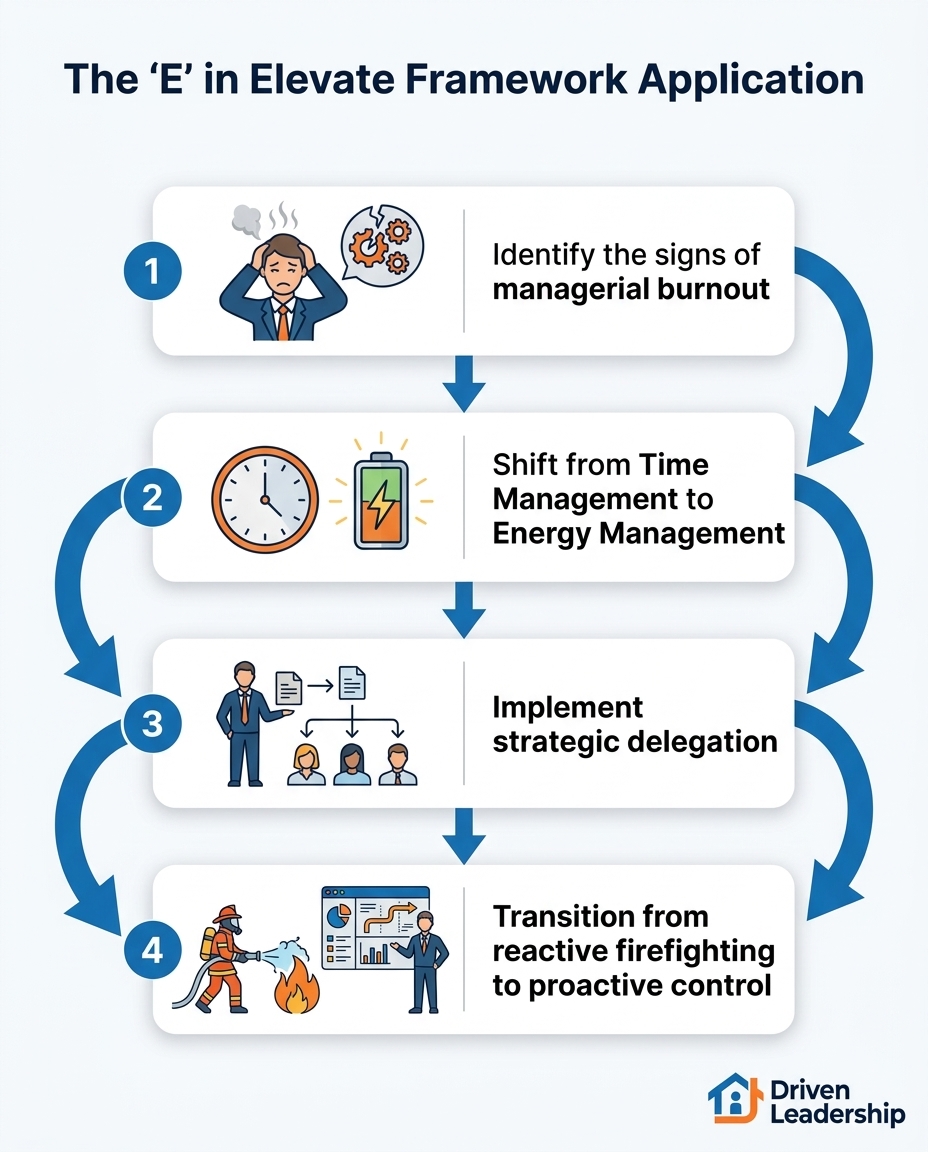
The 'E' primarily stands for Energy, Empowerment, and Execution within the context of daily management routines. It represents a tactical shift from passive, reactive firefighting to proactive, structured leadership. By mastering these three elements, leaders can effectively dismantle the root causes of their daily operational overwhelm.
How can overwhelmed managers apply the Elevate framework?
Overwhelmed managers can apply this framework by first acknowledging their operational bottlenecks and shifting their focus from time management to energy management. They must actively practice strategic delegation, transferring both responsibility and authority to their capable team members. This immediate 'E of Elevate' framework application for burnout provides instant relief to a crowded schedule.
What are the signs of leadership team burnout?
The most prominent signs include severe decision fatigue, where leaders struggle to make basic choices, and the chronic bottlenecking of daily operations. You will also notice a persistent feeling of being overwhelmed, where even minor external pressures cause disproportionate internal stress. Recognizing these symptoms early allows for faster intervention and course correction.
What is the difference between time management and energy management for leaders?
Time management focuses on tracking hours and squeezing as many tasks as possible into a rigid schedule, which often accelerates exhaustion. Energy management focuses on understanding a leader's cognitive peaks and valleys, scheduling high-leverage strategic work during high-energy periods. This approach preserves mental bandwidth and prevents the afternoon crash that plagues reactive managers.
How do structured leadership development programs prevent manager turnover?
Structured programs provide middle managers with the tactical tools and actionable frameworks they need to handle high-pressure environments without sacrificing their well-being. When leaders feel supported and equipped to manage their workloads, their job satisfaction increases significantly. This directly reduces the likelihood of them leaving the organization due to unmanageable systemic stress.
Can the Elevate framework be applied during peak operational seasons?
Yes, the framework is specifically designed to act as a survival guide during high-stress periods, such as peak summer operational loads. By relying on established systems for delegation and energy management, leaders can navigate heavy workloads without reverting to destructive micromanagement habits. It provides the necessary structure to keep the team aligned when external pressures are highest.
Regain Control of Your Leadership Journey
Burnout is not a permanent state if the right framework is applied consistently. By understanding and implementing The 'E' in Elevate: Breaking Down the Framework for Overwhelmed Managers, you can transition your team from a state of constant panic to one of sustainable operational control. The principles of energy management, strategic delegation, and deliberate execution are proven tools for mitigating exhaustion. We encourage you to explore structured programs to solidify these principles in your daily routine, ensuring that you and your team can handle whatever challenges the business year brings.