Free Online Leadership Courses vs Paid Intensive Workshops: A ROI Breakdown

The Myth of Equal Outcomes in Leadership Development
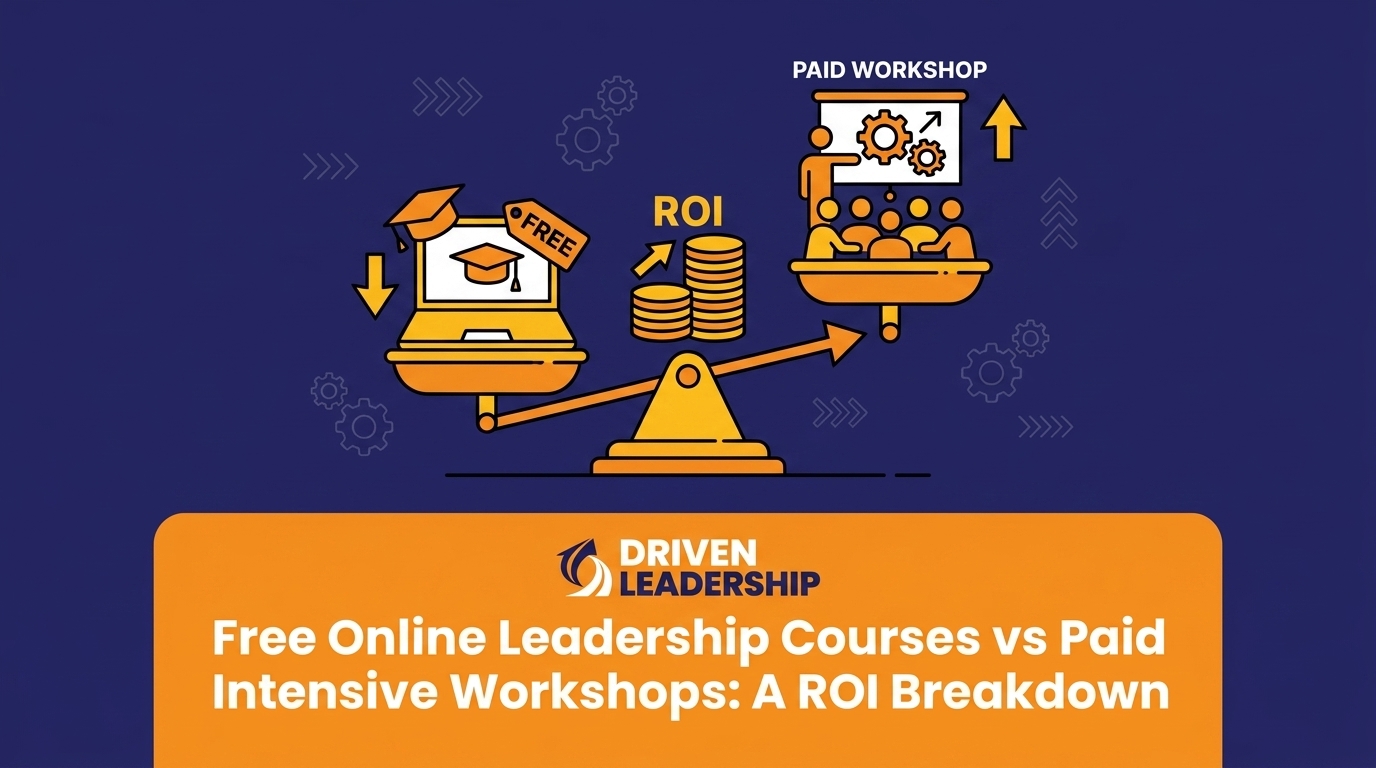
A common myth in professional development is that consuming information automatically translates into better management. If you are weighing Free Online Leadership Courses vs Paid Intensive Workshops: A ROI Breakdown is essential to determine whether self-paced modules actually drive change compared to the resource investment of immersive programs. At Driven Leadership, our team routinely sees organizations operating under the assumption that all leadership training yields similar results, treating a series of online videos with the same weight as a multi-day facilitated experience. This fundamental misunderstanding leads to wasted hours and stagnant workplace dynamics.
The concrete problem facing many decision-makers is evaluating whether free, self-paced courses produce measurable behavioral shifts. Organizations often default to zero-cost online options, assuming that providing access to information is enough to spark professional growth. However, knowing what a good leader does is vastly different from actually doing it under pressure. As teams approach the critical late-summer/back-to-school business transition, leaders face a distinct decision point: how to allocate training hours effectively before the demanding fall cycle begins.
Allocating time and resources requires a clear-eyed look at how different training modalities impact actual workplace performance. To truly transform team execution, you need a strategy that moves beyond basic knowledge transfer. For comprehensive solutions that address this gap, exploring professional leadership trainings provides a foundation for evaluating what actual development requires.
The Illusion of Passive Knowledge Acquisition
To understand why many training initiatives fail to produce results, we have to examine the mechanics of passive knowledge acquisition. This model relies on watching pre-recorded videos, reading articles, and completing multiple-choice quizzes. While this approach is highly scalable and often free, it fundamentally misinterprets how adults learn complex interpersonal skills. Information alone rarely disrupts ingrained behavioral patterns in the workplace. A manager might score perfectly on a quiz about conflict resolution, but still freeze or become defensive when a real-world dispute arises in the boardroom.
The hidden cost of this approach is the phenomenon of zero workplace performance changes. Time is spent, certificates are printed, and compliance boxes are checked, but no measurable growth occurs. Employees return to their desks with an expanded vocabulary but the exact same habits. This lack of execution creates a false sense of security for organizations that believe they are actively developing their talent, while underlying dysfunctions remain entirely unaddressed.
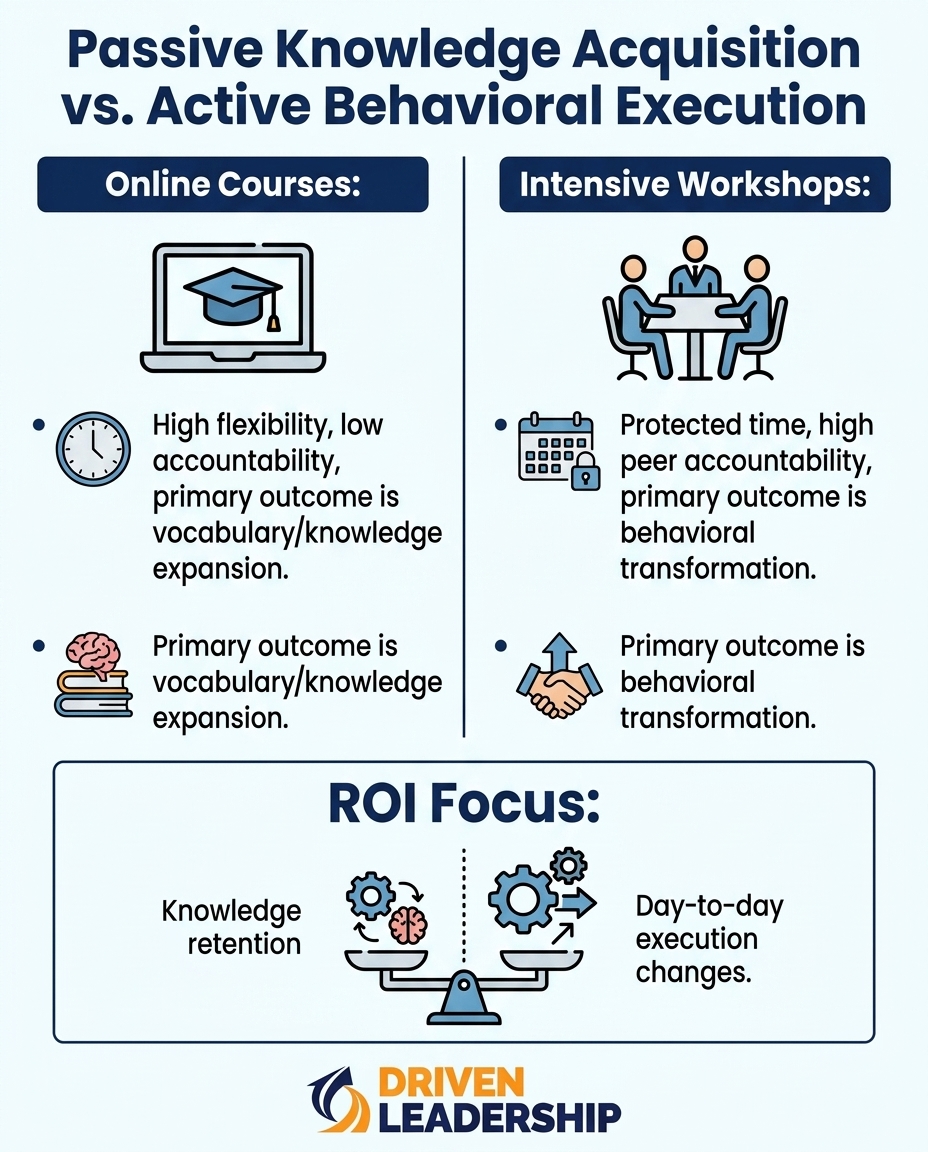
There is a distinct line between passive knowledge acquisition vs active behavioral execution. Self-paced learning is highly appropriate for certain tasks: mastering new software, understanding updated compliance regulations, or reviewing company policies. These are binary, information-heavy topics. However, when it comes to emotional intelligence, conflict resolution, and strategic decision-making, passive learning falls flat.
Real-world experiences highlight this gap. One professional who attended our summer immersive program noted that they previously struggled to gain the courage and confidence needed to tackle significant career challenges. It was only by moving away from passive reading and engaging in an environment that demanded active participation that they finally broke through those barriers, achieving goals they had previously only dreamed about. For foundational knowledge that complements active training, an online leadership academy can serve as a supplementary resource, but we always emphasize that it cannot replace the crucible of real-world practice.
Active Behavioral Execution: The Intensive Workshop Advantage
Multi-day intensive workshops operate on a completely different psychological level than self-paced courses. Rather than dispensing information, these environments force genuine behavioral shifts. By placing participants in experiential scenarios, intensive workshops demand active behavioral execution. You cannot passively scroll through a difficult conversation; you have to look another person in the eye, manage your own emotional regulation, and navigate the interaction in real time. This experiential pressure is what separates superficial learning from deep, lasting transformation.
Immersive environments challenge both personal and professional identities. They strip away the titles and corporate armor that leaders often hide behind, forcing them to confront their actual instincts and reactions. The mechanics of this experiential learning rely on immediate feedback, peer accountability, and real-time behavioral adjustments. When a leader makes a misstep in a simulated high-stakes environment, they receive instant, constructive feedback from our facilitators and peers, allowing them to correct the behavior immediately rather than carrying the blind spot back to their office.
Breaking Down Ingrained Habits
Standard corporate training fails to break old habits because it does not apply enough pressure to reveal them. In a comfortable, low-stakes environment, people default to their intellectual understanding of a topic. Experiential pressure changes the equation. By introducing complex, time-sensitive challenges, intensive workshops bypass intellectual defenses and reveal a leader's true instincts. This is where real growth happens. Once ingrained habits are exposed in a controlled setting, they can be deconstructed and replaced with healthier, more effective leadership behaviors.
Our facilitators witnessed this dynamic firsthand with a professional who attended a spring workshop specifically to improve confidence and take greater initiative. By engaging in active exercises rather than passive study, the individual underwent a profound shift. Management and associates quickly noticed positive changes in attitude, communication, and drive upon their return to the workplace. The shift from passive knowledge acquisition vs active behavioral execution proved to be the catalyst for these tangible results.
Building Real-Time Confidence
Confidence is not built by reading about leadership; it is built by practicing it. Intensive workshops provide a laboratory for practicing difficult conversations, taking charge of chaotic situations, and navigating team friction. This real-time practice builds a reservoir of courage that leaders draw upon when they return to their organizations. Translating workshop breakthroughs into meeting room execution requires the muscle memory developed through active participation. To understand the types of scenarios that build this capacity, reviewing BOLD training exercises for trust and cooperation illustrates how immersive environments forge resilient teams.
Measuring ROI Beyond the Upfront Investment
Calculating the return on investment for leadership development based solely on upfront financial savings is a deeply flawed metric. Free online courses appear to have an infinite ROI if the cost is zero, but if the training yields zero behavioral change, the actual return is negative due to the time wasted. True ROI in leadership development must be redefined from "cost saved" to "performance gained."
The indicators of a successful training initiative are highly visible in daily operations. Organizations should look for improved team alignment, faster and more decisive decision-making, and increased employee retention. Authentic leadership directly impacts a company's bottom line. When leaders communicate clearly, manage conflict efficiently, and inspire their teams, operational efficiency skyrockets. Turnover decreases because employees rarely leave companies; they leave poor managers. By investing in the active behavioral execution of your leadership team, you are directly investing in the stability and productivity of your entire workforce.
Operating out of Puyallup, WA, our team knows that the Pacific Northwest business climate specifically values authentic leadership, high retention, and measurable ROI over superficial corporate checkbox training. In regions where talent is highly competitive and organizational culture is a primary differentiator, generic, passive training solutions are insufficient. Companies in this environment require leaders who can navigate ambiguity and foster genuine team cohesion.
When evaluating long-term sustainability, the behavioral changes produced by immersive programs vastly outperform the quick fade of passive course material. Knowledge acquired through a video module is typically forgotten within weeks if not applied. Conversely, the emotional and psychological breakthroughs achieved in an intensive workshop create new neural pathways and behavioral baselines. The distinction between passive knowledge acquisition vs active behavioral execution becomes undeniable when measuring the long-term operational health of a department led by a transformed manager.
Side-by-Side Breakdown: Modalities and Outcomes
To make an informed decision, it is helpful to look at a direct, scannable comparison of the two primary training modalities. The differences in structure, commitment, and ultimate outcomes dictate which approach will serve your organization's specific needs.
• Time Commitment — Free Online Courses (Passive): Highly flexible, but easily ignored or deprioritized during busy work weeks. — Paid Intensive Workshops (Active): Concentrated, protected time away from daily distractions to ensure deep focus.
• Networking & Connection — Free Online Courses (Passive): Isolated experience with zero to minimal interaction with other professionals. — Paid Intensive Workshops (Active): High-impact peer connection, fostering cross-industry insights and shared vulnerability.
• Accountability — Free Online Courses (Passive): Entirely self-driven; easy to skip modules or multitask during video lectures. — Paid Intensive Workshops (Active): Facilitated and peer-enforced; requires full presence and active participation.
• Primary Outcome — Free Online Courses (Passive): Vocabulary expansion and intellectual understanding of leadership concepts. — Paid Intensive Workshops (Active): Measurable behavioral transformation and the ability to execute under pressure.
• Feedback Loop — Free Online Courses (Passive): Delayed or non-existent; automated quiz scores do not reflect interpersonal skills. — Paid Intensive Workshops (Active): Immediate, real-time feedback from experts and peers on communication style and impact.
This breakdown highlights why organizations seeking genuine change must look beyond the screen. For teams ready to step out of isolation and into a high-accountability environment, exploring onsite workshops provides the protected time and intensive focus required to shift deeply ingrained workplace habits.
Strategic Timing: The Late-Summer Alignment Window
The timing of leadership development is just as critical as the modality. The late-summer/back-to-school business transition represents a unique psychological window for adult professionals. As the relaxed pace of summer concludes, there is a natural inclination toward renewed focus, structure, and goal-setting. Scheduling intensive training during this specific window capitalizes on this natural momentum, making it the optimal time for leadership development.
Intensive workshops conducted in late summer or early fall prepare teams for a strong Q4 push. The final quarter of the year is often the most demanding, requiring high levels of alignment, rapid decision-making, and sustained energy. Overcoming debilitating personal and professional roadblocks before this fall cycle begins prevents end-of-year burnout. When leaders resolve their communication bottlenecks and clarify their strategic vision in August or September, they enter Q4 equipped to guide their teams effectively through high-pressure periods.
This strategic timing stands in stark contrast to the "whenever we get around to it" nature of free online courses. Because self-paced modules lack urgency, they are perpetually pushed to the bottom of the to-do list, meaning the team never actually receives the development they need before critical business cycles hit. Our emphasis at Driven Leadership on producing actual behavioral change through immersive, experiential learning (like our BOLD program) acts as the exact catalyst needed for this seasonal transition.
The impact of timing and immersion is profound. One professional who attended our spring workshop specifically sought to overcome debilitating personal and professional roadblocks. By engaging fully in the intensive environment and receiving direct support from our team, they were able to acknowledge and dismantle these barriers, elevating their performance to new heights just as their organization entered a critical growth phase. Aligning the late-summer/back-to-school business transition with active, experiential training ensures your leadership team is fully calibrated for the challenges ahead.
Frequently Asked Questions
What is the actual ROI of leadership training?
The true ROI of leadership training is measured in performance gained rather than just upfront costs saved. Effective training yields improved team alignment, faster decision-making, and significantly higher employee retention rates. When leaders communicate clearly and manage conflict effectively, operational efficiency increases across the entire department. Ultimately, the return is seen in a more resilient, productive workforce that requires less micromanagement.
How effective are intensive leadership workshops compared to self-paced learning?
Intensive workshops are vastly more effective for driving actual behavioral change. While self-paced learning is excellent for acquiring basic information or learning software, it rarely disrupts ingrained interpersonal habits. Immersive workshops place leaders in experiential scenarios that demand real-time execution, providing immediate feedback and peer accountability. This active environment forces leaders to practice new skills under pressure, ensuring the changes stick when they return to the office.
Can you genuinely learn leadership skills online?
You can learn the vocabulary and theory of leadership online, but practicing the application is much harder. Online courses provide excellent foundational knowledge regarding management frameworks, compliance, and strategic planning. However, soft skills like emotional intelligence, conflict de-escalation, and reading team dynamics require human interaction. To genuinely master leadership, online theory must eventually be paired with real-world, active practice.
Are paid leadership courses worth the upfront investment?
Yes, provided the course focuses on experiential learning and behavioral execution. The upfront investment in a paid, intensive workshop pays dividends by reducing turnover, preventing costly management errors, and accelerating project timelines through better team alignment. Free courses often carry a hidden cost: the time wasted consuming content that never translates into measurable workplace improvements.
How long does it take to see behavioral changes after an intensive workshop?
Behavioral changes are often noticeable immediately upon the leader's return to the workplace. Because intensive workshops focus on real-time practice and breaking down old habits, participants leave with new communication baselines already established. Management and peers typically observe increased confidence, better listening skills, and a more proactive approach to problem-solving within the first few weeks following the training.
Why do so many corporate training programs fail to produce workplace results?
Many programs fail because they rely entirely on passive knowledge acquisition. They treat leadership development as an intellectual exercise rather than a behavioral one. When training consists only of watching videos or reading slides without experiential pressure, immediate feedback, or accountability, participants default to their old habits the moment they face real workplace stress. Without active execution, information rarely transforms into action.
Transform Your Team's Execution Today
Evaluating the true cost of your professional development strategy requires looking past the initial price tag and focusing on the daily execution of your team. Passive online courses may offer a zero-cost way to distribute information, but they consistently fail to produce the behavioral shifts required to navigate complex workplace challenges. As you prepare for the demanding fall business cycle, settling for knowledge acquisition without active execution leaves your organization vulnerable to the same recurring bottlenecks and communication breakdowns.
Real growth demands an environment that challenges ingrained habits, provides immediate feedback, and builds the courage necessary to lead authentically. If you are ready to move beyond superficial corporate training and invest in measurable, sustainable behavioral change, it is time to take action. Equip your leaders with the tools they need to thrive by enrolling in the multi-day intensive BOLD workshop and watch your team's performance transform.