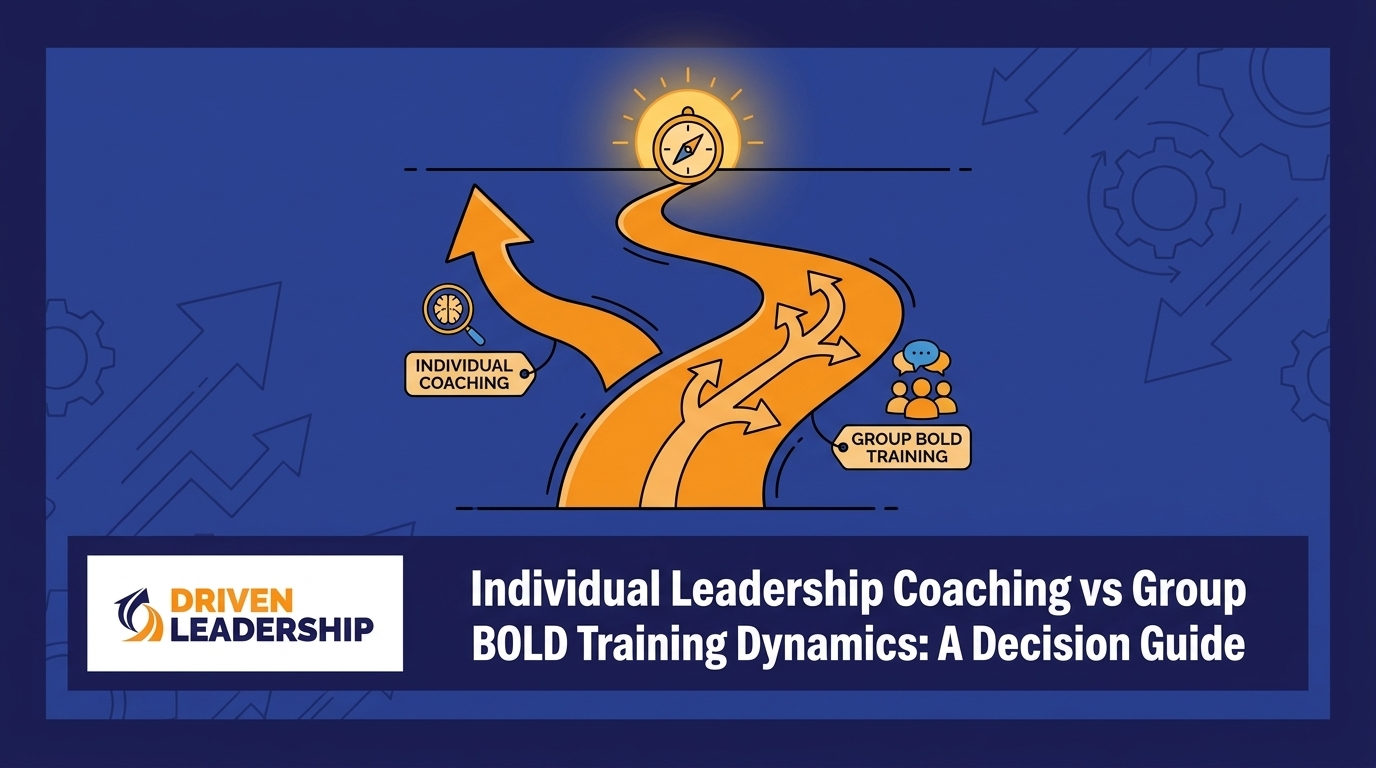
Individual Leadership Coaching vs Group BOLD Training Dynamics

Myth: True Leadership Transformation Only Happens in Private
In our years of developing executives at Driven Leadership, we often see business owners mistakenly believe that the only way to develop an executive is behind closed doors. You might assume that addressing deep-seated blind spots requires total privacy and quiet reflection. But here is the truth we have learned firsthand: choosing between Individual Leadership Coaching vs Group BOLD Training Dynamics usually comes down to determining whether your leadership team needs private, tailored pacing or a high-pressure reality check.
If you are trying to decide between the psychological safety of individualized coaching and the intense, collective exposure of group training, you are not alone. Our team typically sees this as a critical decision point for any organization trying to figure out the right path forward. You have to evaluate whether your managers need a quiet space to untangle their specific challenges, or if your entire team needs an immediate, unified reset to fix systemic dysfunction.
As you navigate the late-summer/back-to-school transition into Q4 planning, the urgency to get this right increases. We constantly remind our clients that they cannot afford to enter the busiest quarter of the year with a misaligned executive team. To explore the foundational differences, you can review our leadership trainings, or look directly at the immersive BOLD training program to see how rapid alignment works in practice.
The Safe Harbor of Individual Leadership Coaching
Our team recognizes that one-on-one coaching serves a very specific and necessary purpose in corporate development. It provides a safe harbor. For executives who are dealing with highly sensitive transitions, imposter syndrome, or deep personal roadblocks, private coaching offers a space where they can be completely vulnerable without fear of judgment from their peers.
In our practice, this modality allows for highly individualized pacing. If a leader needs to spend three weeks unpacking a specific communication habit, our coaches can adapt the curriculum to stay on that topic. The leader does not have to worry about slowing down a group or exposing their insecurities to colleagues they have to manage the next day. They get to work on their tactical growth in a controlled environment.
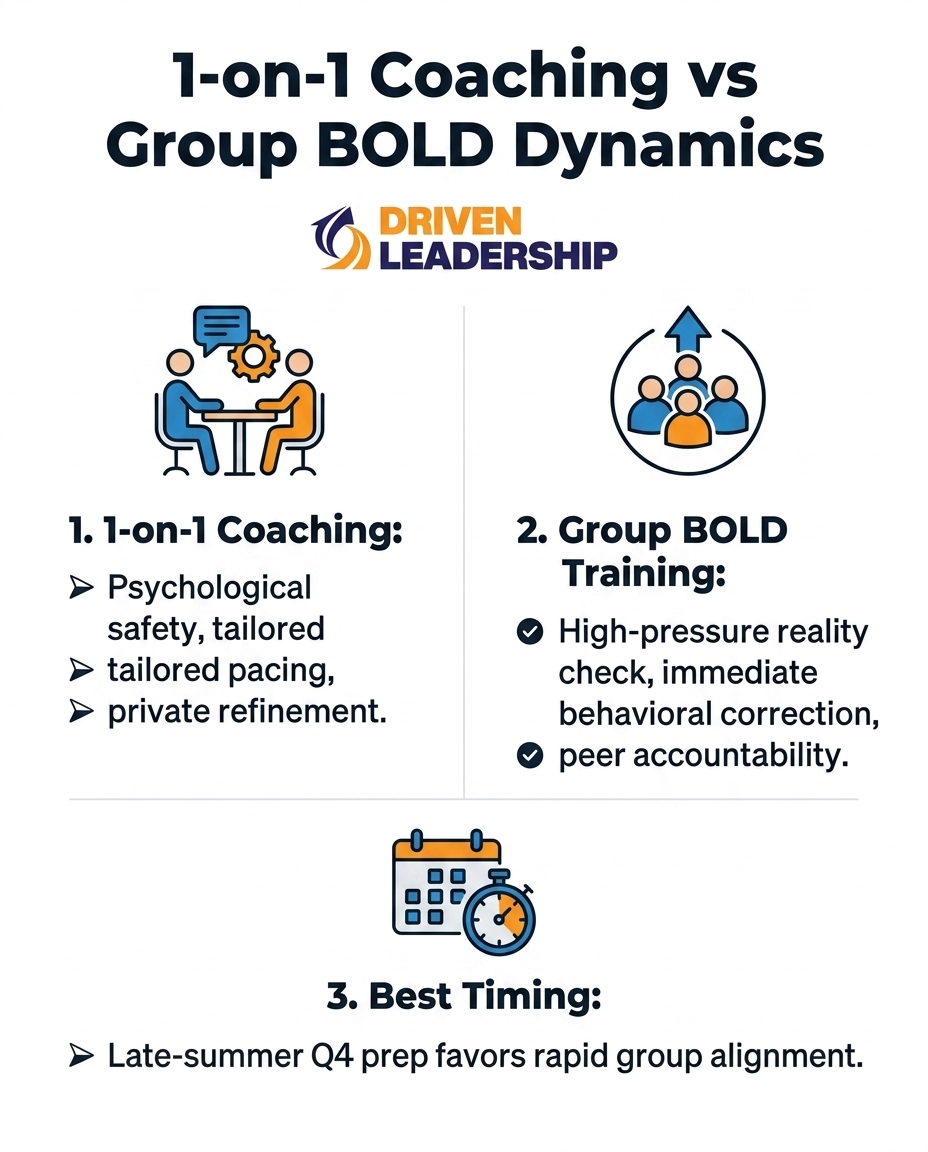
However, we consistently warn clients that this psychological safety comes with a notable limitation. Private coaching lacks real-time peer feedback. A coach only sees the version of the leader that shows up to the private session. They do not see how that leader actually interacts with their team in the hallway, or how they handle friction during a tense board meeting. Because of this, translating private epiphanies into team-wide behavioral changes can be a slow process. For organizations operating within the fast-paced Puyallup and South Sound business community, that slower timeline might not meet immediate operational needs. If you have an executive who needs this specific type of private refinement, exploring individual leadership development is the right first step.
Pros and Cons of Private Pacing
When consulting with organizations, we find it helps to break down the practical advantages and disadvantages of keeping your leadership development isolated.
• Pro: Highly customized curriculum. Every session is tailored directly to the specific individual needs of the executive, allowing them to focus entirely on their unique skill gaps.
• Pro: Safe environment for vulnerability. Leaders can admit to failures, fears, and frustrations without worrying about office politics or losing face in front of their direct reports.
• Con: Lacks immediate friction. Without the reality-testing of group dynamics, a leader might think they have improved a skill, only to revert to old habits the moment they face real-world team pressure.
• Con: Delayed team impact. The organization has to wait for the individual to slowly integrate their new skills into their daily management style before the broader team feels the benefit.
The Mirror-Holding Reality of Group BOLD Training Dynamics
If private coaching is a safe harbor, experiential group dynamics act as a high-pressure testing ground. Having facilitated countless breakthroughs, our team designed Driven Leadership's unique BOLD training to provide a "mirror-holding reality" that forces immediate growth and peer accountability, contrasting sharply with traditional, slower-paced 1-on-1 coaching.
In a group setting, we observe that leaders cannot hide behind a polished persona. Experiential training puts participants into high-stakes, interactive scenarios where their natural instincts take over. If a leader tends to dominate conversations and shut down collaboration, that behavior will immediately surface during a group exercise. Their peers will see it, feel the impact of it, and—most importantly—call it out in real time.
This immediate feedback loop is driven by Social Learning Theory, a principle we rely on heavily. We learn faster and retain more when we observe others, experience friction, and adjust our behavior collectively. Peers expose blind spots much faster and more accurately than a private coach ever could, because the peers are the ones actually experiencing the leader's dysfunction.
We see the profound impact of this environment frequently in our cohorts. One participant who joined our spring cohort arrived looking to overcome debilitating roadblocks that were stalling their career. By participating in the high-pressure environment of the BOLD program, they received immediate, unfiltered support and guidance from their peers. The outcome was a massive elevation in both their personal and professional life, completely breaking through the barriers that private reflection had failed to resolve.
Overcoming these roadblocks together elevates the entire team's baseline. As you finalize your late-summer/back-to-school transition into Q4 planning, putting your leadership team through an advanced leadership program ensures they face their challenges collectively, rather than in silos.
Pacing and Accountability: Slow Refinement vs. Immediate Correction
In our experience, the most significant difference between these two training modalities is the speed at which behavioral change occurs. Individual coaching focuses on gradual, slow refinement. It is a marathon of subtle adjustments. Group dynamic training, on the other hand, is about immediate correction. It forces leaders to adapt on the spot because the success of the group depends on it.
This difference is rooted in how accountability is structured. In a private setting, the leader only answers to their coach once a week or once a month. If they fail to implement a new communication strategy, the only consequence is a slightly uncomfortable conversation with the coach. In a dynamic group setting, accountability is externalized. If a leader drops the ball, they have to look their peers in the eye and own the failure immediately.
During one of our recent spring sessions, we watched a leader who historically struggled to take initiative and communicate clearly find themselves thrust into these exact peer-accountability scenarios. The immersive nature of the training forced them to step up. By the end of the program, management and associates noticed a stark, positive change in their attitude and work ethic. They emerged with greater confidence, improved initiative, and even earned a challenge coin for their breakthrough performance.
Specific exercises in these group settings build a level of trust and cooperation that we find simply cannot be replicated in isolation. When leaders struggle together, fail together, and eventually succeed together, they forge bonds that translate directly back to the boardroom. If you want to understand exactly how this works, you can review specific BOLD training exercises for trust and cooperation.
Accountability Structures Compared
Understanding how your leaders respond to pressure will help you choose the right path. Here is a breakdown of how our team views accountability functioning in both environments.
• 1-on-1 Coaching — Accountability Source: Internal (Coach and Self) — Speed of Correction: Gradual and private — Impact on Team Trust: Delayed; team sees results later
• Group BOLD Dynamics — Accountability Source: External (Cohort of Peers) — Speed of Correction: Immediate and public — Impact on Team Trust: Instant; trust is built in the room
This table highlights why we consistently see companies in the Puyallup and South Sound business community shift toward group dynamics when they need to fix cross-departmental friction quickly.
Strategic Timing: The Late-Summer Transition into Q4 Planning
We constantly advise our clients that timing plays a massive role in deciding which leadership development path to take. August and the late-summer period represent a critical window for corporate planning. Just as families prepare for the back-to-school season, businesses experience a psychological shift. The slower pace of summer vacations ends, and organizations pivot sharply toward end-of-year goals.
This back-to-school mindset mirrors corporate shifts toward Q4 planning. You have a very short runway to ensure your leadership team is fully aligned before the end-of-year push begins. If your departments are siloed, or if your executives are passively competing with one another instead of collaborating, we know from experience that you do not have six months to wait for private coaching to slowly fix the issue.
Teams needing rapid alignment before Q4 pushes are fundamentally better served by immersive group dynamics. The shared experience forces them to drop their egos, align their communication styles, and commit to a unified strategy. Conversely, we position 1-on-1 coaching as a tool for ongoing, year-round personal refinement. If you are leveraging the late-summer/back-to-school transition into Q4 planning, you need the immediate jolt that group training provides.
Navigating the South Sound Corporate Landscape
The environment in which your business operates should also influence your decision. Companies operating in the Pacific Northwest face a unique set of economic and cultural pressures. As the seasons shift from the relaxed summer months into the often demanding, rain-heavy autumn and winter, local corporate cultures must adapt to shifting market demands.
Having worked deeply within the Puyallup and South Sound business community, we know firsthand that it requires highly resilient leadership teams. Local leaders are navigating high-stakes corporate environments that demand agility and thick skin. In this specific regional context, we find that local corporate cultures tend to respond incredibly well to high-stakes peer accountability. The "nice" culture that sometimes pervades the Pacific Northwest can occasionally mask passive-aggressive communication or a lack of directness.
Intense, experiential group training cuts through that polite veneer. It teaches leaders how to engage in healthy conflict, how to hold each other accountable without taking it personally, and how to build genuine resilience. When you ground your team's development in the realities of the Puyallup and South Sound business community, you realize that the ability to navigate friction together is the ultimate competitive advantage.
Making the Choice: Which Modality Fits Your Team's Dysfunction?
Ultimately, choosing the right modality requires an honest assessment of your team's current state. The core deciding factors are the time you have available, the required urgency of the behavioral change, and the specific nature of the leadership gap you are trying to close.
To provide a decisive framework, we use the following checklists with our clients to diagnose which path will best serve their organization during this late-summer/back-to-school transition into Q4 planning.
When to Choose 1-on-1 Coaching:
• Deep personal roadblocks: The leader is dealing with severe imposter syndrome, burnout, or personal issues that require a highly sensitive, private environment to unpack.
• Highly sensitive transitions: A leader is being groomed to take over the CEO role or a major division, and needs confidential space to strategize without alarming the current executive team.
• Niche skill development: The executive needs to focus on a very specific, technical aspect of their leadership style (like public speaking or board presentations) that does not require team involvement.
• Long-term pacing: You have an 8-to-12 month runway to slowly develop a high-potential manager who is not yet in a critical, high-friction role.
When to Choose Group BOLD Training Dynamics:
• Siloed departments: Your marketing, sales, and operations leaders are actively working against each other, and you need to break down those walls immediately.
• A lack of trust: The executive team is polite to each other in meetings but complains behind closed doors, indicating a desperate need for a mirror-holding reality check.
• Need for rapid Q4 alignment: You are entering your busiest season and cannot afford miscommunications; the team needs to learn how to move as a single, cohesive unit right now.
• Passive leadership: Your managers are waiting to be told what to do instead of taking initiative, and they need the pressure of peer accountability to step up.
Frequently Asked Questions About Leadership Training Modalities
What is the difference between 1-on-1 coaching and group dynamics?
The primary difference is the environment and the source of accountability. One-on-one coaching provides a private, safe space for an individual to work on personal blind spots at their own pace. Group dynamics place leaders in a collective environment where peer accountability and real-time friction force immediate behavioral correction.
Is group coaching better than one on one?
In our experience, group coaching is not inherently better, but we find it vastly more effective for fixing team-wide dysfunction and building trust. If the goal is rapid alignment and improving how a team operates together under pressure, group training wins. If the goal is highly sensitive, confidential personal growth, one-on-one coaching is the better tool.
What are the disadvantages of group coaching?
The main disadvantage of group training is the lack of complete privacy. Leaders who are extremely guarded or dealing with highly sensitive personal transitions may struggle to open up in front of their peers. Additionally, the curriculum is focused on the collective dynamic, meaning an individual cannot pause the entire group to spend weeks on their specific niche issue.
How do I choose between individual and group leadership training?
We recommend basing your choice on your team's immediate needs and timeline. If you need to break down silos, fix passive-aggressive behavior, and align your team for an upcoming busy season, choose group training. If you have a single executive who needs confidential refinement over a long period, choose individual coaching.
When should a leadership team use group training?
A leadership team should use group training when they are facing a major transition, experiencing cross-departmental friction, or preparing for a high-stakes quarter. It is the ideal solution when the organization needs to establish a unified culture of accountability and direct communication across the board.
How does peer accountability improve leadership?
Peer accountability improves leadership by removing the ability to hide behind a title. When peers—the people who actually experience a leader's daily behavior—hold that leader accountable, the feedback is undeniable. We see this shared reality force leaders to adopt healthier communication habits and build a profound layer of trust within the Puyallup and South Sound business community.
Finalize Your Team's Development Path
As we tell every executive team we partner with, choosing the right development path requires a clear, uncompromising look at what your team actually needs right now. You now have a decisive framework to evaluate whether your leaders require the quiet refinement of private coaching or the immediate, mirror-holding pressure of group dynamics. Do not let team dysfunction linger as you navigate the late-summer/back-to-school transition into Q4 planning. Finalize your plans today, choose the modality that will force the necessary growth, and ensure your executives are fully aligned before the end-of-year push begins.