How the 'E' of Elevate Prevents Mid-Fall Executive Burnout

The Reality of the Mid-Fall Executive Energy Crash
As the crisp autumn air settles in and Q4 deadlines loom, understanding exactly how the 'E' of Elevate prevents mid-fall executive burnout is a priority for leaders who want to finish the year strong. At Driven Leadership, we see the initial momentum of September fade surprisingly fast year after year. By the time mid-fall arrives, many professionals we work with find themselves facing a steep drop in motivation and focus. You are suddenly caught in the collision of mounting end-of-year expectations and a rapidly shrinking calendar. This phenomenon—often called the October slump—forces a distinct decision point. You can either put your head down and try grinding harder through the fatigue, or you can intentionally shift your perspective to regain control of your daily operations.
If you are ready to proactively address this seasonal fatigue, exploring the Engage & Elevate Program can provide the structured support you need right now.
The mid-fall / October Q4 push is notoriously demanding because it requires a dual focus: closing out current annual goals while simultaneously laying the groundwork for the upcoming year. This heavy cognitive demand drains your executive energy reserves faster than any other season. Relying on sheer willpower is a flawed strategy. Structured leadership development offers a sustainable alternative, giving you the tools to navigate this seasonal transition without sacrificing your well-being or your team's performance. By acknowledging the reality of the October slump, you take the first step toward neutralizing its impact.
Why the October Slump Hits Leaders Differently
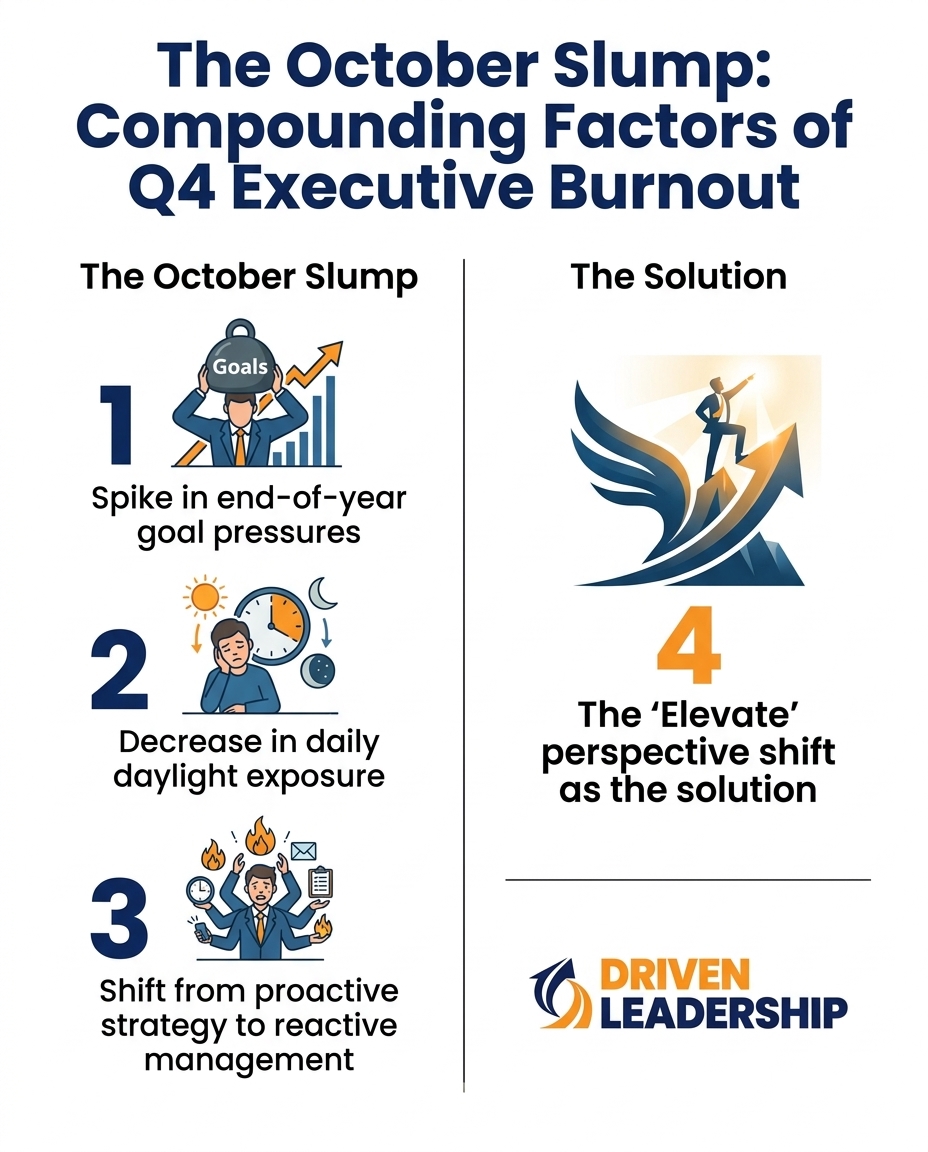
Executive burnout in the fourth quarter is frequently misdiagnosed as a simple time-management failure. If you are struggling to keep up, the standard advice is usually to delegate more or organize your calendar better. However, our team has found that the October slump hits leaders differently because the pressure is deeply tied to end-of-year budget planning, performance reviews, and high-stakes goal pressures. These responsibilities create a unique cognitive load that cannot be solved simply by rearranging a schedule.
Physical seasonal shifts also compound this heavy business stress. In our experience coaching executives here in Puyallup and throughout the Pacific Northwest, mid-fall brings noticeably shorter, darker, and rainier days. This shift naturally alters circadian rhythms and exacerbates cognitive fatigue. When you combine reduced daylight exposure with the highest-pressure quarter of the business year, the result is a perfect storm for end-of-year fatigue.
• Driven by long hours and temporary project spikes. — The Executive October Slump: Driven by compounding Q4 goal pressures and strategic planning.
• Can often be resolved with a long weekend or short PTO. — The Executive October Slump: Requires a strategic shift in perspective, as stepping away is rarely an option.
• Primarily a time-management or task-delegation issue. — The Executive October Slump: Primarily a cognitive load and perspective deficit issue.
Recognizing the difference between basic tiredness and the executive October slump is necessary for finding the right solution. Treating cognitive exhaustion with basic calendar hacks only masks the deeper issue, leaving leaders vulnerable to a complete energy crash just as December approaches.
Perspective Deficit vs. Time Management
When an executive faces mounting stress, well-meaning colleagues often suggest taking a break. While rest is important, taking time off is rarely a realistic option for high-level leaders facing hard Q4 deadlines. Furthermore, a few days away does not solve the root cause of mid-fall fatigue. The core issue is rarely a lack of hours in the day; it is a lack of elevated perspective. This is known as a perspective deficit.
The Problem: As Q4 pressures rise, leaders tend to pull their focus inward and downward. You start managing minute details, putting out daily fires, and reacting to immediate operational friction. This hyper-focus on the micro-level causes you to lose sight of the broader vision.
The Cause: Losing sight of the big picture actively drains your daily operational energy. When every small problem feels like a massive hurdle, decision fatigue sets in. You are no longer leading; you are simply reacting to the loudest problem in the room.
The Solution: To break this cycle, you must intentionally step back and adopt a broader view. Maintaining sustained mental clarity is one of the foundational traits of a great leader. By shifting your focus from the immediate friction to the overarching strategy, you conserve energy and make more effective decisions. A broader perspective allows you to distinguish between minor inconveniences and true strategic roadblocks.
Unpacking the 'E' in the Elevate Framework
The 'E' in the Elevate framework stands for exactly that: intentionally elevating one's mindset above daily operational friction. Our team at Driven Leadership relies on this framework because unlike passive leadership theory that sounds good in a textbook, actionable and immersive frameworks like Elevate actually hold up under the intense stress of Q4. This framework provides a repeatable recipe for individuals to overcome personal and professional roadblocks.
Consider a professional who attended one of our immersive spring leadership workshops. They arrived struggling with personal and professional roadblocks that actively hindered their growth and confidence. Through our structured, immersive process, they walked away able to acknowledge and completely overcome those previously debilitating roadblocks. This exact same recipe for elevation applies directly to the mid-fall / October Q4 push. By neutralizing internal and external roadblocks, you restore the energy needed to lead effectively.
Identifying the Roadblocks
Before you can elevate your perspective, you must understand what is holding you down. This requires honest self-assessment.
• Recognize cognitive hurdles: Identify the specific mental blocks that appear in mid-fall, such as decision fatigue, cynicism, or a tendency to micromanage.
• Separate systemic issues from personal fatigue: Acknowledge which problems are actual business challenges (like a budget shortfall) and which are symptoms of your own exhaustion (like snapping at a colleague over a minor error).
Applying the Recipe for Elevation
Once you have identified the roadblocks, you can apply the framework to shift from a reactive Q4 posture to a proactive, elevated perspective.
1. Pause and detach: Step physically or mentally away from the immediate operational environment to break the reactive cycle.
2. Assess the broader landscape: Look at the problem through the lens of your annual goals, rather than just today's frustration.
3. Implement actionable changes: Adjust your daily executive communication to reflect this elevated stance, providing clear, strategic direction to your team rather than just assigning tasks.
Applying Elevated Perspective to Q4 Pressures
Understanding the concept of elevation is only the beginning; translating that concept into daily leadership habits during October and November is where the real transformation happens. During the busiest time of the year, an elevated perspective changes how you interact with your team, how you manage your schedule, and how you approach high-stress meetings.
Daily Habits for an Elevated Q4 Perspective:
• Morning strategic review: Spend the first fifteen minutes of your day reviewing high-level objectives before opening your email inbox.
• Meeting boundary setting: Decline meetings that do not require high-level strategic input, trusting your team to handle operational details.
• Intentional communication: Frame directives around the "why" rather than just the "what," keeping the entire team focused on the broader vision.
Maintaining these habits alone can be difficult when end-of-year fatigue sets in. This is where an executive manager program proves invaluable. Such programs reinforce these daily habits through structured accountability. When an elevated perspective changes your decision-making in high-stress meetings, your team notices. Modeling this calm, strategic behavior prevents your own burnout from cascading down to the rest of the department.
Sustaining Leadership Energy Through Year-End
Bridging the immediate October slump to long-term Q4 success requires active maintenance. Sustaining your energy is an ongoing process, not a one-time fix. As the days grow even shorter and winter approaches, the initial relief you felt from elevating your perspective must be nurtured to last through December.
One of the most effective strategies for maintaining this elevated posture is committing to continuous growth. Engaging in an advanced leadership program keeps your skills sharp and prevents you from slipping back into comfortable, reactive habits. Surrounding yourself with other professionals who are also dedicated to intentional leadership creates a buffer against the isolating pressure of the season.
Finishing the year with clarity does more than just ensure you hit your Q4 targets; it sets a much stronger foundation for the upcoming Q1. When you cross the finish line of the year feeling strategically grounded rather than entirely depleted, you are positioned to start the new year with genuine momentum. Remember that managing your executive energy is a core responsibility of your role, and treating it with the same rigor you apply to your financial goals yields measurable returns.
Frequently Asked Questions About Q4 Executive Fatigue
What is the E in the Elevate framework?
The 'E' stands for Elevate—the intentional practice of raising one's perspective above daily operational stress to regain strategic clarity. By stepping back from micro-level friction, leaders can view challenges through a broader lens. This shift helps conserve energy and leads to more effective, long-term decision-making.
Why do leaders experience an October slump?
The October slump is a combination of Q4 deadlines, end-of-year budget pressures, and the physical shift in seasonal daylight. After the initial push of September, the reality of the shrinking calendar sets in, creating a heavy cognitive load. This unique convergence of factors rapidly drains executive energy reserves.
How can executives overcome Q4 burnout?
Executives can overcome Q4 burnout by moving away from generic time-management fixes and instead adopting structured, pressure-tested leadership frameworks. Reframing the issue as a perspective deficit rather than a lack of time allows leaders to focus on what truly matters. Applying the Elevate framework provides a repeatable recipe for maintaining focus under pressure.
How does seasonal change affect leadership decision-making?
Shorter, darker days can alter circadian rhythms and accelerate cognitive fatigue, especially in regions with heavy mid-fall weather shifts. This physical exhaustion often leads to reactive rather than proactive decision-making. Leaders operating under seasonal fatigue are more likely to focus on immediate problems rather than strategic, long-term solutions.
What is the difference between an elevated perspective and taking time off?
Taking time off provides temporary physical and mental rest, but it does not change the environment you return to. An elevated perspective provides a sustainable strategic posture for handling ongoing stress while actively working. It equips leaders to navigate high-pressure situations daily without being consumed by them.
Reclaim Your Q4 Focus with Structured Support
The 'E' of Elevate provides a practical, actionable method to regain your strategic focus when the pressure of the fourth quarter peaks. Mid-fall fatigue is a highly predictable challenge, but it is also entirely manageable when you equip yourself with the right tools and mindset. You do not have to simply endure the final months of the year.
By stepping back, identifying your roadblocks, and intentionally raising your perspective above the daily operational noise, you can lead your team with clarity and confidence. At Driven Leadership, we encourage leaders to explore structured leadership development to support their Q4 goals. Embracing this framework offers a clear, actionable explanation of how to counteract mid-fall fatigue and provides a practical method to regain strategic focus for the rest of the year.