Why Local Puyallup Executives Are Rethinking 'Leadership Classes Near Me'

The Hidden Cost of Prioritizing Commute Convenience Over Growth
Your management team is facing complex operational challenges, which is exactly why local Puyallup executives are rethinking 'leadership classes near me' as their default solution for professional development. When directors and business owners recognize a gap in their team's capabilities, the immediate instinct is often to pull out a phone and search for the closest available workshop. However, settling for geographical convenience frequently means sacrificing the depth of transformation required to truly elevate a management team. If you are serious about breaking bad habits and driving real organizational change, it is time to look beyond your immediate zip code and evaluate what actually produces lasting results.
For a deeper look at comprehensive leadership trainings, explore how an immersive BOLD leadership training experience can fundamentally shift your team's trajectory.
Many local directors begin their development journey by typing a generic Leadership Classes Near Me query into a search engine, hoping for a quick fix to deep-seated cultural or communication issues. The appeal is obvious: a seminar hosted at a nearby hotel conference room or local college means minimal disruption to the workday. You can attend a morning session and be back at your desk by lunch. While staying close to the office seems highly efficient on paper, it often results in superficial boardroom seminars that fail to inspire real behavioral change.
There is a massive difference between acquiring new information and fundamentally changing how a leader operates under pressure. Local classes typically focus on the former. They provide binders full of management theories, worksheets, and slide decks. Attendees sit in rows, take notes, and conceptually agree with the material. Yet, when a crisis hits the following week, those same leaders revert to their old habits. True executive growth requires stepping outside the immediate geographic comfort zone and entering an environment that demands active participation and self-reflection.
• Local Convenience Classes — Primary Focus: Information delivery and theory — Environment: High distraction, close to office — Typical Outcome: Temporary motivation, low retention
• Immersive Retreats — Primary Focus: Behavioral change and application — Environment: Dedicated, isolated focus — Typical Outcome: Permanent shift in leadership habits
• Online Seminars — Primary Focus: Passive listening and compliance — Environment: Home office or desk — Typical Outcome: Minimal engagement, easily forgotten
The illusion of productivity: Staying local often feels like a smart business decision because it minimizes time away from the desk. However, this is a false economy. Spending a few hours learning a new concept without the rigorous environment needed to practice and internalize it ultimately wastes both time and resources. To achieve a meaningful return on investment, leaders must be willing to trade the convenience of a short commute for the profound impact of a dedicated, transformative experience.
Breaking the Pierce County Daily Grind: The Psychology of Detachment
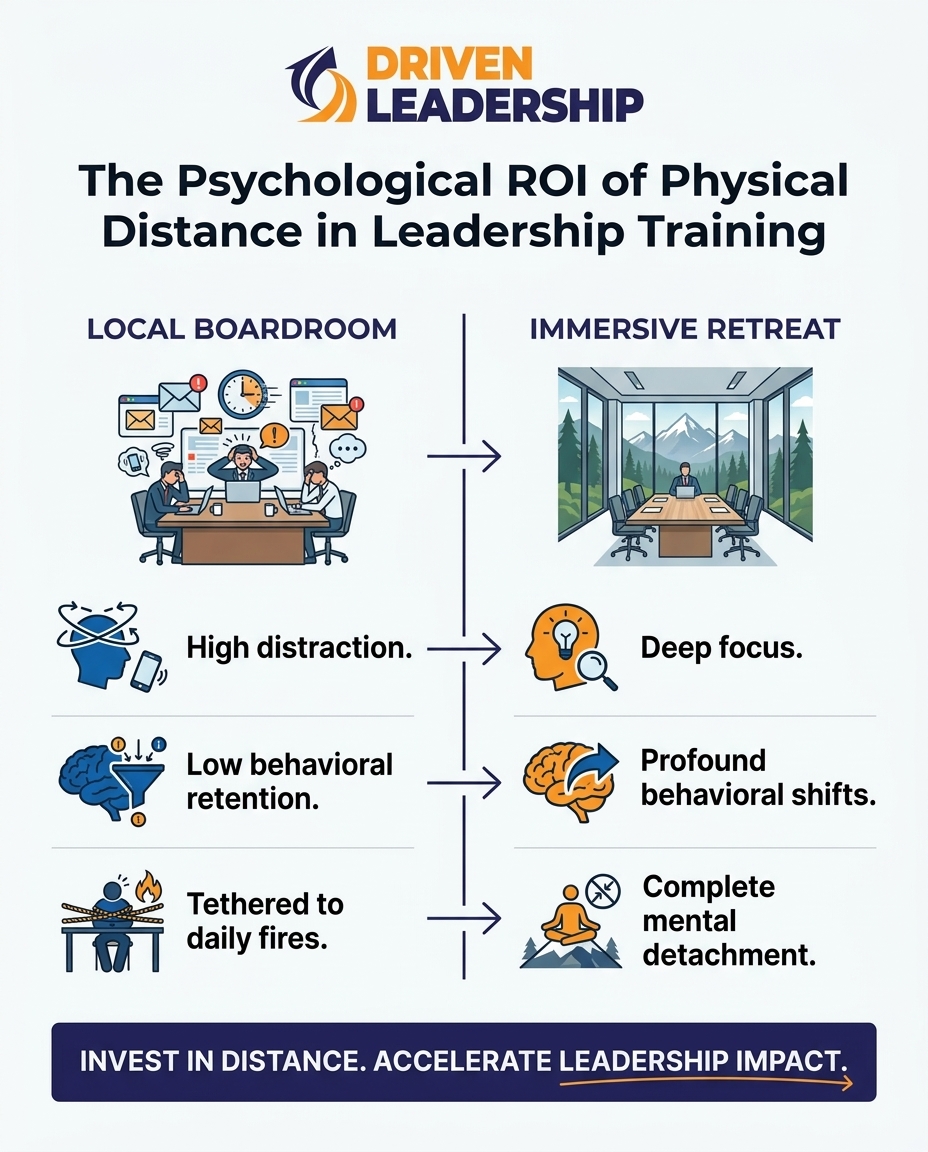
Remaining within a 15-minute drive of the office keeps executives tethered to local operational fires and daily emergencies. When you attend a seminar just down the street from your headquarters, your brain never truly leaves work. Every time your phone buzzes in your pocket, you wonder if it is an urgent email from a client or a question from your floor manager. During breaks, instead of networking or reflecting on the material, local attendees are usually found in the hallway, putting out fires and managing their teams remotely. This fractured attention makes deep, introspective work nearly impossible.
Physical distance forces a necessary mental shift. Making the drive from Puyallup to Wrightwood provides the geographic separation required to drop defensive postures and focus entirely on self-improvement. Weaving out of the immediate Pierce County area and retreating to a dedicated, focused Pacific Northwest environment naturally encourages reflection. The change in scenery signals to the brain that standard operating procedures are temporarily suspended, allowing leaders to open up, be vulnerable, and tackle core identity challenges.
One executive recently recognized they were feeling challenged both personally and professionally, realizing they needed a profound way to "level up" during the winter months. By committing to an immersive experience away from their typical routine, they found an environment where they were tested and challenged, ultimately growing into a stronger, more capable leader without the constant pull of the home office.
A dedicated retreat environment removes the daily distractions that hinder growth. Introduce the immersive BOLD retreats at Wrightwood as the ideal catalyst for this kind of profound behavioral change. Unlike highly convenient but superficial local options, an immersive retreat demands full presence. You cannot simply step out to take a quick meeting. This isolation is not a punishment; it is a psychological requirement for deep learning. When leaders are fully detached from their daily grind, they can finally focus on the internal roadblocks that are holding their teams back.
• Cognitive offloading: Physical distance allows leaders to stop worrying about daily operations and focus entirely on the curriculum.
• Reduced defensive barriers: Away from familiar territory and local competitors, executives are more willing to admit weaknesses and ask for help.
• Enhanced focus: Without the temptation to run back to the office, participants engage more deeply with the material and their peers.
• Environmental reset: A change of scenery disrupts habitual thinking patterns, making it easier to adopt new perspectives.
Contrast the fractured attention of a half-day local workshop with the focused clarity of an immersive experience. In a local setting, you are fighting to pay attention. In a dedicated retreat, the environment itself is engineered to hold your focus, forcing you to confront the leadership challenges you have been avoiding.
Overcoming Roadblocks Ahead of Q4 Strategic Planning
Timing is everything when it comes to executive development. Early fall represents a pivotal transition month for finalizing end-of-year strategies and setting up the next fiscal year. As businesses move into September Q4 strategic planning, the pressure intensifies. This is the period when critical decisions are made regarding budgets, hiring, and long-term goals. If a leadership team is fractured, uncommunicative, or lacking confidence, those deficiencies will directly impact the company's performance during its most crucial quarter.
Leaders facing debilitating personal or professional roadblocks cannot afford to carry those limitations into the fourth quarter. Whether it is an inability to delegate, a fear of difficult conversations, or a lack of strategic vision, these habits drag down entire departments. During a critical spring transition, one professional found themselves needing to acknowledge and overcome debilitating roadblocks that were hindering their effectiveness. By stepping away and engaging in an off-site advanced leadership program, they received the targeted support and guidance necessary to achieve a level of personal and professional elevation that far exceeded their initial expectations.
An intensive, off-site program provides the necessary disruption to break bad habits before high-stakes planning begins. You cannot fix a broken process while you are actively running it. Taking a few days away from the business to focus on leadership mechanics acts as a circuit breaker for toxic or inefficient behaviors. It forces a hard stop, allowing leaders to re-evaluate their approach, learn new frameworks, and return with a clear, unified strategy.
Common Q4 Roadblocks That Require Disruption:
• Siloed communication: Departments hoarding information instead of collaborating on end-of-year goals.
• Decision fatigue: Leaders feeling burned out and making reactive, short-sighted choices rather than strategic ones.
• Poor delegation: Executives bottlenecking processes by refusing to trust their mid-level managers with important tasks.
• Lack of alignment: The management team pulling in different directions, confusing the associate staff.
Investing time in a comprehensive program now yields exponential returns in team alignment and execution later. When a leadership team takes the time to get on the same page before the Q4 rush, they operate with a level of efficiency and clarity that a standard local seminar simply cannot produce. The time spent traveling and participating in the retreat is quickly recouped through faster decision-making and fewer internal conflicts.
Transformation vs. Information: The ROI of the Drive
When evaluating professional development, executives must look beyond the initial time commitment and focus on the specific return on investment they gain when they commit to traveling for an immersive experience. Local seminars often distribute binders of information but fail to address the root causes of poor communication or lack of confidence. You can read a hundred books on how to have a difficult conversation, but until you are placed in a scenario where you actually have to execute one under pressure, your behavior will not change.
Immersive environments simulate high-pressure scenarios that force leaders to take charge and communicate effectively in real-time. Instead of passively listening to a lecture, participants are put into experiential exercises that mirror the stress, ambiguity, and stakes of their real-world roles. This active learning model bridges the gap between knowing what to do and actually doing it. Last spring, an executive recognized they needed to improve their confidence, take more initiative, and drastically enhance their communication skills. After committing to an immersive experience, they returned with such a proactive shift that their entire management team and associate staff immediately noticed the change.
Why Behavioral Retention Requires Immersion
Data shows that immersive retreats yield significantly higher behavioral change retention than standard seminars. Human beings are creatures of habit, and our brains are wired to conserve energy by relying on established neural pathways. Breaking those pathways requires sustained, focused effort. A one-hour class once a week is not enough to disrupt deeply ingrained habits. Sustained focus over multiple days rewires leadership habits permanently, forcing the brain to adapt to new, healthier patterns of communication and decision-making.
The physical journey itself plays a crucial role in this process. Making the drive from Puyallup to Wrightwood is not just about getting to the venue; it is about the transition. The drive back home serves as a crucial integration period, allowing executives to process their transformation before re-entering the workplace. Instead of rushing straight from a local hotel back to a chaotic office, the extended drive provides a quiet space to reflect on the lessons learned, plan how to implement them, and mentally prepare for the challenges ahead.
When leaders return fundamentally changed, the impact cascades throughout the organization. They are better equipped to implement team execution strategies that drive real results. The associate staff notices the proactive shift, the increased clarity in communication, and the newfound confidence. This cultural shift is the true ROI of the drive—a transformation that elevates the entire company, not just the individual who attended the training.
Fostering Authentic Trust Away from the Office
Trust is the bedrock of any successful management team, but it is incredibly difficult to build in an environment filled with daily stressors and historical baggage. Highlight how dedicated off-site exercises build a level of cooperation that standard local classes cannot replicate. Trust isn't built by sitting in a local hotel conference room listening to a lecture while secretly worrying about the unfinished reports sitting on your desk. It requires shared challenges, vulnerability, and a break from the standard corporate hierarchy.
Experiential learning requires a safe, detached environment where leaders can be vulnerable without fear of local office politics. When you search for Leadership Classes Near Me, you are likely to end up in a room with local competitors, vendors, or acquaintances from the local chamber of commerce. This lack of privacy naturally causes executives to keep their guard up. They cannot speak candidly about their struggles with team dynamics or personal burnout if they are worried about local gossip. An off-site retreat provides a secure, confidential space where leaders can drop the facade and address real issues.
How off-site environments build trust:
1. Leveling the playing field: Removing titles and office settings forces individuals to interact as peers, regardless of their position on the organizational chart.
2. Shared adversity: Experiential challenges require teams to rely on one another in unfamiliar situations, accelerating the bonding process.
3. Uninterrupted dialogue: Without the pressure of the next meeting, leaders can engage in the long, difficult conversations necessary to resolve lingering conflicts.
4. Neutral territory: Away from the headquarters, no single department has the "home-field advantage," encouraging more equitable collaboration.
Off-site exercises break down silos, forcing executives to collaborate in entirely new ways. For more insights into this process, you can read about building trust and cooperation through BOLD exercises. These shared experiences forge bonds that translate directly into better cross-departmental cooperation back at the headquarters. When the marketing director and the operations manager have navigated a complex, high-stakes simulation together, they are far more likely to collaborate effectively when planning the next product launch.
Frequently Asked Questions About Executive Development
What makes a leadership development program effective?
An effective program focuses on behavioral change rather than just information delivery. It must include immersive, experiential learning that forces participants out of their comfort zones and simulates real-world pressure. Programs that require a physical detachment from the daily work environment consistently yield the highest long-term retention rates.
Why do executive retreats work better than local seminars?
Retreats work better because they eliminate the distractions of the daily grind. When executives search for Leadership Classes Near Me, they often end up in local seminars where they remain mentally tethered to the office. A retreat forces a cognitive reset, allowing for deep, uninterrupted focus on personal and professional growth.
Are leadership certificates from local colleges worth the time investment?
While local college certificates can provide excellent theoretical knowledge and look good on a resume, they often lack the practical, high-pressure application needed for executive transformation. They are beneficial for foundational learning, but senior leaders typically require the intensive behavioral rewiring that only comes from an immersive, experiential retreat.
What is actually taught in an immersive leadership class?
Immersive classes go beyond standard management theory to tackle core behavioral competencies. Participants learn how to communicate under stress, make decisive choices with limited information, build authentic trust across departments, and overcome personal roadblocks. The curriculum is heavily focused on active simulations rather than passive lectures.
How does physical distance from the office improve strategic planning?
Physical distance provides the necessary mental space to look at the business objectively. When you are sitting in the office, you are surrounded by the symptoms of your operational problems. Stepping away allows you to see the root causes clearly, making your strategic planning sessions far more accurate and effective.
How quickly can a management team see the ROI from an executive retreat?
The return on investment is often visible the moment the executive returns to the office. Because immersive programs focus on immediate behavioral shifts, teams usually notice improved communication, faster decision-making, and a more proactive leadership style within the first week of integration.
Make the Drive to Elevate Your Leadership Impact
The right environment is absolutely critical for lasting behavioral change. If your goal is to fundamentally elevate how your management team operates, you must be willing to step outside of your geographic comfort zone. The journey from Puyallup to Wrightwood is more than just a drive; it is a necessary transition away from the distractions of the daily grind and into a space dedicated entirely to your professional growth.
It is time to stop settling for geographical convenience when your professional growth and your company's future are at stake. The time invested in traveling to the right venue yields significantly better leadership transformation than saving an hour on a local commute. Prompt your team to look beyond the immediate area and explore an immersive experience that will actually prepare them for the challenges ahead, equipping them with the tools, confidence, and clarity needed to lead effectively.