The Y Model

Linking Mission and Values to Employee Engagement
In our previous discussions, we established that knowing the purpose, mission, and values of your organization is essential to drive performance. Today, we delve into the critical next step: how to strategically link your organizational mission and values to those of your employees—current and future—in order to deeply engage them in the business.
Once you understand the fundamental purpose of your business, the challenge (and the ultimate goal) is to connect it directly to the individual goals and values of every person on your team and every potential hire. This alignment is far easier to articulate than to execute, but when successful, it becomes the unbreakable foundation of your business culture. This connection elevates the employment relationship from a transactional arrangement to a shared partnership, fueled by mutual purpose.
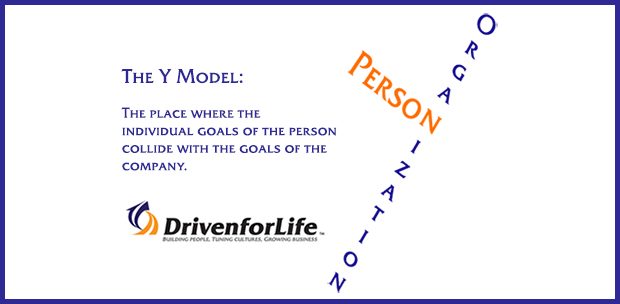
The Y Model: Where Company and Individual Goals Collide
At Driven Leadership, we utilize the Y Model to visualize and achieve this perfect alignment. The Y Model illustrates how to hit the sweet spot of employee engagement while simultaneously furthering your business objectives.
This "sweet spot" is the pivotal intersection where the individual goals and core values of the person collide with the mission and strategic goals of the company. The area where those two forces intertwine is the precise place where top performance is driven and sustained.
Understanding the Collision:
• Individual Goals: These include an employee's desire for career growth, skill development, personal sense of purpose, feeling of contribution, and work-life harmony. These are the why behind their professional journey.
• Company Goals: These encompass strategic objectives, financial targets, market leadership aspirations, and mission execution (e.g., sustainability, customer service excellence). These define the organizational impact.
When these two sets of goals harmonize, employees are not just working for the company; they are working for themselves through the company's mission. This synergy creates discretionary effort—the willingness to go above and beyond. Conversely, where goals fail to intertwine, employees become disengaged, leading to high turnover, low productivity, and a diminished cultural experience.
Actionable Application of the Y Model:The Y Model dictates that every job description, performance review, and promotion discussion must explicitly address how the individual's aspirations (e.g., skill development in X, desire for leadership) contribute to a core company goal (e.g., market expansion, product innovation). This continuous, visible linkage maintains the "sweet spot."
Case Study in Alignment: Nest and Zappos
To explain this concept, consider the example of Nest, a company known for its self-programming, smart thermostats.
• Company Values/Goals: Nest exists to help homeowners save energy by conserving the biggest resource drain in most homes—the thermostat—thereby assisting the environment.
• Employee Alignment: Given this clear environmental and conservation focus, prospective employees instantly understand the core values. It’s immediately clear that the company naturally attracts individuals who prioritize sustainability and technological efficiency. This intrinsic link makes recruiting and retaining mission-driven talent significantly easier. They hire for shared passion, not just technical skill.
However, not every company has a product that people can so easily connect with. Take Zappos, an internet retailer of shoes. Their brand recognition isn't about the product itself; it’s about their people. Zappos is known for its culture of fun-loving, happy people eager to be part of the team. The product may be shoes, but the purpose is delivering happiness. Their brand is their culture.
The lesson is this: No matter what you sell or what service you provide, the goals and underlying values of your company are demonstrated in every single interaction you have with an employee, a customer, or a prospect. Consistency is key; even small discrepancies between stated values and actual behavior erode trust. Since people have a greater memory for unpleasant interactions, consistency and positive value demonstration are non-negotiable. Hostility or uncertainty quickly become viral parts of your brand identity, regardless of your mission statement. Authenticity is the ultimate currency of engagement.
Knowing Your People: Completing the Link
Once you have begun to attract and retain the right people whose baseline values align with the company's, you must get to know them on a deeper, more granular level. This is where truly personalized engagement begins.
While nothing replaces face time (actual, dedicated relationship-building) for truly understanding what matters to your people, we recommend advanced tools to gather objective insights. Driven Leadership utilizes the InnerMetrix Advanced Insights Profile, which is available through us or any certified InnerMetrix partner.
We endorse this profile because it offers the most complete look at individuals available, providing a holistic view of human dynamics. Unlike some profiles that only measure behavior, the InnerMetrix assessment combines three critical dimensions, providing the "What, Why, and How" of an individual's professional persona:
1. Behavior: What the individual does. This measures their style—how they prefer to communicate, operate under pressure, and manage tasks. Understanding this helps place them in roles where their natural style minimizes stress and maximizes output.
2. Values and Motivation: Why they do it. This uncovers the core drivers, such as altruism, financial return, knowledge acquisition, or tradition, which define their intrinsic fulfillment. Connecting their role's impact to their highest-ranking value is the key to unlocking sustained motivation.
3. Approach to Thought and Decision-Making: How they make choices. This reveals their cognitive style, providing insight into problem-solving preferences and situational processing. Knowing this ensures they are assigned tasks that match their innate problem-solving abilities.
When you take the time to truly understand the deeper motivations of individual employees across these three dimensions, you are uniquely positioned to engage them. This knowledge allows you to consciously create the vital link between the values they hold, your company’s mission, and—most importantly—the critical role they play in helping to reach that shared vision. It moves managers beyond generic motivation techniques toward tailored engagement strategies that maximize performance and satisfaction.