The Uncomfortable Truth About Advanced Leadership Courses and Employee Turnover

When New Accountability Triggers Immediate Resignations
At Driven Leadership, we see this scenario play out time and time again: your top-producing manager just handed in their resignation, and it happened right as you realized the uncomfortable truth about advanced leadership courses and employee turnover: effective accountability often drives toxic high-performers out the door. You finally established clear behavioral expectations, and the immediate response was a threat to quit. In our experience, this leaves executives facing a severe decision point. You must choose whether to abandon the new leadership accountability standards to retain a toxic high-producer, or accept the short-term turnover for the long-term health of the organization.
For many business owners we coach, this turnover feels like a failure of the training. In reality, our team knows it is often the very first indicator that your new systems are working. Toxic employees who previously hid behind high production numbers suddenly find themselves exposed when held to comprehensive standards. Navigating this sudden departure requires a solid framework, especially when it aligns with the critical window of early fall Q4 planning and transition. To understand how to manage this fallout, exploring an advanced leadership program provides the foundational knowledge needed to hold the line.
The Paradox of Effective Leadership Development
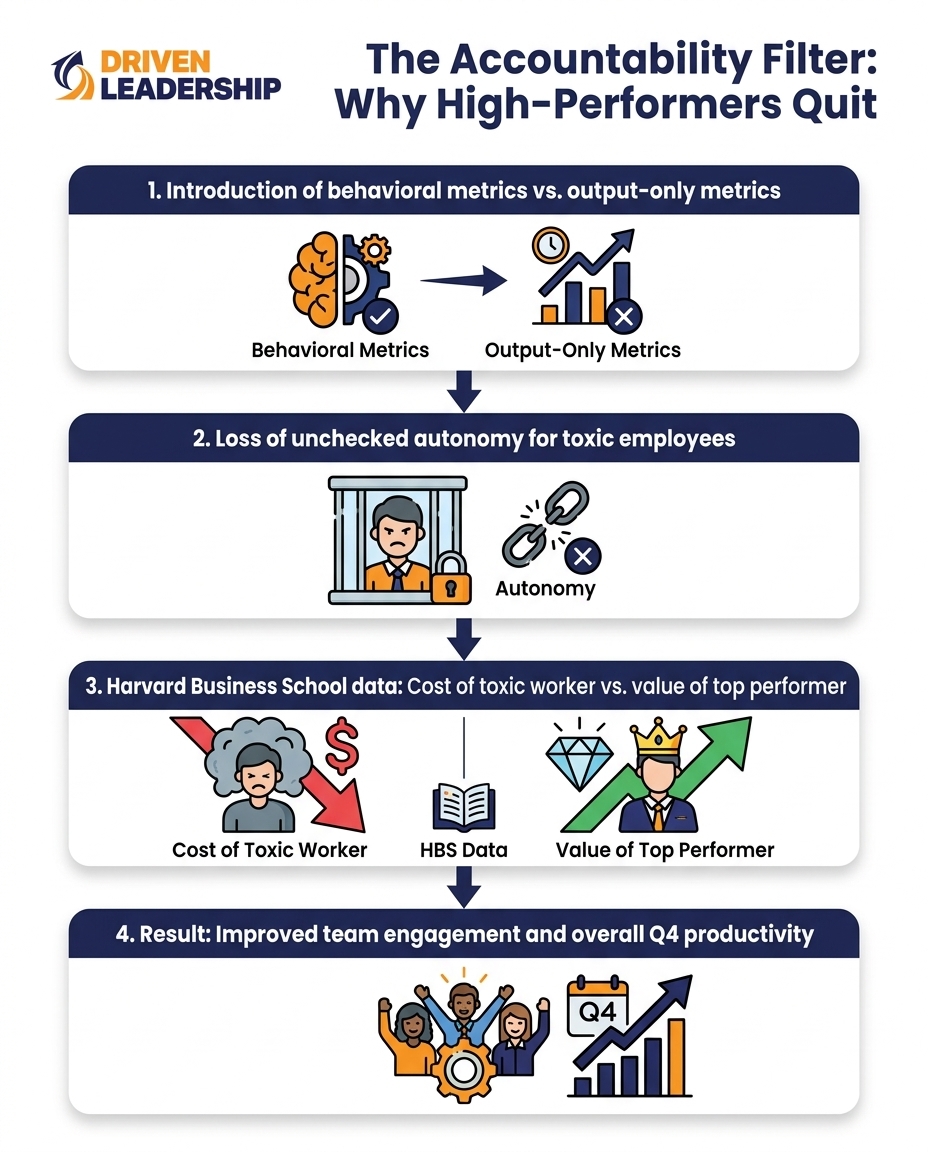
In our years of training corporate teams, we've found that the paradox of leadership development is that building a stronger team often requires breaking down the existing, dysfunctional power dynamics. Effective training acts as a rigorous filter, not just a builder of basic skills. When an organization introduces real accountability, it fundamentally changes the rules of engagement. Toxic high-performers historically survive by using their exceptional output as a shield, deflecting any criticism of their negative behavioral impact on the wider team.
An advanced leadership course establishes firm metrics for behavior, collaboration, and emotional intelligence—not just raw output. By measuring how work gets done alongside what gets done, leadership removes the toxic employee's traditional hiding spots. This realization and subsequent filtering process are necessary steps for organizational health, particularly as you enter early fall Q4 planning and transition. When the shield of production is removed, the toxic employee is forced to either adapt to the new culture or leave.
Why High-Producers Reject New Standards
When the rules change, those who benefited most from the old system are usually the first to rebel. Based on the patterns our team sees most often, the rejection of new standards typically stems from a few core psychological triggers:
• Loss of special privileges: Toxic producers often enjoy unchecked autonomy. Accountability removes their ability to operate outside the rules.
• Inability to adapt: Many high-output individuals lack the emotional intelligence required to meet collaborative, team-first expectations.
• The immediate flight response: When suddenly held to the exact same behavioral standards as the rest of the team, the immediate reaction is often to flee rather than comply.
The Hidden Cost of Abandoning Your New Standards
We've sat across the table from countless executives who panic when a rainmaker threatens to walk out the door. The immediate fear of lost revenue or disrupted client relationships can tempt leaders to backtrack on their newly established expectations. However, the hidden cost of caving to a toxic high-performer's threats far outweighs the short-term pain of their departure. When leadership abandons the new accountability framework to appease one person, a clear message is broadcast to the rest of the organization: the standards only apply to those who do not produce at the highest level.
According to extensive Gallup data—and backed by what we observe in the field—poor management and a lack of consistent accountability are primary drivers of disengagement for the broader team. If you compromise your standards during the early fall Q4 planning and transition phase, you jeopardize the entire foundation of the upcoming year. The rest of the team is watching closely to see if the new leadership principles are genuine or just corporate theater.
• Enforcing New Standards — Short-Term Impact: Immediate resignation of the toxic high-producer; temporary workflow disruption. — Long-Term Organizational Cost: Increased team trust, higher overall engagement, and a sustainable, healthy culture.
• Abandoning Standards — Short-Term Impact: Retention of the high-producer; perceived stability in immediate output. — Long-Term Organizational Cost: Widespread team disengagement, loss of leadership credibility, and higher broader turnover.
Filtering Out Toxicity: A Feature, Not a Bug
Re-framing this turnover requires understanding that losing a misaligned employee is a positive, intentional outcome of rigorous development. Genuine leadership development does not sugarcoat reality; it forces uncomfortable but necessary organizational shifts. Establishing real accountability requires the courage to lose talented staff who refuse to align with the company's core values. This filtering process is essential for setting a clean slate, particularly as teams navigate early fall Q4 planning and transition.
This is where our BOLD methodology stands apart. At Driven Leadership, we actively prepare executives for this exact uncomfortable truth, refusing to sugarcoat the reality of establishing accountability. By engaging in BOLD leadership training, leaders learn to anticipate this resistance. We recently worked with a professional seeking personal growth and a path to becoming a better risk-taker, who found that the experience stayed with them long after the sessions ended. By participating in the program, they connected with others and emerged as a stronger leader and a more willing risk-taker—proving to our team that facing these uncomfortable realities head-on builds lasting resilience.
Moving Beyond Cliché Corporate Training
Traditional corporate training often focuses on surface-level skills, offering platitudes without addressing deep-seated behavioral issues. These generic programs allow toxicity to survive because they never challenge the underlying culture. Advanced programs disrupt the status quo. They challenge personal and professional identity, making it entirely impossible for toxic behaviors to remain hidden within the team structure.
Clearing the Air: Environmental and Cultural Impacts
The removal of a toxic high-performer drastically improves the internal atmosphere for the remaining team members. A toxic workplace creates a heavy, oppressive environment that drains energy and stifles collaboration. When that negative element is finally removed, the broader team typically experiences an immediate sense of relief. This newfound positive atmosphere directly leads to higher overall engagement, better communication, and improved productivity across the board.
Environmental factors can heavily compound the negative effects of a toxic workplace. Operating out of Puyallup, WA, our team knows firsthand how winter gloom in the Pacific Northwest is a very real environmental factor. The darker months naturally amplify workplace mood and toxicity, making the removal of a toxic high-performer critical for clearing the 'gloom' before winter sets in. We teach that leading an engaged culture requires prioritizing the mental and emotional health of the whole team over the output of a single individual. By focusing on leading an engaged culture, executives ensure that the workplace environment remains resilient and supportive, which is especially vital during early fall Q4 planning and transition.
Holding the Line During Critical Business Transitions
Taking ownership and maintaining standards when a key player leaves is one of the most difficult challenges an executive will face. It requires a logical, steady framework to prevent reactive decision-making. During early fall Q4 planning and transition, holding the line is paramount. Short-term disruption is the necessary price of long-term organizational health and true leadership ownership. The remaining team needs to see that the company's commitment to a healthy culture supersedes any individual's production metrics.
Another client of ours, needing to take ownership of their life both personally and professionally, discovered that anyone at any life stage can benefit from this level of accountability. After attending our BOLD and Leadership for Managers courses, they were challenged to take true ownership and become the best version of themselves. We've seen time and again that this kind of transformation across a team only occurs when executives refuse to back down from their established standards.
Steps to Stabilize the Team Post-Resignation
1. Transparently address the departure: Communicate clearly with the team without violating the former employee's confidentiality. Acknowledge the shift in dynamics.
2. Reaffirm the commitment to accountability: Remind the team why the new standards were implemented and how they benefit the entire organization.
3. Redistribute the workload strategically: Temporarily cover the gaps while explicitly highlighting this transition as an opportunity for emerging leaders to step up and showcase their capabilities.
4. Maintain open lines of communication: Conduct regular check-ins to monitor team morale and ensure the transition is progressing smoothly.
The Long-Term ROI of Positive Turnover
The financial and cultural returns of losing a toxic high-performer are heavily supported by organizational data. Harvard Business School research, which aligns perfectly with our internal findings at Driven Leadership, clearly indicates that avoiding—or removing—a toxic worker yields significantly higher organizational returns than retaining a top performer. The damage a toxic individual does to team morale, broader employee retention, and overall productivity vastly outweighs their individual contributions. The traits of a great leader include the courage to recognize this data and prioritize team health over isolated metrics.
Understanding the traits of a great leader helps executives see the compounding financial benefits of reduced broader turnover. When the toxic element is gone, the rest of the team engages more deeply, collaborates more effectively, and stays with the company longer. This strategic, positive turnover perfectly positions the company for a successful early fall Q4 planning and transition, ensuring the organization enters the new year with a unified, high-performing culture.
Frequently Asked Questions About Leadership Training and Turnover
Why do toxic high-performers quit when accountability increases?
Toxic high-performers quit because new accountability standards remove their ability to hide poor behavior behind high output. When leadership begins measuring collaboration and emotional intelligence alongside production, these individuals lose their special privileges. Rather than adapt to a team-first environment, their typical response is to flee the organization. This reaction is a common pattern we observe during early fall Q4 planning and transition.
Does a leadership development program increase employee turnover?
An effective leadership program, like those we run at Driven Leadership, can temporarily increase targeted turnover among misaligned staff. It acts as a filter, pushing out individuals who refuse to meet new behavioral standards. While short-term turnover may spike, long-term retention of healthy, engaged employees significantly improves. This filtering is highly beneficial for establishing a strong foundation during early fall Q4 planning and transition.
How does accountability affect overall employee retention?
Consistent accountability drastically improves overall employee retention by creating a fair, predictable work environment. When the broader team sees that everyone is held to the same standard, trust in leadership grows. Furthermore, removing toxic elements prevents the burnout and frustration that we typically see driving good employees away. This stability is essential for executing a seamless early fall Q4 planning and transition.
What is the ROI of removing a toxic high-producer?
The ROI of removing a toxic high-producer includes reduced broader staff turnover, higher team engagement, and improved overall productivity. Research shows—and our clients frequently confirm—that the financial drain of a toxic worker, through lost team morale and replacement costs for other staff, far exceeds the value of their individual output. Capitalizing on this positive shift maximizes efficiency during early fall Q4 planning and transition.
How should executives handle a top performer who refuses to adapt to new standards?
Executives must hold the line and enforce the standards uniformly, even if it means accepting the top performer's resignation. Compromising on behavioral metrics to save one producer destroys leadership credibility and alienates the rest of the team. We advise standing firm to ensure the organization's culture remains intact, which is critical for a successful early fall Q4 planning and transition.
Embracing the Uncomfortable Truth for a Stronger Future
The uncomfortable truth about advanced leadership courses and employee turnover is that early resignations are often the clearest signal of success. When toxic high-performers leave because they refuse to meet new behavioral standards, our team believes they are doing the organization a favor. Reassure yourself that this turnover is not a failure of your training initiatives, but rather the accountability filter working exactly as intended.
Leaders must view the early fall Q4 planning and transition phase as the perfect opportunity to solidify their culture. By holding the line and refusing to compromise on core values, you pave the way for a highly engaged, collaborative team. At Driven Leadership, we encourage executives to continue exploring educational resources on advanced leadership methodologies to ensure they remain equipped to handle these necessary, yet challenging, organizational shifts.