The Intense Reality of Going 'All In' at a Wrightwood Retreat

Are You Ready to Drop the Armor? Confronting the Reality of BOLD
Are you wondering if you have what it takes to face the intense reality of going 'all in' at a Wrightwood retreat? You are certainly not alone in that hesitation. When executives and managers first begin researching this rigorous program, the most common question they ask our team at Driven Leadership is simple, yet loaded with apprehension: what actually happens at BOLD? The underlying concern is rarely about the daily itinerary or the specific schedule. Instead, it is about the psychological friction they know they will face when leaving their safe, predictable corporate routines behind.
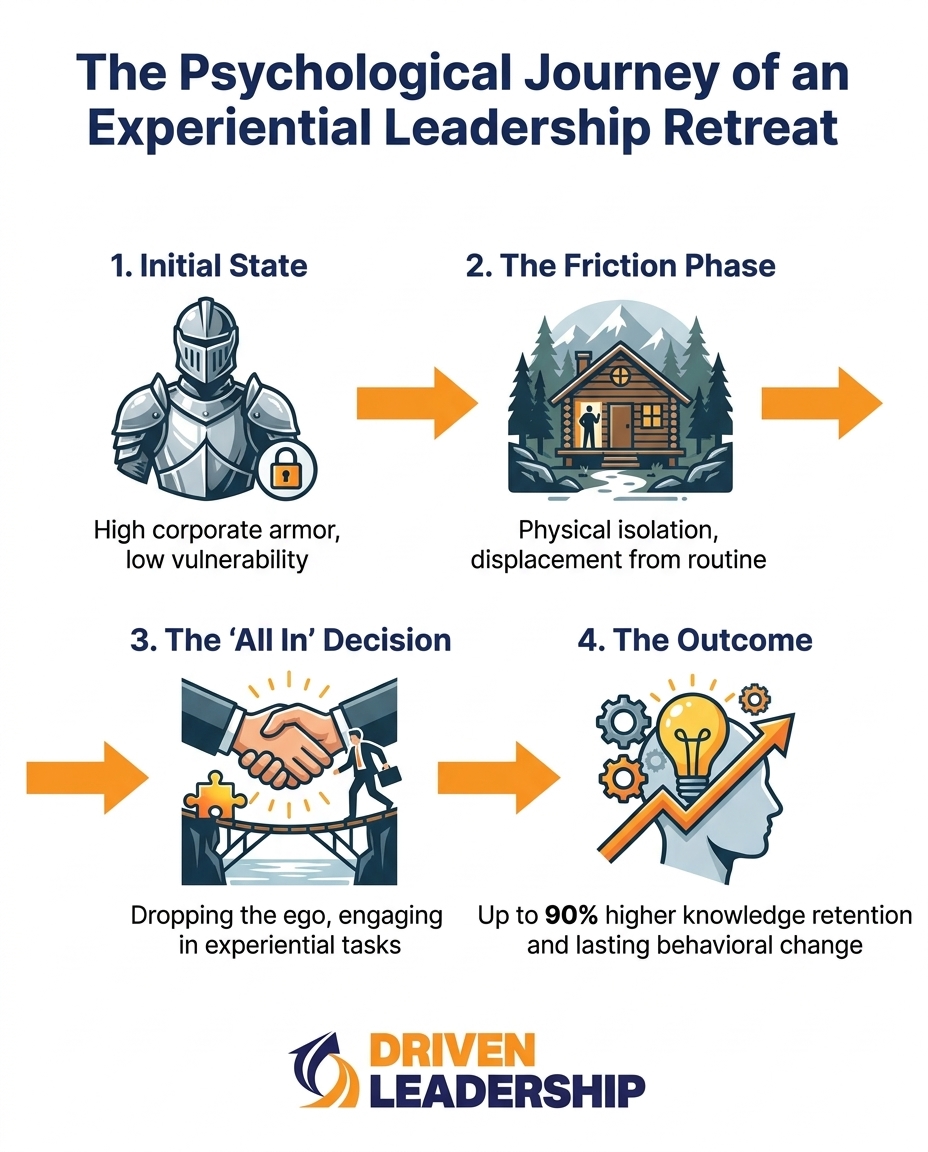
If you are ready to explore how our leadership trainings push you past your comfort zone, it helps to understand the mechanics of this friction. Over our years of coaching professionals from Puyallup to the broader Pacific Northwest, we have seen how corporate leaders spend years building professional armor. This armor protects you from failure, insulates you from criticism, and projects an image of unwavering competence to your team. However, that same armor acts as a barrier to authentic growth. True leadership breakthroughs require a definitive choice: you can continue holding back and protecting your ego, or you can choose to go fully 'all in'.
The internal conflict: The transition from a polished executive to a vulnerable participant creates immediate psychological discomfort. This discomfort is not an accident; it is the core mechanism of our retreat. Setting foot into an environment that demands absolute vulnerability means confronting the very blind spots you have spent your career avoiding. Understanding why we engineered this specific environment to demand such exposure is the first step toward achieving lasting, transformative results.
The Illusion of Safety: Why Standard Corporate Seminars Fall Short
Many professionals attempt to solve deep-seated leadership issues by attending standard hotel-ballroom seminars. These traditional settings provide comfortable chairs, catered lunches, and neatly bound workbooks. Unfortunately, they also provide the perfect cover for leaders to maintain their everyday corporate armor and avoid true introspection. Driven Leadership takes a fundamentally different path. Based on our extensive experience facilitating executive breakthroughs, our immersive, experiential approach pushes leaders beyond safe boardroom theory and directly into intense, real-world psychological growth.
Standard environments fail to produce lasting behavioral change because they allow you to remain a passive observer. You can sit in the back row, take a few notes, and nod along to tactical alignment sessions without ever questioning your own internal roadblocks. One leader recently attended a session with us specifically to overcome debilitating roadblocks that standard seminars could not resolve. By participating in our truly immersive program, they received the intense support and guidance necessary to acknowledge those barriers, resulting in significant personal and professional elevation.
Why Comfort Zones Prevent Growth
Human behavior is heavily dictated by routine and environment. When you remain in a comfortable, familiar setting, your brain defaults to its standard operational habits. Breaking those habits requires a disruption to your baseline.
• Neuroplasticity and displacement: Scientific studies on adult learning show that neuroplasticity—the brain's ability to form new connections—increases significantly when individuals are physically displaced from standard work environments.
• The failure of theory: Theoretical learning rarely translates to high-pressure leadership scenarios. Reading about conflict resolution is entirely different from practicing it in real-time under emotional duress.
• The default to safety: Without engineered discomfort, leaders will always default to their safest, most practiced behaviors, ensuring that no real growth occurs.
If your organization only requires a surface-level tactical review, our onsite leadership workshops can provide excellent foundational alignment. However, as our facilitators have seen with countless executive teams, if you need to dismantle deeply ingrained behavioral patterns and build a more resilient executive team, a comfortable ballroom will simply never provide the necessary friction.
• Traditional Hotel Seminar — Primary Focus: Passive theory and lectures — Psychological Impact: Low friction, high comfort — Long-Term Retention: Typically under 20%
• Immersive BOLD Retreat — Primary Focus: Active experiential problem solving — Psychological Impact: High friction, required vulnerability — Long-Term Retention: Up to 90% behavioral retention
The Catalyst of Isolation: The Role of the Wrightwood Environment
The physical location of an intensive retreat is just as critical as the curriculum itself. Our team deliberately selected the crisp, isolated natural environment of the Pacific Northwest and Wrightwood settings to physically remove leaders from corporate distractions, acting as a natural catalyst for deep introspection.
This isolation is absolutely not designed for relaxation. We are not bringing you to the mountains to take a vacation or escape your responsibilities. Instead, the environment intentionally creates a space where standard distractions—constant emails, immediate staff demands, and the comforting hum of the city—are entirely removed. Without these familiar buffers, you are forced to confront yourself and your leadership style head-on.
Timing the reset: The timing of this isolation also plays a crucial role in executive development. For example, as the September strategic planning season and early fall reset approaches, many leaders tell us they recognize the urgent need to recalibrate their mindset before the end-of-year push. Taking a team into an isolated environment during these critical seasonal transitions strips away the noise of the previous quarters. The natural environment acts as a mirror, reflecting the realities of your leadership without the protective layer of your daily routine.
Facing the Friction: The Apprehension of Arrival
It is completely normal to feel a profound sense of uncertainty and anxiety upon arriving at an intensive retreat. You are stepping out of a world where you are the recognized authority and entering a space where you are simply a participant. We consistently see that this transition period—from a heavily guarded corporate executive to an exposed, active learner—is often the most uncomfortable phase of the entire experience.
During a recent retreat we hosted, our facilitators watched one participant traveling to Wrightwood experience deep uncertainty about the experience upon arrival. However, by trusting the process and pushing through that initial friction to fully engage with the challenges presented, they emerged as a stronger person, a better leader, and someone much more willing to take calculated risks. The initial resistance you feel is a meticulously designed part of our experiential learning process.
The stages of arrival apprehension we often observe:
1. The analytical defense: Upon arrival, many leaders try to analyze and outsmart the curriculum, viewing the exercises as a puzzle to be solved rather than an experience to be felt.
2. The emotional wall: As the exercises demand more vulnerability, participants often experience a spike in anxiety, wanting to retreat to familiar, dominant behaviors.
3. The breakthrough acceptance: Overcoming this initial friction and choosing to trust the process is the first major milestone of the program.
If you do not feel a sense of apprehension when you arrive, you are likely not preparing to stretch yourself far enough. We rely on this friction as the exact mechanism that proves you are stepping outside of your established boundaries.
What It Actually Means to Go 'All In' at BOLD
People frequently ask our team what actually happens at BOLD, but the more important question is how you choose to respond to what happens. Defining 'going all in' is critical. It means making the conscious, active decision to participate fully without cynicism, reservation, or the need to look perfect in front of your peers. It is the moment you stop managing your image and start doing the actual work of leadership development.
Going all in requires you to participate in experiential exercises that may initially feel uncomfortable, non-traditional, or entirely foreign to your corporate experience. You cannot stand on the sidelines and critique the process. You must be in the arena. This level of vulnerability is the only way to build authentic trust with a cohort of peers who are undergoing the exact same stress test alongside you.
The Mechanics of Experiential Trust
Experiential learning is not about playing games; it is about simulating the emotional and psychological pressures of real-world leadership in a controlled environment. When you engage fully in BOLD training exercises that build trust, we force you to drop your ego to engage in real-time problem solving.
Key requirements for full participation:
• Replacing theory with action: You must stop talking about what you would do in a crisis and start demonstrating what you actually do when under pressure.
• Embracing failure: You have to be willing to fail publicly in front of other leaders, acknowledging your mistakes and learning from them immediately.
• Active listening: You must prioritize hearing the feedback of your peers over defending your original position.
When participants fully commit to these mechanics, the results we witness are undeniable. Experiential learning increases knowledge retention by up to 90% compared to traditional lecture-based formats, simply because the lessons are anchored in real emotional experiences rather than abstract concepts.
The Breakthrough: Overcoming Debilitating Leadership Roadblocks
The intense reality of the retreat is demanding, but the payoff is profound. There is a distinct turning point during the process where psychological friction transforms into clarity and confidence. When you stop fighting the environment and start leaning into the discomfort, you gain the ability to acknowledge and dismantle previously debilitating roadblocks that have held your career back for years.
Another participant recently finished our program, noting to our team that it was far from a cliché corporate training. By engaging fully with the rigorous testing and psychological challenges we presented, they grew significantly, overcoming long-standing self-perception issues to emerge as a better overall person and a more decisive leader.
Pushing through this discomfort connects directly to long-term strategic execution and team alignment back at the office. When you return to your organization after completing an advanced leadership program, you do not just bring back a binder of notes; you bring back a rewired approach to conflict, communication, and strategy. This newfound resilience prepares leaders for critical organizational pivots, ensuring they can guide their teams through uncertainty with authentic confidence rather than manufactured bravado.
Frequently Asked Questions About the BOLD Retreat Experience
What actually happens at a BOLD leadership retreat?
At a BOLD retreat, we remove leaders from their standard corporate environments and place them into an intensive, experiential learning setting. Instead of sitting through theoretical lectures, participants engage in high-pressure, real-time problem-solving exercises designed to expose their natural leadership defaults. This process creates necessary psychological friction, forcing executives to drop their professional armor, confront their blind spots, and rebuild their communication and trust-building skills from the ground up.
Why is physical isolation important for executive leadership training?
Physical isolation acts as a necessary catalyst for deep psychological introspection by completely removing daily corporate distractions. When executives are physically displaced from their urban hubs and digital tethers, they can no longer hide behind immediate staff demands or constant email checking. This enforced disconnect breaks standard routine habits, significantly increasing neuroplasticity and making leaders far more receptive to lasting behavioral change.
How do you psychologically prepare for an intensive executive retreat?
Psychological preparation requires a conscious decision to leave your ego and defensive mechanisms at the door. You must accept that you will feel uncomfortable, that you will not have all the answers, and that you may fail publicly during our experiential exercises. Preparing means committing to the process without cynicism and understanding that the initial anxiety you feel is a designed, necessary step toward authentic growth.
Why is experiential leadership training more effective than traditional lectures?
Experiential training is highly effective because it anchors leadership lessons in real emotional and psychological experiences rather than abstract concepts. While traditional lectures allow participants to passively agree with theories, experiential learning forces them to act under pressure. This active engagement increases knowledge and behavioral retention by up to 90%, ensuring that the skills learned translate directly to real-world corporate crises.
What makes a leadership retreat successful in producing long-term behavioral change?
A retreat produces long-term change only when it successfully forces leaders out of their comfort zones and demands absolute vulnerability. Success hinges on the participants' willingness to go "all in" and our program's ability to simulate the actual emotional stress of executive leadership. When leaders dismantle their defensive armor and practice new behaviors in real-time, those changes permanently alter how they manage their teams back at the office.
Is the BOLD retreat physically demanding or strictly focused on psychological growth?
While the retreat utilizes the physical environment to create displacement and isolation, our core focus is intensely psychological. The challenges are designed to test emotional resilience, communication, and ego-management rather than physical athletic endurance. The exhaustion participants feel is typically mental and emotional, stemming from the rigorous demand for constant vulnerability and active, real-time problem solving.
Take the First Step Toward Authentic Leadership Growth
The intense reality of this retreat is exactly what makes it so uniquely effective. Leaving your comfort zone is not just a recommendation; it is a mandatory step for leaders who want to stop relying on safe theory and start executing with authentic power. If you continue to protect your ego, you will continue to hit the same organizational roadblocks year after year.
Take a moment to reflect on whether you are truly ready to drop your armor and experience the friction required for true growth. If you are tired of standard hotel seminars that yield no real behavioral change, we invite you to explore the details of the BOLD advanced leadership program. Discover what happens when you fully commit, and see if this immersive experience aligns with your ultimate goals for yourself and your executive team.