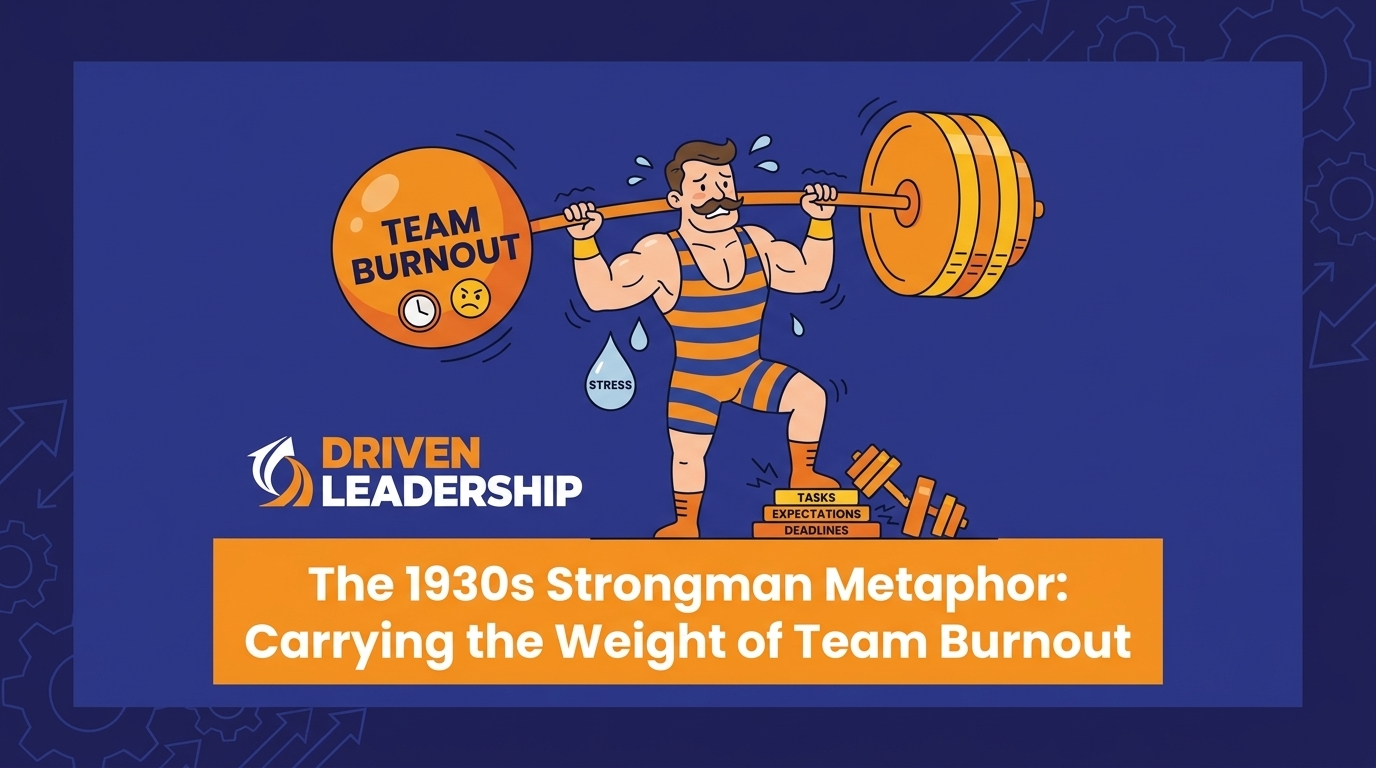
The 1930s Strongman Metaphor: Carrying the Weight of Team Burnout

The Illusion of the Solo Load-Bearer
The classic image of a vintage circus performer holding up an entire collapsing structure isn't actually a display of raw, brute force—it is a carefully orchestrated trick of perfect balance. When it comes to modern management, The 1930s Strongman Metaphor: Carrying the Weight of Team Burnout perfectly captures a dangerous misconception. Leaders often believe they must act as the sole load-bearing pillar for their organization. You take on every escalated problem, absorb the emotional stress of your staff, and single-handedly carry the operational weight of the department. But this heroic posture is an unsustainable illusion. The moment you realize this load-bearing strategy is actually breaking your own resilience and creating a massive single point of failure for your team, you face a critical decision point. If you want to shift from carrying the load to building a self-sustaining team, exploring professional leadership trainings and implementing proven team execution strategies is the essential first step.
To understand why this leadership style fails, you have to look at how the original strongman trick actually worked. The performer wasn't simply muscling a thousand pounds of weight; they were relying on highly controlled conditions, precise center-of-gravity calculations, and a perfectly static environment. As long as nothing moved, the illusion held up. Business, however, is never static. Your organization is a living, breathing ecosystem filled with unpredictable variables, shifting deadlines, and complex human emotions.
When you attempt to be the solo load-bearer, you are relying on everything going exactly according to plan. You might be able to handle the day-to-day operations when the workload is light and the team is fully present. But what happens when the environment shifts? A prime example is the late summer and back-to-school transition. During this season, schedules are suddenly upended. Team members adjust their hours for childcare, final summer vacations overlap, and the predictable rhythm of the office shatters. The controlled conditions disappear, and the massive weight you have been balancing suddenly shifts, leading directly to severe exhaustion.
You cannot out-work a structural flaw. Believing that you just need to push harder or stay at the office later only deepens the dependency your team has on you. True strength in management isn't measured by how much operational weight you can carry on your own shoulders; it is measured by how effectively you can distribute that weight across a capable, accountable team.
Diagnosing the Hero Syndrome: When Strength Becomes a Liability
The core problem: The "hero syndrome" in management is incredibly seductive. When a crisis hits and you step in to save the day, you receive an immediate psychological reward. You feel needed, competent, and deeply valuable to the organization. Over time, this creates a feedback loop where you subconsciously encourage your team to bring every minor issue to your desk. However, this constant firefighting eventually depletes your energy reserves, transforming what felt like strength into a massive organizational liability.
The underlying cause: This dynamic takes root because it is often faster in the short term to simply do the work yourself rather than teaching someone else how to do it. You might lack trust in your team's ability to execute to your exact standards, or you might fear that delegating will lead to costly mistakes. As a result, you hoard responsibilities. The inevitable outcome of this behavior is a spike in common leadership burnout symptoms. If you are experiencing these warning signs, your management structure is fundamentally unbalanced:
• Severe decision fatigue: You feel paralyzed by minor choices by the end of the day because you have made every single decision for your team since 8:00 AM.
• Chronic irritability: You snap at well-meaning employees who ask basic questions, forgetting that you trained them to rely on you for those very answers.
• Inability to disconnect: You cannot take a weekend off without constantly checking your email, terrified that the "perfect balance" will collapse in your absence.
• Stagnant innovation: You are too busy managing the daily operational chaos to focus on long-term strategy, growth, or vision.
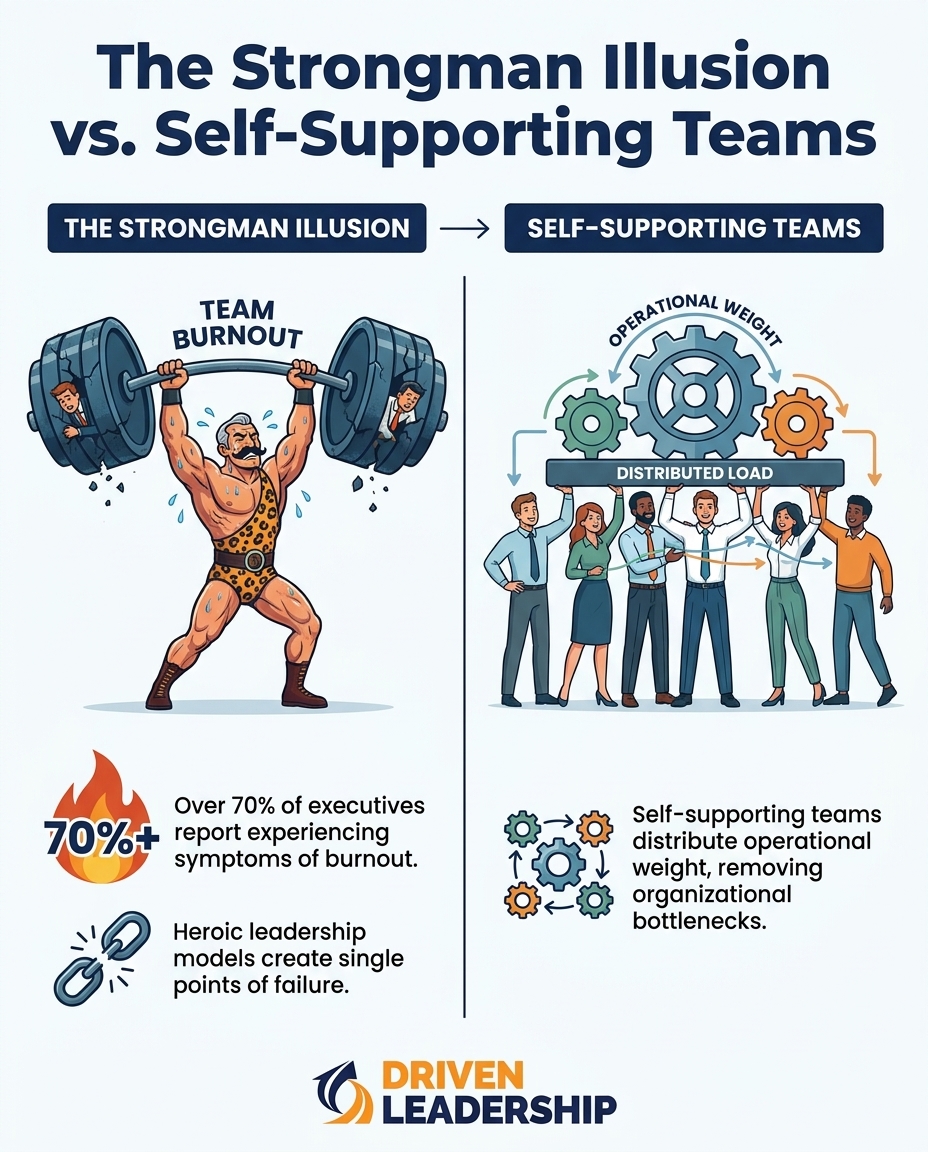
The structural solution: You must recognize that this exhaustion is not a personal weakness or a failure of stamina. It is a structural flaw in your leadership approach. When you refuse to distribute responsibility, you become the ceiling for your team's potential. Breaking this cycle requires stepping back, allowing your team to struggle through challenges, and accepting that their way of solving a problem might look different than yours.
The Anatomy of an Organizational Bottleneck
When you carry the entire team, you unintentionally become an organizational bottleneck. A bottleneck occurs when the flow of work is restricted by a single, overloaded point in the system—and in a hero-led team, that point is you. If every client email needs your final review, and every minor expense requires your signature, team momentum grinds to a halt. Your high-performers will eventually become disengaged, realizing they have no autonomy, while your lower-performers will remain comfortably dependent on you to fix their mistakes.
There is a vast difference between guiding a team and carrying them. Guiding involves setting the destination, providing the right tools, and allowing the team to navigate the terrain. Carrying means you put the team on your back and walk every step of the journey for them.
• Carrying the Team (Hero) — Immediate Impact: Fast short-term execution, high leader control — Long-Term Result: Severe burnout, low team autonomy, high turnover
• Guiding the Team (Empowering) — Immediate Impact: Slower initial execution, requires patience — Long-Term Result: Scalable growth, high resilience, self-sufficient staff
The Q3 Squeeze: Navigating the Late-Summer Schedule Shift
The illusion of the solo load-bearer often shatters during specific periods of heightened external pressure. One of the most predictable breaking points in the business calendar is the late summer and back-to-school transition. This period, often referred to as the "Q3 Squeeze," introduces a volatile mix of operational stress and shifting personal schedules that can crush a leader who is trying to balance everything alone.
During this transition, the predictable routines of mid-summer evaporate. Parents on your team are adjusting to new school hours, sudden illnesses require unexpected time off, and the final waves of summer vacations leave departments chronically understaffed. If your organizational structure relies entirely on your constant oversight, these schedule shifts will bring your operations to a standstill. You cannot simply "muscle through" a week where half your key staff is adjusting to a new routine and the other half is waiting on your approval to move forward.
Furthermore, this seasonal shift coincides with the aggressive push of third-quarter deadlines. End-of-year project targets are suddenly looming, budget planning for the following year begins, and the pressure to deliver results intensifies. When you combine compressed deadlines with unpredictable team availability, the operational weight multiplies.
The Q3 stress amplifiers include:
• Overlapping absences: Managing the gap between returning vacationers and parents adjusting to school drop-offs.
• Budgetary friction: The mental bandwidth required to forecast next year's needs while simultaneously managing today's crises.
• Client urgency: Customers returning from their own summer breaks with immediate, high-priority demands.
The strongman balance shatters when these external variables introduce instability. If you are the only one holding the structure up, a sudden shift in the wind—like a key employee needing a modified schedule—will cause the entire edifice to collapse. Surviving the Q3 squeeze requires a team that can bear its own weight, allowing you to focus on strategy rather than daily survival.
The Internal Overcast: The Psychological Toll of Undistributed Weight
Carrying the weight of a team is not just an operational problem; it takes a profound psychological toll. If you live in the Pacific Northwest, you are deeply familiar with the region's heavy, dreary, prolonged overcast winters. It is a persistent fog that limits visibility and settles over the landscape for months on end. For an overloaded leader, that overcast becomes an internal reality. Even during the exterior heat and bright days of late summer, you might feel a lingering, heavy emotional fog that clouds your judgment and dampens your enthusiasm.
This internal overcast is the direct result of having every team problem escalate to your desk. When you absorb the frustrations, conflicts, and anxieties of your entire staff, you carry an emotional burden that is invisible to the outside world. On the surface, your business might look incredibly successful. You might be hitting revenue targets and winning industry awards. But internally, you feel crushed by the endless dependencies. You wake up dreading the sheer volume of questions you will have to answer before noon.
True leadership requires immense emotional intelligence, which means recognizing when this internal fog is affecting your performance. One management team noticed this exact dynamic unfolding with a key individual in their organization. They observed a distinct lack of confidence, a sharp drop in initiative, and increasingly poor communication during crucial meetings. The leader was buckling under the invisible weight they were carrying. After attending an immersive advanced leadership program, that same individual fully embraced the behavioral concepts. The outcome was profound: they returned with renewed confidence, began taking proactive initiative, and demonstrated vastly improved communication and active listening skills. They learned how to clear the fog by distributing the load.
You cannot effectively lead a team if you are emotionally depleted. Stepping back and allowing others to take responsibility isn't about abandoning your team; it is about preserving your own capacity to lead them effectively into the future.
Rewiring the Leader: Why Surface-Level Tips Fail
The surface-level trap: When leaders finally recognize they are burning out, their first instinct is usually to seek out a quick fix. You might download a new time-management app, try the Pomodoro technique, block out "focus time" on your calendar, or even take a week-long vacation to recharge. While these tactics can provide temporary relief, they fundamentally fail to address the root cause of the exhaustion. Taking a vacation doesn't cure the hero complex; it just means you return to an overflowing inbox and a team that has been paralyzed in your absence.
The behavioral root: The need to carry the team is rarely a scheduling problem; it is a behavioral pattern. It stems from a deep-seated need for control, a fear of failure, or a reliance on the validation that comes from being the "fixer." Time management hacks cannot rewire these psychological drivers. To genuinely stop carrying the weight, you must undergo an immersive, behavioral change that fundamentally rewires how you operate under pressure.
The deep rewiring solution: This transition requires moving from stepping in to solve problems, to actively challenging your team to take ownership. It means getting comfortable with silence when an employee asks you what to do, forcing them to articulate their own proposed solution first. This level of change requires dedicated focus and professional guidance.
This is why standard webinars and reading lists fall short. One recent participant, who was facing unspecified personal and professional limitations, realized they needed more than a cliché corporate training seminar. They needed a fundamental shift in self-perception. By completing BOLD leadership training, they actively challenged their own limitations and assumptions. Through this immersive experience, they grew significantly, emerging as a better, more capable person who understood that true leaders build capable, accountable teams rather than acting as a solo strongman.
Building a Self-Supporting Organizational Structure
Transitioning away from the 1930s strongman metaphor requires deliberate, actionable steps. You must actively dismantle the systems that force you to carry the load and replace them with frameworks that demand team autonomy. Here is how you can begin building a self-supporting organizational structure:
1. Audit your daily interventions: For one week, track every time you step in to solve a problem that an employee could have handled. Identify the recurring themes. Are they constantly asking for approval on minor discounts? Are they escalating routine client complaints? Once you identify the pattern, you can address the specific lack of training or confidence causing it.
2. Shift your response mechanism: When an employee brings you a problem, stop giving them the answer. Instead, ask, "What do you think our best option is here?" This simple question forces them to engage their critical thinking skills rather than relying on yours.
3. Define the outcome, not the process: Micromanagement is the heaviest weight a leader can carry. Tell your team exactly what a successful outcome looks like, but allow them the freedom to determine the process to get there. They may stumble, but those missteps are crucial for their professional development.
4. Normalize productive failure: If your team is terrified of making a mistake, they will never take the initiative. You must create an environment where minor, non-catastrophic failures are treated as learning opportunities rather than punishable offenses.
Fostering Team Accountability
A self-supporting structure relies entirely on accountability. Developing the traits of a great leader means setting crystal-clear expectations rather than micromanaging the daily outcomes. When expectations are vague, employees default to asking for permission. When expectations are precise, employees can measure their own progress and self-correct along the way.
Allowing team members to navigate their own challenges builds their inherent resilience. When they successfully resolve a complex issue without your intervention, their confidence grows, and their reliance on you shrinks. Empowering others to handle responsibilities doesn't make you less important to the company; it elevates the entire organization's capacity, allowing you to finally put down the crushing weight of the strongman act and focus on true, visionary leadership.
Frequently Asked Questions
What is hero syndrome in leadership?
Hero syndrome in leadership occurs when a manager constantly steps in to "save the day" by taking over tasks and solving every problem for their team. While it provides a short-term ego boost, it ultimately creates a toxic dependency. The team stops taking initiative, and the leader becomes an organizational bottleneck, leading inevitably to severe exhaustion and operational slowdowns.
What are the most common leadership burnout symptoms?
The most common leadership burnout symptoms include chronic decision fatigue, irritability with staff, a persistent inability to disconnect from work, and a sense of emotional numbness. Leaders may also experience physical symptoms like insomnia or tension headaches. These signs indicate that the leader is carrying too much operational weight and failing to delegate effectively.
How do you stop carrying the weight of your team?
You stop carrying the weight of your team by shifting from solving their problems to coaching them through their own solutions. When an employee asks for help, require them to present a proposed solution first. Furthermore, you must define clear outcomes and allow the team to manage the process, accepting that they may make minor mistakes as they learn to operate autonomously.
Why is heroic leadership dangerous to a company's growth?
Heroic leadership is dangerous because it creates a single point of failure within the organization. If all decisions, approvals, and crisis management must flow through one person, the company can only grow as fast as that one person can work. It stifles innovation, drives away high-performing employees who crave autonomy, and leaves the company highly vulnerable if the leader becomes unavailable.
How can leaders overcome burnout during high-stress transitions like Q3?
Leaders can overcome burnout during high-stress transitions by proactively distributing responsibilities before the seasonal pressure hits. During the late summer and Q3 squeeze, leaders must ruthlessly prioritize tasks, delay non-essential projects, and lean heavily on their team's established accountability structures. Immersive behavioral training can also help leaders rewire their instinct to take control during chaotic periods.
What is the difference between leading a team and carrying a team?
Leading a team involves setting a clear vision, providing resources, and empowering individuals to execute their roles independently. Carrying a team means the manager micromanages every detail, absorbs all the stress, and does the actual work for the employees. Leading builds a scalable, resilient organization, while carrying guarantees eventual leader burnout and team stagnation.