
Managing Q4 Stress Through Structured Leadership Frameworks

The October Reality Check: When Q4 Targets Miss the Mark
The transition into mid-fall is always a critical pivot point, but managing Q4 stress through structured leadership frameworks becomes absolutely essential when your October targets fall short. At Driven Leadership, we have spent years coaching executives through this exact realization. You finalize your Q3 numbers, look at the remaining goals for the year, and suddenly realize the math simply is not adding up. The natural biological response to this realization is panic. You want to push your team harder, demand more output, and sprint recklessly to the finish line. However, reactive leadership during this high-stakes season often does significantly more harm than good. Instead of letting end-of-year pressure dictate your decisions, relying on a proven, objective system is the only way to stabilize your team and recover your momentum. To explore how to build these essential systems, leaders often turn to our advanced leadership training and the comprehensive Engage & Elevate program.
As mid-fall / October arrives, the runway to the end of the year starts looking uncomfortably short. The pressure from stakeholders, the board of directors, or your own internal expectations hits a boiling point. This creates a highly specific environment where leaders feel they must act immediately to close the revenue gap. The immense pressure business leaders face during the end-of-year push can cloud judgment and lead to erratic communication.
You reach a critical decision point right here: do you reactively push the team based on panic, demanding longer hours and setting arbitrary deadlines? Or do you pause, take a breath, and apply a structured framework to objectively assess the situation? Acknowledging this critical pivot point—when Q3 results are finalized and Q4 shortfalls become glaringly apparent—is the first step toward effective recovery. We consistently see that leaders who choose to pause and rely on established methodologies outperform those who lead by gut instinct during a crisis. By choosing structure over emotion, you set the tone for a disciplined, focused, and ultimately successful year-end push.
How the Pacific Northwest Transition Amplifies Executive Stress
As we move deeper into the final quarter, our team at Driven Leadership knows firsthand the unique compounding factor leaders in Puyallup, WA, and across the Pacific Northwest face: the dramatic shift in weather. The transition into the dark, rainy fall and winter months is not just a logistical inconvenience; it biologically and psychologically impacts how you and your team operate. Understanding these environmental factors is crucial for maintaining productivity when the pressure is highest.
The Biological Impact of Late Fall
The most immediate challenge of the regional climate shift is the biological impact of reduced daylight hours. As the sun sets earlier, circadian rhythms are disrupted, leading to decreased energy levels across the entire organization. This biological reality exacerbates fatigue for both leaders and their teams. Just as expectations and business demands reach their absolute peak, the physical capacity of your workforce naturally dips.
This intersection of seasonal fatigue and peak business demands creates a volatile environment. The psychological toll of the rainy season's onset coinciding with end-of-year business pressures means that minor setbacks can feel catastrophic. When physical resilience is low, emotional reactions tend to be high. Team members may become more irritable, communication can break down faster, and the overall tolerance for stress drops significantly.
Why Environmental Stress Demands Operational Structure
These compounding environmental factors make relying on objective systems not just helpful, but absolutely essential. You cannot rely on sheer willpower or emotional motivation when your team is physically and mentally drained by the seasonal shift. Operational structure acts as a vital safety net.
By implementing rigid, predictable routines, you succeed in removing emotional variables when physical resilience is low. Your team does not have to guess what the priorities are or how to handle a bottleneck; the framework dictates the response. Creating predictable routines during unpredictable seasonal shifts provides a sense of stability. When the weather is gloomy and the revenue targets are daunting, a clear, structured operational framework gives your team a reliable path forward, reducing cognitive load and allowing them to focus entirely on execution.
The Danger of Reactive Leadership During the End-of-Year Push
The primary problem during an October shortfall is that when pressure spikes, leaders often default to their most reactive instincts. The cause is a deeply ingrained biological stress response—the fight-or-flight mechanism—hijacking the logical, planning centers of the brain. The solution is recognizing these internal triggers early and consciously pivoting away from emotion toward data-driven management. When leaders fail to make this pivot, the results can be devastating to the organization's culture and bottom line.
Recognizing the Signs of Panic-Driven Decisions
Defining what reactive, panic-driven leadership looks like in practice is essential for stopping it. In our experience, it rarely looks like outright yelling; more often, it manifests as a sudden loss of trust in established processes. Leaders in panic mode begin setting unrealistic, arbitrary deadlines that have no basis in historical data or team capacity. They start micromanaging previously autonomous teams, demanding constant updates on minor details because they feel out of control of the macro-level goals.
To illustrate the difference, consider how a stressed leader behaves versus a structured leader:
• Reactive / Panic-Driven — Response to Shortfalls: Sets arbitrary, accelerated deadlines — Impact on Team Dynamics: Creates anxiety, confusion, and resentment
• Structured / Objective — Response to Shortfalls: Realigns milestones based on actual capacity — Impact on Team Dynamics: Fosters focus, clarity, and determination
• Reactive / Panic-Driven — Response to Shortfalls: Micromanages details and assigns blame — Impact on Team Dynamics: Destroys autonomy and halts innovation
• Structured / Objective — Response to Shortfalls: Isolates bottlenecks in the workflow — Impact on Team Dynamics: Empowers managers to solve specific problems
The Cost of Short-Sighted Q4 Strategies
When you contrast emotional reactions with objective, data-driven management, the long-term consequences become starkly clear. Short-sighted decisions damage team morale and retention in ways that outlast the current quarter. If you push a team to the brink of exhaustion to hit an arbitrary December target, you risk severe long-term damage to employee trust.
This relentless pressure directly causes burnout, inevitably leading to early Q1 turnover. You might hit the Q4 goal, but you will start the new year entirely depleted and understaffed. Understanding how poor leadership impacts team performance and business results highlights exactly why emotional, knee-jerk reactions during the end-of-year push sabotage the very recovery you are trying to achieve.
Using the Elevate Framework as an Emotional Circuit Breaker
To stop the cycle of reactive panic, leaders need a mechanism to forcefully pause their biological stress response. This is where a defined, proven methodology becomes invaluable. Highlighting the Elevate framework as a proven, structured methodology demonstrates how leaders can prevent themselves from defaulting to emotional reactions during high-stress Q4 revenue pushes.
What is an Emotional Circuit Breaker?
In high-stakes business environments, an emotional circuit breaker functions exactly like an electrical circuit breaker in a home: it stops an overload before it causes a catastrophic fire. When the October numbers come in low, the stress response overloads the system. The Elevate framework acts as this breaker, deliberately interrupting the biological stress response. It forces a mandatory pause.
This pause is not about ignoring the problem; it is about creating space for logical analysis. By engaging the circuit breaker, you stop the immediate urge to send an angry email or schedule a mandatory weekend meeting. You allow the initial wave of adrenaline to pass, enabling you to look at the shortfall objectively rather than emotionally.
Moving from Emotion to Execution
Once the panic cycle is paused, the framework shifts the leadership focus entirely from emotion and blame to execution and recovery. It is about relying on defined methodologies instead of gut feelings. Our Engage & Elevate program teaches leaders how to systematically break down the remaining gap without assigning guilt to specific departments.
By focusing on the "how" instead of the "who," you are effectively re-establishing control over the Q4 narrative. Your team stops waiting for the next unpredictable outburst and starts looking at the revised playbook. The framework provides the exact steps needed to assess the damage, realign the resources, and move forward with a clear, objective mind.
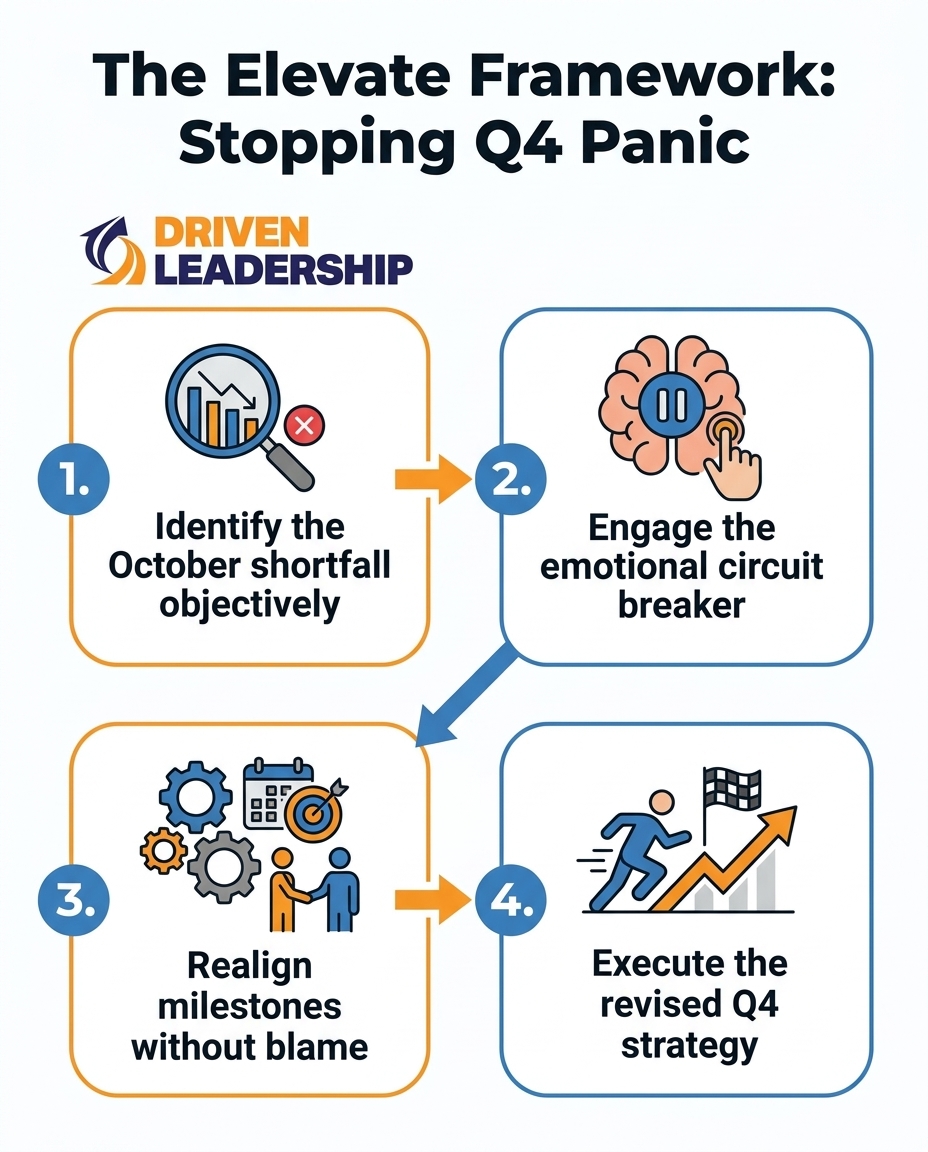
Step-by-Step: Applying Structured Methodologies to Revenue Shortfalls
Understanding the concept of an emotional circuit breaker is only the beginning; you must know how to apply these structured frameworks to recover off-track targets effectively. Providing actionable, sequential steps ensures that your entire organization moves in unison toward the revised goals.
Step 1: Objective Data Assessment
The first step in any recovery plan is isolating the specific data points causing the shortfall without assigning blame. This requires gathering accurate Q3 and early Q4 metrics. You must look past the aggregate revenue number and dig into the leading indicators. Are close rates dropping? Is lead generation slowing down? Are project delivery timelines extending?
The goal here is identifying bottlenecks holding back progress. We see this exact transformation frequently in our own practice. For example, during a recent spring quarter, a participant in our advanced leadership training cohort struggled with the confidence to step up and take charge during critical meetings. By applying a structured methodology focused on communication and active listening, they gained the confidence to objectively assess their team's data and take charge of the recovery plan when it mattered most. That same objective confidence is required when dissecting October data.
Step 2: Realigning Milestones
Once the bottlenecks are identified, the next step is realigning milestones to create realistic, achievable weekly targets. You cannot simply take the missing revenue and dump it onto December's quota. That only guarantees failure and burnout. Instead, focus on breaking down the remaining gap into manageable weekly sprints.
Ensuring targets are challenging but attainable is a delicate balance. The team needs to feel a sense of urgency, but they also need to believe the goal is mathematically possible. Finally, you must communicate the revised plan transparently to all stakeholders. When everyone understands the new milestones and the logic behind them, alignment replaces anxiety.
Stabilizing Team Focus and Overcoming Q4 Roadblocks
With the new milestones in place, leadership must shift its focus to team management, maintaining morale, and fostering effective communication under intense pressure. A revised plan is useless if the team is too burned out or distracted to execute it.
Fostering Active Listening Under Pressure
The importance of active listening peaks when team stress is at its highest. Leaders must focus on creating safe channels for team feedback. If a new weekly sprint is physically impossible due to a software limitation or a supply chain delay, you need to hear about it immediately, not at the end of the month.
This involves validating concerns while maintaining focus on the goal. You do not have to lower the standard, but you must acknowledge the difficulty of the task. Building confidence in managers to take charge of their respective departments ensures that communication flows smoothly in both directions. During one of our recent intensive sessions at Driven Leadership, we worked with a manager who faced debilitating roadblocks that were hindering both their personal and professional growth. By participating in an executive manager program that provided expert support and a clear growth framework, they successfully acknowledged and overcame those roadblocks to reach the next level—a crucial skill when navigating Q4 pressures.
Mitigating Manager Burnout
Preventing mid-level manager burnout during the final push is critical. These managers bear the brunt of the pressure, acting as the buffer between executive expectations and front-line execution. Distributing the leadership load is essential; no single manager should be responsible for driving the entire recovery.
Executive leaders must be proactive in recognizing early signs of fatigue in key personnel. If a highly reliable manager suddenly starts missing details or communicating poorly, the framework should prompt you to step in and offer support, rather than issuing a reprimand. Protecting your managers protects the entire execution strategy.
Equipping Your Managers for End-of-Year Success
To ensure the recovery plan succeeds, you must broaden the scope to organizational alignment, ensuring all layers of management utilize the same structured frameworks. If the executive team is using an objective methodology but front-line managers are still leading by panic, the system will fracture.
• Distribute stress-mitigation tools: Ensure mid-level managers have access to the exact same emotional circuit breakers and stress-mitigation tools that the executive team uses. Consistency in methodology prevents mixed messaging.
• Leverage digital and remote resources: Utilize tools like a virtual management academy to effectively support distributed teams. Remote workers often feel Q4 stress more acutely due to isolation, making structured digital support vital.
• Maintain organizational alignment: Keep communication consistent from the executive suite down to the front line. Every department should understand how their specific weekly sprint contributes to recovering the October shortfall.
• Schedule weekly bandwidth checks: Before assigning new Q4 initiatives or accelerating timelines, require managers to objectively report on their team's current capacity to prevent accidental overload.
• Standardize reporting metrics: Remove ambiguity by establishing exactly which key performance indicators matter for the remainder of the year, so managers can focus on execution rather than data gathering.
Reclaim Your Q4 Momentum Before the Year Ends
The transition from panic to structured, objective execution is the defining characteristic of elite leadership. Falling behind in mid-fall does not dictate your final year-end result; how you respond to that shortfall does. When you utilize an emotional circuit breaker, you stop the biological stress response from sabotaging your strategy. By objectively realigning your milestones and supporting your managers, you turn a chaotic situation into a highly focused recovery mission. Do not let October's reality check turn into December's failure. Start managing Q4 stress through structured leadership frameworks today, stabilize your team's focus, and experience the profound satisfaction of guiding your organization to a successful, data-driven year-end finish.
Frequently Asked Questions
How do leaders avoid emotional decision-making under stress?
Leaders avoid emotional decision-making by implementing an emotional circuit breaker, such as a structured leadership framework. This predefined system forces a mandatory pause between the stressful event—like missing a target—and the leadership response. By relying on objective data assessment rather than gut instincts, leaders can bypass the biological fight-or-flight response and make logical, strategic choices.
What is the best framework for Q4 goal recovery?
The best framework for Q4 goal recovery is one that shifts the focus from assigning blame to executing a revised, objective strategy. Methodologies like the Elevate framework are highly effective because they emphasize isolating specific bottlenecks and realigning milestones into manageable weekly sprints. This ensures the team remains focused on achievable targets rather than being overwhelmed by the macro-level shortfall.
How do you manage team burnout in Q4?
Managing team burnout in Q4 requires proactive monitoring and the equitable distribution of the leadership load. Leaders must recognize the early signs of fatigue, especially in mid-level managers, and create safe channels for transparent feedback regarding team capacity. By setting realistic, data-driven deadlines instead of arbitrary demands, you protect your team's physical and mental resilience during the final push.
How do leaders manage stress effectively during critical business periods?
Effective stress management during critical periods involves removing emotional variables from daily operations through predictable routines. Leaders manage their own stress by trusting a tested operational structure rather than trying to control every minor detail through micromanagement. This structured approach reduces cognitive load, allowing leaders to maintain clarity and project confidence to their teams.
Why is mid-fall a critical pivot point for end-of-year business goals?
Mid-fall is a critical pivot point because it is the exact moment when Q3 results are finalized and any Q4 shortfalls become mathematically apparent. It represents the last viable window of opportunity to adjust strategies and realign milestones before the year ends. Decisions made during this specific timeframe dictate whether an organization will objectively recover its targets or succumb to reactive, panic-driven failure.
