
The Complete Guide to How Poor Leadership Affects Team Performance

Why How Poor Leadership Affects Team Performance and Business Results Matters
: Finding the Best Leadership Development Training in Phoenix, AZ

If you want to know how poor leadership affects team performance and business results, the short answer is that bad bosses drain morale, stall growth, and cost companies billions of dollars every year. Many business owners and mid-level managers face constant team misalignment, poor communication, and stalled growth. It is incredibly easy to feel overwhelmed by workplace conflict when you lack the confidence to lead effectively. That is why so many organizations seek professional leadership development training in Phoenix, AZ to turn things around. When leaders fail to connect, work environments become stressful, and productivity drops by up to 30%.
To fix these issues, check out our leadership development solutions or schedule a consultation to transform your team today.
When managers lack direction or empathy, the damage spreads quickly. Here is a quick breakdown of how weak leadership impacts an organization:
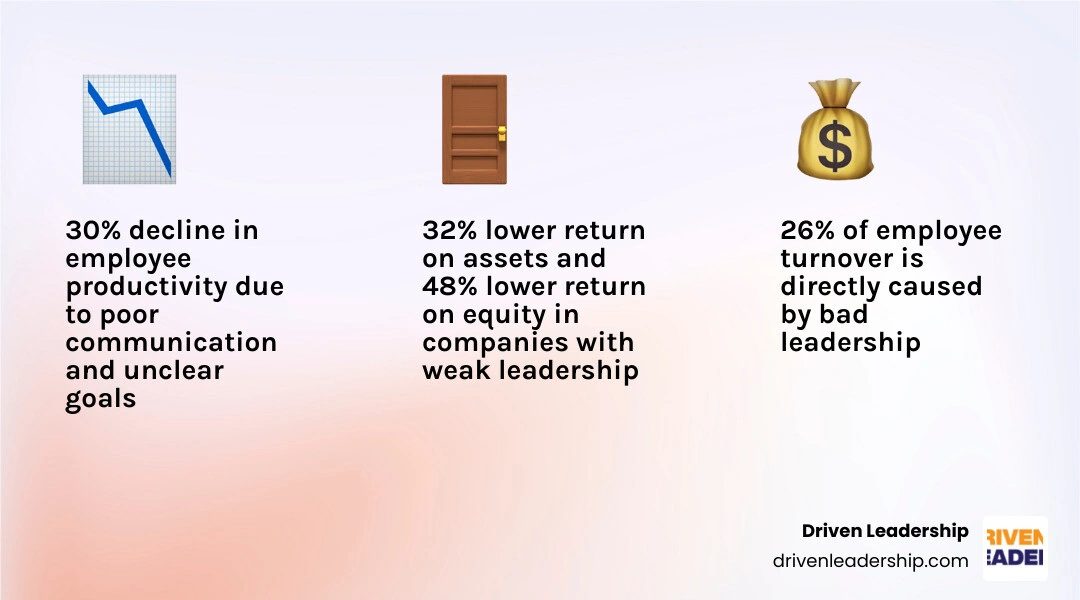
• Slashes Productivity: Poor communication and unclear goals lead to a 30% decline in employee productivity.
• Drives High Turnover: Managers account for 70% of the variance in employee engagement, and bad leadership is directly responsible for 26% of employee turnover.
• Destroys Financial Performance: Companies with weak leadership see a 32% lower return on assets and a 48% lower return on equity.
• Stifles Innovation: An environment without psychological safety causes a 40% mission drift and stops creative problem-solving.
We often see managers who got promoted because they were great individual contributors. But leading a team requires completely different skills than doing the technical work. Without proper training, these well-meaning managers struggle. They might micro-manage, play favorites, or fail to communicate.
This behavior does not just make employees unhappy—it directly hurts the bottom line. It creates a quiet, creeping drain on your company's energy. Employees stop sharing their best ideas. They do the bare minimum, or they simply leave. To learn more about how this impacts your team's motivation, read our guide on the three types of employees or explore the impact of leadership development training to see how targeted coaching can turn a struggling team around.
If you want to stop the talent drain and build a high-performing culture, contact Driven Leadership today to discover how we can help your team succeed.
Poor Leadership vs. Toxic Leadership: Defining the Workplace Divide
While both styles drag down performance, there is a distinct line between a leader who is simply out of their depth and one who is actively destructive. Understanding this divide helps us diagnose issues within our teams and apply the right developmental solutions.
Poor leadership is often passive or accidental. It usually stems from a lack of preparation, inadequate training, or organizational pressure. These are well-intentioned individuals who want to do a good job but lack the practical management skills to keep their teams aligned. They might struggle with slow decision-making, poor organizational systems, or a failure to communicate a clear vision.
One common variation is "impoverished leadership." This is a passive-conservative style where a manager evades responsibility and ignores problems to avoid making mistakes. It is often triggered by an "error aversion climate"—a workplace culture where mistakes are punished rather than treated as learning opportunities. Under this pressure, a manager retreats into survival mode, doing just enough to get by without taking any ownership.
Toxic leadership, on the other hand, is active and ego-driven. Toxic leaders prioritize their personal agendas over organizational success. They thrive on praise while denying accountability, demean subordinates publicly, and actively foster a culture of fear. Studies show that approximately one-third of all leaders are capable of exhibiting toxic behaviors, and 56% of employees report working for a toxic CEO at some point in their careers.
Toxic leadership has a devastating, statistically significant effect on job satisfaction and work motivation. While poor leaders create confusion, toxic leaders create trauma. Employees working under toxic managers are faced with a grim choice: fit into the unhealthy environment or leave.
To help visualize this divide, we can look at how these leadership styles interact with the three types of employees. Poor leadership slowly turns engaged employees into unengaged ones. Toxic leadership actively pushes them into becoming disengaged, where they actively work against the organization's goals.
• Primary Cause — Poor Leadership (Ineffective): Lack of training, poor skills, system bottlenecks — Toxic Leadership (Destructive): Ego, self-promotion, desire for control
• Decision-Making — Poor Leadership (Ineffective): Slow, hesitant, inconsistent — Toxic Leadership (Destructive): Authoritarian, self-serving, erratic
• Error Handling — Poor Leadership (Ineffective): Ignores mistakes or gets overwhelmed — Toxic Leadership (Destructive): Blames others, publicly humbles employees
• Communication Style — Poor Leadership (Ineffective): Unclear, infrequent, passive — Toxic Leadership (Destructive): Manipulative, aggressive, fear-inducing
• Impact on Motivation — Poor Leadership (Ineffective): Slowly drains energy and enthusiasm — Toxic Leadership (Destructive): Destroys trust, drives immediate disengagement
The Core Signs and Behaviors of Ineffective Managers
Recognizing the early warning signs of weak management allows us to intervene before the damage spreads. In our years of coaching teams across California, Washington, and Nashville, TN, we have identified several recurring behavioral patterns that signal ineffective management:
• Micromanagement: This stems from a deep lack of trust. When a manager refuses to give employees autonomy, it signals that they do not trust their team's capabilities. This suffocates initiative and leaves employees feeling undervalued.
• Favoritism and Bias: Promoting or rewarding people based on personal relationships rather than performance metrics destroys team cohesion. It creates resentment and ruins the credibility of the leadership team.
• Inconsistent Decision-Making: When a leader's priorities shift daily based on self-promotion or external pressures, the team is left in a state of perpetual whiplash. This lack of consistency makes it impossible to build long-term momentum.
• Ignoring Feedback: Ineffective leaders often view feedback as a personal attack rather than guidance. By closing their ears to the front lines, they continue making misguided decisions.
• Operating with No Vision: A leader's primary job is to provide direction. When there is no vision, employees do not understand how their daily tasks contribute to the bigger picture, leading to apathy and drift.
To combat these behaviors, we encourage leaders to take the "Mirror Test" daily. This simple self-reflection technique requires leaders to look in the mirror and ask: "Would I be motivated to follow myself today?" If the honest answer is no, it is time to adjust their approach.
How Poor Leadership Affects Team Performance and Business Results
The consequences of weak management are not just emotional; they are highly measurable on a company's profit and loss statement. Leadership debt compounds just like technical debt, and if left unchecked, it can lead to business failure.
When we look at how poor leadership affects team performance and business results, we see a direct hit to key financial metrics. Companies with poor leadership experience a 32% lower return on assets (ROA) and a 48% lower return on equity (ROE). Conversely, teams guided by influential, highly trained leaders are 21% more profitable than those struggling under weak management.
Let's break down exactly how these financial losses occur across three critical areas: morale, turnover, and innovation.
The Direct Impact of Poor Leadership on Employee Morale and Engagement
Culture is built through how leaders make people feel every day, not through the mission statement on the wall. When managers rule with an iron fist or neglect their teams entirely, employee mental health takes a massive hit. In fact, research shows that managers have as much of an impact on an employee's mental health as their spouse or doctor.
Under poor leadership, employees experience a 25% increase in stress and burnout. When people dedicate their health and energy to making a self-promoting leader look good without receiving any appreciation or support, they run out of steam. This leads to "silent quitting," where employees show up physically but withdraw mentally, doing the bare minimum to avoid getting fired. This quiet drain on productivity costs companies billions in lost output.
How Poor Leadership Affects Team Performance and Business Results Through High Turnover
People do not quit their jobs; they quit their managers. Gallup research indicates that poor leadership accounts for 26% of all employee turnover, and 1 in 2 employees has quit a job specifically to get away from a bad boss.
This high turnover creates an incredibly expensive talent death spiral:
1. A-Players Leave First: Your top performers have options. When leadership fails, they are the first to resign, sometimes without even having another job lined up.
2. Recruitment Costs Skyrocket: Replacing an employee is incredibly expensive. Recruiting, onboarding, and training a new team member can cost up to twice that employee's annual salary.
3. Loss of Institutional Knowledge: When experienced people leave, they take valuable client relationships and internal processes with them, leading to client dissatisfaction and operational errors.
4. Overburdening the Remaining Team: The employees who stay must absorb the extra workload, which increases their stress and triggers even more departures.
How Poor Leadership Affects Team Performance and Business Results by Stifling Innovation
To innovate, employees must feel safe enough to share unconventional ideas and take calculated risks. This is known as psychological safety, which Google's famous Project Aristotle study identified as the single most critical factor for team success.
Under an ineffective leader, a fear-based, error-averse culture takes root. When mistakes are met with public criticism or humiliation, employees learn to keep their heads down, play it safe, and cover up errors. This suppresses creativity and leads to a 40% mission drift, where the organization loses its competitive edge because everyone is too afraid to suggest new ways of working.
Real-world history is filled with examples of this dynamic. Companies like Nokia, Lehman Brothers, Enron, and General Motors suffered catastrophic failures because their fear-driven cultures prevented employees from raising red flags about risky strategies or faulty products to their superiors.
The Role of Emotional Intelligence in Leadership Effectiveness
Technical expertise might get a person promoted, but emotional intelligence (EQ) is what makes them a successful leader. EQ is the ability to identify, understand, and manage both our own emotions and the emotions of those we lead.
A leader with high EQ excels at empathy, active listening, and self-awareness. They know how to meet people where they are, tailor their communication style to different personalities, and build mutual trust. Instead of ruling with an iron fist, they manage to outcomes while maintaining a genuine care for the human beings trying to reach those goals.
Fortunately, EQ is not a fixed trait. Through targeted workshops and interactive coaching, leaders can develop their self-awareness, learn conflict resolution strategies, and master the art of constructive feedback. Investing in EQ training is one of the fastest ways to transform a commanding, aggressive manager into an inspiring, collaborative leader.
Turnaround Strategies: How Organizations Can Identify and Fix Weak Leadership
If your organization is currently suffering from the effects of weak management, you do not have to accept it as a permanent state. Teams can recover, but it requires a structured, intentional approach to rebuild trust and capability.
We recommend a three-phase turnaround protocol:
1. Phase 1: Stop the Bleeding (Weeks 1–2): Gather brutal, honest feedback using anonymous 360-degree assessments. This helps identify where the leadership gaps are without fear of retaliation.
2. Phase 2: Rebuild the Foundation (Months 1–3): Implement targeted development programs. Rather than using generic, one-size-fits-all training, focus on personalized coaching that targets specific behavioral adjustments. This is where our BOLD training programs make a massive difference by delivering lasting, measurable behavioral changes.
3. Phase 3: Scale and Align (Months 4–6): Create clear systems of accountability. Establish communication rhythms, clarify decision-making frameworks, and ensure that leadership development remains an ongoing priority rather than a one-time event.
By pairing structured frameworks like EOS (Entrepreneurial Operating System) with immersive coaching, we help organizations build a strong leadership pipeline. To see how these interventions work in practice, explore our detailed analysis of the impact of leadership development training.
How Employees Can Cope Under Ineffective Managers
If you are currently working under an ineffective manager, there are steps you can take to protect your mental health and career progression while your organization works to address the issue:
• Establish Clear Boundaries: Keep your professional and personal lives separate. Protect your personal time to prevent burnout.
• Build Peer Support Networks: Connect with colleagues who understand the situation. Having a safe space to vent and share coping strategies is incredibly valuable.
• Document Everything: Keep a written record of your projects, decisions, and communications. This protects you if a manager attempts to shift blame or take credit for your work.
• Focus on External Growth: Seek out professional development opportunities outside of your immediate manager's control. Attend workshops, earn certifications, and expand your network to keep your career moving forward.
Frequently Asked Questions About Leadership Impact
Can a team recover from poor leadership?
Yes. With a commitment to a cultural reset, anonymous feedback systems, and targeted training, teams can successfully rebuild trust and recover their productivity. It requires the organization to hold leaders accountable to new behavioral standards.
What is the fastest way to spot poor leadership?
Look for high turnover rates, low team morale, frequent communication breakdowns, and a sudden drop in productivity or innovation. If your best employees are leaving, it is a major red flag that there is a leadership issue.
Why do good employees leave under poor leadership?
Good employees leave because they feel undervalued, micromanaged, and blocked from professional growth. When they realize that their efforts are only serving to protect a manager's ego rather than driving real success, they will take their talents elsewhere.
Conclusion
The cost of weak management is simply too high to ignore. From stalled productivity and high turnover to lower financial returns, how poor leadership affects team performance and business results is clear.
At Driven Leadership, we specialize in helping organizations throughout California, Washington, and Nashville, TN close these leadership gaps. We do not just offer short-term inspiration; we provide immersive training programs, interactive workshops, and EOS implementation designed to deliver lasting, measurable behavioral changes that improve business performance.
If you are ready to transform your management team and build a high-performing culture, explore our Leadership Development Training programs or contact Driven Leadership today to schedule a consultation.