The Back-to-School Transition for Corporate Teams: Resetting Q4 Goals

Combating the 20% Productivity Drop: Why Late Summer Requires a Strategic Pivot
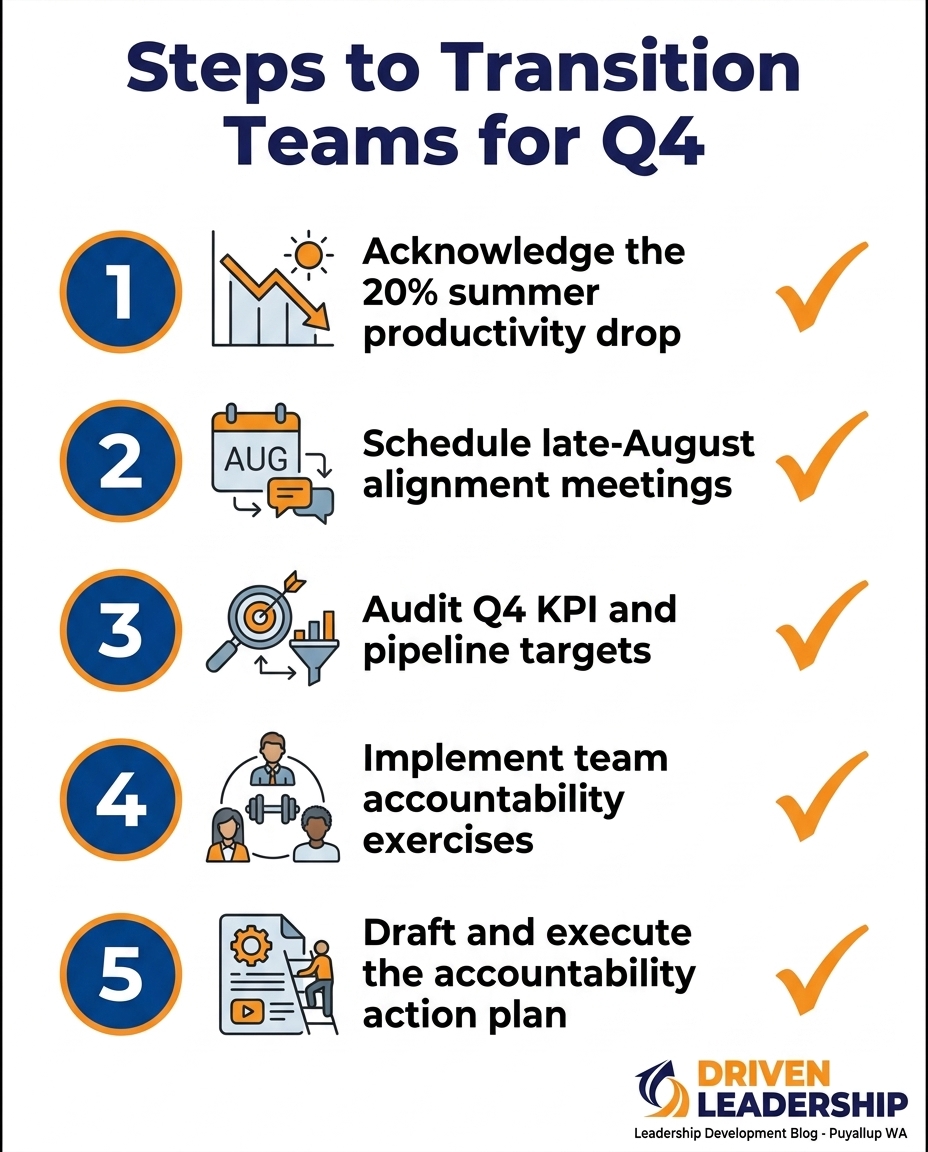
At Driven Leadership, we regularly see workplace productivity drop by up to 20% during the summer months due to relaxed schedules and vacations. Navigating the late-summer slump where corporate teams are distracted requires a deliberate strategy, and the back-to-school transition for corporate teams: resetting Q4 goals is the precise framework we recommend to regain momentum. The decision point for executives is clear: how to formally reset team cadence and accountability in late August or early September without destroying the remaining summer morale. Passively waiting for October 1st to enforce urgency is a critical management mistake that leaves teams scrambling to catch up during the most important quarter of the year.
During the late-summer August vacation wind-down, the natural tendency is to let operational rigor slide. Meetings become shorter, pipelines stall, and high-stakes execution takes a back seat to out-of-office auto-replies. However, leaders who recognize this pattern can proactively combat the slump by deploying structured team execution strategies before the final quarter officially begins. Acknowledging the statistical reality of the summer productivity dip is the first step toward correcting it. Position the back-to-school mindset as a deliberate, strategic leadership tool rather than just a calendar event. By addressing the slump directly, management can set a new standard of urgency without relying on aggressive, top-down mandates that typically breed resentment.
The core challenges of the late-summer transition include:
• Loss of operational rhythm: Weekly check-ins often lose their structure during the summer, leading to misaligned priorities.
• Stalled project momentum: Key initiatives are frequently pushed to the fall, creating an overwhelming backlog for Q4.
• Decreased peer accountability: With team members rotating through vacations, the standard for daily deliverables naturally lowers.
• Misaligned quarterly targets: Annual goals set in January often feel disconnected from reality by the time late August arrives.
Addressing these challenges requires more than a single company-wide email. It demands a formal pivot in daily operations, ensuring that every team member understands the shift from a relaxed summer cadence to a high-accountability execution phase.
Harnessing the 'Fresh Start Effect' for High-Stakes Execution
Behavioral science offers a powerful tool for leaders looking to reset their teams: the "fresh start effect." This psychological phenomenon occurs when people use temporal landmarks—like the end of summer or a new month—to shed old habits and commit to new goals. Drawing parallels between the academic back-to-school reset and corporate operating rhythms allows leaders to leverage this natural psychological shift. Working closely with organizations here in Puyallup, WA, we notice that the transition from the Pacific Northwest's dry, warm August into the wetter, cooler September provides a strong environmental cue that signals a return to rigorous routines and focused indoor work. This visceral shift makes it easier for teams to accept a sudden increase in accountability.
Bridging the gap between summer morale and Q4 urgency requires structured intention. Organizations that successfully navigate this period do not simply demand more output; they reframe the upcoming quarter as a fresh opportunity to excel. This is why investing in an Executive Manager Program can equip leaders with the behavioral insights needed to guide their teams through this critical juncture. A mismanaged transition, on the other hand, risks burning out employees who are abruptly forced from low gear into overdrive, ultimately leading to missed early-quarter targets.
To effectively harness the fresh start effect, leaders must understand the shift in operating mindsets:
• Goal Tracking — Late-Summer Mindset: Flexible deadlines and delayed reviews — Q4 Execution Mindset: Rigorous, data-driven weekly accountability
• Communication — Late-Summer Mindset: Asynchronous, relaxed updates — Q4 Execution Mindset: Proactive, obstacle-clearing daily huddles
• Project Scope — Late-Summer Mindset: Broad exploration and planning — Q4 Execution Mindset: Ruthless prioritization of high-yield tasks
• Team Cadence — Late-Summer Mindset: Accommodating absences and coverage — Q4 Execution Mindset: Full-team alignment on critical deliverables
By explicitly defining the difference between these two mindsets, executives provide their teams with a clear roadmap for the transition. The late-summer August vacation wind-down is not something to fight against, but rather a baseline from which to launch a highly structured, reinvigorated operational cadence.
Auditing and Re-Anchoring Q4 Performance Metrics Early
Waiting until the first week of October to review Q4 KPI and pipeline targets guarantees a sluggish start to the quarter. High-performing organizations schedule alignment meetings in late August or early September to review existing data and identify gaps between current performance and end-of-year expectations. This early audit allows leaders to translate high-level strategic priorities into daily and weekly actionable metrics well before the pressure peaks.
The process of auditing and re-anchoring these metrics should follow a structured, seasonal timeline to ensure no operational blind spots remain. In our experience, this process is often best facilitated through onsite leadership workshops, which provide the dedicated focus required to pull managers out of their day-to-day tasks and into strategic alignment.
1. Step 1: Aggregate Year-to-Date Data: Before setting new targets, compile all relevant performance data from the first three quarters. Identify which teams are pacing ahead of schedule and which are lagging due to the summer slowdown.
2. Step 2: Identify the Performance Gap: Clearly define the delta between where the organization currently stands and the final annual goals. This gap becomes the singular focus for Q4 execution.
3. Step 3: Translate Strategy to Daily Actions: Break down the quarterly gap into monthly, weekly, and daily metrics. Every team member must understand their specific role in closing the gap, shifting the focus from vague outcomes to controllable inputs.
4. Step 4: Secure Team Buy-In: Present the audited metrics to the broader team, framing the new targets as an exciting, achievable challenge rather than a punitive mandate.
The Pre-Q4 Pipeline Review
A critical component of this early audit is the pre-Q4 pipeline review. Leaders must evaluate sales and operational pipelines objectively, removing stalled summer projects to focus exclusively on high-yield Q4 deliverables. Often, teams carry "zombie projects"—initiatives that sound good in theory but consume valuable bandwidth without driving measurable results. By formally killing these stalled projects in early September, management frees up the necessary capacity to hit aggressive Q4 KPI and pipeline targets. This ruthless prioritization ensures that when the quarter begins, the team is executing against a clean, highly focused operational slate.
Implementing Team Accountability Exercises Without Micromanaging
A common pitfall during the late-summer transition is confusing high accountability with toxic micromanagement. Micromanagement dictates exactly how a task must be done, stripping employees of autonomy. High accountability, conversely, sets crystal-clear expectations for outcomes and establishes transparent tracking mechanisms, leaving the execution strategy to the professional. Our team's focus here at Driven Leadership on structured team execution and high-accountability frameworks actively breaks the summer slump rather than passively waiting for urgency to hit.
To rebuild operational cadence and trust, organizations must introduce specific accountability exercises designed for the late-summer transition. These exercises shift the burden of enforcement from top-down management to peer-to-peer accountability, creating a more resilient and self-correcting team culture. Utilizing bold training exercises for trust and cooperation can significantly accelerate this cultural shift.
1. Implement the "Say-Do" Ratio Check-In: Have team members openly track their commitments versus their actual deliverables for a two-week period. This transparent exercise quickly highlights where the late-summer August vacation wind-down is still impacting follow-through.
2. Establish Peer Accountability Partnerships: Pair team members across different departments to review each other's weekly priorities. This breaks down silos and ensures that cross-functional dependencies are managed without constant executive intervention.
3. Conduct Active Listening Drills: Miscommunication spikes when teams transition from relaxed to urgent mindsets. Structured exercises focused on repeating back priorities and confirming understanding can eliminate costly rework.
4. Run the "Obstacle Anticipation" Exercise: Before launching a Q4 initiative, require the team to list every potential roadblock and assign a specific owner to mitigate each one before it occurs.
In one instance during a spring quarter, a professional recognized a distinct need to increase confidence, take charge, and improve communication within their department. Management and associates had noticed a lack of proactive engagement. By attending an immersive BOLD advanced leadership training program and focusing on active listening skills, the individual gained greater confidence. They became significantly more proactive, and the resulting improvement in meeting communication and client interaction was evident across the organization. This type of structured development is exactly what we implement for teams needing to snap back into high-performance mode.
Drafting Accountability Action Plans for the Fall
Transitioning a team's mindset is only half the battle; the other half requires formalizing that transition into written, trackable accountability action plans. An effective action plan defines clear roles, strict deadlines, and specific check-in cadences. It serves as the operational contract for the quarter, ensuring that the urgency generated in September translates into sustained execution throughout October, November, and December.
Equipping managers with the tools to build a strong foundation of leadership and communication is paramount during this phase. Enrolling in our Engage Elevate Program can provide the structural frameworks necessary to draft these plans effectively. A robust accountability action plan must directly map to the previously audited Q4 KPI and pipeline targets, leaving no ambiguity regarding who is responsible for which outcome.
During another crucial transition period, a professional realized the need to take ownership of their life both personally and professionally. Experiencing the passion and enthusiasm from instructors while attending BOLD and Leadership for Managers courses, they were challenged to become the best version of themselves. This level of personal ownership is exactly what a well-drafted accountability action plan seeks to instill in every team member: a deep, personal commitment to the collective quarterly goals.
Structuring the Weekly Check-In
The cornerstone of the accountability action plan is the weekly check-in meeting. Leaders must shift away from the relaxed, conversational check-ins of summer to data-driven, obstacle-clearing meetings. These sessions should be kept brief, strictly focused on execution, and designed to catch misalignments early in September.
The ideal Q4 weekly check-in format includes:
• Metric Review (5 minutes): A rapid-fire update on pacing against the Q4 KPI and pipeline targets.
• Commitment Audit (5 minutes): Reviewing what was promised last week versus what was actually delivered.
• Roadblock Identification (10 minutes): Highlighting any operational bottlenecks that threaten the upcoming week's deliverables.
• Resource Allocation (5 minutes): Adjusting team bandwidth to clear identified roadblocks immediately.
Overcoming Common Transition Roadblocks
Shifting an organization from low gear to high gear inevitably creates friction. Anticipating resistance to sudden schedule strictness and increased expectations is a fundamental part of the late-summer transition. Employees who have grown accustomed to the late-summer August vacation wind-down may view the sudden re-anchoring of goals as an unreasonable acceleration. To combat this, leaders must maintain open lines of communication so employees feel supported during the pivot.
Addressing burnout fears is critical. Leaders must clarify that the Q4 push is about ruthless prioritization, not simply increasing workload. By eliminating low-value tasks and focusing solely on high-impact initiatives, management can demand higher accountability without demanding longer hours. Acknowledge and overcome previously debilitating professional roadblocks through focused development, ensuring the team has the necessary skills to execute the new plan.
We frequently see this dynamic in our own training sessions—consider a past situation where a leader during a transition sought personal growth and the skills to become a better manager. By participating in a highly challenging, non-cliché corporate training experience, the memorable and life-changing event helped them emerge as a stronger person and a more capable risk-taker. When leaders themselves demonstrate a willingness to embrace discomfort and grow, teams are far more likely to mirror that resilience when facing the demanding transition into Q4.
Frequently Asked Questions About Q4 Corporate Preparation
How do you motivate employees after summer vacation?
Motivating employees after a summer break requires leveraging the "fresh start effect" to set new, exciting challenges rather than just returning to the old routine. Leaders should frame the upcoming quarter as a clean slate, emphasizing new opportunities for professional wins. By introducing structured, peer-driven accountability exercises, teams can rebuild momentum naturally without feeling micromanaged.
How do you prepare a team for Q4?
Preparing a team for Q4 begins with conducting a comprehensive review of existing metrics in late August. Leaders must audit Q4 KPI and pipeline targets early, identifying the exact gap between current performance and year-end goals. Following this audit, management should build and distribute a written accountability action plan that establishes a rigorous new daily operating rhythm.
What is a Q4 strategy?
A Q4 strategy is a highly focused execution plan designed to close the gap on annual targets before the year ends. It differs from general annual planning by ruthlessly prioritizing only the highest-yield projects and eliminating stalled initiatives. The strategy relies heavily on data-driven weekly check-ins and strict adherence to predetermined accountability frameworks.
How do you reset team goals?
Resetting team goals involves holding formal alignment meetings to evaluate past performance objectively and clearly define expectations for the upcoming quarter. It is essential to translate high-level strategic priorities into daily and weekly actionable inputs for every team member. Transparent communication during this reset ensures everyone understands their specific role in achieving the new targets.
What are effective team accountability exercises?
Effective team accountability exercises focus on peer-to-peer check-ins, transparent metric tracking, and structured leadership workshops. Exercises like the "say-do" ratio audit or obstacle anticipation drills force teams to communicate proactively. These frameworks build trust and cooperation by ensuring all team members are holding their weight as the urgency of the quarter increases.
Secure Your Q4 Success Before Summer Ends
A successful fourth quarter is rarely the result of a sudden burst of energy in October; it is determined by the strategic actions taken in late August and September. By recognizing the late-summer productivity dip and implementing a clear, actionable framework for shifting the team's mindset, leaders can reset daily operating rhythms effectively. Secure your team's momentum now by seeking structured executive training from Driven Leadership to manage this transition, ensuring you return to high-accountability mode without micromanaging.