Assessing the ROI of an Emerging Leaders Program Before the New Year

Navigating Q4 Resource Allocation: The True Cost of Leadership Gaps
Here at Driven Leadership, we consistently remind organizations that assessing the ROI of an emerging leaders program before the new year is one of the most critical operational decisions you face as the fourth quarter approaches. The end of the year brings a familiar squeeze, and as you finalize your early fall budget planning, you are likely weighing exactly where to allocate your remaining resources. Evaluating whether to invest proactively in mid-level manager training now versus deferring that development into the next fiscal year is a concrete decision point we see impacting entire organizations across Puyallup, WA, and the broader Pacific Northwest. It is tempting to push leadership development down the road to save current capital, but our team has witnessed firsthand how doing so forces you to face the hidden operational costs of executive turnover in Q1. If you want to protect your organizational health, you have to look beyond the immediate training schedule and examine the long-term compounding impact on your team.
To build a stronger foundation today and prevent future leadership gaps, explore our leadership trainings.
Strategic Resource Allocation: The critical window for early fall budget planning is not just about balancing the books; it is about securing your operational capacity for the upcoming year. When you allocate resources toward an emerging leaders program in Q4, you are making a deliberate choice to stabilize your workforce during a high-stress period. We always recommend choosing predictable, controlled investments over unpredictable crisis management.
Hidden Operational Costs: Framing the ROI discussion requires you to move past theoretical exercises. You must look at the direct comparison between upfront proactive training and the massive, compounding costs of future turnover. In our experience, when an organization lacks trained mid-level managers, the operational friction increases daily. Projects stall, communication breaks down, and the burden shifts upward. By addressing these leadership gaps now, you establish a neutral, expert framework that prioritizes organizational health and strong retention ratios over the chaotic scramble of replacing burnt-out executives.
The Compounding Operational Impact of Q1 Turnover
Delaying leadership interventions past the new year exposes your organization to specific, predictable risks. The Q1 post-holiday turnover surge is a well-documented phenomenon that our team sees repeatedly. After the stress of year-end closes and the reflection time of the holidays, professionals historically reassess their career trajectories. If they return to an environment led by unsupported, untrained managers, their decision to leave becomes much easier.
As we see every year in the Pacific Northwest as it transitions into the darker, colder fall and winter months, team morale and engagement naturally dip. This seasonal shift makes Q4 leadership interventions critical. Our experts emphasize that you must proactively support your team before the winter slump turns into a first-quarter exodus.
When mid-level managers are not equipped to lead, the operational impact compounds rapidly. Here is how our team typically sees that breakdown unfold:
1. Post-Holiday Reassessment: Employees return in January looking for growth, support, and clear direction. If their immediate supervisors lack the skills to engage them, these employees become prime candidates for the Q1 post-holiday turnover surge.
2. Mid-Level Management Strain: Unsupported managers directly contribute to this surge. Without proper training, they fail to communicate effectively, struggle to manage conflict, and ultimately fail to retain their direct reports. They become a bottleneck rather than a bridge.
3. Compounding Operational Costs: The true cost of this turnover is staggering. You face lost productivity as teams operate short-handed. You spend countless hours on recruitment, interviewing, and onboarding. Ultimately, replacing a staff member requires a massive percentage of their annual compensation—resources that could have been invested in proactive training.
4. Systemic Pipeline Failures: The risk of deferring training isn't just a lack of immediate skills on the floor; it is a systemic failure in your organizational pipeline. When the middle layer collapses, the entire structure of your business is compromised.
Passive Corporate Theory vs. Immersive Behavioral Change
To establish what actually drives a return on investment, you have to compare traditional, ineffective training methods against programs that demand real-world transformation. Standard "check-the-box" corporate theory training rarely produces lasting results. Sitting in a conference room clicking through slides does not equip a manager to handle a complex interpersonal conflict or navigate a high-stakes project deadline.
Passive theory fails to equip leaders with the resilience needed to manage Q4 stress and Q1 transitions. Tangible ROI is only achieved when leaders step out of their comfort zones and transform their daily operational habits. This is where an immersive approach becomes essential. By focusing on immersive, real-world behavioral changes, Driven Leadership directly mitigates uncertainty about personal potential and builds stronger, more decisive leaders.
For example, one professional who attended our summer immersive session was seeking personal and professional development to tackle new challenges in their career. By stepping entirely out of their comfort zone with our facilitators, they gained the courage and confidence to pursue previously dreamed-about goals, transforming their daily operational habits and proving the immediate value of active participation.
• Passive Corporate Theory — Methodology: Lectures, slide decks, and theoretical models — Operational Outcome: Low retention, minimal change in daily habits — ROI Indicator: High risk of continued Q1 turnover
• Immersive Behavioral Change — Methodology: Real-world scenarios, active problem solving — Operational Outcome: Increased resilience, decisive action — ROI Indicator: Stabilized teams, strong retention ratios
Transforming your team requires more than just a manual; it requires a fundamental shift in how they approach leadership. This is why investing in BOLD training provides a clear path to tangible ROI, contrasting sharply against passive corporate theory.
Connecting Mid-Level Competence to Executive Retention
When assessing the ROI of an emerging leaders program, organizations often miss the direct correlation between mid-level manager training and upper-level executive retention. There is a powerful trickle-up effect in every business. We consistently warn our clients that when mid-level managers lack confidence, initiative, or the ability to resolve conflicts independently, those issues do not just disappear—they escalate.
The Trickle-Up Effect: Executives are ultimately forced to step in and micromanage daily operations that should be handled by their direct reports. This constant firefighting leads directly to executive burnout. You are paying high-level salaries for leaders to focus on strategy and organizational growth, but instead, they are consumed by lower-level operational friction.
During a recent spring leadership cohort led by our team, an emerging leader realized they needed to improve their confidence and enhance their communication skills. After completing our immersive training program, both upper management and frontline associates noticed a distinct change. The manager became significantly more proactive, taking charge of daily operations and demonstrating vastly improved listening skills. This shift immediately relieved the pressure on the executive team above them.
Unified Leadership Language: Empowering emerging leaders frees up your executives. It creates a unified leadership language from the middle up, ensuring that everyone is operating from the same playbook. When a mid-level manager can confidently handle a crisis, the executive team can remain focused on the horizon.
Strategic Retention: Therefore, mid-level leadership courses are not just a perk or a reward for a promising manager. They are a critical retention strategy for your executive team. By building an executive manager program that strengthens the middle, you protect the top.
Side-by-Side ROI Comparison: Proactive Fall Investment vs. Reactive Replacement
When we deliver a core comparison framework to our Puyallup-area clients, we require weighing the proactive training investment against the reactive costs of turnover. The predictable, controlled allocation of your early fall budget planning stands in stark contrast to the unpredictable, compounding operational costs of a Q1 crisis.
When you evaluate "Time to Value," fall training yields immediate Q4 engagement improvements. Your team feels supported during the busiest time of the year. Conversely, Q1 recruitment results in months of lost productivity while you search for, hire, and train replacements. Analyzing "Cultural Impact" reveals that proactive investment signals a deep commitment to employee growth, whereas reactive hiring signals instability and chaos to your remaining staff.
• Budget Control — Proactive Fall Investment: Predictable, controlled early fall budget planning — Reactive Q1 Replacement: Unpredictable, compounding operational costs
• Time to Value — Proactive Fall Investment: Immediate Q4 engagement and morale improvements — Reactive Q1 Replacement: Months of lost productivity during recruitment
• Cultural Impact — Proactive Fall Investment: Signals commitment to growth and stability — Reactive Q1 Replacement: Signals organizational instability and high stress
• Risk Mitigation — Proactive Fall Investment: Secures existing talent pipeline before the new year — Reactive Q1 Replacement: Guarantees exposure to post-holiday turnover surge
The Proactive Fall Leadership Investment
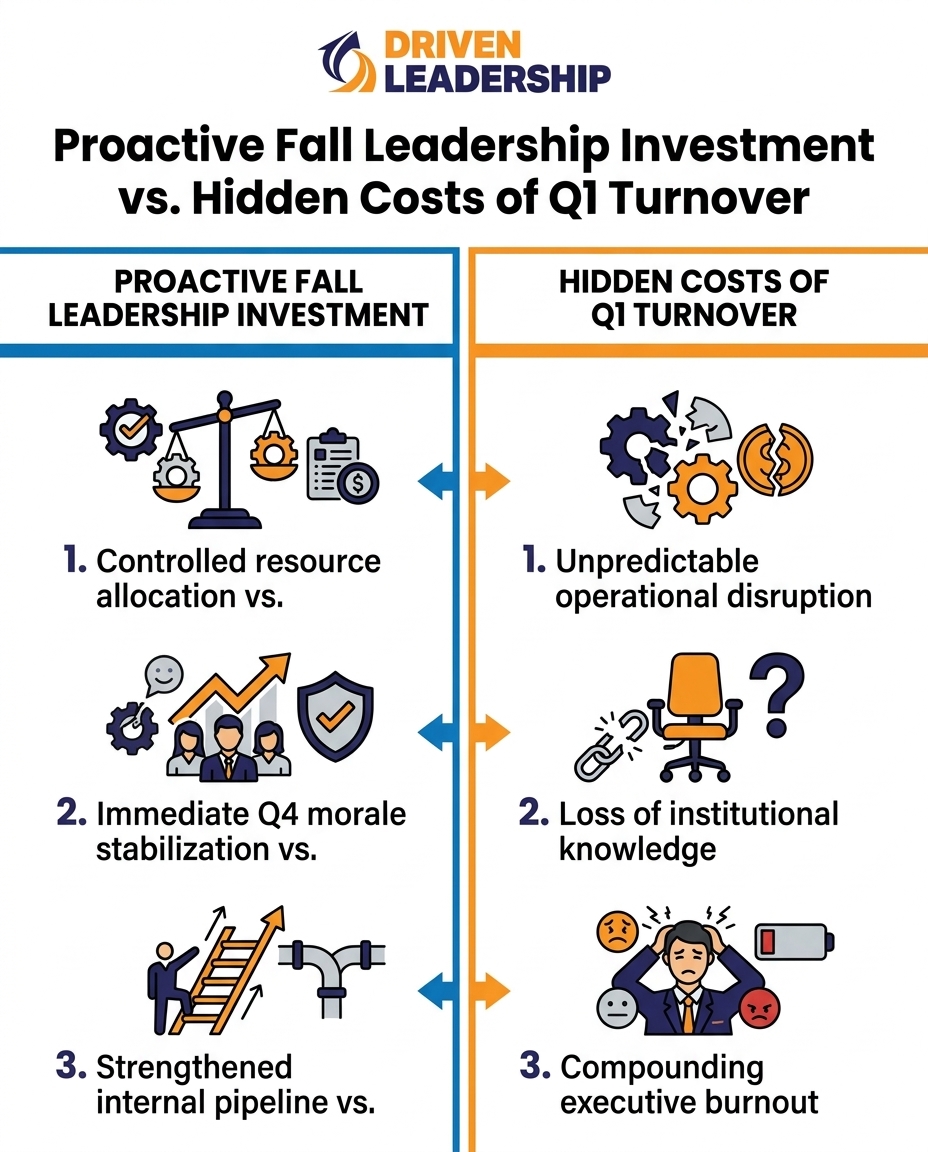
Choosing to invest in your leaders during the fall provides several distinct operational advantages. First, it allows for controlled resource allocation. You know exactly what you are investing and when the training will occur. Second, it delivers immediate morale stabilization during Q4. As the workload increases, your managers have new tools to handle the stress. Finally, it results in a strengthened pipeline for the new year, ensuring you hit the ground running in January.
The Hidden Costs of Q1 Turnover
Deferring this investment guarantees you will face the hidden costs of Q1 turnover. This path leads to unpredictable operational disruption as key players exit the organization. You suffer a severe loss of institutional knowledge that takes years to rebuild. Most critically, it leads to compounding executive burnout, as your senior leaders are forced to cover the gaps left by a collapsing middle management tier.
Establishing Metrics for Your Leadership Development Program
To truly understand the value of your investment, our team advises defining clear, non-financial metrics for success. Relying solely on immediate revenue bumps ignores the deeper structural benefits of leadership training. Instead, track metrics that reflect organizational health and operational efficiency.
Using evaluation frameworks, such as the Kirkpatrick model, allows you to track behavioral changes post-training. You are not just measuring whether participants enjoyed the course; you are measuring whether they apply the new skills on the floor. It is crucial to set baseline engagement scores in Q4 so you have a clear comparison to measure against Q1 outcomes.
When assessing the ROI of an emerging leaders program, look for these specific indicators of success:
• Improved employee retention rates: A direct reduction in the Q1 post-holiday turnover surge among teams led by newly trained managers.
• Higher internal promotion ratios: Identifying and elevating talent from within rather than relying on external recruitment.
• Faster project execution: Teams operate with less friction and require less executive intervention to meet deadlines.
• Decisive conflict resolution: Managers handle interpersonal issues at their level before they escalate to HR or senior leadership.
• Observable behavioral shifts: Leaders exhibiting the core traits of a great leader, such as active listening, accountability, and resilience under pressure.
Frequently Asked Questions About Leadership Training ROI
How do you measure the ROI of a leadership development program?
We measure the ROI of a leadership development program by tracking non-financial operational metrics like employee retention rates, internal promotion ratios, and project execution speed. Instead of looking for immediate dollar-for-dollar returns, evaluate how behavioral changes in your managers reduce the costly friction of turnover and executive burnout. Frameworks like the Kirkpatrick model help quantify these behavioral shifts over time.
What is the operational ROI of leadership training?
In our experience, the operational ROI of leadership training is the stabilization of your workforce and the reclaiming of executive time. When mid-level managers are trained to handle conflicts and guide their teams independently, executives are freed from micromanaging daily tasks. This leads to smoother operations, fewer stalled projects, and a stronger, more resilient organizational pipeline.
Why do emerging leaders programs fail to produce results?
We find that emerging leaders programs fail when they rely entirely on passive corporate theory rather than immersive behavioral change. If a program only offers slide decks and check-the-box lectures, participants rarely alter their daily habits under stress. Real results require training that forces leaders out of their comfort zones to practice decisive action in real-world scenarios.
How does leadership training reduce employee turnover?
Leadership training reduces employee turnover by directly improving the daily experience of the frontline staff reporting to those managers. Employees typically leave managers, not companies; when a manager is equipped to communicate clearly, offer support, and foster engagement, their direct reports are far less likely to seek employment elsewhere during high-risk periods.
When is the best time of year to implement management training?
The fourth quarter is the optimal time to implement management training to proactively safeguard your organization. By utilizing early fall budget planning to train leaders before the new year, you stabilize team morale during the stressful holiday push. This timing directly mitigates the well-documented post-holiday turnover surge that hits unprepared companies in Q1.
How do mid-level managers impact executive retention?
Mid-level managers impact executive retention through the trickle-up effect of operational strain. When middle managers lack the competence or confidence to lead, executives are forced to step down and manage daily crises, leading to severe burnout and frustration. Empowering the middle tier protects the executive tier by allowing senior leaders to focus on high-level strategy.
Finalize Your End-of-Year Strategy to Protect Your Team
The true cost of delaying leadership training is the compounding impact of Q1 executive turnover. When you push mid-level development into the next fiscal year, you are not saving resources; you are simply transferring the burden onto your executive team and exposing your organization to the inevitable Q1 post-holiday turnover surge.
At Driven Leadership, we know that what satisfies stakeholders is a clear, logical framework that prioritizes proactive fall investment over the chaotic, reactive costs of replacement. Now is the time to finalize your resource allocation. Challenge yourself to secure the health of your organizational pipeline today. Book immersive training before the new year to prevent fallout and build a resilient team. Secure your foundation by enrolling your emerging managers in our Advanced Leadership Program.