Navigating Sibling Dynamics in Family-Owned Businesses Through Leadership Training

Are Childhood Roles Derailing Your Fall Strategic Planning?
Are the critical decisions for your company constantly delayed by arguments that sound suspiciously like the ones you had around the dinner table twenty years ago? Navigating sibling dynamics in family-owned businesses through leadership training is often the missing link between a stalled organization and a thriving, multi-generational enterprise. At Driven Leadership, we frequently see that when brothers and sisters attempt to run a company together, they bring decades of unspoken hierarchy, emotional baggage, and entrenched communication habits straight into the boardroom. The older sibling may instinctively override others, while the younger sibling might feel perpetually dismissed—dynamics that have nothing to do with business acumen and everything to do with childhood history.
The Urgency of Executive Alignment
As the fall Q4 strategic planning season approaches, the cost of these unresolved conflicts becomes painfully clear. This is the time of year when executive teams must align on budgets, hiring plans, and growth targets for the upcoming year. If your strategic planning sessions repeatedly devolve into personal grievances or passive-aggressive standoffs, your business is losing its competitive edge. You cannot effectively plan for the future if your leadership team is stuck litigating the past.
The decision point for many family enterprises comes down to this: you must step outside the daily grind and utilize an objective, structured environment to reset these entrenched personal dynamics into professional relationships. Specialized training acts as a powerful pattern-interrupt, forcing siblings to communicate not as family members, but as accountable corporate leaders. For organizations ready to break these destructive cycles, investing in BOLD leadership training provides the neutral ground necessary to strip away the family baggage and build a unified executive front.
The Psychological Transition from Family Member to Accountable Executive
The core challenge of navigating sibling dynamics in family-owned businesses lies in the profound psychological shift required to function as co-leaders. In a healthy family, relationships are built on unconditional loyalty and shared history. In a healthy business, relationships must be built on conditional accountability, measurable performance, and objective results. Blending the two without a clear framework is a recipe for organizational chaos.
Standard office meetings completely fail to break these decades-old habits. When siblings sit in the same conference room where they have argued about operations for years, the environment itself acts as a trigger. They easily slip back into familiar, unproductive communication patterns. To successfully transition from family member to accountable executive, siblings must follow a structured path:
1. Acknowledge the Dual Relationship: Recognize that you are managing two entirely separate relationships—the familial bond and the corporate partnership. Each requires different boundaries and rules of engagement.
2. Establish Objective Metrics: Remove emotion from business decisions by tying performance and strategic goals to hard data rather than personal feelings or historical family hierarchy.
3. Engage in Structured Conflict Resolution: Disagreements are inevitable, but they must be handled constructively. Implementing professional conflict management training ensures that disputes remain focused on business outcomes rather than personal attacks.
4. Commit to Continuous Development: Leadership is a muscle that must be trained. Siblings must commit to ongoing executive education to continually refine their roles and responsibilities.
Structured conflict management is a primary factor in the longevity of multi-generational businesses. However, making this transition almost always requires an objective expert voice. A neutral third party can mediate the shift, calling out unproductive family dynamics in real-time and enforcing the professional boundaries necessary for the business to thrive.
Overcoming Stoicism in Pacific Northwest Legacy Businesses
The cultural landscape of your region plays a significant role in how family conflicts are handled—or ignored. Operating out of Puyallup, WA, our team at Driven Leadership works closely with the region's strong foundation of multi-generational legacy businesses operating in trades, heavy manufacturing, and the timber industry. We consistently see that these companies are built on a deep-rooted culture of resilience, hard work, and a "head down, get it done" mentality. While this regional stoicism serves companies incredibly well during economic downturns and industry shifts, it can become a fatal liability behind closed doors.
In many of these legacy businesses, stoicism acts as a mask for festering interpersonal conflicts between siblings. The prevailing attitude is often that emotional issues or communication breakdowns should be ignored in favor of simply working harder. But unresolved tension does not disappear; it goes underground, quietly eroding trust, slowing down decision-making, and creating a toxic shadow culture for non-family employees. When the fall Q4 strategic planning season arrives, this lack of alignment paralyzes the company's ability to adapt and grow.
The cost of silence:
• Stalled growth: Important structural changes are delayed because siblings want to avoid the conflict required to make hard decisions.
• Employee turnover: Top-tier talent leaves when they are forced to navigate the unpredictable waters of family disputes or unclear leadership hierarchies.
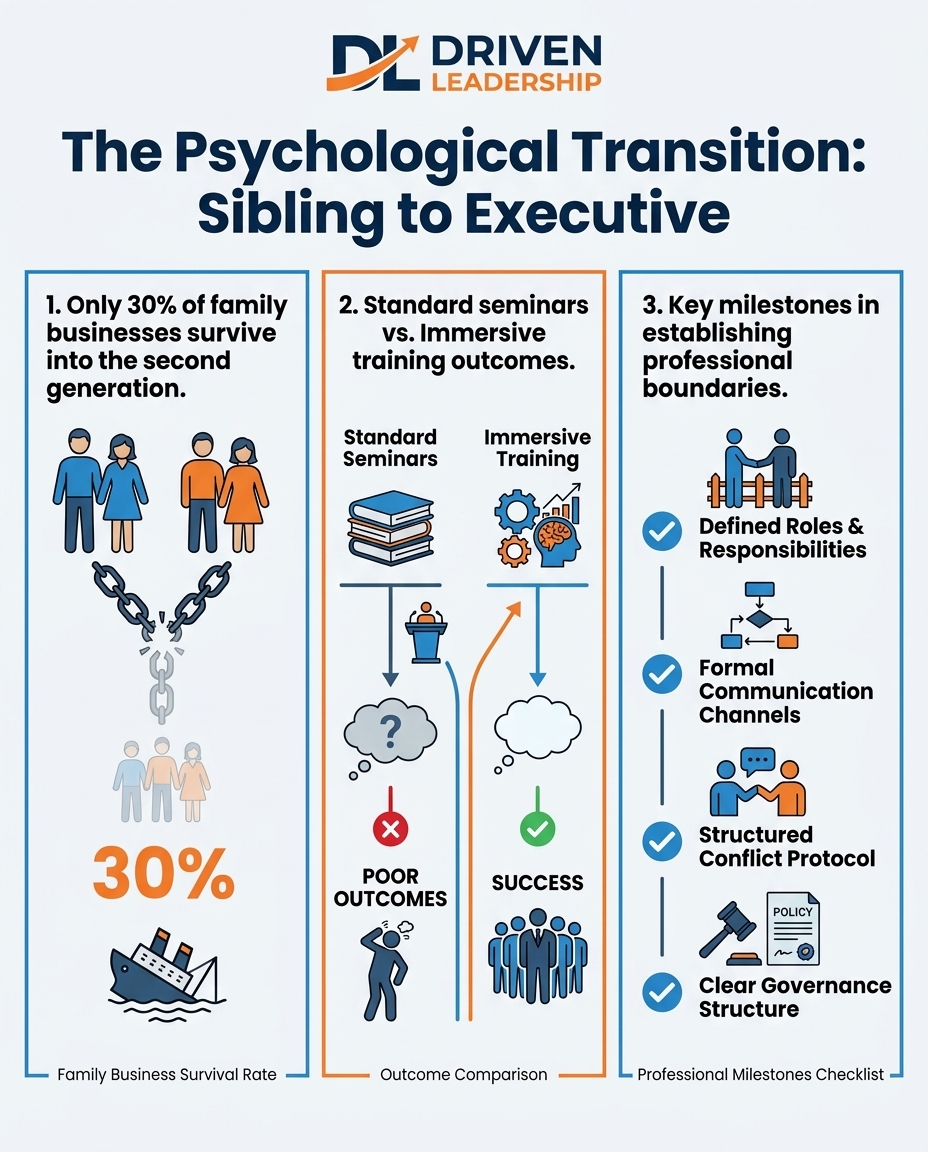
• Generational failure: The statistics are unforgiving—only about 30% of family businesses survive into the second generation, largely due to internal family conflict and a lack of clear executive alignment.
To survive regional economic shifts and outlast the competition, legacy businesses cannot rely on stoicism alone. They require robust, vocal executive alignment strategies that bring sibling conflicts out of the shadows and resolve them in a structured, professional manner.
Why Immersive Environments Succeed Where Standard Seminars Fail
When it comes to navigating sibling dynamics in family-owned businesses, not all training is created equal. Generic advice often relies on "talking it out" in the office or attending a passive afternoon seminar. These methods only scratch the surface. They fail because they do not disrupt the environment or the established power dynamics. To truly strip away decades of emotional baggage, siblings require a neutral, off-site location and an intensive, immersive experience.
Immersive environments force participants to step completely out of their day-to-day operations. Without the safety net of their job titles, their private offices, or their familiar routines, siblings are challenged to interact purely on the merit of their leadership and communication skills. This is where real breakthroughs happen.
• Environment — Standard Office Seminars: Familiar, full of daily distractions and triggers. — Immersive Intensive Training (e.g., BOLD): Neutral, off-site, completely removed from daily operations.
• Engagement Level — Standard Office Seminars: Passive listening, easy to disengage or check emails. — Immersive Intensive Training (e.g., BOLD): Active participation, forces vulnerability and true accountability.
• Focus — Standard Office Seminars: Surface-level theory and generic business strategies. — Immersive Intensive Training (e.g., BOLD): Stripping away personal baggage to build core leadership skills.
• Outcomes — Standard Office Seminars: Short-term motivation that fades within a week. — Immersive Intensive Training (e.g., BOLD): Permanent pattern-interrupts that redefine the executive relationship.
Observations from our intensive environments at Driven Leadership consistently show that stepping out of the comfort zone allows siblings to finally see each other as capable executives rather than childhood rivals. For example, one participant who entered our spring intensive training program alongside her husband and brother arrived feeling uncertain about her personal and business direction. By fully engaging in the challenging environment, she was able to break free from historical family expectations. She emerged as a stronger leader and a more confident risk-taker, successfully redefining how she connected with her family members in a professional context. Programs like the Five Behaviors Workshop provide the exact framework needed to build this new foundation of trust and accountability.
Addressing the Reality of Festering Interpersonal Conflicts
Ignoring the reality of navigating sibling dynamics in family-owned businesses is a dangerous game. When personal issues and unspoken resentments are allowed to fester, they inevitably bleed into business operations. This bleed-over creates a highly toxic environment. Staff morale plummets when employees feel they must take sides or walk on eggshells to avoid triggering a family dispute. Furthermore, external vendors and key clients can often sense the tension, which undermines your company's professional reputation.
The necessity of objective tools: To combat this, family executives must utilize objective tools to separate personal feelings from business facts. This means enforcing strict professional boundaries—what happens at the Sunday dinner table cannot dictate the Monday morning operations meeting. It requires a commitment to active listening, leaving egos at the door, and prioritizing the health of the business partnership over the need to be "right" in a sibling rivalry.
Participating in challenging leadership programs alongside family members is one of the most effective ways to forge stronger, more risk-tolerant leaders. During a summer session our team facilitated in 2020, one couple working within a family enterprise realized they needed to tackle their shared business challenges with more courage and confidence. By fully immersing themselves in our advanced leadership program, they experienced profound shifts not just in their careers, but in their personal lives. They gained the objective tools necessary to confront long-standing roadblocks and tackle their ambitious dreams. If your family enterprise is struggling under the weight of unresolved tension, confronting the reality of a failing business partnership head-on is the only way to protect both the legacy of the business and the integrity of the family relationship.
Frequently Asked Questions About Sibling Dynamics in Business
How do you separate family from business?
To successfully separate family from business, you must establish clear, documented roles and responsibilities for every family member involved. Enforce strict professional boundaries during business hours, meaning family disputes are left at the door and communication remains focused on corporate objectives. Additionally, utilizing neutral, third-party environments for major strategic discussions prevents the home dynamic from bleeding into the boardroom.
What causes conflict between siblings in a family business?
The primary cause of conflict is the bleed-over of historical childhood roles and rivalries into the professional sphere. This is often compounded by a lack of clear executive alignment and an absence of structured accountability. When siblings have fundamentally different work ethics, long-term visions, or communication styles—and no objective framework to manage those differences—conflict is inevitable.
How do you deal with siblings in a family business?
You must treat your siblings with the exact same professional accountability and respect as you would a non-family executive. This means engaging in structured conflict management training to ensure disagreements are handled constructively. Commit to active listening, objective problem-solving, and utilizing data rather than emotion to drive your business decisions.
Why do family businesses often fail in the second generation?
Family businesses frequently fail in the second generation due to an inability to transition from a single founder-led model to a collaborative executive team. Internal family conflict often derails strategic planning, causing the business to lose its competitive edge. Ultimately, the failure stems from an inability to separate emotional family baggage from objective corporate decision-making.
How does leadership training help siblings in family businesses?
Leadership training in family-owned businesses provides a neutral, structured environment where siblings can safely address and resolve deep-seated conflicts. It acts as a pattern-interrupt, forcing siblings to break historical personal habits and communicate effectively. Ultimately, it establishes the professional, accountable executive relationships that are absolutely necessary for long-term organizational growth.
Establish Executive Alignment Before the Next Quarter
Separating family baggage from corporate responsibilities is not something that happens organically; it requires structured boundaries, intentional effort, and often, professional intervention. As the fall Q4 strategic planning season approaches, the window to align your leadership team and set clear, actionable goals for the coming year is closing rapidly. You cannot afford to let another quarter slip by paralyzed by the same old arguments. Navigating sibling dynamics in family-owned businesses through leadership training provides the exact framework you need to reset your relationships and secure your company's future. Take the proactive step today—reach out to our team at Driven Leadership to discuss how specialized, immersive training options can transform your family's dynamic from a business liability into your greatest executive asset.