Addressing the 'Run to the Roar' Fear When Reorganizing Departments

The Paralysis of Necessary Change: Confronting Restructure Hesitation
Your current operational structure is failing to support your goals, and addressing the 'run to the roar' fear when reorganizing departments is the only way to break the cycle of dysfunction. At Driven Leadership, we frequently sit down with executive teams in Puyallup and the surrounding areas who are staring at the upcoming year's targets as a heavy burden sets in. You know exactly what needs to happen. The current departmental boundaries are creating silos, communication is breaking down, and the hierarchy simply cannot sustain the growth you are projecting. Yet, you hesitate. The thought of announcing a major structural shift brings an immediate wave of anxiety about the short-term fallout.
In our years of organizational consulting, we have found that this hesitation is incredibly common, especially during Q4 year-end planning and restructuring cycles. You are acutely aware that changes must be made for the upcoming year, but you find yourself procrastinating due to the anticipated chaos. It feels easier to maintain the status quo than to intentionally disrupt your team's daily workflow. However, you are facing a critical decision point: you must choose between enduring the slow, quiet decay of a misaligned department or initiating a loud, disruptive, but absolutely necessary reorganization.
To move forward, you have to recognize that avoiding the restructure does not actually prevent chaos. It merely stretches the dysfunction over a longer timeline, bleeding your team's energy day by day. If you are ready to stop procrastinating on vital structural shifts, understanding the fundamentals of organizational development is your first step forward.
Why Leaders Procrastinate on Structural Changes
The problem: Every leader wants a high-performing team, but the path to get there often requires tearing down existing structures. During Q4 year-end planning and restructuring, performance reviews and operational audits frequently trigger the realization that deep structural flaws can no longer be ignored. Despite this clear evidence, we routinely see executives stall the reorganization process. They kick the proverbial can down the road, hoping that minor tweaks will solve foundational issues.
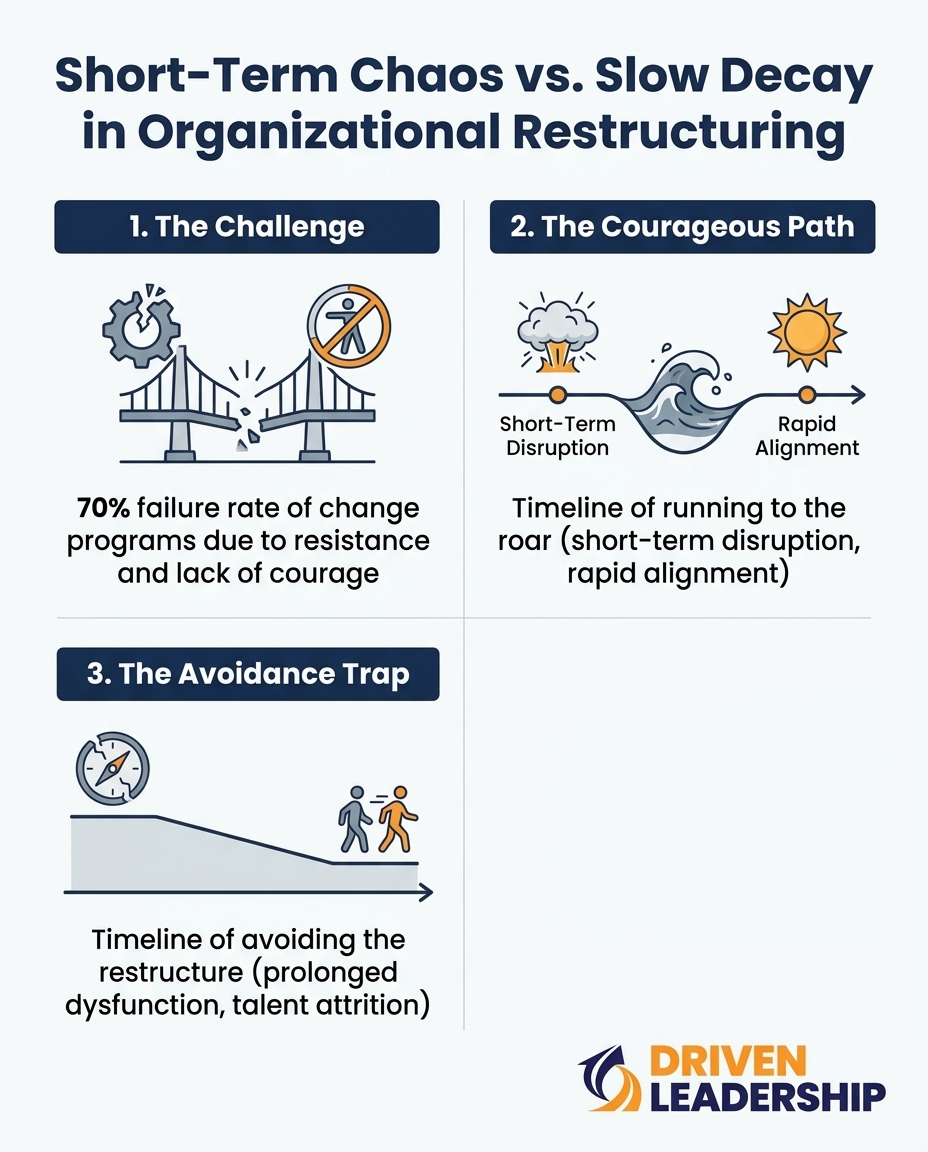
The cause: The root of this procrastination is a deep-seated fear of an immediate drop in productivity and morale. Leaders worry that top performers will quit, that daily operations will grind to a halt, and that the internal friction will be too much to manage. This fear is not entirely unfounded. According to data from McKinsey & Company, approximately 70% of change programs fail to achieve their goals. This staggering failure rate is largely driven by employee resistance and a distinct lack of management courage to push through the hardest phases of the transition.
The Illusion of Preserving Morale
Many leaders convince themselves that delaying a restructure protects their team's morale. In reality, working within a broken system is far more demoralizing than going through a period of structural change. When you avoid necessary reorganization, you compound the operational drag. High performers become frustrated by inefficiencies, bottlenecks, and lack of clarity.
The solution: Overcoming this procrastination requires a fundamental shift in perspective. You must accept that a temporary dip in morale and productivity is the price of admission for long-term operational health. By addressing these structural flaws head-on during your Q4 year-end planning and restructuring sessions, you stop the slow bleed of talent and set a definitive course for recovery and growth.
Defining the 'Run to the Roar' Leadership Metaphor
To understand how to lead through this specific type of fear, we have to look at a powerful lesson from nature. In the wild, a pride of lions uses a highly coordinated hunting strategy that relies entirely on fear and misdirection. The older, weaker male lions—who have lost their speed and their teeth, but still possess a terrifyingly loud roar—are positioned on one side of the prey. On the opposite side, hidden silently in the tall grass, wait the fast, lethal lionesses.
When the trap is set, the male lion roars. The prey, terrified by the deafening noise, turns and runs directly away from the sound. By fleeing the noise, they run straight into the silent, deadly ambush of the lionesses. In this scenario, running toward the terrifying roar is actually the only path to safety.
"In leadership, the things that sound the most dangerous are often just noise. The real danger lies in the silent dysfunction you are running toward by avoiding the noise."
We can translate this directly to organizational leadership, especially when tackling Q4 year-end planning and restructuring:
• The Roar: This is the immediate discomfort, the employee pushback, the complaints, and the short-term chaos of announcing a restructure. It is loud, it is intimidating, but it will not destroy your company.
• The Lioness: This is the silent danger of doing nothing. It is the slow attrition of your best talent, the gradual loss of market share, and the quiet failure of a misaligned team.
• Running to the Roar: This means courageous leaders must actively seek out the discomfort of the reorganization rather than retreating into the trap of prolonged dysfunction.
When you recognize that the pushback is just noise, you can confidently lead your team through the necessary changes without falling into the trap of avoidance.
Navigating the Fog: Short-Term Chaos vs. Slow Organizational Decay
Deconstructing the illusion that avoiding change preserves team stability is critical. When you leave a failing structure in place, you are not maintaining stability; you are accelerating top-talent attrition. Your best employees will not wait around for you to find the courage to fix a broken system. To understand the difference between action and inaction, we have to contrast the immediate discomfort of restructuring with the long-term damage of doing nothing.
We often tell our clients to think of leading a restructure like driving through the unpredictable, overcast fall seasons we experience here in the Pacific Northwest. When a dense, heavy fog rolls onto the highway, visibility drops to zero, and the natural instinct is to slam on the brakes. But stopping in the middle of the highway is the most dangerous thing you can do. You have to maintain a steady, deliberate pace, navigating through the fog and discomfort, trusting that clear skies are on the other side. A transitional restructure is that necessary, temporary fog. It obscures immediate clarity, but it is the only way to reach a better destination.
As you approach Q4 year-end planning and restructuring, consider the timelines of your two options. Unresolved internal friction often requires different approaches to resolve once the restructure begins, which is why understanding different conflict management styles becomes essential during the transition.
• Timeline of Pain — Running to the Roar (Short-Term Chaos): Intense but brief (typically weeks to a few months). — Avoiding the Restructure (Slow Decay): Indefinite and prolonged (years of compounding issues).
• Impact on Top Talent — Running to the Roar (Short-Term Chaos): Temporary frustration during transition, followed by high engagement. — Avoiding the Restructure (Slow Decay): Deep burnout, leading to the eventual resignation of high performers.
• Operational Clarity — Running to the Roar (Short-Term Chaos): Brief confusion as new roles are learned, then sharp alignment. — Avoiding the Restructure (Slow Decay): Constant ambiguity, overlapping duties, and dropped responsibilities.
• Leadership Perception — Running to the Roar (Short-Term Chaos): Viewed as decisive and courageous, even if initially unpopular. — Avoiding the Restructure (Slow Decay): Viewed as passive, hesitant, and out of touch with daily realities.
The timeline of short-term, managed chaos is a calculated investment. You are trading a few weeks of loud complaints for years of streamlined, highly effective operational structure.
Injecting a BOLD Approach into Your Reorganization Strategy
Traditional change management often focuses entirely on over-mitigating or "smoothing over" the chaos. Consultants will advise you to roll out changes so slowly that no one gets upset, prioritizing comfort over effectiveness. This hesitant approach is exactly why we see so many Q4 year-end planning and restructuring initiatives fail before we are brought in to help. You cannot quietly tiptoe your way into a high-performance culture.
Instead, you need an approach that serves as the antidote to restructure procrastination. Embracing the disruption head-on achieves faster, more authentic long-term alignment. By utilizing our BOLD training principles at Driven Leadership, we help you encourage your executive team to face discomfort directly rather than avoiding short-term chaos. Here is how we recommend injecting this courageous approach into your strategy:
1. Acknowledge the difficulty immediately: Do not insult your team's intelligence by pretending the restructure will be entirely seamless. Tell them it will be challenging, tell them there will be a learning curve, and tell them exactly why the struggle is worth it.
2. Model vulnerability from the top down: Leaders must model vulnerability and courage during the announcement phase. If the executive team appears defensive or evasive, the department will mirror that anxiety. Stand firm, answer questions honestly, and admit when you do not have all the micro-answers yet.
3. Set a definitive cut-over date: Avoid the trap of a "phased transition" where old reporting structures overlap with new ones. Pick a date, flip the switch, and deal with the fallout in real-time.
4. Equip your managers for the pushback: Your middle managers will take the brunt of the "roar." Prepare them for the emotional reactions of their teams. Facing this fear equips the executive team with the resilience needed for future organizational challenges.
The takeaway: When you stop trying to make everyone comfortable, you free up your energy to make the organization successful. A bold, direct approach cuts through the anxiety and gets everyone focused on the new reality faster.
Executing the Restructure: Shifting from Paralysis to High Performance
The problem: Even after leaders find the courage to announce a reorganization, they often stumble during the execution phase. The initial adrenaline wears off, the reality of the operational fog sets in, and executives revert to hesitant, accommodating behaviors. During Q4 year-end planning and restructuring, this hesitation can cause the new structure to collapse before it even takes root.
The cause: This failure in execution happens because leaders try to compromise on structural decisions to appease unhappy employees. They drag out the changes through phased, hesitant steps, hoping to soften the blow. This only prolongs the chaos and prevents the team from establishing new operational norms.
Communicating Through the Disruption
To execute successfully, you must outline the importance of communicating the "why" behind the reorganization transparently to the entire department. You must maintain open channels for feedback without compromising on the structural decisions you have made. Listening to an employee's frustration is necessary; changing the org chart back to the old way to make them happy is fatal. Keep the leadership narrative fiercely focused on the long-term vision and operational health of the company.
The solution: Advocate for decisive action. Establish new operational norms and reporting structures immediately to minimize the duration of the transitional chaos. If a process breaks under the new structure on day one, fix the process—do not abandon the structure. This decisive action bridges the gap toward advanced operational success. By holding the line, you guide your people through the fog and build genuine team execution capabilities that will serve the company for years to come.
Frequently Asked Questions About Leading Through Organizational Change
What does 'run to the roar' mean in leadership?
Running to the roar is a metaphor for facing your operational fears head-on instead of avoiding them. In leadership, it means actively stepping into the short-term discomfort and pushback of a necessary change, knowing that avoiding it will only lead to greater long-term dysfunction. It requires the courage to prioritize the organization's health over temporary harmony.
How do leaders overcome the fear of reorganizing a department?
Leaders overcome this fear by shifting their focus from the immediate fallout to the long-term consequences of inaction. During Q4 year-end planning and restructuring, acknowledging that the current system is actively damaging the company helps executives realize that temporary chaos is a necessary trade-off. Building a solid communication plan and standing firm in the "why" behind the change also builds executive confidence.
Why do executives often delay necessary departmental restructures?
Executives typically delay restructures because they fear a sudden drop in morale, the loss of key personnel, and a temporary dip in productivity. They fall into the trap of believing that the current, broken system is safer than the unknown variables of a new organizational chart. This procrastination simply kicks the can down the road, making the eventual restructure much harder.
What are the biggest challenges when reorganizing a team?
The most significant challenges include managing employee resistance, navigating the temporary drop in productivity, and maintaining clear communication as new reporting structures take effect. Middle managers often struggle to enforce new boundaries, and rumors can quickly derail the narrative if leadership is not highly visible and transparent throughout the transition.
How can you maintain morale during short-term organizational chaos?
You maintain morale not by pretending everything is perfect, but by being relentlessly transparent about the challenges and the end goal. Acknowledge the difficulty of the transition openly, celebrate small wins as the new structure begins to work, and ensure that employees feel heard even if their structural preferences are not accommodated. Clarity and honesty do more for morale than false reassurances.
Take the Next Step in Your Leadership Evolution
Facing the fear of a restructure is one of the most difficult, yet defining, moments for an executive. When we guide leaders to choose to run to the roar, they minimize the duration of disruption and dramatically accelerate their team's path to high performance. The temporary fog of transition is a small price to pay for a unified, deeply aligned organization.
As you finalize your upcoming operational plans, especially during Q4 year-end planning and restructuring, it is time to stop procrastinating on the necessary structural changes that will dictate your future success. If you are ready to build the courage and clarity required to lead teams through complex transitions, exploring an Advanced Leadership Program will equip you with the actionable mindset shift needed to execute decisively.