
The Ultimate Guide to Conflict Management Styles

Why Understanding the Five Conflict Management Styles Can Transform Your Leadership
If you've ever asked what are the five conflict management styles and when to use each, here's the short answer:
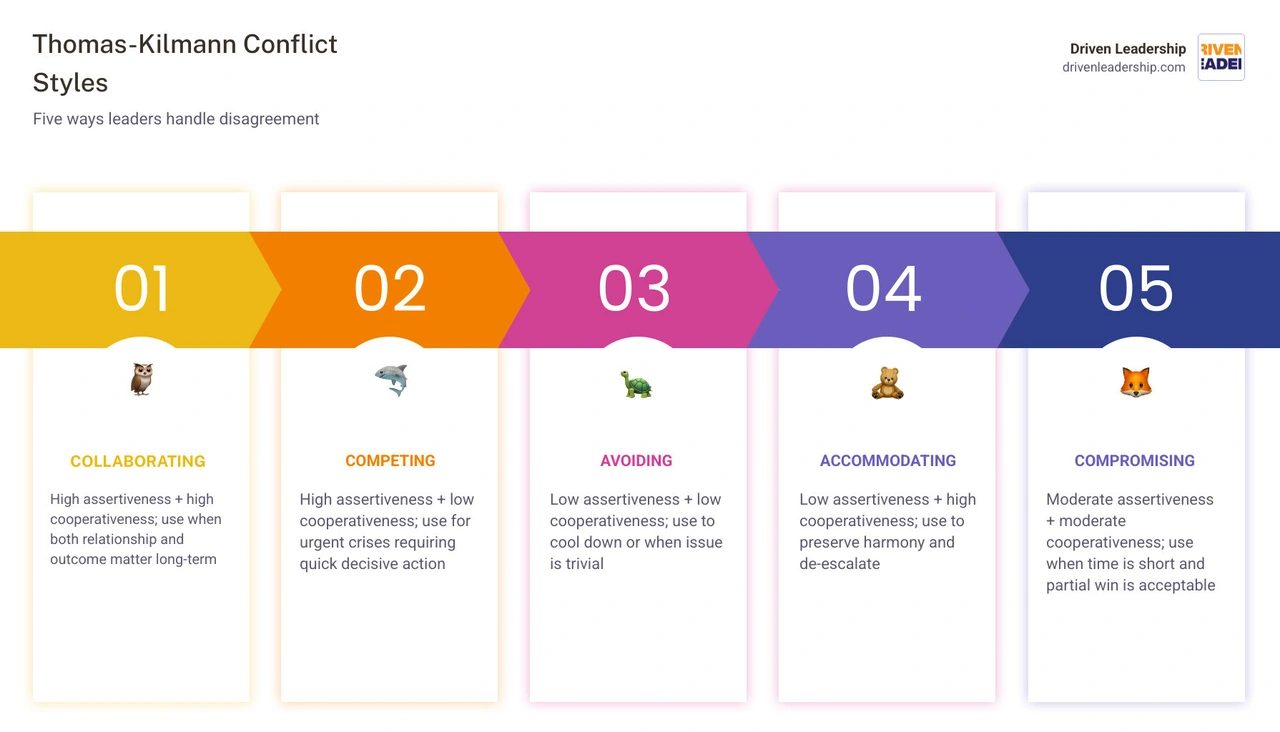
• Collaborating — Approach: Win-win — Best Used When: The issue and relationship both matter long-term
• Competing — Approach: Win-lose — Best Used When: A quick, decisive call is needed and stakes are high
• Avoiding — Approach: Lose-lose — Best Used When: The issue is trivial or emotions are too hot right now
• Accommodating — Approach: Lose-win — Best Used When: Preserving the relationship outweighs the outcome
• Compromising — Approach: Win-some/lose-some — Best Used When: Time is short and a partial solution is acceptable
These five styles come from the Thomas-Kilmann Conflict Mode Instrument (TKI), introduced in 1974, and they remain the gold standard for understanding how people handle disagreement.
Here's a number worth sitting with: managers spend somewhere between 25% and 40% of their time dealing with workplace conflict. That's not a minor distraction — that's a significant drain on your capacity to lead, grow, and build a high-performing team.
The problem isn't that conflict exists. Conflict is a normal, sometimes healthy part of any workplace. The real problem is that most leaders default to one or two styles regardless of the situation — and that rigidity costs them. It damages relationships, stalls decisions, and quietly erodes trust across teams.
The good news is that conflict style isn't fixed. With self-awareness and the right framework, you can learn to read a situation and respond strategically — not reactively.
This guide walks you through each of the five conflict management styles, what drives them, when to use them, and how to build the flexibility that separates reactive managers from confident, effective leaders.
Understanding the Thomas-Kilmann Conflict Mode Instrument (TKI)
To understand how disputes unfold in our teams, we have to look at the underlying forces that drive human behavior during disagreements. Developed by Kenneth Thomas and Ralph Kilmann in 1974, the Thomas-Kilmann Conflict Mode Instrument (TKI) is the world’s leading tool for assessing conflict styles. It has been used for decades by HR professionals, executives, and team builders across Washington, California, Nashville, and SoCal to transform organizational communication.
The TKI model operates on two distinct, intersecting axes:
• Assertiveness: The degree to which you attempt to satisfy your own concerns, goals, and needs.
• Cooperativeness: The degree to which you attempt to satisfy the other person's concerns, goals, and needs.
When we map these two dimensions against each other, we get five distinct conflict-handling modes. None of these modes is inherently "good" or "bad." Instead, each mode is a tool. Just as a carpenter wouldn’t use a hammer to turn a screw, a leader shouldn't use the same conflict style for every challenge. Understanding where your team members fall on this grid is the first step toward building a cohesive, high-performing culture. To learn more about utilizing this tool in your organization, you can explore the Thomas Kilmann Assessment and find out how a structured TKI Assessment can bring clarity to your leadership team.
Assessing Your Team: What Are the Five Conflict Management Styles and When to Use Each
Most of us have a default conflict style that we revert to under pressure. This default is often shaped by our personality traits, cultural backgrounds, and even the behaviors we observed in our families during childhood. When things get heated, some of us naturally raise our shields (avoiding), while others prepare for battle (competing).
Without self-awareness, these default patterns can create major blind spots in team dynamics. For example, if a manager defaults to avoiding while their direct report defaults to competing, the manager may withdraw, leaving the employee feeling ignored and frustrated. Conversely, two competing styles clashing without mediator support can quickly turn a productive debate into a toxic turf war.
By introducing your team to the question, what are the five conflict management styles and when to use each, you open the door to objective, blame-free conversations about communication. To help your team identify their natural tendencies, we invite you to take our Free Thomas Kilmann Assessment. Gaining this self-awareness is the catalyst for shifting from automatic, emotional reactions to intentional, strategic responses.
What Are the Five Conflict Management Styles and When to Use Each
To make these styles easy to remember and apply, we often use animal metaphors that represent the core behavior of each style. Below is a quick-reference table outlining the characteristics, benefits, and drawbacks of each approach.
• Collaborating — Metaphor: The Owl — Assertiveness: High — Cooperativeness: High — Primary Benefit: Finds true win-win; builds deep trust — Potential Drawback: Extremely time and energy-consuming
• Competing — Metaphor: The Shark — Assertiveness: High — Cooperativeness: Low — Primary Benefit: Fast, decisive action; protects boundaries — Potential Drawback: Can damage relationships and morale
• Avoiding — Metaphor: The Turtle — Assertiveness: Low — Cooperativeness: Low — Primary Benefit: Cools down hot emotions; saves time — Potential Drawback: Problems can fester and grow 3x larger
• Accommodating — Metaphor: The Teddy Bear — Assertiveness: Low — Cooperativeness: High — Primary Benefit: Preserves harmony; de-escalates tension — Potential Drawback: Your own needs go unmet; breeds resentment
• Compromising — Metaphor: The Fox — Assertiveness: Moderate — Cooperativeness: Moderate — Primary Benefit: Fast, democratic, and practical — Potential Drawback: No one is fully satisfied; "half-baked" choices
In leadership, strategic flexibility is far more valuable than rigid adherence to any single style. Effective leaders practice situational leadership, assessing the stakes, the relationship, and the timeline before choosing their approach. Let’s dive deep into each style to understand how to execute them successfully. For a comprehensive overview of how to bring these strategies to your workplace, explore our core training on Conflict Management.
1. Collaborating (The Owl Style)
The Collaborating style, represented by the Owl, is a high-assertiveness, high-cooperativeness approach. The goal here is a true "win-win" where both parties' needs are fully met. Instead of searching for a quick middle ground, collaborators dig deep to explore the underlying interests behind each person's position.
When to Use Collaborating
Collaboration is the gold standard when both the outcome of the dispute and the long-term relationship are of vital importance. For example, if you are planning the integration of two departments, or designing a new product prototype where diverse technical perspectives must align, collaboration is essential. Research shows that collaborative conflict resolution leads to 50% higher employee engagement compared to competitive approaches.
Actionable Skills for Collaboration
To succeed as an "Owl," you must master interest-based problem solving. This means focusing on interests (why people want what they want) rather than positions (what they say they want). Use open-ended questions like, "What are your main concerns regarding this timeline?" rather than closed questions that force a yes-or-no answer. It also requires "we" language to frame the dispute as a shared puzzle to solve, rather than a battle to win. That collaboration is only realistic when you have ample time, high mutual trust, and creative possibilities. To develop these high-level communication habits, see our guide on Conflict Resolution Training for Leaders.
2. Competing (The Shark Style)
The Competing style, represented by the Shark, is characterized by high assertiveness and low cooperativeness. This is a "win-lose" approach where one party pursues their own concerns at the other person's expense, using whatever power seems appropriate to win.
When to Use Competing
While competing can easily damage workplace relationships if overused, it is an essential tool in a leader's arsenal for specific scenarios:
• Urgent Crises: When a safety hazard is identified or a major product defect is discovered right before launch, there is no time for a committee vote. Quick, decisive action is mandatory.
• Unpopular Decisions: When enforcing budget cuts, implementing disciplinary actions, or terminating employment, a leader must stand firm.
• Protection Against Exploitation: When dealing with external entities or highly competitive counterparties who are trying to take unfair advantage of your organization.
Actionable Skills for Competing
To compete constructively without destroying morale, you must separate the person from the problem. Avoid personal attacks, yelling, or emotional outbursts. Instead, use noncoercive assertiveness: state your decision clearly, explain the objective rationale behind it, and replace threats with professional warnings about consequences. Use it sparingly, and communicate the "why" behind your decision once the crisis has settled.
3. Avoiding (The Turtle Style)
The Avoiding style, represented by the Turtle, is low in both assertiveness and cooperativeness. When using this style, an individual side-steps, postpones, or completely withdraws from the conflict.
When to Use Avoiding
Many people view avoidance as a sign of weak leadership, but it can be highly strategic. You should pull into your shell when:
• The Issue is Trivial: Disagreeing over minor details like the font on an internal memo or the color of a slide background is rarely worth the energy.
• Emotions Are Volatile: When tempers are flaring, attempting to resolve a complex issue is counterproductive. An intentional "cool-down period" allows everyone to regain emotional regulation.
• You Need More Information: Postponing the discussion gives you time to gather necessary facts and approach the situation objectively.
Actionable Skills for Avoiding
The key to constructive avoidance is differentiating it from passive-aggressive "evading." Do not simply ignore emails or drop subtle hints, hoping your colleagues will decode your silence. Instead, communicate your boundary clearly: "I want to make sure we make the right decision on this, but I need to gather the Q3 data first. Let’s table this discussion until our meeting on Thursday morning." Avoiding should be a temporary pause. Leaving conflict completely unaddressed is dangerous — studies show that avoiding conflict entirely leads to problems growing 3x larger before resolution is attempted.
4. Accommodating (The Teddy Bear Style)
The Accommodating style, represented by the Teddy Bear, is low in assertiveness and high in cooperativeness. When you accommodate, you neglect your own concerns to satisfy the concerns of the other person. It is a "lose-win" approach.
When to Use Accommodating
Accommodating is highly effective when:
• The Relationship Outweighs the Issue: If your business partner has a strong emotional preference for a certain office layout and you are relatively indifferent, yielding builds goodwill.
• You Realize You Are Wrong: Admitting your mistake quickly and accommodating the correct solution restores credibility and shows humility.
• Immediate De-escalation is Needed: If a client or supervisor is highly upset, accommodating their immediate request can defuse the tension so a rational discussion can happen later.
Actionable Skills for Accommodating
To accommodate successfully, do so with grace and clarity. Do not play the martyr or drop resentful comments later. If you choose to yield, do it completely and align your body language and tone to show genuine support. However, monitor your usage of this style; consistently playing the Teddy Bear can cause you to lose your voice in the organization, leading to professional burnout and unexpressed resentment.
5. Compromising (The Fox Style)
The Compromising style, represented by the Fox, sits directly in the middle of the TKI grid. It is moderate in both assertiveness and cooperativeness. The goal of compromise is to find an expedient, mutually acceptable solution that partially satisfies both parties. It is a "win-some, lose-some" approach.
When to Use Compromising
Compromise is the ultimate practical tool for busy professionals. Use it when:
• You Face Tight Time Constraints: If you need to make a decision on a marketing campaign budget by 5:00 PM and two department heads are deadlocked, a 50/50 split of the remaining funds keeps things moving.
• Goals Are Mutually Exclusive: When two parties with equal power are strongly committed to incompatible goals.
• A Temporary Backup is Needed: When a complex collaboration is underway but you need a temporary patch to keep operations running.
Actionable Skills for Compromising
To compromise effectively, both parties must agree on a criterion of fairness before making concessions. Use objective, neutral sources of information to determine the middle ground. Be prepared to trade off less important items to secure your must-haves. That because compromise requires both sides to give up something, it can sometimes result in "half-baked" solutions that leave lingering dissatisfaction if used for high-stakes, strategic issues.
The Psychology and Impact of Conflict Styles in Teams

When we look beyond individual interactions, we see that the mix of conflict styles within a team heavily influences its overall performance and culture. Understanding how these styles interact can help us unlock hidden potential in our organizations.
One of the most fascinating insights from negotiation research is the power of complementary conflict styles. A 2015 study published in Negotiation and Conflict Management Research found that complementary pairs — such as a dominant, assertive negotiator paired with a submissive, cooperative negotiator — actually outperform pairs with identical styles.
Why? Because they create a natural cognitive buffer. The assertive partner is comfortable stating clear preferences, while the cooperative partner asks clarifying questions. This exchange uncovers hidden value-creation opportunities that two aggressive "Sharks" or two passive "Turtles" would miss.
This dynamic is mirrored in developmental psychology and relationship research. Dr. John Gottman’s famous marriage studies identified three stable, successful conflict-solving styles: validating, conflict-avoidant, and volatile. The key takeaway from his research is that couples can thrive using any of these styles, provided both partners share and match the same style.
In the workplace, however, we rarely have the luxury of hand-picking a team with identical conflict styles. We must learn to lead teams with highly diverse profiles. When managed effectively, this diversity is a massive asset. Organizations that master conflict management see a 25% higher productivity rate and a significant reduction in absenteeism.
To help your team navigate these interpersonal dynamics smoothly, it is highly beneficial to establish clear communication guidelines. For practical steps on maintaining team harmony, read our insights on Navigating Conflict Resolution: Strategies for Maintaining Harmony and Productivity.
Training Your Leaders: What Are the Five Conflict Management Styles and When to Use Each
Building a high-performing organization requires moving conflict resolution from an abstract concept to a core leadership competency. Leaders across Washington, California, and our other regions need practical, hands-on training to develop these behavioral changes.
Many leadership programs offer short-term inspiration but fail to deliver lasting behavioral shifts. At Driven Leadership, we focus on deep, immersive development that helps executives and managers break free from their default reactions and consciously choose the right tool for the job.
If you are ready to equip your management team with these critical skills, explore our customized Conflict Resolution Training for Leaders and discover how our specialized TKI Conflict Training can transform your company culture.
Developing Strategic Flexibility in Conflict Resolution
Knowing what are the five conflict management styles and when to use each is excellent theory, but executing them under pressure is where the real challenge lies. When a high-stakes disagreement occurs, our amygdala often hijacks our rational brain, triggering a fight-or-flight response.
To develop true strategic flexibility, leaders must build a specific set of supportive behaviors:
1. Emotional Regulation: Before you speak, take a breath. Recognize your physiological triggers (a racing heart, a tight jaw) and consciously slow down your reaction. This creates a cognitive buffer, allowing you to choose a style rather than reacting on instinct.
2. Active Listening: You cannot collaborate or compromise effectively if you do not truly understand the other side's perspective. Practice summarizing their points back to them: "It sounds like your primary concern is meeting the client's launch date without burning out the design team. Is that correct?"
3. Clear Interest Articulation: Be clear and direct about your own needs without being hostile. State the "why" behind your goals so others can help you find creative solutions.
4. Creative Problem Solving: Learn to look at disputes as puzzles. Brainstorm multiple options before settling on a single course of action.
These behaviors are not innate talents; they are skills that can be practiced and mastered. For leaders looking to build these capabilities within their teams, we highly recommend reading about our Conflict Management Training Course: Essential Strategies for Leaders and exploring our guide on Understanding Conflict Resolution & Mediation Training.
Frequently Asked Questions about Conflict Management
What is the most effective conflict management style?
There is no single "best" conflict management style. While collaboration is often praised as the ideal approach because it yields win-win outcomes and builds deep trust, it is not always practical. If you are facing a tight deadline or dealing with a minor issue, collaboration is too slow and energy-intensive. The most effective style is always situational, depending on the importance of the issue, the value of the relationship, and the time available.
Can an individual's conflict management style change over time?
Absolutely. While we all have a default style shaped by our personality and past experiences, conflict management is a professional competency. With self-awareness, targeted training, and intentional practice, you can expand your comfort zone and learn to navigate all five TKI modes with ease.
How does unresolved conflict impact organizational productivity?
When conflict is ignored or poorly managed, it doesn't go away — it goes underground. Unresolved disputes lead to low team morale, decreased productivity, high absenteeism, and increased staff turnover. By training your team to address disagreements constructively, you can reclaim the 25% to 40% of management time currently wasted on resolving toxic workplace friction.
Conclusion
Conflict is an unavoidable reality of working with other people. But as we have explored, conflict is not inherently destructive. When handled with self-awareness and strategic flexibility, disagreements can become a powerful driver of innovation, stronger relationships, and organizational growth.
By understanding what are the five conflict management styles and when to use each, you give your leadership team a shared, objective language to navigate tension without drama. Whether you are leading a team in Seattle, managing an executive board in Southern California, or scaling a business in Nashville, mastering this framework is one of the highest-leverage investments you can make in your business performance.
At Driven Leadership, we specialize in delivering measurable, lasting behavioral change through immersive workshops, executive coaching, and EOS implementation. We don't just teach the theory of conflict management — we help your leaders build the real-world muscle memory to apply it when the pressure is on.
Ready to transform how your organization handles disagreement? Discover our interactive TKI Live Conflict Management Workshops - Driven Leadership and take the first step toward a more cohesive, high-performing culture with our comprehensive Conflict Management Training Course. Let's build a stronger team, together.