Run to the Roar: Why Avoiding Difficult Conversations Costs You Your Best Employees

The Hidden Toll of Leadership Silence
Unaddressed tension in a team meeting rarely resolves itself, which is exactly why leaders must understand the concept of run to the roar: why avoiding difficult conversations costs you your best employees. A typical pattern we see is leaders dodging necessary but uncomfortable team conflicts, inadvertently creating a toxic environment beneath the surface. The critical decision point happens in a split second: a manager notices a brewing interpersonal conflict or a sudden drop in performance, and they must choose whether to confront the issue directly or look the other way. Choosing to look away is often the default human instinct, but in an organizational setting, that silence carries a massive hidden cost.
To establish a culture of accountability and high performance, exploring structured leadership training programs is one of the most effective steps a proactive manager can take.
Conflict avoidance isn't just a passive leadership flaw; it is an active driver of top-performer turnover. When leadership stays silent on poor behavior or missed deadlines, the rest of the team absorbs the impact. The burden of maintaining standards shifts from the manager to the highest-performing employees, who are suddenly forced to compensate for their peers. Leaning into the discomfort of a difficult conversation is not about creating unnecessary friction; it is about preserving team integrity. Addressing the issue early prevents a localized performance problem from metastasizing into a department-wide cultural breakdown.
What Does It Mean to "Run to the Roar"?
The problem of instinctual avoidance: In the wild, a pride of lions uses a highly coordinated hunting strategy. The older lions, who have lost their speed and stamina, are positioned on one side of the prey. Their job is simply to roar as loudly as possible. The prey, acting on sheer instinct, turns and runs directly away from the terrifying noise. Unfortunately, they run straight into the tall grass where the younger, faster lionesses are waiting in absolute silence to spring the trap. By fleeing the obvious discomfort, the prey guarantees its own demise.
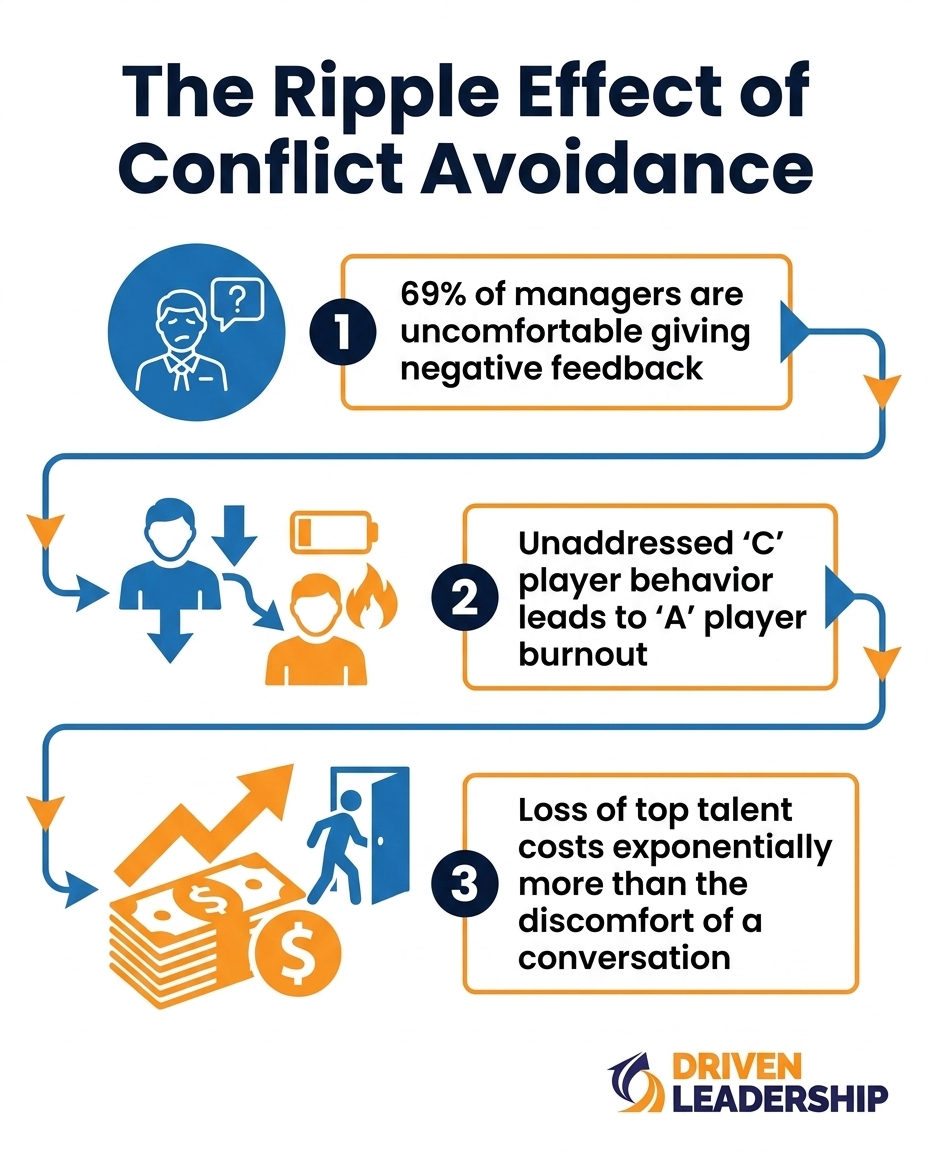
The cause of managerial silence: This biological instinct maps perfectly onto organizational behavior. Data from Harvard Business Review reveals that 69% of managers report feeling uncomfortable communicating with employees, particularly when giving negative feedback. The immediate, loud discomfort of a confrontational meeting—the emotional reactions, the defensive posturing, the awkwardness—acts just like the roaring lion. Managers instinctively retreat from that noise, hoping the problem will fade. Instead, they run their teams directly into the hidden trap of long-term cultural decay and lost talent.
The solution of trained engagement: Translating this metaphor to leadership means recognizing that running toward the loud, uncomfortable problem is actually the safest path for the team's survival. Much like navigating through the heavy fog and sudden storms of the Pacific Northwest, leaders must steer directly through the low visibility and turbulence of team conflict rather than pulling over and waiting for it to passively blow over. Effective leaders are trained to override their flight response. They understand that the roar is just noise, and the true danger lies in what happens when standards are left unenforced.
The Ripple Effect: How Conflict Avoidance Breeds Resentment
The internal mechanics of a team break down rapidly when conflict is avoided. The dynamic between high performers ('A' players) and underperformers ('C' players) is highly sensitive to leadership intervention. When a manager fails to address a 'C' player's missed deadlines or toxic attitude, the 'A' players do not simply ignore it—they are forced to carry the extra load. This creates a profound emotional toll. 'A' players resent carrying the load for unaddressed issues, and their trust in leadership evaporates when they see that excellence is demanded of them but not of their peers.
Understanding the cost of actively disengaged managers is critical for any organization looking to scale. Gallup data consistently shows that highly engaged employees are significantly more likely to leave if they feel leadership tolerates poor performance from others. Psychological safety is not just about feeling safe to share ideas; it is also about trusting that leadership will maintain a fair and accountable environment.
• Avoiding the difficult conversation — Impact on 'A' Players: Increased workload, resentment, burnout — Impact on 'C' Players: Validation of poor habits, lack of growth — Long-Term Cultural Result: High turnover of top talent, normalized mediocrity
• Running to the roar (confronting) — Impact on 'A' Players: Validation of effort, restored trust — Impact on 'C' Players: Clear expectations, opportunity to improve — Long-Term Cultural Result: High accountability, retention of driven employees
The Silent Leak of Top Talent
One of the most dangerous aspects of conflict avoidance is that the consequences are often invisible until it is too late. Top performers rarely complain loudly when standards drop. They do not throw tantrums in the breakroom; they simply disengage, quietly update their resumes, and take their talents elsewhere. The cost of recruiting, onboarding, and training a replacement for an 'A' player far exceeds the temporary discomfort of sitting down with a 'C' player to address their behavior.
Why Late Summer is the Critical Window for Difficult Conversations
Timing plays a significant role in organizational dynamics. During the late summer and Q3 transition when end-of-year performance metrics come into focus, leaders face a natural inflection point. The relaxed pace of the earlier months gives way to the pressure of Q4 targets. If interpersonal conflicts or performance gaps have been simmering since spring, this is the moment they will boil over and jeopardize major strategic goals.
Implementing strong team execution strategies requires a clear runway. Addressing brewing conflicts during this late summer window prevents them from derailing critical Q4 execution. Leaders should utilize the Q3 review cycle as a structured, expected opportunity to initiate uncomfortable dialogue. Because reviews are already on the calendar, the friction of calling a sudden, unexpected meeting is removed, making it easier to step into the necessary discomfort.
Waiting until November or December to address a problem that began in August virtually guarantees that year-end goals will be missed. Proactive leaders use this seasonal shift to reset expectations, clear the air, and ensure the entire team is aligned and accountable before the heaviest workload of the year begins.
Moving from Avoidance to Action: A Framework for Leaders
Recognizing the need for a difficult conversation is only the first step; executing it without destroying team trust requires a structured approach. One professional recently faced a severe lack of confidence and effective communication skills, struggling through both internal team discussions and client meetings during the spring quarter. After attending immersive advanced training focused on active listening, the outcome was transformative. The individual gained the initiative to take charge of meetings and communicate with newfound drive. That kind of transformation relies on actionable, non-theoretical frameworks.
To safely navigate these necessary confrontations, organizations often rely on methodologies like Driven Leadership's specialized TKI conflict training. This provides a definitive roadmap for stepping into discomfort constructively. If you need to face the roar, follow these structured steps:
1. Separate facts from emotions: Before scheduling the meeting, write down the objective behaviors you have observed. Avoid subjective labels like "lazy" or "uncommitted." Focus entirely on measurable outcomes, missed deadlines, or specific statements made in meetings.
2. Initiate with active listening: When the conversation begins, state the objective facts and immediately ask for their perspective. A strong leader listens more than they speak in the opening minutes, allowing the employee to explain their side without interruption.
3. Focus on shared team goals: Frame the confrontation around the team's overarching mission. The conversation is not about punishing the individual; it is about realigning their behavior with the standards required for the group to succeed.
4. Establish clear next steps: Never leave a difficult conversation open-ended. Agree on specific, measurable changes in behavior and set a firm date for a follow-up review to ensure accountability is maintained.
Mastering this framework often requires formal conflict management training, which equips managers with the psychological tools needed to protect their team's culture without alienating their staff.
Realizing the Transformation: Stepping Out of the Comfort Zone
Embracing the mindset of running toward the roar leads to profound personal and professional realization. Overcoming the fear of conflict transforms hesitant managers into respected, proactive leaders. When a leader consistently demonstrates that they will protect the team's standards by addressing issues head-on, the entire organizational culture elevates.
Another common scenario involves professionals who realize their daily routines have become stagnant and their professional identity is being challenged. Following participation in an intensive spring leadership program, these individuals report that their lives were profoundly changed for the better. They develop the courage to tackle challenges directly, and facing the roar daily becomes a deeply ingrained habit rather than a sporadic, anxiety-inducing event.
This type of personal and professional elevation is the core focus of Driven Leadership's 'Bold' leadership principles. By committing to continuous improvement and refusing to settle for the comfort of avoidance, leaders build teams that are resilient, fiercely loyal, and highly productive. The initial discomfort of the conversation fades quickly, but the respect earned from your top performers lasts for years. Exploring a bold leadership program can be the catalyst that shifts a manager from a state of passive avoidance to active, confident direction.
Frequently Asked Questions About Leadership and Conflict
What does run to the roar mean in leadership?
It means confronting problems and difficult conversations head-on rather than avoiding them. The concept is based on the metaphor of prey running toward the roaring, older lion rather than fleeing into the silent, deadly trap of the waiting lionesses. In business, leaning into the loud discomfort of a conflict is the safest and most effective way to protect your team's culture.
Why do managers avoid difficult conversations?
Managers typically avoid these conversations due to a fear of negative emotional reactions and defensive posturing. Many lack formal conflict resolution training, leading them to rely on the false hope that a performance issue will magically resolve itself over time. This instinctual retreat from discomfort is a natural human reaction, but a detrimental leadership flaw.
How does conflict avoidance affect top performers?
It breeds deep resentment, as high performers ('A' players) are inevitably forced to compensate for the unaddressed poor performance of their peers. When leadership fails to enforce standards, top talent loses trust in management. This dynamic rapidly accelerates burnout, disengagement, and ultimately drives your best employees to leave the company.
How can leaders prepare for a difficult conversation?
Leaders can prepare by utilizing structured frameworks to separate objective facts from subjective emotions before the meeting begins. Documenting specific behaviors and outcomes ensures the conversation remains grounded in reality. During the meeting, focusing on mutual team success and employing active listening techniques helps de-escalate tension and drive productive results.
What is the actual cost of losing an 'A' player to poor team dynamics?
The cost extends far beyond the immediate expense of recruiting and onboarding a replacement. Losing a top performer drains institutional knowledge, lowers overall team morale, and disrupts client relationships. The financial and cultural damage of losing your best talent is exponentially higher than the temporary discomfort of addressing a 'C' player's behavior.
Equip Your Leaders to Face the Roar
Avoiding conflict is never a neutral decision; it is an active choice that inevitably costs you your best people. When leaders refuse to address poor performance, they inadvertently signal to their top talent that excellence is not truly valued. The short-term relief of dodging an awkward meeting is vastly outweighed by the long-term damage to your team's psychological safety and overall productivity.
If you are noticing the signs of disengagement among your highest performers, now is the time to act. Encourage your management team to seek out the tools, methodologies, and frameworks necessary to build real confidence. By equipping your leaders with an actionable, non-theoretical framework to initiate difficult conversations, you ensure they can protect team trust and drive lasting organizational success.