
The True Cost of Actively Disengaged Managers in Your Organization

The Hidden Toll of Managerial Apathy on Organizational Health
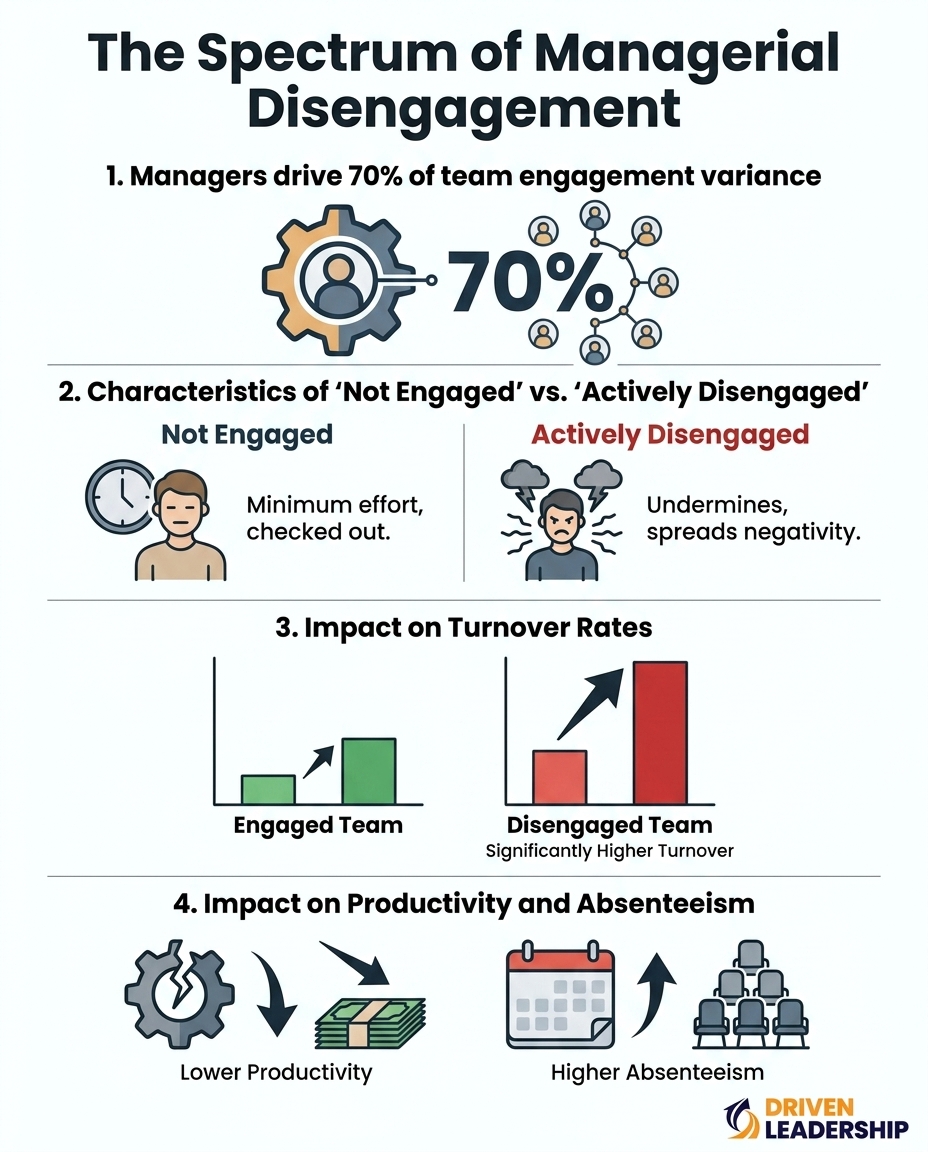
Managers account for nearly 70% of the variance in team employee engagement scores—a staggering statistic when you consider the true cost of actively disengaged managers in your organization. At Driven Leadership, working with businesses throughout Puyallup, WA, and the Pacific Northwest, our team typically sees that if you notice a sudden drop in team morale or missed performance targets, you are likely witnessing the silent productivity leaks caused by poor leadership. Middle managers who are actively disengaged do not just underperform in a vacuum; they create a ripple effect of high direct-report turnover and toxic cultural shifts. This negative impact frequently peaks during the July mid-year productivity slump, forcing a critical decision: do you write off a manager's poor attitude as temporary burnout, or do you intervene with an intensive leadership turnaround strategy before your top-performing team members quit?
To address these deep-rooted issues, strategic organizational development and a structured executive manager program are necessary to transform your leadership team.
When leadership falters, the entire organizational structure suffers. A poor managerial attitude cannot be ignored or simply brushed aside as a passing phase. The longer a toxic manager remains unchecked, the more entrenched the silent productivity leaks become. Employees stop volunteering discretionary effort, collaboration stalls, and the baseline standard for acceptable work drops. Recognizing this hidden toll is the first step in protecting your company's operational health.
Defining the Spectrum: Not Engaged vs. Actively Disengaged
The problem: Organizations frequently group all underperforming managers into a single category of "bad leadership." This oversimplification prevents executives from applying the correct solutions, as different levels of apathy require entirely different interventions.
The cause: The core issue lies in failing to distinguish between a manager who is merely "not engaged" and one who is "actively disengaged." Middle managers are the critical bridge between executive vision and frontline execution. When their specific behavioral failures are misdiagnosed, the root causes of poor performance remain unresolved.
The solution: You must clearly define the spectrum of managerial behavior to understand exactly how it skews employee turnover and team engagement metrics downward. Only then can you implement the right developmental framework.
The Baseline of 'Not Engaged'
A "not engaged" manager is essentially coasting. They do the bare minimum required to keep their job, lacking the passion and drive necessary to push their team forward. While they are generally non-disruptive, their passive management style results in massive missed opportunities for team growth.
• Passive oversight: They rarely offer constructive feedback or career development guidance.
• Status quo maintenance: They avoid taking risks or championing new operational efficiencies.
• Invisible leadership: They are physically present but mentally checked out during critical strategy sessions.
The Toxicity of 'Actively Disengaged'
An actively disengaged manager is fundamentally unhappy and acts out that unhappiness in the workplace. They do not just miss opportunities; they actively undermine team efforts and sabotage morale. This active toxicity spreads negativity to direct reports, creating a hostile environment that drives high performers out the door.
• Feedback Style — Not Engaged Manager: Infrequent and generic — Actively Disengaged Manager: Harsh, critical, and public
• Team Advocacy — Not Engaged Manager: Fails to fight for team resources — Actively Disengaged Manager: Actively hoards resources or blames the team for failures
• Impact on Metrics — Not Engaged Manager: Stagnant employee turnover and team engagement metrics — Actively Disengaged Manager: Rapidly declining employee turnover and team engagement metrics
The Cascading Multiplier Effect on Direct Reports
A single actively disengaged manager does not just fail as an individual; they multiply their negative impact across their entire team. This cascading multiplier effect systematically erodes the confidence and foundational skills of the direct reports working under them. When employees feel unsupported, unheard, and constantly criticized, they stop innovating and start looking for the exit.
Proper leadership trainings are required to rebuild the foundational communication and listening skills that a toxic manager has eroded. In our years facilitating executive turnarounds, a pattern we see often is professionals who need to take ownership of their personal and professional lives seeking out structured interventions. During our recent intensive leadership courses here at Driven Leadership, participants who were challenged by immersive programs found they were able to take true ownership of their careers, benefiting from the passion and enthusiasm required to overcome a previously negative environment.
Eroding Direct-Report Confidence
An actively disengaged manager creates an environment devoid of psychological safety. Through either aggressive micromanagement or extreme apathy, they stifle employee initiative.
1. Loss of autonomy: Employees are second-guessed at every turn, teaching them to wait for orders rather than solving problems proactively.
2. Fear of retribution: Mistakes are punished rather than used as coaching moments, causing the team to hide errors.
3. Skill stagnation: Without active mentorship, direct reports lose confidence in their own professional capabilities.
The Inevitability of Turnover
It is a well-known operational truth: employees quit managers, not companies. When the daily work environment becomes intolerable, absenteeism spikes as employees look for ways to avoid the toxic atmosphere. Eventually, this leads to inevitable turnover. The operational disruption of losing top talent is severe, requiring you to rebuild institutional knowledge from scratch while employee turnover and team engagement metrics plummet.
Navigating the July Mid-Year Productivity Slump
The problem: The peak summer months often bring a natural dip in workplace focus, widely recognized as the July mid-year productivity slump. As we navigate the peak heat of July 2026, we frequently remind our clients that vacations, warmer weather, and the exhaustion of the first two quarters naturally slow down operational momentum.
The cause: An actively disengaged manager exacerbates this seasonal slump. Instead of rallying the team through the Q3 drop, they lean into their own apathy, turning temporary seasonal distraction into long-term team-wide disengagement.
The solution: You must distinguish between genuine mid-year burnout and active disengagement to apply the correct intervention and prevent late-summer resignations.
Recognizing the Q3 Drop
Historical data consistently shows a dip in summer productivity. However, poor leadership amplifies these seasonal distractions. A healthy manager anticipates the July mid-year productivity slump and adjusts workflows, sets clear short-term goals, and maintains accountability. A disengaged manager uses the summer slowdown as an excuse to completely check out, leaving the team rudderless during a critical transitional quarter.
Distinguishing Burnout from Disengagement
Misdiagnosing the root cause of a manager's poor performance leads to failed solutions. You must look for the distinct signs of exhaustion versus active sabotage:
• Signs of Burnout: The manager is tired, easily overwhelmed, but still cares about the team's success. They need rest, delegation support, and time off to recover.
• Signs of Active Disengagement: The manager is cynical, blames others for failures, and actively works against company initiatives. Rest will not fix this; intensive intervention is required.
The Cultural Drain: A Stagnant Atmosphere
The non-financial, cultural costs of bad management are often the most difficult to repair. A disengaged manager silences innovation, shuts down constructive feedback, and abandons the core principles that teams need to succeed. The effect on team culture is much like a stagnant, dreary Pacific Northwest overcast day that traps the team in a gloomy, oppressive atmosphere, even when it is peak summer outside here in Washington. The environment becomes heavy, suffocating, and completely devoid of energy.
Without the core values teams need to share, the shift moves rapidly from collective success to individual survival. High performers who thrive on collaboration and forward momentum will not stay in a stagnant atmosphere. They will leave for brighter, more supportive environments, accelerating the cultural deterioration that inevitably precedes operational failure.
Silencing Innovation and Feedback
Fear of a disengaged manager stops creative problem-solving in its tracks. When a manager dismisses new ideas or attacks the person presenting them, the team quickly learns to stay quiet. This creates a dangerous "yes-man" culture where obvious operational flaws are ignored simply because no one wants to risk the manager's wrath. The organization loses its agility and its ability to adapt to market changes.
Misalignment of Core Principles
A strong culture relies on shared values and mutual respect. An actively disengaged manager breaks down these shared values by playing favorites, hoarding information, and prioritizing their own comfort over the team's success. This misalignment creates a fragmented team where individuals work in isolated silos, completely disconnected from the broader organizational mission. You can clearly track this cultural decay through declining employee turnover and team engagement metrics.
The Silent Macro Cost to Productivity
On a macro scale, managers who are not engaged or who are actively disengaged cost the U.S. economy massive amounts in lost productivity and turnover. While it is easy to view a bad attitude as a localized HR issue, the reality is that poor leadership creates a severe operational bottleneck. Measuring this lost output reveals that addressing management issues is an urgent operational necessity, not just a soft personnel concern.
Measuring Lost Output Without Dollar Signs
You can clearly see the macro cost of a toxic manager by looking at percentage drops in output and efficiency. When you evaluate the true cost of actively disengaged managers in your organization, the metrics speak for themselves:
• Absenteeism spikes: Teams under toxic managers show significantly higher percentages of sick days and unplanned absences.
• Error rates increase: Because employees are disengaged and lack psychological safety, quality control drops and rework percentages climb.
• Profitability drops: A team that operates at only 60% capacity due to poor leadership drags down the overall efficiency of the entire department.
The Price of Replacing Top Talent
The price of replacing top talent is exceptionally high when measured in time and lost institutional memory. When a great employee leaves because of a bad manager, you lose the weeks or months required to recruit, onboard, and train a replacement. Furthermore, you risk losing critical client relationships and the specific operational knowledge that the departing employee took with them. These compounding losses highlight exactly why an actively disengaged manager is an operational emergency.
Shifting from HR Checklists to Operational Necessity
The problem: Passive solutions like "better communication memos" or standard online training modules do not fix active disengagement. They merely mask the symptoms, allowing the toxic behavior to continue unchecked.
The cause: Standard corporate training fails actively disengaged managers because it does not challenge them to change their fundamental behaviors. Reading a checklist of best practices does not rebuild a leader's mindset.
The solution: Implementing an intensive turnaround challenges leaders to take ownership of their professional lives and elevate their standards. At Driven Leadership, we recommend immersive interventions over standard modules because we focus heavily on intensive turnarounds and measurable bottom-line results, proving that addressing managerial disengagement is a critical operational strategy rather than a simple HR task.
Beyond Passive HR Solutions
To truly fix active disengagement, you need immersive, challenging experiences that force a manager to confront their impact on the team. During a recent cohort of intensive leadership training we hosted, professionals needing critical growth and development in their leadership skills received fantastic, immersive instruction. The outcome was a completely new level of leadership capability that they subsequently shared with their teams. A structured Engage Elevate Program provides exactly this type of necessary framework to rebuild a manager's foundational skills and completely reset broken team dynamics.
Measuring KPI Recovery
The ultimate proof of a successful leadership intervention is found in the data. By treating leadership development as an operational necessity, you can track the direct rebound of employee engagement scores. Following a successful turnaround, you will observe immediate drops in absenteeism and stabilization in turnover rates, confirming that the intervention successfully stopped the silent productivity leaks.
Reclaiming Your Team's Potential Through Strategic Intervention
Actively disengaged managers drain your resources, stall your overall productivity, and drive away your absolute best talent. Allowing toxic leadership behavior to continue unchecked guarantees that your employee turnover and team engagement metrics will continue to suffer. The true cost of actively disengaged managers in your organization is measured in lost potential, broken cultures, and constant recruitment cycles.
Intervening with a proven executive manager program can reverse these dangerous trends and restore your organizational health. By shifting away from passive HR warnings and moving toward structured, intensive leadership development, you can rebuild your managers into true leaders. Take the time to explore your options to develop your leadership team, protect your company's culture, and reclaim the high-performing environment your business deserves.
Frequently Asked Questions
What happens when a manager is disengaged?
When a manager is disengaged, their lack of enthusiasm and focus immediately trickles down to their direct reports. The team often experiences a sharp drop in morale, increased absenteeism, and a noticeable decline in overall work quality. Without active guidance and support, employees become frustrated and lose their drive to innovate, leading to stalled projects and lower productivity.
How do you deal with an actively disengaged manager?
You deal with an actively disengaged manager by moving past passive warnings and implementing a structured, intensive leadership intervention. It is critical to hold them accountable for their behavior while providing a rigorous developmental framework designed to challenge their mindset. If they refuse to engage with the turnaround process, you must be prepared to make tough personnel decisions to protect the rest of the team.
What is the difference between not engaged and actively disengaged?
A "not engaged" manager simply does the bare minimum to get by, acting passively and failing to inspire their team, though they rarely cause intentional harm. An "actively disengaged" manager is fundamentally toxic; they act out their unhappiness, undermine company initiatives, and actively sabotage team morale. While passive managers stall growth, actively disengaged managers actively destroy culture and drive away top talent.
How does a bad manager affect a team?
A bad manager affects a team by destroying psychological safety and eroding the confidence of their direct reports. Employees working under poor leadership frequently stop sharing new ideas, hide mistakes out of fear, and eventually start looking for new jobs. The cascading multiplier effect of a bad manager ultimately leads to high turnover rates and a deeply fragmented, uncollaborative team culture.
Can an actively disengaged manager be turned around?
Yes, an actively disengaged manager can be turned around, but it requires an immersive and challenging developmental program rather than standard corporate training. The manager must be willing to take extreme ownership of their professional shortcomings and commit to rebuilding their communication and listening skills. When guided through a rigorous executive program, many leaders successfully reset their behaviors and reclaim their potential.
How long does it take to see improvements in team engagement metrics after leadership intervention?
You can often begin to see early improvements in team engagement metrics within the first 30 to 60 days following a successful leadership intervention. As the manager begins applying new, healthier communication habits, direct reports quickly notice the shift in the daily work environment. Full cultural recovery and stabilization of turnover rates typically solidify over the following two to three quarters as trust is fully rebuilt.
