EOS Training vs. Custom Leadership Frameworks for Rapidly Scaling Companies

The Myth of the One-Size-Fits-All Scaling Playbook
A pervasive myth in the corporate world is that evaluating EOS Training vs. Custom Leadership Frameworks for Rapidly Scaling Companies must always result in adopting the exact same rigid playbook used by every other startup. At Driven Leadership, we often hear founders express the belief that surviving the chaotic transition from a scrappy startup to a mature enterprise requires locking every department into a strict, inflexible operational grid. The reality our team sees is far more nuanced. Leadership teams inevitably reach a critical friction point where their current, informal management structure begins breaking under the weight of rapid growth. This realization forces a pivotal decision: choosing between strict, off-the-shelf systems and adaptable, bespoke frameworks.
For organizations navigating this transition, the shift into early fall and the kickoff of Q4 strategic planning serves as the ultimate catalyst for change. Before the new year begins, leadership must decide how to structure their operations to support continued expansion without losing their competitive edge. To explore foundational systems, you can review our team's guide on EOS implementation, or discover how the Engage Elevate program can transform your executive team.
The Breaking Point of Rapid Expansion
During the initial phases of a company's lifecycle, informal communication and loose processes are often enough to keep the engine running. However, as headcount multiplies and revenue targets escalate, those informal systems collapse. The friction point usually manifests as missed deadlines, duplicated efforts, and executive burnout. Leaders realize that scaling requires a new operating system, but we frequently see them panic and purchase the most rigid system available, mistakenly equating strict rules with scalable success. This overcorrection can stifle the very innovation that drove the company's initial success.
The Hyper-Growth Dilemma: Operational Discipline vs. Agility
The tension between needing structure to manage scale and retaining the agility that drove early growth is the central dilemma for any fast-moving organization. In our experience working within the fast-paced Pacific Northwest business environment, our team at Driven Leadership frequently helps Puyallup and Seattle companies that are scaling at a velocity demanding highly adaptable systems. When a company hits the hyper-growth breaking point, the immediate reaction is often to implement heavy processes to regain control. However, this introduces a new set of risks.
The Danger of Over-Process
Implementing too many rules too fast can create an environment of "over-process," where agility goes to die. When a company over-indexes on operational mechanics, we typically observe the following symptoms emerge:
• Decision bottlenecks: Every minor choice requires approval from multiple committees, slowing down response times to market shifts.
• Loss of autonomous problem-solving: Employees stop thinking creatively and default to asking, "What does the checklist say?"
• Decreased morale: High-performers who thrived in a dynamic environment feel boxed in by administrative red tape.
• Stifled innovation: New product features or service improvements are delayed by rigid quarterly planning cycles that cannot accommodate mid-stream adjustments.
Why Organizational Change Initiatives Fail
We've found that organizational change initiatives frequently fail when they focus solely on operational mechanics without addressing underlying people dynamics. A new meeting structure or reporting hierarchy cannot fix a team that lacks trust or struggles with poor communication. Sustainable growth requires balancing operational discipline with human agility. The goal is not merely to control the chaos, but to channel it into productive, competitive momentum that allows the organization to pivot when market conditions demand it.
Evaluating the Entrepreneurial Operating System for Scaling Companies
To make an informed decision during fall Q4 strategic planning, it is necessary to conduct an objective analysis of the Entrepreneurial Operating System (EOS). This system has gained massive popularity for its ability to bring order to chaotic startups, but in our practice, we note it is not without its limitations for companies operating in high-velocity markets.
The Foundations of Operational Discipline
EOS provides immediate operational clarity through its structured approach. The system is built upon the Six Key Components: Vision, People, Data, Issues, Process, and Traction. By forcing leadership teams to define these areas explicitly, the system eliminates ambiguity. One of its most effective tools is the Visionary vs. Integrator dynamic, which separates the big-picture founder from the detail-oriented operational leader, ensuring both roles are executed without stepping on toes. Additionally, the strict Level 10 (L10) meeting structure forces teams to focus on solving high-priority issues rather than getting bogged down in endless status updates.
The Limitations of Rigid Adherence
Despite these strengths, the primary limitation of off-the-shelf systems is the rigid adherence they require. In high-velocity markets, the strict quarterly rhythms and inflexible meeting agendas can sometimes break the fluid agility needed to capitalize on sudden opportunities. For teams we work with who are weighing traditional management coaching vs EOS, it is important to recognize that while the system provides excellent operational tracking, it may not solve underlying behavioral misalignments. A scorecard can tell you that a metric is failing, but it cannot teach a defensive manager how to accept feedback constructively or collaborate cross-departmentally.
The Case for Custom Leadership Frameworks in High-Velocity Environments
For organizations that find off-the-shelf systems too restrictive, custom leadership frameworks offer a fluid alternative that adapts to a company's unique culture and scaling speed. Rather than forcing a company to conform to a pre-written playbook, our team builds custom frameworks around the organization's specific operational realities and behavioral needs.
Building a Fluid Operational Architecture
A customized approach to organizational development allows companies to scale processes without forcing leaders into rigid, unnatural roles. When our experts implement a custom framework, we generally follow these core steps:
1. Assess behavioral baselines: Before establishing new operational rules, evaluate how the current leadership team communicates, handles conflict, and makes decisions under pressure.
2. Design modular processes: Create operational structures that can be adjusted or scaled back depending on the department's specific needs, rather than forcing a uniform process across the entire company.
3. Align structure with culture: Ensure that the new meeting rhythms and reporting structures reinforce the company's core values, rather than feeling like an imported, foreign system.
4. Implement scalable feedback loops: Build agile review processes that allow the company to pivot strategies mid-quarter if market conditions shift rapidly.
Taking Ownership at Every Level
The success of a custom framework relies heavily on personal accountability. During our recent early fall leadership sessions, a common pattern our facilitators observed is that true scaling requires individuals to take ownership of life both personally and professionally. Participants engaged in our challenging and inspiring courses found that stepping away from a simple checklist mentality and embracing total ownership was the catalyst for their organization's next growth phase. Custom programs are highly scalable because they evolve as the company transitions through different growth phases, continuously challenging leaders to adapt rather than just manage a static system.
Side-by-Side Comparison: Structure, Agility, and Focus
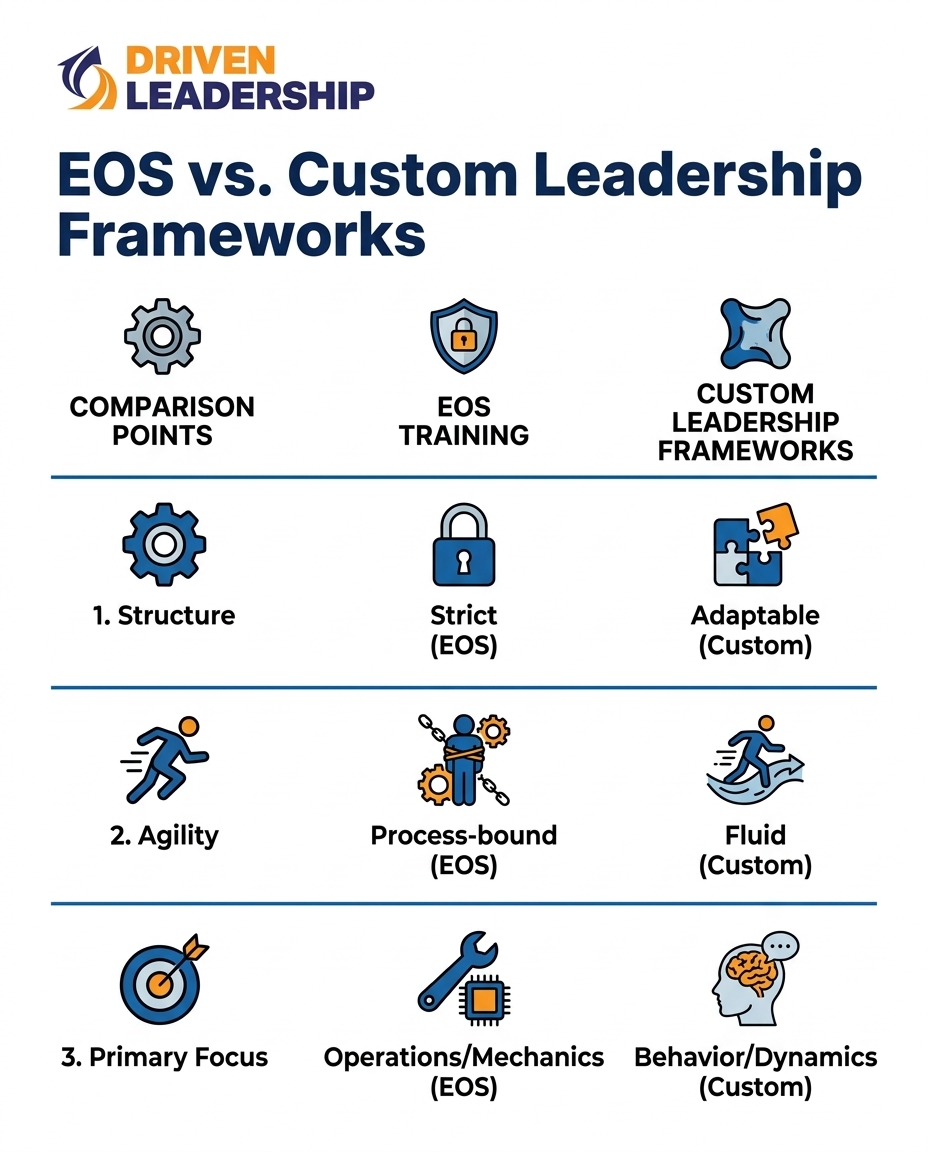
To aid in your Q4 decision-making, we find it helpful to view these operational models side-by-side. The choice between an off-the-shelf system and a bespoke framework fundamentally alters how a leadership team will function in the coming fiscal year.
• Structure — EOS (Entrepreneurial Operating System): Strict adherence to a universal, pre-defined playbook. — Custom Leadership Frameworks: Modular adaptability designed around the company's unique DNA.
• Agility — EOS (Entrepreneurial Operating System): Predictable but rigid; changes are typically batched into quarterly cycles. — Custom Leadership Frameworks: Highly responsive; fluid enough to pivot rapidly with market shifts.
• Primary Focus — EOS (Entrepreneurial Operating System): Purely operational mechanics (scorecards, meeting agendas, process tracking). — Custom Leadership Frameworks: Blended focus on both operational systems and human behavioral dynamics.
• Ideal Growth Stage — EOS (Entrepreneurial Operating System): Companies needing basic stabilization and fundamental process implementation. — Custom Leadership Frameworks: High-velocity companies needing advanced leader development and sustained agility.
Bridging the Gap: Why Behavioral Transformation Drives Operational Success
The missing element we see in most operational frameworks is the human behavioral component required to execute the system effectively. There is a critical distinction between operational discipline (the processes, meetings, and scorecards) and behavioral transformation (the people dynamics, communication styles, and emotional intelligence). You can implement the most rigorous meeting structure in the world, but if the people in the room refuse to collaborate, the system will fail.
The Cost of Behavioral Misalignment
Lack of confidence, poor communication, or hesitation in executive meetings can derail any operational system. It is a common pattern we see when newly promoted executives struggle with a lack of confidence and a hesitation to take charge during rapid growth phases. In our immersive training environments at Driven Leadership, which require the acceptance of new experiences, leaders who participate in our advanced training consistently see remarkable shifts. By leaning into the discomfort of the process, these individuals report increased confidence, a proactive approach to taking initiative, and improved active listening skills that positively impact both their professional execution and their family lives.
Transforming "What" into "How"
While operational systems dictate what to do, programs like our Engage & Elevate program focus on the true behavioral transformation of how leaders execute and collaborate. An advanced leadership program shifts attitudes, breaks down defensive barriers, and improves the active listening required to make cross-departmental frameworks function smoothly. True scaling requires leaders who are willing to step out of their comfort zones, address their own blind spots, and engage in healthy conflict, rather than just managing a scorecard from behind a desk.
Choosing the Right Operational Model for the Next Fiscal Year
Ultimately, we recommend evaluating whether the primary obstacle facing your organization is a lack of basic process or a need for advanced behavioral agility. If the company is drowning in chaos and lacks fundamental meeting structures, a rigid system provides an immediate life raft. However, if the company is scaling rapidly and needs leaders who can adapt, innovate, and communicate effectively under pressure, a custom behavioral framework is the superior choice.
Making this structural decision proactively before the new year is essential. The transition into fall and Q4 strategic planning offers a narrow window to evaluate current leadership dynamics with an expert and implement the systems that will define the next twelve months of growth. To move beyond rigid playbooks and develop a leadership team capable of navigating hyper-growth, explore how the Engage Elevate program can build the adaptable framework your organization needs to thrive.
Frequently Asked Questions
What are the limitations of EOS for fast-growing companies?
In our experience, the primary limitation is its rigid adherence to strict quarterly cycles and meeting formats. For fast-growing companies that need to pivot strategies rapidly based on market feedback, this inflexible structure can stifle agility. Additionally, the system focuses heavily on operational mechanics but often fails to address the deep behavioral misalignments that cause executive dysfunction.
How do custom leadership frameworks compare to EOS?
Custom leadership frameworks offer modular adaptability rather than forcing a company into a pre-defined playbook. While EOS dictates exactly how meetings should be run and how roles should be structured, our custom frameworks are built around the unique culture and scaling velocity of the organization. This allows for a blended focus on both operational processes and the behavioral transformation of the leadership team.
When should a scaling company transition its operating system?
A company should transition its operating system when informal communication breaks down and the current management structure becomes a bottleneck to growth. We recommend implementing this transition during Q4 strategic planning, allowing the new framework to be fully integrated before the start of the new fiscal year. Waiting until mid-year often causes unnecessary operational disruption.
What is the difference between operational discipline and behavioral transformation?
Operational discipline refers to the processes, meeting rhythms, and tracking metrics that keep a company organized. Behavioral transformation addresses the human element—how leaders communicate, handle conflict, and take ownership of their roles. Without behavioral transformation, even the most disciplined operational systems will fail due to poor execution and lack of trust.
Is EOS the only option for small businesses looking to scale?
No, it is simply one of the most heavily marketed off-the-shelf systems available. Many rapidly scaling businesses find greater success by partnering with organizational development experts to build custom frameworks. These bespoke solutions provide the necessary structure for growth while preserving the agility and unique culture that made the small business successful in the first place.