Are 'Leadership Classes Near Me' Enough for a Company in Crisis?

When a Company is in Crisis, Can Local Leadership Classes Save the Day?
Are 'Leadership Classes Near Me' enough for a company in crisis? It is a question many founders ask when it is 5 p.m. on a Friday, another key employee has just handed in their resignation, and the internal complaints are piling up. When your organization is facing a deeply ingrained toxic culture, the immediate instinct is to look for a quick, accessible fix. At Driven Leadership, we frequently see business owners and HR directors turn to search engines, typing in the search pattern: Leadership Classes Near Me, hoping that a convenient, local evening workshop will magically smooth out the friction. The stress of managing a company in crisis is overwhelming, and taking immediate action feels like the right move.
While individual skill building is always valuable, dismantling a toxic environment requires a systemic approach, like an advanced leadership program, rather than a generic seminar. When a business is in crisis, the stakes are incredibly high. You are not just dealing with a few minor miscommunications; you are managing a system-wide breakdown. Sending one or two managers off-site for a few hours of basic training is like putting a small bandage on a major wound. It feels productive, but the underlying infection remains untreated. A true organizational crisis demands systemic intervention. If the foundation of your company culture is fractured, individual tactics will not hold it together. You need a unified, foundational shift across your entire leadership team to achieve a meaningful, lasting turnaround.
Understanding the True Capabilities of 'Leadership Classes Near Me'
Before you can decide if a local class is the right move for your current situation, you have to understand what standard leadership courses actually accomplish. These programs are designed for a specific purpose, and they generally do that job very well. However, they are built on one crucial assumption: that the organizational system the manager is returning to is already functional and healthy. In our work supporting companies across Puyallup, WA, and the broader Pacific Northwest business environment, our team typically sees underlying cultural toxicity amplified by fast growth and intense production deadlines, particularly within rapid-scaling tech firms and high-pressure manufacturing plants. Surface-level fixes simply cannot withstand the pressure of these high-stakes regional industries.
What Generic Leadership Classes Cover
Standard evening or weekend classes focus heavily on surface-level skill acquisition, usually tailored for brand-new or mid-level managers who need to learn the basic mechanics of their role. They follow a standardized, curriculum-based approach to daily operations.
• Basic communication tactics: Learning how to phrase constructive feedback, format clearer emails, or run a standard weekly meeting.
• Time management strategies: Organizing daily schedules, prioritizing tasks, and learning how to delegate simple projects to junior staff.
• Individualized learning: Focusing solely on the person sitting in the classroom, without accounting for the complex, specific team dynamics they face back at the office.
• Standardized compliance: Reviewing basic human resources guidelines, conflict avoidance, and standard corporate policies.
Where Generic Classes Fall Short in a Crisis
The core problem arises when these baseline skills are applied to a broken system. If your company is in an active crisis, the issue is not just that a manager does not know how to manage their calendar; it is that the environment itself is toxic.
• Inability to address systemic behaviors: A class on active listening will not stop a deeply ingrained culture of workplace bullying, information hoarding, or siloed departments.
• Lack of behavioral-shifting experiences: Real change requires challenging deeply held beliefs and confronting uncomfortable truths, which passive, lecture-style learning simply cannot achieve.
• No framework for team friction: When a manager returns to the office with new ideas, they are often immediately shut down by the existing toxic workflows and unaligned leadership peers.
Why Fall Q4 Performance Reviews Reveal the Need for Deeper Change
Timing often forces a founder's hand when it comes to addressing company culture. In our years of guiding organizations through crisis management, our team has noticed a specific seasonal pattern that dictates when these issues boil over: Fall Q4 performance reviews uncovering deep-rooted team friction. As the year draws to a close, the intense pressure of Q4 goal-setting, final pushes for revenue, and annual evaluations brings every hidden cultural issue directly to the surface. What might have looked like minor disagreements in April suddenly reveal themselves as major structural failures in October.
During these fall reviews, you might notice that individual performance is not just dropping because of a lack of effort or skill. It is being actively hindered by systemic toxicity. Employees might complain that they cannot get necessary approvals from other departments. Managers might express frustration that their teams are actively working against each other instead of collaborating. The friction that arises during these evaluations is rarely a complete surprise, but the sheer intensity of it often catches founders off guard. When multiple reviews point to the exact same cultural roadblocks, it is a clear sign that the system itself is failing.
This realization is the critical decision point for a business owner. As you sit through review after review hearing the same complaints, the temptation is to mandate a quick training session before the new year begins. But looking at the volume of Q4 friction should tell you that a quick fix will not work. The start of a new year is the perfect time to implement comprehensive solutions. Instead of rushing to book a local workshop just to check a box, use the insights from your Q4 reviews to diagnose the deeper organizational failures. If you want next year's reviews to look completely different, you must look beyond surface-level interventions.
Individual Skill Acquisition vs. Systemic Organizational Intervention
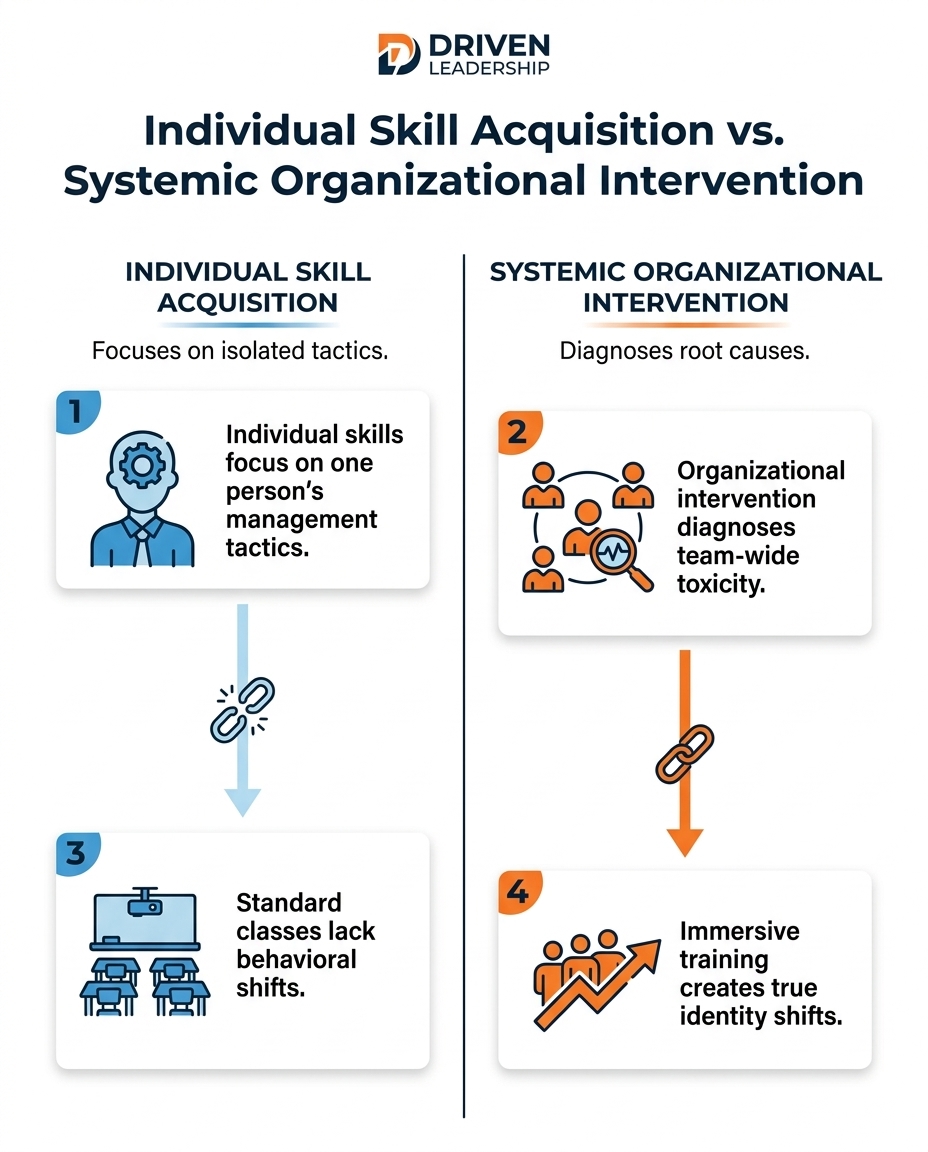
To truly fix a company in crisis, you have to understand the vast difference between training one person and intervening at the organizational level. Toxic culture is a system-level failure, not an isolated incident. Therefore, it requires a unified foundational shift among all leaders. Consider a real-world scenario where professionals seeking personal and professional development realized they needed to build a stronger foundation to communicate effectively. By participating in an advanced communication class that highlighted specific areas for improvement, they altered their thinking and significantly improved their communication abilities. This kind of targeted, deep-level intervention changes how a person operates within a system, rather than just giving them a checklist of tactics.
To achieve this kind of alignment across an entire company, you need organizational development that diagnoses the root causes of dysfunction and brings the whole team onto the same page.
• Target Audience — Individual Skill Acquisition (Local Classes): One or two mid-level managers. — Systemic Organizational Intervention: The entire leadership team and executive board.
• Core Curriculum — Individual Skill Acquisition (Local Classes): Standardized daily operational tactics. — Systemic Organizational Intervention: Diagnosing and dismantling toxic team behaviors.
• Learning Style — Individual Skill Acquisition (Local Classes): Passive, lecture-based, curriculum-driven. — Systemic Organizational Intervention: Immersive, behavioral-shifting, highly interactive.
• Impact on Crisis — Individual Skill Acquisition (Local Classes): Minimal; new skills are suppressed by the system. — Systemic Organizational Intervention: High; resets the cultural baseline for everyone.
• Long-Term Result — Individual Skill Acquisition (Local Classes): Individual earns a certificate, culture remains toxic. — Systemic Organizational Intervention: Unified team with shared language and accountability.
The Limits of Individual Training
Training one person does not change the environment they return to. If you send a well-meaning manager to a local leadership class, they might come back energized and full of new ideas. However, if the rest of the leadership team is still operating from a place of toxicity, those new skills are quickly suppressed. The existing toxic workflows, the unwritten rules of the office, and the lack of peer support will quickly drain that manager's enthusiasm. Eventually, the friction between how they want to lead and how the company forces them to lead will result in burnout or resignation.
The Mechanics of Organizational Development
Systemic intervention works entirely differently. For example, our approach at Driven Leadership starts by diagnosing the root cause of the crisis across the entire company, rather than assuming a lack of individual skill is the problem. It involves aligning the entire leadership team—founders, partners, and managers—on core values and acceptable behaviors. When the whole system shifts at once, there is no toxic environment left to suppress the new, healthy behaviors. Everyone is held accountable to the same new standard, creating a supportive framework where true leadership can thrive.
The High Cost of Ignoring Toxic Company Culture
Ignoring the root causes of a company crisis in favor of a quick fix is a dangerous gamble. Organizations with toxic cultures experience significantly higher turnover rates and noticeably lower productivity. When employees feel unsupported, micromanaged, or actively undermined by leadership, they do not perform at their best, and eventually, they leave. The financial and operational drain of this high turnover is staggering. Every time a key player walks out the door because of a toxic environment, you lose institutional knowledge, momentum, and team morale.
You also have to spend significant time and resources recruiting, hiring, and training their replacement—only to have that new person enter the exact same broken system. Poor leadership directly impacts your bottom line. If you want to understand the full scope of this impact, it is helpful to look at how poor leadership affects team performance and overall business results.
This brings us to the false economy of cheap, local classes. When Fall Q4 performance reviews uncover deep-rooted team friction, spending a small amount of money on a generic evening class feels like a safe, economical choice for a stressed founder. But if that class yields zero return on investment because the underlying system remains broken, you have not saved money. You have wasted it, while allowing the toxic culture to persist and cause further financial damage through lost productivity, missed deadlines, and ongoing staff turnover.
Creating Identity Shifts Through Immersive Behavioral Training
If generic classes do not work for a company in crisis, what is the alternative? Overcoming a deeply ingrained toxic culture requires leaders to push past their personal and professional limitations. It requires far more than just taking notes from a PowerPoint presentation or filling out a personality questionnaire. To fix a broken system, the people running that system have to change how they operate at a fundamental level.
This is where the approach must completely shift. Immersive, behavioral-shifting experiences (like BOLD training) create true identity shifts, exposing the limitations of standard performative classes. When leaders are put into intensive, challenging environments, they are forced to confront their own blind spots and default behaviors. Engaging in immersive BOLD training breaks down the walls that leaders build up to protect themselves in a toxic workplace, allowing them to rebuild healthier communication habits.
Breaking Out of Comfort Zones
True leadership growth requires discomfort. You cannot change a toxic culture by staying comfortable.
1. Acknowledge the baseline: Leaders must first recognize exactly how their current behaviors contribute to the toxic system, which requires intense honesty.
2. Experience the shift: There is a massive difference between reading a book about active listening and being placed in a high-stakes simulation where you must actively listen to succeed.
3. Embrace the discomfort: Immersive training forces participants out of their comfort zones, which is exactly where meaningful identity transformation happens.
Sustaining Long-Term Cultural Change
The ultimate goal of this deep work is translating personal identity shifts into organizational culture shifts. Once a leadership team has gone through an immersive behavioral shift together, they share a new baseline.
• Shared language: The team now has a common vocabulary to address friction before it escalates into a crisis.
• Mutual accountability: Because everyone experienced the shift together, peers can hold each other accountable to the new, healthy standards without it feeling like a personal attack.
• New healthy baselines: The toxic norms—like backchanneling or blame-shifting—are replaced with a culture of trust, direct communication, and aligned goals.
Frequently Asked Questions About Crisis Leadership and Toxic Culture
Can leadership training fix a toxic work culture?
Standard leadership training alone cannot fix a toxic work culture, but systemic organizational intervention can. While generic classes teach individual skills like time management and basic communication, they do not address the root causes of organization-wide dysfunction. To truly fix a toxic culture, a company must invest in behavioral-shifting experiences that align the entire leadership team on new, healthy baselines rather than just sending one person to a seminar.
What is the difference between leadership classes and organizational development?
Leadership classes focus on teaching individual tactics to a single person, whereas organizational development diagnoses and improves the entire company system. If you send one manager to a class, they return to the same broken environment and their new skills are quickly suppressed. Organizational development ensures that the environment itself changes, creating a solid foundation where new leadership skills can actually thrive and be supported by peers.
How do you fix a company in crisis?
Fixing a company in crisis requires immediate, systemic intervention rather than surface-level band-aids. Founders must look beyond standard "near me" searches for quick classes and commit to immersive behavioral training for their core team. By breaking down communication silos, establishing mutual accountability, and confronting toxic behaviors directly, the leadership team can dismantle the toxic culture from the top down and rebuild a functional system.
Are local leadership workshops worth it for new managers?
Local leadership workshops are highly valuable for baseline continuing education and teaching basic management mechanics. If your company already has a healthy, functioning culture, these classes are a great way to onboard new managers and teach them standard operating procedures. However, if your organization is in crisis, these workshops will not provide the deep identity shifts needed to turn the company around.
When should a founder seek systemic cultural intervention over individual training?
A founder should seek systemic intervention when turnover is high, cross-departmental friction is constant, and toxic behaviors are ingrained in the daily workflow. A clear indicator is when Fall Q4 performance reviews uncover deep-rooted team friction that individual coaching hasn't resolved. At that point, the entire system is failing, and only a unified, organization-wide shift will solve the problem.
Choosing the Right Intervention for Your Company's Future
When your organization is struggling, the path you choose dictates your future success. While local leadership classes absolutely have their place for continuing education and basic skill acquisition, a company in crisis needs a much deeper solution. Relying on a quick evening seminar to fix a deeply ingrained toxic culture is a recipe for continued frustration, wasted resources, and high turnover.
It is time to stop wasting time on the wrong solutions. If Fall Q4 performance reviews are uncovering deep-rooted team friction, we recommend getting a clear, objective breakdown of what is actually required to turn things around. Explore targeted, systemic organizational intervention. By choosing an immersive approach that creates true identity shifts, you can finally dismantle the toxicity and build the healthy, high-performing culture your company deserves.