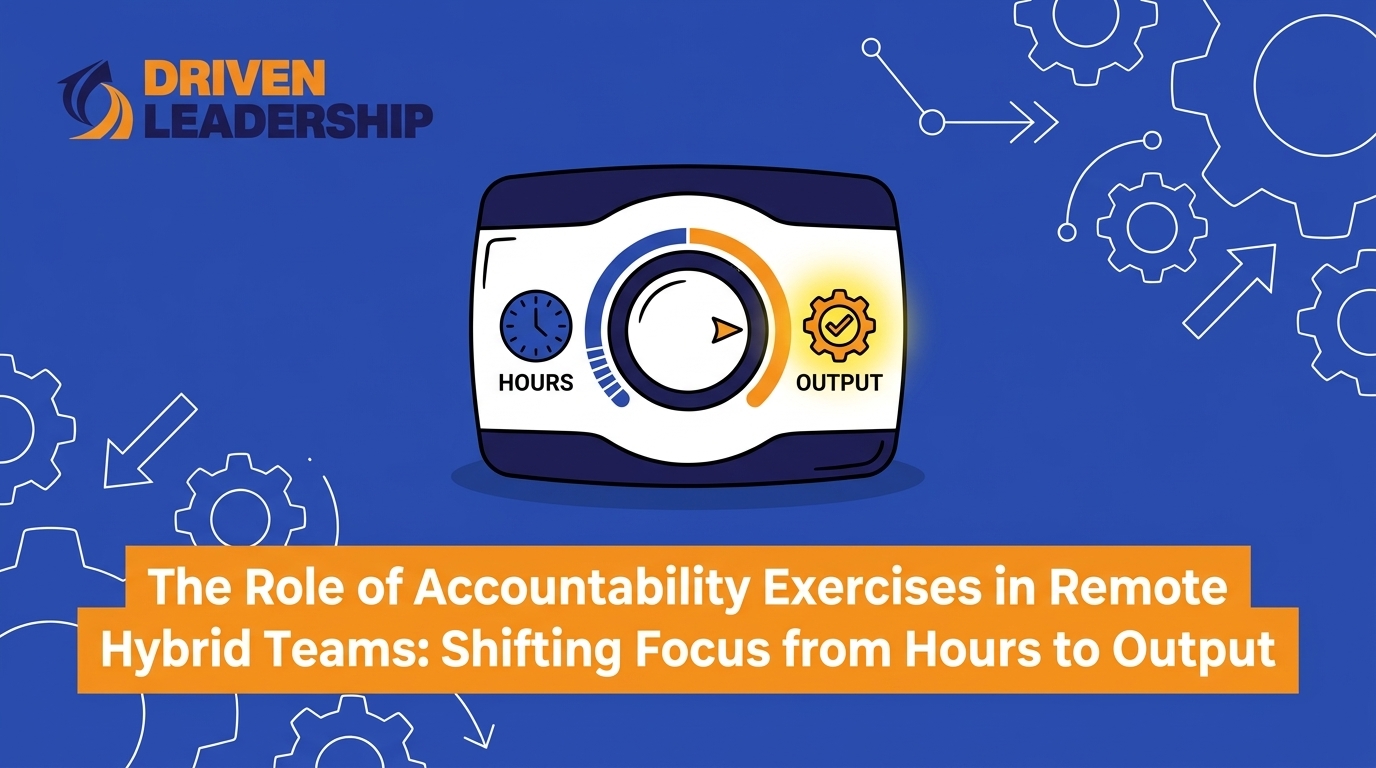
The Role of Accountability Exercises in Remote Hybrid Teams

Navigating the Shift from Physical Oversight to Output-Based Results
Your team is logging on every morning, but without seeing them at their desks, you might be left wondering if the real work is actually getting done. The role of accountability exercises in remote hybrid teams becomes absolutely critical when you can no longer rely on physical oversight to measure productivity. Managing by presence is a habit that dies hard for many mid-level managers. When you transition away from watching people work in an office setting, you must learn to measure what they actually produce. If you are struggling with this transition, our Virtual Management Academy provides the exact frameworks you need to lead effectively from afar.
As you push through the Q4 year-end goal sprint, this transition becomes urgent. Relying on passive observation simply does not scale in a distributed environment. Mid-level managers often face a specific, frustrating challenge: they know their team is busy, but they cannot easily verify if that busyness translates into meaningful progress. The instinct is to tighten the grip, schedule more meetings, and demand constant updates.
However, true accountability does not stem from surveillance or constant check-ins. It comes from structured, empowering frameworks that clarify expectations. When you shift your focus from physical oversight to output-based results, you give your team the autonomy they need to thrive while ensuring the business goals are met. This requires a fundamental behavioral shift in how you conduct check-ins, how you set daily goals, and how you measure success.
Signs You Are Still Managing by Presence
Many leaders do not realize they are clinging to physical oversight habits. If you notice these patterns in your own management style, it is time to pivot toward output-based metrics:
• Monitoring activity statuses: You frequently check if team members have a "green dot" on Slack or Teams.
• Demanding immediate replies: You expect instantaneous responses to emails and messages, regardless of the employee's current task.
• Equating hours with value: You praise employees who log the most hours, even if their actual deliverables are subpar.
• Micromanaging daily schedules: You require detailed daily itineraries rather than focusing on the week's final deliverables.
Why Time-in-Seat Metrics Fail Remote and Hybrid Teams
The core problem with remote management often traces back to a reliance on outdated metrics. Managers attempt to replicate the office environment by tracking when employees log in, how long they stay active, and how quickly they respond to messages. This approach creates a toxic environment of surveillance. The cause of this failure is a fundamental misunderstanding of what drives productivity. Tracking software and constant check-ins lead directly to employee burnout, decreased autonomy, and a breakdown in trust. When you rely on these tactics, you will quickly see how poor leadership affects team performance across the board.
The solution lies in adopting specific remote team accountability exercises that foster ownership. Driven Leadership's methodology focuses heavily on output and behavioral shifts over "time-in-seat" metrics, ensuring leaders manage actual results rather than policing schedules. When you focus on behavioral changes, you create a more resilient distributed workforce that understands how their specific contributions move the needle.
The Illusion of Productivity Through Surveillance
Hours logged online simply do not equate to actual deliverables. An employee can easily keep their screen active for eight hours while producing very little of value. Conversely, a highly efficient employee might complete their critical tasks in five hours. If you punish the efficient employee for logging off early, you incentivize slow, inefficient work.
According to Gallup, only 2 in 10 employees strongly agree that their performance is managed in a way that motivates them to do outstanding work. Furthermore, data from the Harvard Business Review shows that output-based management increases employee autonomy and significantly reduces burnout compared to active monitoring. Micromanagement destroys morale and ultimately hurts your bottom line.
• Surveillance-Based — Primary Metric: Hours logged online — Employee Impact: High burnout, low trust — Business Result: Inefficiency, high turnover
• Behavioral Accountability — Primary Metric: Quality of deliverables — Employee Impact: High autonomy, strong trust — Business Result: Efficient output, goal achievement
Combating Seasonal Isolation with Structured Engagement
Managing remote teams requires an awareness of the psychological barriers your employees face, especially during seasonal transitions. Environmental factors heavily exacerbate remote detachment and isolation. For example, managing teams through dark, isolating Pacific Northwest winters—a reality for many businesses around the Puyallup and Seattle areas—highlights the deep psychological need for strong, output-focused check-ins. When the sun sets before the workday ends, remote workers often feel disconnected from their peers and the broader company mission.
Structured accountability frameworks double as vital psychological connection points for these isolated workers. When you implement a predictable rhythm of engagement, you give your team a sense of stability and belonging. They know exactly when they will connect with you, what is expected of them, and how their work contributes to the larger picture.
Maintaining alignment during the Q4 year-end goal sprint requires proactive engagement structures. This is not the time to leave your team drifting in isolation. By scheduling specific, output-focused touchpoints, you combat the seasonal slump and keep the momentum high. These touchpoints should never feel like a manager checking up on a worker; rather, they should feel like a coach clearing obstacles so the team can score.
The Psychological Impact of Predictability
When remote workers lack a structured engagement plan, their anxiety increases. They spend mental energy worrying about whether they are doing enough, rather than focusing on the work itself. By establishing clear, predictable accountability routines, you remove that anxiety. Your team knows exactly how their performance is measured, which frees them to focus entirely on execution.
Essential Accountability Training Activities for Distributed Workforces
Shifting your management style requires practical application. You need concrete, actionable exercises that you can implement immediately to shift your team's focus toward output. Effective remote team accountability exercises differ significantly from generic virtual team building. While virtual happy hours might build rapport, accountability training activities build operational discipline and trust. If your group needs a structured environment to master these skills, exploring dedicated team execution programs can accelerate the process.
Here are three essential activities you can integrate into your weekly management cadence:
1. The Daily Output Huddle: Shift your daily stand-up from a boring status report to an obstacle-clearing session. Instead of asking, "What did you do yesterday?" ask, "What is your primary deliverable today, and what roadblocks are in your way?" This focuses the conversation entirely on output and support.
2. Peer-to-Peer Commitments: Decentralize accountability away from just the manager. Pair team members up and have them state one specific commitment to each other for the week. When peers hold each other accountable for deliverables, the pressure on the manager decreases, and team cohesion increases.
3. The Retrospective Review: At the end of a project sprint, hold a review that analyzes outcomes rather than hours spent. Ask the team what worked, what failed, and how the process can be improved for the next cycle. This exercise reinforces the idea that the final product is what matters most.
Implementing the Exercises Effectively
Do not introduce all these activities at once. Start with the Daily Output Huddle to establish a baseline of communication. Once the team is comfortable discussing roadblocks openly, introduce Peer-to-Peer Commitments. The goal is to build a culture where accountability is viewed as a supportive tool for success, rather than a punitive measure for failure.
How to Build a Remote Team Accountability Action Plan
To make these behavioral shifts permanent, you need a formal action plan. The core purpose of an accountability action plan in a hybrid setting is to eliminate ambiguity. Every team member must know exactly how their success is measured and how they are expected to communicate their progress. Building this framework is a core component of our Engage Elevate Program, which equips leaders to build high-performing teams.
Follow these steps to create a robust remote team accountability action plan:
• Define clear, measurable output metrics for each role: Stop tracking hours. Identify the 3-5 key deliverables that define success for each specific position on your team.
• Establish asynchronous communication protocols: Determine which updates require a live meeting and which can be handled via project management software or a quick message.
• Schedule regular, structured 1-on-1 behavioral feedback loops: Use these meetings to discuss professional development, clear major roadblocks, and review the quality of deliverables.
• Integrate specific remote team accountability exercises: Bake the Daily Output Huddle and Retrospective Reviews directly into the team's weekly calendar so they become non-negotiable habits.
• Review and adjust the plan based on deliverable success: Evaluate the plan monthly. If the deliverables are hitting the mark, the plan is working—regardless of how many hours the team is logging.

Measuring Deliverables Over Logged Hours
Synthesizing these actionable steps into a broader philosophical shift is challenging for mid-level managers. The most common hurdle is the lingering fear of losing control. When you stop tracking time, it feels like you are flying blind. However, you are actually trading a false sense of control (watching a green dot on a screen) for true operational control (measuring the quality and timeliness of actual work).
To evaluate the quality and timeliness of deliverables effectively, you must set crystal-clear expectations up front. A deliverable is only useful if it meets the required standard and arrives on time. If an employee struggles to meet these standards under an output-based model, you now have concrete data to address the performance issue. You can say, "The report was due Thursday and lacked the required data analysis," rather than, "You seemed offline a lot on Wednesday."
This shift is vital for maintaining momentum through the Q4 year-end goal sprint. When the pressure is high, you cannot afford to waste time policing schedules. You need your team focused entirely on crossing the finish line. Measuring deliverables over logged hours ensures that every ounce of team energy goes toward achieving the actual business goals.
Handling Performance Issues in an Output Model
When an employee fails to deliver, the output model makes course correction much easier. Because the metrics are objective, the conversation removes personal bias. You focus entirely on the work. Ask the employee what specific roadblocks prevented the deliverable from meeting the standard. Often, you will find that the issue was a lack of resources, unclear instructions, or a bottleneck in another department, rather than a lack of effort.
Frequently Asked Questions About Remote Accountability
How do you build accountability in a remote team?
You build accountability in a remote team by focusing on clear expectations, trust, and output rather than micromanagement. Establish exactly what success looks like for each role and provide the resources needed to achieve those specific deliverables. When leaders step back from tracking hours and step into clearing roadblocks, team members naturally take greater ownership of their responsibilities.
What are examples of accountability exercises?
Effective remote team accountability exercises include peer-to-peer commitments, output-focused daily huddles, and retrospective reviews. Peer-to-peer commitments decentralize pressure by having teammates hold each other to weekly goals. Output huddles shift daily meetings away from status updates and toward clearing obstacles, while retrospective reviews analyze the final outcomes of a project sprint to improve future performance.
How do you hold hybrid employees accountable without micromanaging?
You hold hybrid employees accountable without micromanaging by shifting entirely to deliverable-based metrics and empowering them with autonomy over their schedules. Instead of dictating how and when the work gets done, dictate what the final product must look like and when it is due. This respects their professional autonomy while ensuring the business receives the necessary results.
How do you create an accountability action plan?
You create an accountability action plan by outlining specific goals, establishing asynchronous check-ins, and defining success strictly by results. Start by defining 3-5 measurable output metrics for each role. Then, schedule regular behavioral feedback loops and integrate structured exercises into the weekly calendar so expectations remain clear and consistent.
How do you measure output instead of hours worked?
You measure output instead of hours worked by using project milestones, quality assessments, and deadline adherence as your primary indicators of success. Evaluate whether the final deliverable met the required standard and was submitted on time. If the work is excellent and punctual, the number of hours the employee sat at their desk is irrelevant.
Empowering Your Team for Long-Term Autonomy
The transition from physical oversight to structured, output-focused empowerment is one of the most critical shifts a modern leader must make. When you implement proper frameworks, you respect your employees' autonomy while guaranteeing that business goals are met. This balance is the hallmark of a mature, highly functioning distributed workforce.
Do not wait until productivity slips to make these changes. Finalize your accountability frameworks ahead of the Q4 year-end goal sprint to ensure your team has the clarity and support they need to finish the year strong. If you are ready to build a more resilient, self-directed team, explore our leadership trainings to master the skills required for effective virtual management.