Why Puyallup Logistics Companies Invest in Advanced Leadership Training

The Breaking Point of Rapid Scale in the Pierce County Logistics Hub
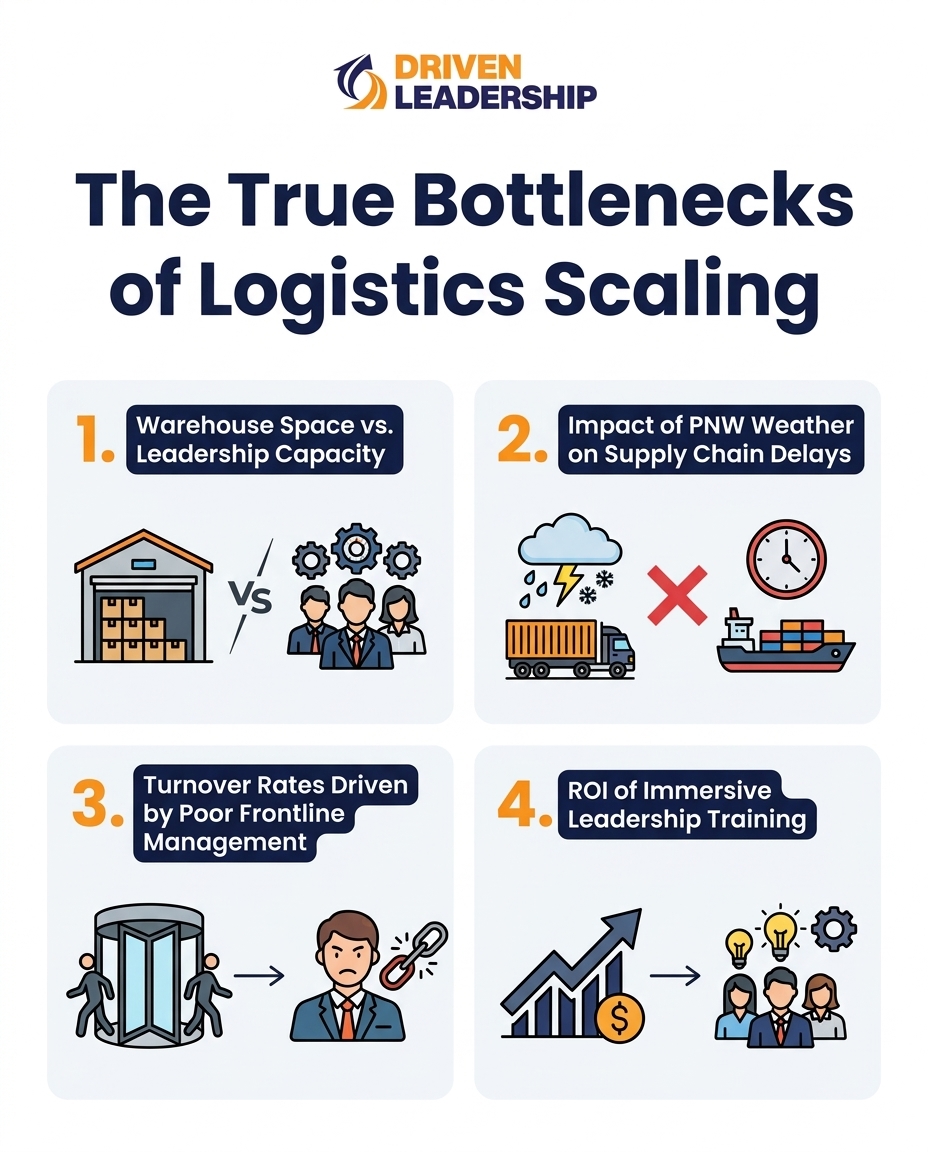
Your warehouse floor is expanding, new fleets are rolling in, and the Q4 peak fall shipping season is looming, but daily operations feel more chaotic than controlled. That is exactly why Puyallup logistics companies invest in advanced leadership training. In the rapidly scaling Pierce County logistics hub, simply adding more square footage or hiring extra hands on the floor is no longer enough to survive the upcoming seasonal surge. The real bottleneck to your operational growth isn't a lack of physical resources or sophisticated software—it is the capacity of your mid-level warehouse managers to make critical, rapid-fire decisions under immense pressure. When regional expansion outpaces internal leadership development, daily operations inevitably hit a breaking point. To truly capitalize on the industrial growth tied to the Port of Tacoma, logistics directors must address this hidden constraint before the peak shipping window closes.
Learn more about our advanced leadership program and discover how an advanced leadership course can transform your frontline management strategy.
The Illusion of Infinite Expansion
The explosive growth of the Pierce County logistics hub has created unprecedented opportunities for local transport and warehousing companies. However, this regional boom also masks a critical operational vulnerability. Many organizations operate under the assumption that scaling a logistics business is a simple math equation: double the warehouse footprint, double the workforce, and double the output. The reality on the warehouse floor tells a very different story. As operations scale, the complexity of managing those operations scales exponentially, not linearly.
The tipping point of scale: There comes a specific moment in every growing logistics company when physical constraints—like available loading docks or fleet size—are no longer the primary roadblocks to profitability. Instead, the friction shifts to human capital. A massive facility with state-of-the-art inventory software will still grind to a halt if the supervisors running the floor cannot effectively delegate tasks, resolve interpersonal conflicts, or pivot when a scheduled delivery window is missed. Surviving the Q4 peak fall shipping season requires a management team that possesses the cognitive and emotional tools to navigate continuous operational stress without passing that anxiety down to the frontline workforce.
Moving Frontline Supervisors from Reactive Firefighting to Proactive Management
One of the most common organizational traps in the warehousing sector is the "Peter Principle"—promoting your absolute best forklift driver or fastest picker into a supervisory role without providing them the foundational tools required to actually lead people. Rapid scaling forces these excellent frontline workers into management positions out of sheer necessity. While they possess deep technical knowledge of the facility's operations, they often lack the interpersonal frameworks needed to guide a team through high-stress environments.
The Cost of the Reactive Trap
Without proper development, these newly minted supervisors default to what they know best: doing the work themselves. This creates a culture of "reactive firefighting." Instead of optimizing team workflows or anticipating the next shift's bottlenecks, these managers spend their days chasing lost pallets, covering for absent staff, and handling isolated crises as they erupt. This constant state of emergency limits the facility's throughput and directly illustrates how poor leadership affects team performance on a fundamental level.
Consider the daily friction this creates during the Q4 peak fall shipping season. A typical pattern we see with warehouse supervisors elevated directly from the floor is a struggle to take charge in high-stakes meetings or during critical shift handoffs. For example, a recent participant in our program entered the spring training cycle lacking the confidence to communicate effectively when operational bottlenecks occurred. They hesitated to redirect their former peers, leading to massive inefficiencies. By engaging in immersive advanced leadership training focused on active listening and core confidence, this supervisor learned to carry greater authority, take charge when needed, and vastly improve communication skills across the floor.
Shifting to Proactive Delegation
Transitioning from a firefighter to a proactive manager requires a deliberate shift in perspective. Proactive leaders do not wait for a crisis to manifest; they anticipate the friction points before the shift even begins. This transition involves several key behavioral changes:
• Anticipating roadblocks: Reviewing incoming manifest data to identify potential staffing shortages before the trucks arrive at the bay.
• Confident delegation: Trusting the team to execute technical tasks while the supervisor maintains a high-level view of the entire floor's workflow.
• Clear communication: Delivering instructions with absolute clarity, ensuring that safety protocols and efficiency standards are universally understood.
• Conflict resolution: Addressing interpersonal disputes on the floor immediately, rather than allowing resentment to fester and impact productivity.
When frontline supervisors master these proactive skills, the entire facility breathes easier. The frantic energy of the warehouse is replaced by a methodical, controlled hum of productivity, even during the most demanding shipping windows.
Weathering Pacific Northwest Supply Chain Disruptions
Operating a logistics hub in the Pacific Northwest introduces a unique set of environmental variables that directly impact supply chain reliability. As October and November roll in, unpredictable weather patterns become a daily operational hurdle. Heavy rain, high winds, and early winter storms routinely disrupt transit times along the I-5 corridor, causing severe cascading delays at the loading docks.
Dynamic Adaptation on the Loading Dock
When regional weather disrupts the carefully planned logistics schedule, workforce stress levels spike. Trucks that were supposed to arrive staggered throughout the morning suddenly show up simultaneously in the mid-afternoon. Outbound shipments are delayed, pallets pile up in the staging areas, and the physical space on the floor becomes dangerously constricted. In these moments of climate-induced chaos, rigid management frameworks completely fall apart. A supervisor who only knows how to follow a static daily checklist will freeze when that checklist is rendered useless by a four-hour transit delay.
This is where resilient, dynamic leadership becomes non-negotiable. To keep operations moving within the Pierce County logistics hub, supervisors must possess the mental agility to rewrite the playbook on the fly. They need the confidence to reallocate labor dynamically, prioritize critical outbound freight, and keep morale high when the team is forced into mandatory overtime due to weather delays.
• Simultaneous late arrivals due to heavy rain — Rigid Management Response: Overwhelms the dock, creates unsafe staging conditions, panics the team. — Resilient Leadership Response: Quickly triages incoming freight, reassigns pickers to receiving, maintains calm.
• Sudden staffing shortage during a storm — Rigid Management Response: Attempts to do the physical work themselves, losing sight of the overall workflow. — Resilient Leadership Response: Communicates the revised expectations, prioritizes essential tasks, delegates effectively.
• Extended transit delays impacting outbound loads — Rigid Management Response: Blames dispatch, allows floor morale to plummet as frustration builds. — Resilient Leadership Response: Keeps the team informed, uses downtime for staging prep, maintains a positive operational tempo.
Adapting to the realities of Pacific Northwest weather requires more than just waterproof gear; it requires leaders who do not panic when the schedule breaks down. Building this level of resilience on the warehouse floor is a primary reason why Puyallup logistics companies invest in advanced leadership training.
Why an Advanced Leadership Course Outperforms Standard HR Seminars
The industrial sector has long relied on standard corporate seminars to check the box for management training. These traditional programs usually involve a day spent in a sterile conference room, watching slide presentations on generic communication strategies, and filling out multiple-choice worksheets. While this format might suffice for basic compliance tracking, it fails spectacularly when applied to the demands of a high-stress logistics environment.
The Identity-Shifting Difference
Standard seminars often fail to change actual behavior on the warehouse floor because they only address the surface level of management: the "what" and the "how." They provide a checklist of best practices but do nothing to address the core confidence, emotional intelligence, and self-awareness of the individual. When the Q4 peak fall shipping season hits and the pressure mounts, supervisors inevitably revert to their baseline behaviors, abandoning the seminar checklists entirely.
True transformation requires identity-shifting, immersive programs rather than standard corporate seminars. This is the cornerstone of effective organizational development. Immersive training fundamentally changes how leaders view their roles and themselves. It forces participants to confront their own limitations, communication barriers, and stress responses in a controlled, high-stakes environment.
• Experiential learning: Moving beyond theory into practical, scenario-based exercises that mimic the pressure of the warehouse floor.
• Core confidence building: Helping leaders discover their authentic voice, allowing them to command respect without resorting to authoritarian aggression.
• Emotional regulation: Teaching supervisors how to process their own stress so they can remain a stabilizing force for their team during chaotic shifts.
• Peer accountability: Fostering a network of internal support among mid-level managers, ensuring that the training principles are reinforced long after the course concludes.
By investing in this deeper level of development, logistics directors equip their management teams to handle rapid scaling without burning out. The result is a leadership bench that doesn't just survive peak volume, but actively thrives in it.
Curbing Warehouse Turnover Through Empowered Executive Management
The logistics industry is notoriously competitive when it comes to labor, and retaining top talent is a constant battle. While wage increases and benefit packages are important, industry data consistently shows that high turnover rates in warehousing often stem directly from poor frontline management. The old adage holds true: employees do not quit companies; they quit bad managers.
The Ripple Effect of Confident Leadership
Losing experienced logistics staff is always painful, but experiencing a mass exodus of talent right before or during the busy fall season can cripple a facility's throughput. The cost of turnover extends far beyond the immediate hiring expenses. It includes the lost productivity of the vacant role, the time spent onboarding a replacement, and the inevitable increase in errors as the new hire learns the specific workflows of the Pierce County logistics hub.
Implementing a robust executive manager program sets the tone for the entire facility. When frontline workers feel supported by competent, confident leaders, retention and productivity naturally stabilize. Empowered executive managers understand how to build psychological safety on the floor, ensuring that workers feel comfortable reporting safety hazards or suggesting process improvements without fear of reprimand.
1. Establish clear expectations: Confident leaders remove ambiguity, ensuring every floor worker knows exactly what success looks like for their shift.
2. Provide consistent feedback: Moving away from annual reviews to real-time, constructive coaching that helps employees grow their skills.
3. Recognize and reward: Acknowledging hard work publicly, which builds loyalty and reinforces positive behaviors during high-stress periods.
4. Advocate for the team: Strong managers act as a buffer between executive demands and frontline realities, protecting their team from unnecessary burnout.
When a warehouse operates under this caliber of leadership, it transforms from a revolving door of temporary labor into a destination workplace for skilled logistics professionals.
Frequently Asked Questions About Logistics Leadership Development
Why is leadership important in supply chain management?
Strong leadership ensures teams can pivot quickly when systems fail or delays occur. Supply chains are highly dynamic and inherently prone to disruption, from weather delays to sudden shifts in consumer demand. Without capable leaders on the warehouse floor, these disruptions cause operations to grind to a halt. Effective leadership maintains the forward momentum, keeping the workforce focused, safe, and productive even when the original daily plan falls apart.
What makes a good logistics manager in a high-volume hub?
The ability to remain calm under pressure is the defining trait of a successful logistics manager. In a high-volume facility, crises are a daily occurrence, and a manager's anxiety is highly contagious to the rest of the team. A good manager combines this emotional regulation with strong communication skills, allowing them to delegate effectively, prioritize tasks accurately, and maintain rigorous safety standards during peak shipping volumes.
What is included in an advanced leadership and management course?
Immersive scenario training and identity-shifting exercises form the core of advanced programs. Unlike standard seminars that rely on passive lectures, advanced courses utilize experiential learning to build core confidence and self-awareness. Participants are equipped with practical tools for active listening, conflict resolution, and emotional intelligence, fundamentally changing how they interact with their teams on the warehouse floor.
How do you train warehouse supervisors without disrupting daily operations?
Utilize targeted, immersive events combined with ongoing virtual support to minimize floor absence. The most effective training models condense the most impactful identity-shifting work into focused, intensive sessions, followed by continuous integration coaching. This approach ensures that supervisors spend less time in a classroom and more time applying practical, newly acquired skills directly to their daily operational challenges.
How does leadership training impact warehouse safety compliance?
Confident leaders enforce safety standards more consistently and effectively. When supervisors lack the confidence to confront unsafe behaviors, compliance slips, increasing the risk of severe accidents. Better communication and proactive management reduce the likelihood of rushed, unsafe practices during peak volume, ensuring that safety protocols are viewed as non-negotiable requirements rather than optional suggestions.
Equip Your Puyallup Logistics Team for the Challenges Ahead
Surviving the pressures of rapid scale in the Pierce County industrial sector requires far more than just expanding your physical footprint. It demands a proactive, targeted investment in the people who actually run your operations day in and day out. If your frontline managers are stuck in a cycle of reactive firefighting, your facility will never reach its true throughput potential, especially when the Q4 peak fall shipping season pushes your systems to their absolute limit.
Now is the time for logistics directors and operations executives to honestly evaluate their current leadership capacity. Are your supervisors prepared to handle the incoming volume, or are they already showing signs of burnout? Don't wait until the supply chain bottlenecks become unmanageable. Equip your team with the tools they need to lead with confidence, adapt to disruptions, and stabilize your workforce. Explore an advanced leadership course today to secure your operational success for the challenges ahead.