Using the Innermetrix DISC Assessment to Resolve October Project Bottlenecks

The Reality of the Q4 Sprint: Why Teams Buckle in Mid-Fall
Using the Innermetrix DISC assessment to resolve October project bottlenecks is often the deciding factor between a team that finishes the year strong and one that fractures under the pressure. As the third quarter closes, the workplace dynamic undergoes an immediate, palpable shift. In our years of partnering with local businesses here in Puyallup and across the Pacific Northwest, we've seen how the literal transition into fall brings rapidly shifting weather and noticeably shorter days, which can compound seasonal fatigue. Just as the physical climate changes outside, the corporate climate shifts indoors as businesses enter the high-stakes, high-pressure Q4 sprint.
During this October Q4 push, previously high-performing teams often begin to show signs of strain. You might notice missed micro-deadlines, an uptick in passive-aggressive communication, or a sudden inability to reach consensus on routine decisions. These are the classic symptoms of a team buckling under year-end pressure. As a leader, you face a critical decision point: you can either attempt to force the team through the friction using sheer willpower, or you can proactively diagnose the root cause of the slowdown.
Leveraging an objective Innermetrix Leadership Assessment allows you to take the latter approach. By treating these slowdowns as measurable behavioral data rather than vague personality conflicts, you can unlock seasonal bottlenecks before they derail your end-of-year deliverables. In our coaching sessions, we constantly remind leaders that the friction your team is experiencing is rarely a mystery; it is a predictable response to stress that can be identified, measured, and resolved.
Technical Deficits vs. Behavioral Breakdowns
At Driven Leadership, we frequently observe that by the time October arrives, the technical skills of your team are rarely the cause of sudden project delays. Your engineers know how to engineer, your sales team knows how to sell, and your project managers know how to build timelines. If a project suddenly stalls in mid-fall, a lack of competence is almost never the culprit.
Instead, these slowdowns are driven by behavioral bottlenecks—friction caused by misaligned communication and predictable stress responses. Our historical project management data consistently points to human friction as the primary cause of late-stage project failures. When the pressure of the October Q4 push mounts, individuals revert to their most deeply ingrained behavioral habits, which often clash violently with the habits of their peers.
• Technical Deficit — Root Cause: Lack of specific skill or knowledge — Typical Symptom: Errors in the actual work product — Resolution Approach: Additional training or resources
• Behavioral Breakdown — Root Cause: Misaligned stress responses — Typical Symptom: Work product is fine, but delivery is delayed by conflict — Resolution Approach: Objective behavioral diagnostics
Recognizing the Signs of Behavioral Friction
To resolve these issues, you must first recognize what an invisible behavioral bottleneck looks like in practice. Because team members rarely announce that they are stressed and communicating poorly, our facilitators train leaders to look for the operational symptoms:
• Endless email chains: Increased back-and-forth messaging that loops endlessly without ever reaching a firm resolution or next step.
• Siloed execution: Collaborative work behavior is suddenly replaced by individuals retreating to their desks, hoarding information, and refusing to ask for help.
• Defensive posturing: Status meetings shift from productive updates to defensive sessions where team members spend more time protecting their territory than solving the problem.
When you see these signs, you need an objective framework to measure this friction. Without a diagnostic tool, we see leaders often resort to guessing, which only exacerbates the tension.
How the Innermetrix DISC Assessment Diagnoses Stress Responses
The Innermetrix DISC Assessment serves as a highly precise diagnostic instrument tailored for active, real-time bottleneck resolution. Unlike generic behavioral models, this tool measures the specific mechanics of how individuals process information, make decisions, and interact with others.
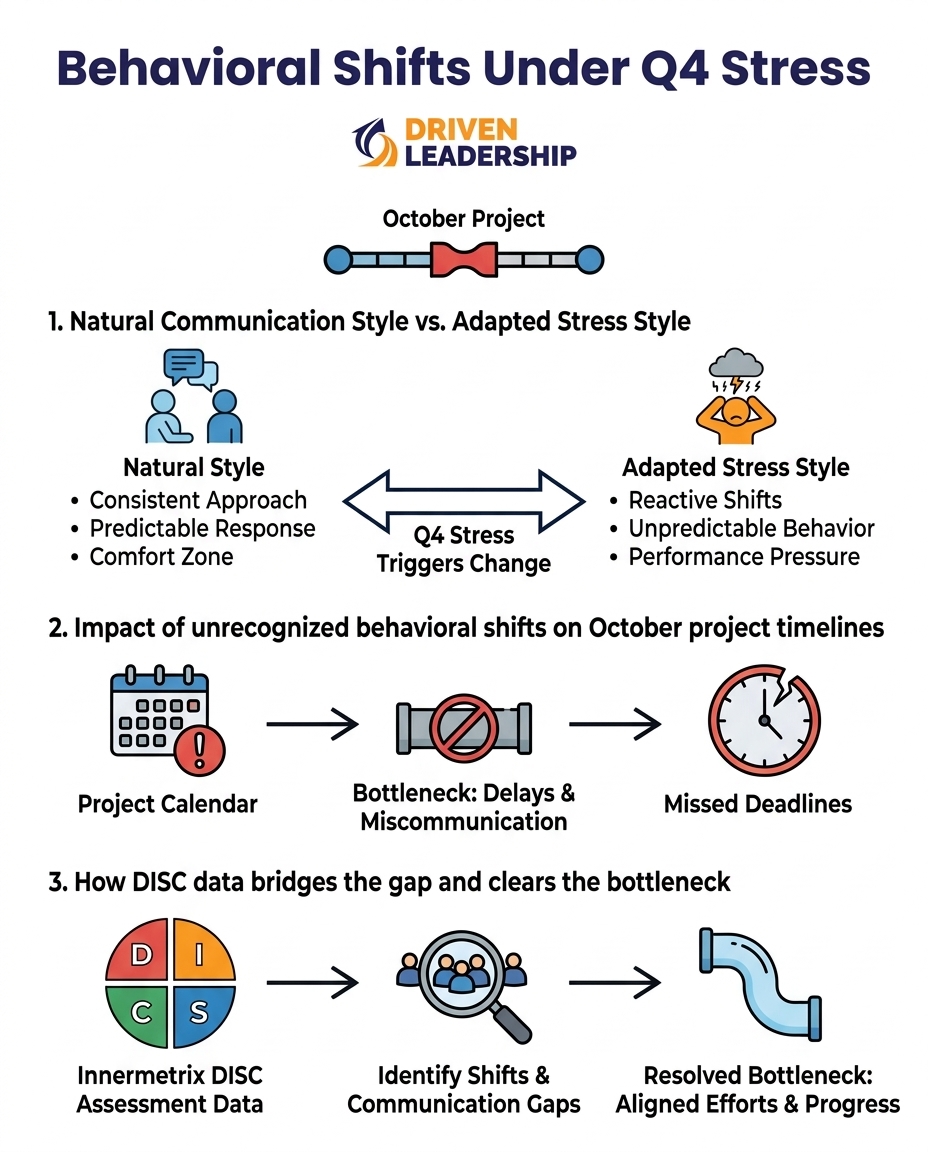
When evaluating an Innermetrix DISC vs Standard Personality Tests, the critical difference lies in the measurement of natural versus adapted behavioral styles. Your natural style is how you behave when you are completely relaxed and free of external pressure. Your adapted style is how you modify your behavior to survive what you perceive to be the demands of your environment.
Under the weight of year-end deadlines, the gap between a person's natural style and their adapted style often widens drastically. This requires an immense amount of psychological energy, leading to rapid burnout and erratic communication. Our team at Driven Leadership utilizes this assessment to provide concrete, data-backed behavioral insights. This moves you far beyond generic "communicate better" management advice, allowing you to pinpoint the exact friction points causing your project to stall. Framing the assessment as a critical mid-project intervention removes the stigma of "fixing" broken employees and focuses entirely on optimizing team execution.
Mapping Behavioral Shifts Under Q4 Pressure
To understand why a previously smooth-running team is now stalling, you have to map how different behavioral profiles react to the October deadline crunch. The Innermetrix DISC Assessment categorizes these behaviors into four primary dimensions: Dominance (D), Influence (I), Steadiness (S), and Compliance (C). Each style has a highly predictable stress response that, if left unmanaged, creates a unique type of project bottleneck.
• High-D (Dominance) — Natural Strength: Decisive, results-oriented — Adapted Stress Response in Q4: Becomes overly aggressive and dictatorial — Resulting Bottleneck: Alienates team members, causing others to withhold critical information
• High-I (Influence) — Natural Strength: Optimistic, persuasive — Adapted Stress Response in Q4: Over-promises and avoids difficult conversations — Resulting Bottleneck: Details are dropped, leading to missed micro-deadlines
• High-S (Steadiness) — Natural Strength: Supportive, consistent — Adapted Stress Response in Q4: Resists rapid structural changes and shuts down — Resulting Bottleneck: Pace of execution slows dramatically as they demand stability
• High-C (Compliance) — Natural Strength: Accurate, detail-focused — Adapted Stress Response in Q4: Falls into severe analysis paralysis — Resulting Bottleneck: Refuses to release work until it is "perfect," stalling the next phase
When a High-D leader pushes for faster results, a High-C team member will instinctively slow down to ensure accuracy, while a High-S member may quietly disengage from the conflict altogether. This clashing of stress responses halts project momentum entirely.
These behavioral shifts are not permanent flaws; they are acute reactions to pressure. For example, during one of our recent leadership programs, a professional seeking a personal and professional transformation realized that their adapted stress style was acting as a severe bottleneck for their department. The objective data from the assessment served as a powerful "wake up" call, leading to a permanent, positive change in how they handled high-stakes project phases. By understanding these shifts neutrally, you remove the emotion from the conflict.
Translating Insights into Immediate Team Execution
Having the data is only the first step; you must translate these insights into actionable steps to clear your current project blockages. The October Q4 push does not afford you the luxury of a week-long corporate retreat. You need a fast, step-by-step approach to realign the team and restore effective Team Execution. Here is the framework we recommend:
1. Review the data objectively: Present the assessment results to the team in a safe, neutral environment. Frame the conversation around "how we work under pressure" rather than "what you are doing wrong." This immediately de-escalates defensive posturing.
2. Realign project roles based on current strengths: Look at the actual tasks required to cross the finish line. If a High-C team member is stuck in analysis paralysis on a rapid-prototyping task, temporarily shift that responsibility to a High-D or High-I member who thrives on quick, iterative momentum. Align tasks with natural behavioral strengths rather than just formal job titles.
3. Establish targeted communication protocols: Design specific rules for the Q4 sprint based on the team's makeup. If the team is heavy on High-S profiles, mandate written agendas 24 hours before meetings to give them time to process. If the team is heavy on High-D profiles, enforce a "bottom-line first" rule for all internal emails.
4. Create immediate relief for severe bottlenecks: Identify the single biggest point of friction in your current project timeline. Use the assessment data to mediate the conflict between the specific individuals involved, giving them a shared vocabulary to explain their stress responses and agree on a compromise.
Building Long-Term Organizational Resilience from Q4 Data
While the immediate goal is to clear the October bottleneck, the data gathered during this crunch is highly valuable for next year's strategic planning. Surviving the Q4 push using objective behavioral insights builds a stronger, more resilient foundation for your leaders and communicators.
When individuals learn how to navigate their stress responses in real-time, they develop a structural resilience that prevents future burnout. During one of our winter leadership development experiences, we watched a participant facing significant personal and professional growth challenges discover that these behavioral insights do more than just solve immediate conflicts. They challenge individuals to step up, take ownership of their communication styles, and become better versions of themselves through testing and growth.
This continuous process is the bedrock of effective Organizational Development. By integrating the Innermetrix DISC Assessment into your standard operating procedures, you transition from constantly reacting to seasonal crises to proactively designing teams that can withstand high-pressure environments. The goal is not just a seasonal fix, but a permanent upgrade to your company's operational maturity.
Frequently Asked Questions About Mid-Project Behavioral Diagnostics
How does the Innermetrix DISC assessment improve team communication?
The assessment improves communication by providing an objective, neutral vocabulary to discuss conflict. Instead of accusing a coworker of being "stubborn" or "reckless," team members can identify that they are simply clashing over High-C and High-D behavioral traits. This removes personal bias and emotion from communication breakdowns, allowing the team to focus on solving the actual project issue.
How do you resolve project bottlenecks under stress?
You resolve project bottlenecks by first identifying the specific behavioral friction point causing the delay. Once you understand how the individuals involved are adapting to stress, you can realign tasks to match their natural strengths rather than forcing them to work through their adapted stress behaviors. This immediately lowers the psychological energy required to complete the work, restoring momentum.
Why do teams struggle with communication specifically in Q4?
Teams struggle in Q4 due to the compounded fatigue accumulated throughout the year, combined with heightened stakes. The immovable nature of end-of-year deadlines triggers deep-seated stress responses in almost every behavioral profile. When everyone on a team simultaneously shifts into their adapted stress style, natural communication pathways break down rapidly.
Is October too late to introduce a behavioral assessment?
No, October is actually an ideal time to use the assessment as an acute diagnostic tool for immediate intervention. The assessment takes minimal time to complete, but the insights it provides can save countless hours of friction and wasted meetings. It serves as a rapid realignment tool exactly when the team needs it most.
What is the difference between this and standard personality tests?
The primary difference is that the Innermetrix DISC Assessment focuses heavily on behavioral execution and stress adaptation in professional environments, rather than just abstract personality traits. It provides actionable, measurable project data that leaders can use to restructure workflows and clear bottlenecks, making it a functional business tool rather than just a personal insight exercise.
Clear Your Q4 Blockages and Finish the Year Strong
October project bottlenecks are entirely solvable when you have the right behavioral data in hand. By recognizing that late-stage project friction is driven by misaligned stress responses rather than technical failures, you can take immediate, targeted action. A clear, neutral explanation of these behavioral shifts brings immediate relief to struggling teams, allowing them to drop their defensive posturing and refocus on execution.
Do not wait until the friction turns into a failed deliverable. By deploying the Innermetrix DISC Assessment during the October Q4 push, you can diagnose the root cause of your team's slowdown and realign their efforts for maximum efficiency. If you are ready to clear your current blockages and equip your leaders with the tools to prevent future burnout, explore our Advanced Insights Training to ensure your team finishes the year strong.