Preparing Your Puyallup Manufacturing Team for the End-of-Year Push

The Real Q4 Bottleneck Looming Over Puyallup Facilities
The warehouse floor is already running near capacity, and the holiday volume spikes haven't even hit yet. Preparing Your Puyallup Manufacturing Team for the End-of-Year Push requires more than just servicing forklifts and forecasting inventory—it requires immediate attention to human bottlenecks. The impending Q4 supply chain rush brings unprecedented pressure to local logistics hubs, threatening to overwhelm underprepared teams. If your shift supervisors are already struggling to communicate clearly during normal operations, the holiday surge will expose and magnify every single crack in your foundation.
Addressing these communication gaps during the September pre-Q4 transition is the only way to build resilience before the October volume spikes. At Driven Leadership, our team typically sees facility directors focus entirely on equipment maintenance and seasonal hiring, completely missing the true breaking point: leadership communication failing under stress. By investing in organizational development now, you ensure that shift handoffs, daily operations, and team morale remain stable when the pressure peaks across the Puyallup industrial and logistics corridors.
The hidden cost of delay: Waiting until November to fix a broken communication chain means you are already too late. Supervisors will be trapped in reactionary mode, putting out fires rather than leading their teams effectively. The window to establish clear, high-functioning communication protocols is right now, before the seasonal rush dominates every hour of the workday.
Why Operational Prep Isn't Enough for the Holiday Supply Chain Rush
Standard Q4 preparation—like seasonal temp hiring, inventory forecasting, and equipment servicing—ignores the daily friction of human interactions. You can have the most finely tuned conveyor system in Pierce County, but if the people managing that system are misaligned, production will stall.
When expectations between shift supervisors and floor workers are unclear, it leads to costly errors, delayed shipments, and massive frustration during high-volume periods. High-pressure, fast-paced environments require specialized accountability frameworks, not just generic management advice. In our experience working with local supply chains, we've found that pre-season communication tune-ups are just as critical as changing the oil on your heavy machinery.
Effective team execution strategies require leaders to proactively address morale and accountability before the holiday rush begins. When leaders fail to set clear expectations, workers are left guessing, which breeds resentment and ultimately leads to burnout.
The Cost of Ignored Leadership Gaps
High turnover during peak season is rarely about the sheer volume of work; it is almost always driven by poor management communication. When employees feel unsupported, unheard, or unfairly criticized by stressed supervisors, they leave. Identifying weak links in shift leadership early during the September pre-Q4 transition prevents these cascading failures in November and December.
• Servicing conveyor belts and forklifts — True Leadership Readiness: Tuning up daily shift handoff communication protocols
• Hiring seasonal temporary workers — True Leadership Readiness: Establishing clear, fast-paced accountability frameworks
• Forecasting Q4 inventory needs — True Leadership Readiness: Proactively addressing morale and burnout risks
• Scheduling holiday time-off requests — True Leadership Readiness: Training supervisors to deliver real-time, constructive feedback
Actionable September Communication Tune-Ups for Shift Supervisors
To survive the end-of-year push, your supervisors need practical, repeatable communication habits. Vague directives like "work harder" or "pay attention" do nothing but increase anxiety. Instead, facility directors must implement structured routines that eliminate ambiguity and keep teams focused on immediate priorities.
A pattern we see often is supervisors lacking the tools to command a room. For example, one local shift manager we coached noticed a distinct lack of confidence and communication during meetings during the spring ramp-up. After completing immersive, advanced leadership training with our team, they gained the confidence to take charge proactively and significantly improved their active listening skills on the floor. This kind of transformation is exactly what prevents Q4 meltdowns. Understanding how poor leadership affects team performance is the first step toward correcting it.
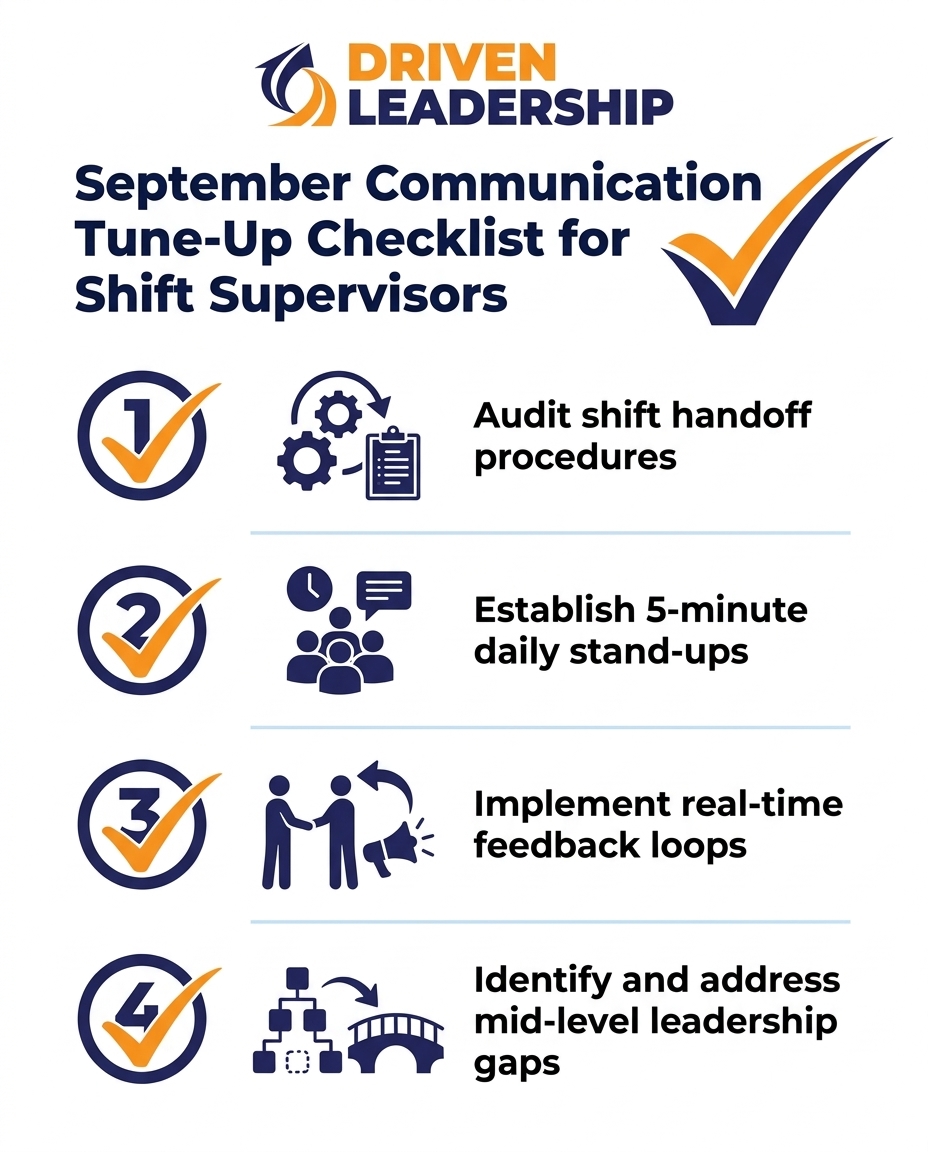
Here are the specific communication tune-ups we recommend your facility implement during the September pre-Q4 transition:
1. Audit current shift handoff procedures: A sloppy handoff guarantees a slow start to the next shift. Require outgoing supervisors to leave a concise, written log of bottlenecks, broken equipment, and priority targets for the incoming team. Eliminate ambiguous instructions and lost time.
2. Establish daily 5-minute stand-up frameworks: Long meetings are impossible during Q4. Replace them with strict 5-minute stand-ups at the start of every shift focused entirely on immediate bottlenecks, safety hazards, and the day's primary goal.
3. Train supervisors to deliver real-time feedback: Waiting for an end-of-week review is useless when volume is spiking daily. Leaders must be trained to deliver constructive, immediate feedback on the floor, correcting behaviors in the moment without demoralizing the worker.
4. Empower mid-level leaders to take charge: Plant managers cannot be everywhere at once. Empower your mid-level supervisors to make proactive decisions regarding minor logistical hiccups, reducing the bottleneck at the top level.
Combating the Pacific Northwest Fall Slump on the Warehouse Floor
Managing a facility in the Puyallup industrial and logistics corridors comes with a unique set of regional challenges. The transition into late fall brings drastically shorter, darker, and rainier days to Pierce County, directly impacting worker energy levels. Seasonal affective drops in morale often coincide exactly with the steepest increases in production demands.
When employees arrive at the warehouse in the dark and leave in the dark, while simultaneously dealing with relentless rain and cold loading docks, their resilience naturally dips. Leaders must compensate for this environmental shift. This means elevating your own enthusiasm, ensuring facility lighting is optimized, and enforcing strict safety protocols around wet, slick surfaces.
Proactive morale checks: Acknowledging the environmental toll builds trust. When leaders show they are attuned to their team's actual working conditions—rather than just pushing for higher numbers—workers respond with greater loyalty. Check in with your team frequently. Ask about their fatigue levels. Small adjustments in empathy and environmental awareness go a long way in combating the Pacific Northwest fall slump.
Implementing Daily Accountability Frameworks That Survive High Pressure
Generic management advice falls apart when supply chain demands peak. Telling a supervisor to "be more supportive" means nothing when three inbound trucks are delayed and the outbound dock is backed up. Leaders need proven leadership communication strategies tailored specifically for the high-pressure environment of manufacturing and logistics.
Accountability must be tied to specific, measurable daily outcomes rather than vague weekly goals. In a fast-paced environment, a mistake made at 8:00 AM compounds into a disaster by 3:00 PM. Creating a culture where team members hold each other accountable reduces the supervisory burden and keeps the entire floor moving efficiently.
Our team at Driven Leadership recommends structured development initiatives, like our Engage Elevate Program, to provide the exact recipe needed for individual and team elevation during stressful periods. These frameworks teach leaders how to maintain high standards without resorting to micromanagement or aggression.
Moving from Reactive to Proactive Management
Surviving Q4 requires anticipating common bottlenecks before they occur. This means pre-assigning leadership responsibilities for when—not if—equipment goes down or shipments are delayed.
• Build a "run to the roar" mentality: Train supervisors to tackle problems immediately rather than avoiding conflict. When an issue arises, leaders should face it head-on.
• Pre-assign crisis roles: Everyone should know exactly who handles an unexpected inventory shortage or a sudden equipment failure, eliminating the chaos of overlapping commands.
• Maintain visible leadership: In high-stress moments, supervisors need to be visible on the floor, guiding the team through the friction rather than hiding in an office.
Empowering Plant Managers to Take Ownership of Q4 Outcomes
The success of the end-of-year push ultimately rests on the plant manager's ability to lead with confidence and clarity. If the director is panicked, the supervisors will be panicked, and the floor workers will be chaotic. Leaders must challenge themselves to step out of their comfort zones, taking full ownership of both their facility's performance and their personal growth.
Advanced training helps leaders overcome debilitating roadblocks that prevent them from effectively managing peak-season chaos. For example, another local manager we partnered with realized last spring that they needed to take full ownership of their facility's performance and their own life. By participating in advanced leadership courses, they were challenged to become the best version of themselves, which directly impacted how they led their teams through stressful surges.
We consistently see that investing in BOLD advanced leadership training equips managers with the resilience needed to guide their teams through the hardest months of the year. When plant managers elevate their own communication and emotional intelligence during the September pre-Q4 transition, that stability cascades down to every single person on the warehouse floor.
Common Questions About Managing Q4 Manufacturing Surges
How do you keep manufacturing teams motivated during peak season?
Keeping teams motivated requires clear communication, immediate recognition, and proactive support. Leaders should focus on removing daily obstacles that frustrate workers, rather than just demanding higher output. Acknowledging the difficulty of the surge and celebrating small, daily wins helps maintain energy levels across the Puyallup industrial and logistics corridors.
How can plant managers improve shift communication during Q4?
Plant managers improve communication by implementing strict, repeatable frameworks. This includes standardizing shift handoff logs and replacing long meetings with 5-minute daily stand-ups focused on safety and immediate bottlenecks. Eliminating ambiguity in instructions is the fastest way to improve execution.
What are effective communication strategies for shift workers?
Effective strategies for shift workers rely on real-time, constructive feedback and active listening. Supervisors should address issues immediately on the floor rather than waiting for formal reviews. Additionally, creating an environment where workers feel safe reporting problems without fear of aggressive retaliation keeps operations running smoothly.
How do you prepare a warehouse for peak season?
Preparing a warehouse involves both operational readiness and leadership tune-ups. While servicing equipment and forecasting inventory are necessary, facility directors must also audit communication protocols and train supervisors to handle high-pressure scenarios. True preparation addresses both the physical machinery and the human element.
Why is proactive leadership training essential for reducing peak-season turnover?
Employees rarely quit because the work is hard; they quit because management is chaotic or unsupportive. Proactive leadership training equips supervisors with the skills to manage stress, deliver clear expectations, and maintain morale. When leaders handle pressure well, team members feel secure, which drastically reduces seasonal burnout and turnover.
Fortify Your Leadership Team Before the October Rush
The window to prepare your supervisors for the end-of-year push is closing rapidly. Don't wait for communication to break down under the weight of holiday supply chain demands. The stress of Q4 is inevitable, but chaotic management is entirely preventable if you take action during the September pre-Q4 transition.
Implement actionable, sector-specific communication strategies today to establish clear expectations and reliable feedback loops. By tuning up your daily accountability frameworks now, you protect your facility's performance, reduce turnover, and ensure your team is ready to execute when the pressure hits. Contact the Driven Leadership team to discuss how our targeted organizational development programs can fortify your logistics operations before the October rush begins.