Overcoming Executive Resistance to the Elevate Leadership Framework

Navigating Initiative Fatigue During Q4 Strategic Rollouts
Overcoming Executive Resistance to the Elevate Leadership Framework is a complex challenge that many HR directors and organizational leaders face when September Q4 strategic planning rollouts begin and initiative fatigue sets in. You sit down in the boardroom, present a carefully structured plan to unify the management team, and are immediately met with crossed arms, deep sighs, or polite disengagement. Your veteran managers have seen countless frameworks come and go. When they hear new terminology, their default reaction is often to dismiss it as just another round of corporate HR jargon that will distract them from hitting their end-of-year targets.
To help guide your team through this critical transition, exploring the Engage Elevate Program provides a structured path forward.
The reality of initiative fatigue: By the time fall planning arrives, leadership teams are generally exhausted. They are focused on closing out the fiscal year strong, finalizing budgets, and managing the holiday operational sprint. Introducing a comprehensive behavioral model during September Q4 strategic planning rollouts requires careful navigation. Most managers are not actively trying to sabotage the company's growth; they are simply overwhelmed by the volume of new initiatives expected of them.
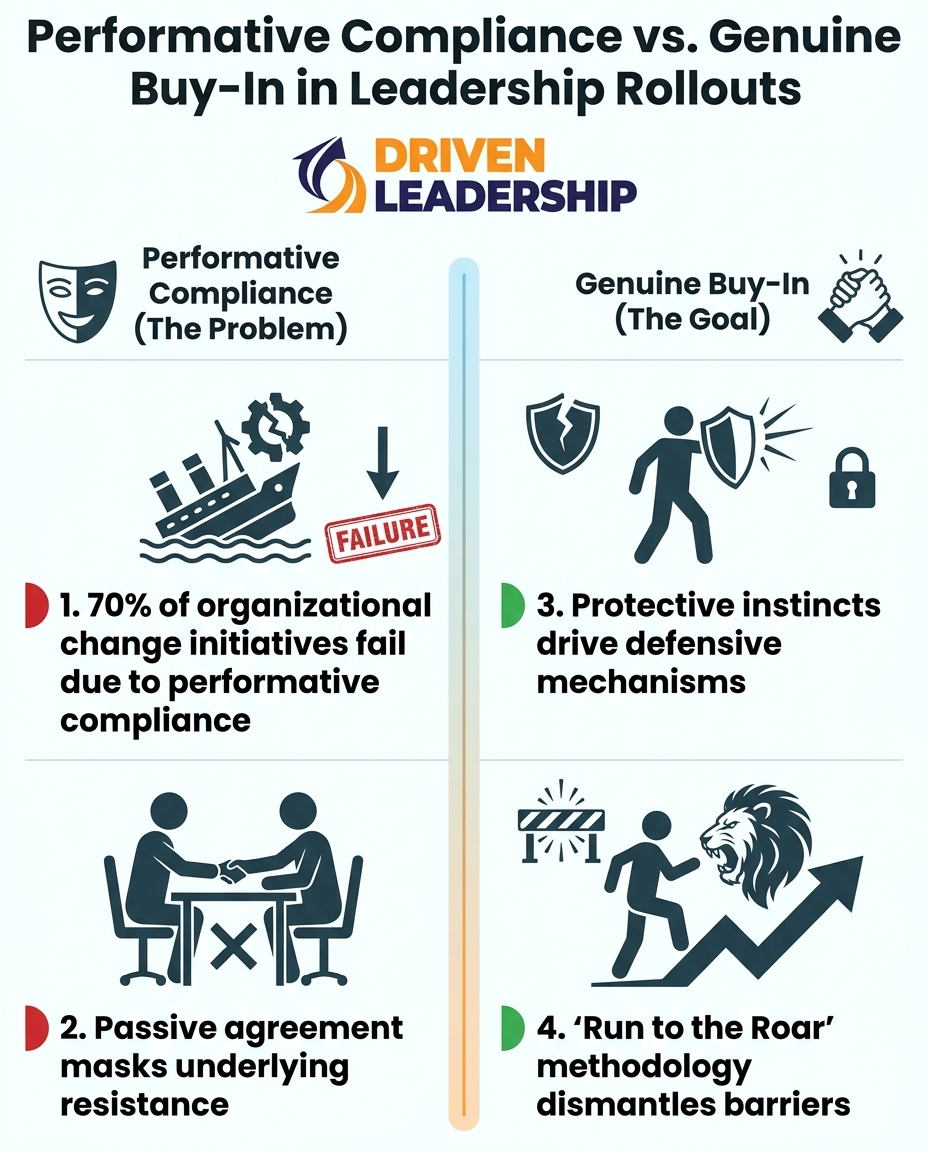
The cost of missing the mark: Research consistently shows that nearly 70% of organizational change initiatives fail to reach their intended goals. This massive failure rate rarely stems from a flawed framework. Instead, it traces directly back to a lack of genuine executive buy-in. When tenured leaders—who are already accustomed to their own deeply ingrained methods—feel that a new system is being forced upon them, they naturally push back. Dismantling this resistance without alienating your top talent requires understanding the psychological barriers at play and shifting these critical leaders from a stance of defensive compliance to one of active, enthusiastic participation.
Why Veteran Managers View the Elevate Leadership Framework as a Threat
When you introduce the Elevate Leadership Framework to a group of highly experienced directors, the immediate pushback is rarely about the actual content of the training. Instead, tenured managers often resist new frameworks because they perceive them as a direct threat to their established competence. If a leader has successfully run a division for fifteen years using their own intuition and management style, a new structured accountability model can feel like an invalidation of their past successes.
The root of the resistance: The psychological barrier here is significant. Adopting a new methodology requires a manager to admit that their current way of doing things might not be perfect. It forces them back into a beginner's mindset, which is a deeply uncomfortable place for an established expert. The key to successful organizational development is bridging the gap between high-level company goals and these individual, often unspoken, insecurities.
The Protective Instinct Over Team Dynamics
Managers possess a natural, deeply ingrained instinct to shield their teams from perceived operational disruptions. When resistance surfaces, it is frequently rooted in loyalty to their direct reports rather than defiance of the broader organization.
• Fear of disruption: Veteran leaders worry that new terminology and tracking requirements will slow down their team's daily productivity.
• Loss of autonomy: They fear that a standardized framework will strip away the unique sub-culture they have built within their specific department.
• Misunderstanding the purpose: They mistakenly view the framework as a replacement for their leadership style, rather than a tool designed to enhance it.
To effectively implement the Elevate Leadership Framework, you must reframe the narrative. The framework is not designed to replace the unique dynamics that make their teams successful. Instead, it provides a shared organizational language that helps those teams execute more efficiently.
• "This invalidates my past success." — The Actual Framework Reality: It builds upon past success by providing tools to scale that success across new teams.
• "It will slow my team down." — The Actual Framework Reality: It eliminates communication bottlenecks, ultimately speeding up daily execution.
• "It replaces my personal leadership style." — The Actual Framework Reality: It acts as an operating system, allowing individual leadership styles to shine more clearly.
"Let's talk about the e of elevate" leadership framework: Confronting Passive Agreement
When HR leaders say, "let's talk about the e of elevate" leadership framework, they are drilling down into the most critical and often most difficult components of the model: the emotional intelligence and execution requirements. It is in these areas that resistance most frequently disguises itself as polite consensus.
The danger of the boardroom smile: In highly collaborative, consensus-driven business environments—particularly in Pacific Northwest business cultures like those found around Seattle and Puyallup—overt confrontation is rare. Instead, executive resistance often manifests as passive non-compliance. Leaders will sit in the boardroom, nod thoughtfully, smile, and verbally agree that the new framework is a fantastic idea. Then, they will walk out onto the floor and change absolutely nothing about how they manage their teams. This performative compliance is far more dangerous than active pushback because it creates a false sense of progress.
Performative compliance vs. genuine change: Passive agreement allows executives to check the box on HR requirements without ever doing the difficult emotional work required to change their behavior. They verbally agree to the Elevate Leadership Framework, but they fail to implement the tracking, the one-on-one structures, or the accountability metrics with their direct reports. Unaddressed, this passive resistance silently sabotages organizational development, as the rest of the company watches senior leaders ignore the very standards they are supposed to be championing.
Real change requires moving past the polite nod. For example, during a spring leadership session focusing on the BOLD and Leadership for Managers courses, one participant initially struggled with this exact dynamic. They possessed a deep desire for personal and professional ownership but were caught in a cycle of passive agreement at work. By engaging fully with the emotional components of the training, they were challenged to take true ownership of their life and role. The result was a dramatic shift from stagnation to becoming the best version of themselves, driven by the passion and enthusiasm of the process. If you want to dive deeper into overcoming this specific hurdle, breaking down the Elevate framework for overwhelmed managers is a vital next step.
Decoding the 'Flavor of the Month' Defense Mechanism
When rolling out new standards during September Q4 strategic planning rollouts, you will inevitably encounter specific defensive tactics designed to deflect accountability. The most common of these is the "flavor of the month" dismissal. This occurs when veteran managers consciously decide to simply wait out the new HR initiative, assuming that if they ignore it long enough, executive leadership will eventually get distracted by a new priority.
To successfully implement the Elevate Leadership Framework, you must learn to identify and decode these defense mechanisms as soon as they appear.
1. The "Flavor of the Month" Dismissal: The manager agrees to the training but treats it as a temporary fad. They tell their team, "Just humor HR on this one, we'll be back to normal by January." This creates a buffer that prevents the framework from ever taking root.
2. The Demand for Excessive Data: A highly analytical leader will stall implementation by demanding endless proof. They will ask for more case studies, more ROI metrics, and more pilot programs before they commit, using "due diligence" as a smokescreen for resistance.
3. The "My Team is Different" Claim: The manager insists that while the framework is great for sales or operations, their specific department (often IT, engineering, or creative) is too unique to be bound by standard leadership metrics.
4. The Delegation Dodge: The executive assigns the entire framework implementation to a junior subordinate. By removing themselves from the process, they avoid personal accountability while technically complying with the mandate.
Recognizing Performative Compliance
Spotting the difference between a manager asking genuine, clarifying questions and one who is creating intentional roadblocks is critical. A manager seeking to understand will ask, "How do I apply this specific tool to my weekly meeting?" A manager practicing performative compliance will ask, "Do we really need to use this tool if our current meetings are already working?" HR directors and VPs must recognize these subtle deflections early in the rollout process to prevent them from becoming entrenched cultural norms.
Using the 'Run to the Roar' Methodology to Dismantle Resistance
When faced with deep-seated executive resistance to the Elevate Leadership Framework, the standard corporate response is often to soften the message. Organizations will dilute the framework, make the training optional, or compromise on accountability metrics just to appease tenured leaders. This approach guarantees failure. Instead, dismantling resistance requires leaning into the discomfort using the 'Run to the Roar' methodology.
Facing the fear directly: In nature, lions use a specific hunting tactic where the older, slower lions roar loudly to drive prey away from the noise and directly into the waiting trap of the younger, faster hunters. Survival requires running toward the roar—facing the fear rather than running away from it. In leadership development, running to the roar means confronting uncomfortable truths about performative compliance directly.
Actionable confrontation: When a veteran manager claims their team is "too busy" for the new framework, running to the roar means addressing that excuse head-on. It involves sitting down with the manager and saying, "I hear that you are busy, but avoiding this framework is actually creating more chaos for your team. Let's look at where the breakdowns are happening." This methodology shifts the dynamic entirely. It moves the rollout from a top-down, punitive mandate to a shared journey of personal and professional growth.
The impact of this direct approach is profound. Consider the experience of a participant in a spring advanced leadership program who was seeking a life-changing personal development experience. By leaning into the intense discomfort of the training and running toward their own personal "roars," they found it to be the best thing they had ever done for themselves. Their life changed for the better, and they shifted from passive participation to actively pursuing their goals on a daily basis. Confronting the resistance directly is what breaks down the barriers and unlocks true potential.
Transforming Performative Compliance into Active Team Execution
Moving executives from a state of defense to one of active participation requires actionable, non-confrontational strategies that connect the Elevate Leadership Framework directly to what they already value. You cannot force genuine buy-in; you have to engineer it by proving that the framework makes their daily lives easier.
Connecting to personal success metrics: The fastest way to secure buy-in is to tie the framework's tools to the manager's personal KPIs. If a director is struggling with high turnover, demonstrate exactly how the framework's communication models improve retention. When leaders see the framework as a tool that helps them hit their bonuses and reduce their stress, rather than a test they have to pass for HR, their resistance melts away.
• Practice active listening: Validate the manager's past experiences. Acknowledge their historical success before setting new expectations. Say, "Your intuition has gotten this division to where it is today; this framework is the tool that will help us scale that intuition to the new hires."
• Shift the focus: Move the conversation away from individual critique and toward collective team execution. Frame the initiative as a way to empower their direct reports.
• Establish feedback loops: Implement ongoing, low-stakes check-ins. Don't wait for a quarterly review to find out the framework isn't being used. Ask for their feedback on what parts of the model feel clunky in daily operations, and adjust accordingly.
By establishing these ongoing feedback loops, you ensure the framework becomes ingrained in daily operations rather than fading away as just another flavor of the month.
Frequently Asked Questions About Executive Buy-In
How do you handle resistance from senior management?
The most effective way to handle resistance from senior management is to address it directly rather than working around it. Start by identifying the root cause of their pushback, which is often a fear of losing autonomy or disrupting their team. Use active listening to validate their concerns, then clearly connect the new initiative to their specific departmental goals and personal success metrics so they see the practical value.
Why do executives resist organizational change?
Executives typically resist organizational change because it threatens their established sense of competence. When leaders have spent years perfecting a specific way of operating, new frameworks force them out of their comfort zone and back into a beginner's mindset. Additionally, they often possess a protective instinct over their teams and fear that new corporate mandates will slow down daily productivity.
What is the Elevate leadership framework?
The Elevate Leadership Framework is a structured, comprehensive model designed to unify management teams through shared communication and accountability standards. It focuses on bridging the gap between high-level strategic planning and daily team execution. By providing a common language for expectations and feedback, it helps organizations scale their leadership capabilities consistently across all departments.
How do you get executive buy-in for leadership training?
Securing executive buy-in requires shifting the narrative from a mandatory HR exercise to a strategic operational tool. You must demonstrate exactly how the training solves the specific, daily pain points the executives are currently facing, such as communication bottlenecks or high turnover. When the training is positioned as a solution that makes their jobs easier rather than an extra task on their plate, buy-in naturally follows.
How can you tell the difference between genuine buy-in and performative compliance?
Genuine buy-in is demonstrated through proactive behavioral changes, such as a manager actively using new terminology in meetings and holding their direct reports accountable to the new standards. Performative compliance occurs when a leader verbally agrees with the initiative in the boardroom but changes absolutely nothing about their daily management style once they return to their department. Tracking actual implementation metrics, rather than just attendance, reveals the difference.
Securing Long-Term Buy-In for Your Leadership Initiatives
Successfully navigating and ultimately Overcoming Executive Resistance to the Elevate Leadership Framework requires patience, strategy, and courage. By recognizing that veteran manager pushback is often a protective instinct rather than simple stubbornness, you can begin to dismantle the barriers that block true organizational growth. Identifying defensive mechanisms—like the "flavor of the month" dismissal or the trap of passive agreement—is the first critical step.
From there, applying the 'Run to the Roar' methodology allows HR directors and VPs to confront uncomfortable truths directly, transforming performative compliance into active, enthusiastic participation. Lasting change doesn't happen by softening the message; it happens by aligning new frameworks with the personal success of your leaders. If you are ready to explore advanced strategies for unifying your leadership team and fostering genuine accountability, exploring an executive manager program can provide the deep, structural support your organization needs to thrive.