The Difference Between a Leadership Workshop and an Identity Shift

Myth vs. Reality: The Illusion of Permanent Change
At Driven Leadership, our team has seen time and again that sending your executive team to a standard afternoon seminar won't permanently change how they lead—it just gives them a temporary emotional high. If you are exploring the difference between a leadership workshop and an identity shift, you already know that surface-level tactics rarely survive real-world stress. When the pressure hits, leaders default to their ingrained habits. Breaking those habits requires more than a polished PowerPoint presentation; we have found it requires a fundamental change in how a leader views themselves and their role within the organization.
To explore your options, learn more about our leadership trainings and discover the impact of an immersive BOLD leadership program.
The Trap of the Afternoon Seminar
There is a persistent myth in corporate development that a single afternoon in a hotel conference room will permanently fix deep-seated organizational behavior. In our years of facilitating executive transformations, we've watched companies routinely invest heavily in these short-term events, expecting long-term transformations. However, the reality is far less encouraging. Standard workshops are excellent for transferring basic information—like how to use a new software platform or the steps of a new HR protocol—but they are entirely unequipped to alter human behavior.
In our experience working with organizations throughout Puyallup and the greater Seattle area, this reality becomes painfully clear during Q4 fall strategic planning for upcoming leadership initiatives. Executives and HR directors sit down to evaluate the return on investment from the past year's training budget, only to realize that the enthusiasm generated by the spring seminar dissipated within thirty days. The communication silos returned, the conflict avoidance persisted, and the overall team dynamic reverted to the baseline.
Framing the Decision Point
This frustration brings organizations to a critical decision point. You must choose between applying another motivational band-aid or committing the resources necessary for a fundamental behavioral shift. Continuing with standard seminars means accepting that any positive changes will be fleeting. Opting for a true identity shift means acknowledging that permanent change requires a fundamentally different approach to human development—one that challenges leaders at their core rather than simply handing them a new binder of management theories.
The Psychology of a Temporary Motivational High
Understanding why traditional methods fail requires looking at how the human brain processes and retains new information. Standard seminars often fail to produce lasting change because they ignore the psychological realities of adult learning and behavioral modification.
The Ebbinghaus Forgetting Curve
The fundamental flaw in most corporate training can be explained by the Ebbinghaus Forgetting Curve. This psychological principle demonstrates how rapidly memory declines when new information is not practically applied or emotionally anchored. In our training observations, the process typically unfolds in a predictable pattern:
1. Immediate retention: Learners leave the seminar highly motivated, remembering the core concepts and feeling equipped to implement them.
2. The 24-hour drop: Within one day, without immediate practical application under pressure, participants forget up to 50% of the nuanced material.
3. The one-week reality: By the end of the first week, learners forget approximately 75% of the new information. The remaining 25% is rarely enough to override years of ingrained habits.
4. The 30-day baseline: Within a month, the temporary spike in enthusiasm is gone, and the leader has fully reverted to their previous behavioral patterns.
Surface-Level Skills vs. Foundational Mindsets
There is a vast psychological difference between surface-level skill acquisition and foundational mindset changes. Learning active listening techniques in a sterile corporate boardroom is easy. It is a controlled environment with zero emotional stakes. However, deploying those same active listening techniques when a major client account is in jeopardy and team tensions are high is an entirely different challenge. The sterile boardroom fails to replicate the emotional intensity of the real world.
This is why standard team workshops often result in a temporary spike in enthusiasm that fails to survive real-world stress. When leaders are pushed to their limits, they do not consult their seminar notes; they fall back on their deepest psychological reflexes. Unless those reflexes are rewired in an immersive, high-stakes leadership environment, the training is merely an intellectual exercise rather than a developmental milestone.
Defining a True Identity Shift in Leadership
If standard training only provides a temporary high, what does actual transformation look like? An identity shift in leadership goes far beyond learning a new management framework. It fundamentally changes how a leader perceives their own capabilities, responsibilities, and reactions to adversity.
Moving Beyond Tactics
An identity shift changes how a leader views themselves, rather than just giving them a new tactic to deploy. A tactic is something you do; an identity is something you are. When a leader only learns tactics, they have to consciously remember to use them. When a leader undergoes an identity shift, the new behaviors become their default setting. True leadership development requires breaking down the ego, confronting limiting beliefs, and rebuilding a stronger, more resilient self-image.
The Psychological Break from Old Habits
Achieving this level of change requires a psychological break from old habits to build lasting courage and confidence. You cannot become a new type of leader while remaining entirely comfortable. Growth requires friction. This dynamic was evident in one leader who attended our immersive summer program after feeling limited by past dreams and lacking the courage to tackle new challenges. By engaging fully with our team, they gained the courage and confidence to pursue goals they had previously only dreamed about, leading to profound, positive changes in both their career and personal life.
Behavior-Focused Development
This type of behavior-focused development creates lasting changes that ripple outward. When a leader undergoes a true identity shift in an immersive, high-stakes leadership environment, they do not just become better managers during office hours. They become better communicators, stronger decision-makers, and more empathetic individuals in every facet of their lives. The transformation is permanent because the underlying person has changed, not just their corporate toolkit.
The Necessity of High-Stakes, Immersive Environments
The environment in which training occurs dictates the depth of the transformation. We firmly believe you cannot forge resilient, adaptable leaders in an environment designed for absolute comfort and predictability.
The Problem: Rehearsed Corporate Scripts
In a standard office setting, leaders are protected by their titles and the familiar rhythms of corporate life. When presented with a challenge in a conference room, they rely on rehearsed corporate scripts. They know what they are supposed to say. They can intellectualize the problem without ever actually feeling the pressure of it. This safe environment completely insulates them from the very stress that reveals their true leadership gaps.
The Cause: Comfort Zones Prevent Growth
Removing leaders from their comfort zones is mandatory for testing self-perception. If a leader never feels genuine pressure during development, they will never uncover the blind spots that hold them back. Stuffy, predictable corporate boardrooms allow leaders to hide behind their professional masks. There is no catalyst for vulnerability, and without vulnerability, there is no foundational growth.
The Solution: Disruptive, Immersive Settings
This is why high-stakes scenarios force reliance on core behaviors rather than rehearsed answers. Moving away from the city and stepping into the grounding, immersive nature of Pacific Northwest retreat environments accessible from Seattle and Puyallup provides the ideal psychological break. The physical change of scenery signals to the brain that the old rules no longer apply. Our team's unique methodology at Driven Leadership moves beyond passive seminars to utilize these high-stakes environments, intentionally creating the friction we know is necessary for a fundamental identity shift.
The impact of this disruption is profound. For example, during one of our recent winter programs, a participant arrived with their personal and professional self-perception deeply challenged, knowing they needed to "level up." Because the setting was not a cliché corporate training, they were tested through immersive challenges that forced them to step up. The result was genuine growth, leaving them a better, more capable individual overall. An advanced leadership program leverages these exact environments to forge permanent change that a PowerPoint presentation simply cannot match.
Side-by-Side: Standard Workshop vs. Identity Shift
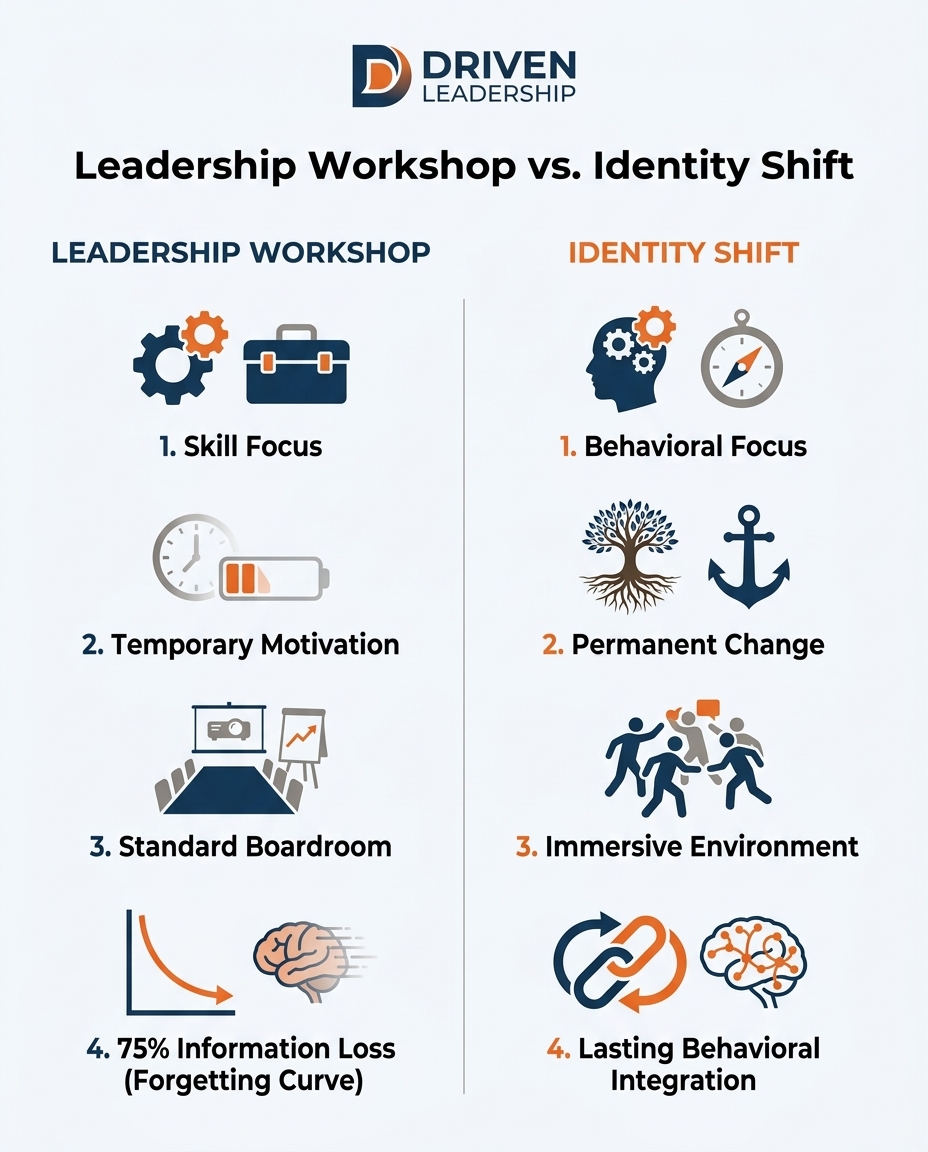
When evaluating options for your executive team, it helps to see the stark differences between these two approaches. The following comparison highlights why standard workshops serve a different purpose than programs designed for foundational behavioral change.
• Primary Focus — Standard Leadership Workshop: Surface-level skill acquisition and theory. — True Identity Shift Program: Deep behavioral focus and mindset rewiring.
• Duration of Impact — Standard Leadership Workshop: Temporary motivational high (fades in 30 days). — True Identity Shift Program: Permanent change integrated into daily life.
• Learning Environment — Standard Leadership Workshop: Standard, comfortable corporate boardroom. — True Identity Shift Program: Immersive, high-stakes leadership environment.
• Ultimate Outcome — Standard Leadership Workshop: Knowing what to do in a perfect scenario. — True Identity Shift Program: Fundamentally changing who you are under pressure.
Overcoming the ROI Frustration of Past Training Failures
For those holding the budget, the cycle of investing in training only to see zero behavioral change is exhausting. Breaking this cycle requires a shift in how development is evaluated and procured.
Acknowledging the Investment Gap
It is crucial to acknowledge the deep frustration of investing in training that yields no long-term ROI. As we frequently observe during Q4 fall strategic planning for upcoming leadership initiatives, HR directors are often tasked with finding a solution that will actually stick. When past investments have only resulted in temporary spikes in morale, there is a natural hesitation to approve another round of funding. The key is recognizing that the failure was not necessarily the team's willingness to learn, but the methodology used to teach them.
Concept vs. Development
Evaluating the difference between learning a concept and developing a leader is the first step toward better ROI. Learning a concept is passive; it requires only listening and nodding. Developing a leader is active; it requires struggle, feedback, and behavioral adjustment. If an upcoming initiative does not include a mechanism for testing the leaders under pressure, it is merely teaching a concept.
Choosing the Right Catalyst
Providing guidance on choosing the right environment ensures that upcoming initiatives actually take root. The environment must demand participation. Consider the experience of one professional who attended our spring program because they lacked confidence, struggled to take charge, and communicated poorly in meetings. By entering an immersive training setting that required the acceptance of new, challenging experiences, they were forced to practice taking initiative in real-time. The outcome was a dramatic increase in confidence and active listening that translated directly into positive professional changes. That is the true ROI of an immersive, high-stakes leadership environment.
Translating Retreat Breakthroughs to Boardroom Realities
A common concern with off-site, immersive programs is whether the breakthroughs achieved in the woods will actually survive the return to the office. The mechanics of an identity shift ensure that they do.
Breaking Down Barriers Under Pressure
Detailing how breaking down barriers under pressure leads to genuine active listening reveals the power of experiential learning. In a high-stakes environment, artificial corporate hierarchies strip away. Leaders must rely on each other to solve complex, immediate problems. This dynamic forces individuals to drop their egos and actually listen to their peers. Once a leader experiences the efficiency and connection of genuine active listening in a high-stakes scenario, they naturally carry that standard back to their daily operations.
Taking Vulnerability Back to the Office
The process of taking the vulnerability learned in an immersive setting back to the office is organic. When an executive team struggles together, fails together, and ultimately succeeds together in an immersive, high-stakes leadership environment, they build a shared language of resilience. They learn that admitting a mistake or asking for help is not a sign of weakness, but a requirement for rapid problem-solving. This shared experience permanently lowers the defensive walls that typically stifle corporate communication.
Fostering a Culture of Trust
These breakthroughs foster a culture of trust and cooperation among executive teams that standard seminars cannot replicate. When leaders have seen each other at their most vulnerable and resilient, office politics lose their appeal. Teams operate with higher efficiency because they trust the intentions of their peers. Exploring bold training exercises that build trust demonstrates exactly how these immersive experiences translate into measurable boardroom success.
Charting a New Course for Your Leadership Team
Understanding the difference between a leadership workshop and an identity shift is the first step toward building a truly resilient executive team. Standard workshops, while useful for basic skill acquisition, inevitably fall victim to the Ebbinghaus Forgetting Curve, providing only a temporary motivational high that dissipates within weeks.
Lasting change requires stepping out of the conventional boardroom and into an immersive, high-stakes leadership environment. By forcing leaders to confront their limiting beliefs under pressure, you facilitate a fundamental identity shift that changes how they lead, communicate, and navigate adversity long after the program ends. If you are tired of investing in temporary fixes and are ready for permanent behavioral change, it is time to explore an immersive BOLD leadership program and chart a new course for your organization's future.
Frequently Asked Questions
Why do leadership workshops fail to change behavior?
Leadership workshops often fail because they focus entirely on surface-level skill acquisition rather than fundamental behavioral changes. Participants sit in a comfortable, low-stakes environment and passively absorb information, which leads to a temporary motivational high. According to the Forgetting Curve, without immediate emotional anchoring or high-stakes application, learners forget up to 75% of this new information within a week, causing them to revert to their old habits.
How do you create an identity shift in leadership?
Creating an identity shift requires removing a leader from their comfort zone and placing them in an immersive, high-stakes environment. By challenging their ingrained habits and forcing them to navigate complex problems under pressure, they must abandon rehearsed corporate scripts. This friction breaks down limiting beliefs and allows the leader to rebuild a stronger, more resilient self-image that becomes their new default behavior.
What is the difference between leadership training and development?
Leadership training is typically about transferring specific knowledge or teaching a new tactic, such as how to use a new software or conduct a performance review. Leadership development, on the other hand, focuses on evolving the person behind the title. Development is an active, often uncomfortable process that reshapes a leader's core behaviors, emotional intelligence, and ability to handle adversity.
What makes a leadership development program effective?
An effective leadership development program must include a psychological break from the participant's standard routine. It requires an immersive environment where leaders cannot hide behind their titles or standard office politics. By incorporating high-stakes scenarios that require vulnerability, active listening, and immediate problem-solving, the program ensures that the lessons learned are permanently anchored in the leader's behavior.
How long does a true leadership identity shift take?
While the immersive experience that triggers the shift may only last a few days, the internal realization often happens in a single breakthrough moment under pressure. However, solidifying that identity shift into permanent daily habits requires ongoing commitment and application once the leader returns to the office. The initial high-stakes environment serves as the necessary catalyst to make that long-term integration possible.
Why is a change of environment critical for leadership development?
A change of environment is critical because the human brain heavily associates physical spaces with specific behavioral patterns. If you attempt to train a leader in the same sterile boardroom where they normally check emails and avoid conflict, they will naturally default to those same defensive behaviors. Moving to a disruptive, immersive setting signals to the brain that old rules do not apply, opening the door for genuine vulnerability and growth.