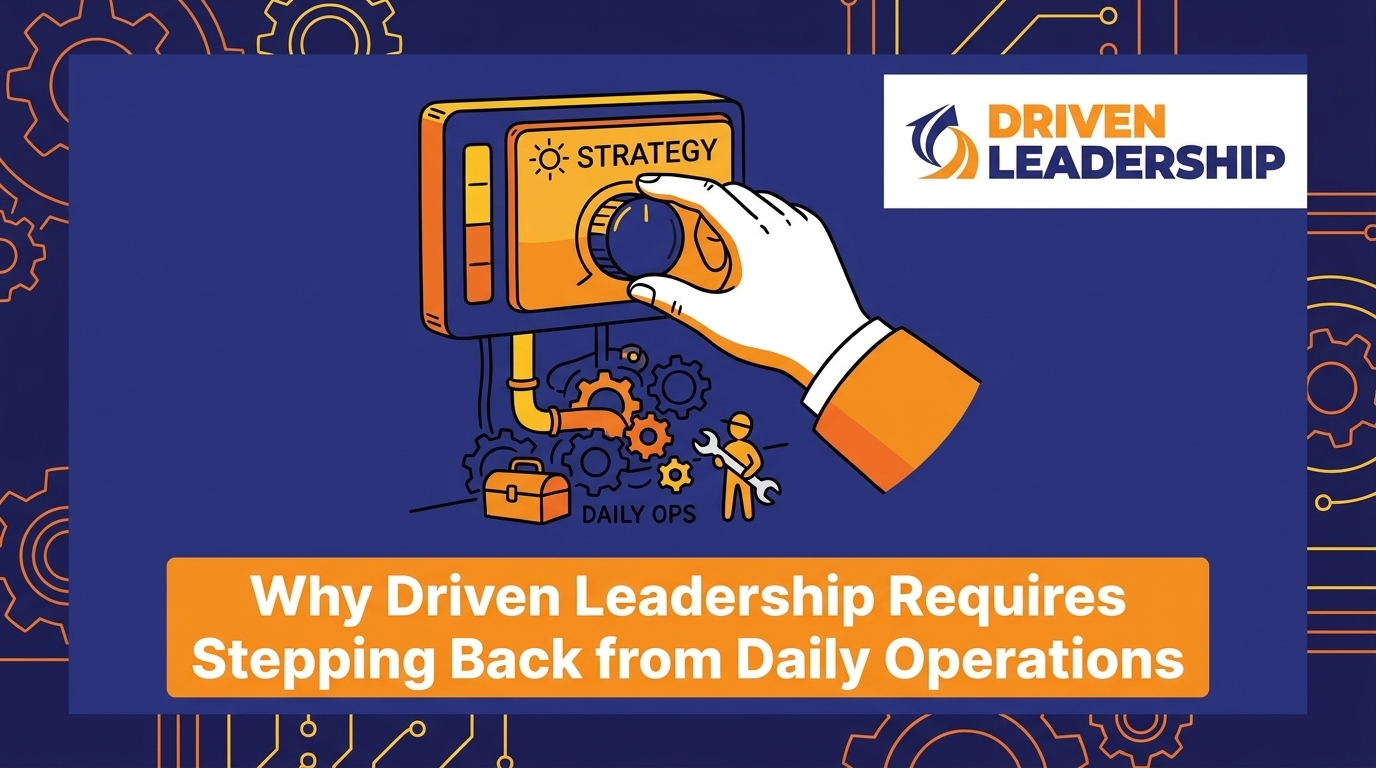
Why Driven Leadership Requires Stepping Back from Daily Operations

The Founder's Dilemma: Recognizing When You've Become the Bottleneck
Your business is growing, but instead of feeling liberated, you are drowning in a sea of tasks—which is exactly why driven leadership requires stepping back from daily operations. Every critical decision still lands on your desk, and your team waits for your input before moving forward. This is the concrete problem many founders face: the technical expertise and relentless hustle that built your company have become the very bottleneck choking its potential. As we approach early fall and Q4 strategic planning, you stand at a critical decision point. You must decide whether to continue acting as the primary technician or to step back and build the cultural frameworks that empower your team to thrive independently. Understanding this transition is the first step toward true scalability and long-term organizational health.
If you are ready to transition from a doer to a visionary, exploring our leadership trainings and the Executive Manager Program can provide the structured path you need to elevate your impact.
The paradox of early business success is that the behaviors required to launch a company are entirely different from the behaviors required to scale one. In the beginning, you wear every hat. You are the lead salesperson, the primary technician, and the chief problem solver. This hands-on approach ensures quality and builds early momentum. However, as the organization grows, clinging to these daily operational tasks stifles your team's development. Recognizing that stepping back is not an abandonment of your team, but a necessary evolution in leadership, is a monumental shift in perspective.
Signs You Have Become the Operational Bottleneck:
• Decision fatigue: You are the final sign-off for minor, day-to-day choices that your staff should be handling.
• Stalled projects: Initiatives pause the moment you step into a meeting or take a rare day off.
• Talent turnover: High-performing employees leave because they feel micromanaged or lack autonomy.
• Strategic neglect: You spend zero hours on early fall and Q4 strategic planning because you are too busy putting out immediate fires.
To successfully navigate this transition, you must set the stage for essential cultural shifts. This means acknowledging that your highest value to the company is no longer in executing the work, but in architecting the environment where the work gets done.
The Psychological Hurdle: Why Letting Go Feels Like Losing Control
The logical argument for delegation is easy to understand, but the emotional reality of stepping back is often jarring. For many founders, their identity is deeply tied to their output. When you stop doing the "real work" alongside the frontline team, a profound sense of guilt can creep in. You might feel disconnected or worry that your team thinks you are slacking off. Overcoming this psychological hurdle is mandatory, especially as you gear up for early fall and Q4 strategic planning, where your mental energy must be focused on the horizon, not the trenches.
The 'Best Technician' Syndrome
Deep operational expertise creates massive blind spots for leadership development. When you are genuinely the fastest and most accurate person at a specific task, it is incredibly tempting to just "do it yourself" rather than spending three times as long teaching someone else. This is the trap of the "best technician in the room" syndrome. You convince yourself that no one else can do the job to your exact standards, which leads to micromanagement disguised as quality control.
This mindset fundamentally caps your business growth. A company cannot outgrow its founder's willingness to relinquish control. If every output must pass through your hands to meet your standard, your company's revenue and capacity will forever be limited by the number of hours you can personally stay awake.
Redefining Productivity as a Leader
To overcome this hurdle, you must redefine what productivity looks like. As an operator, productivity is measured by tasks completed, emails answered, and fires extinguished. As a leader, productivity is measured by the capabilities you build within your team.
• Focuses on completing the immediate task efficiently. — The Leader's Mindset: Focuses on building a system so the task is handled automatically.
• Measures success by personal output and hours worked. — The Leader's Mindset: Measures success by team autonomy and overall growth.
• Steps in to fix mistakes before they impact the client. — The Leader's Mindset: Uses mistakes as coaching moments to build team competence.
• Views early fall and Q4 strategic planning as a distraction from real work. — The Leader's Mindset: Views early fall and Q4 strategic planning as the most critical work of the year.
Learning to value strategic foresight over daily task execution requires patience. It means sitting on your hands while an employee struggles through a problem you could solve in five minutes, knowing that their struggle is the exact friction required for their professional growth.
The Cost of Founder Dependence on Business Growth
The refusal to step back is not just a personal stressor; it carries severe financial and organizational consequences. When a leader remains deeply entrenched in daily operations, the entire company suffers from "founder's syndrome." This creates a fragile ecosystem where organizational stagnation and employee burnout become the norm. High-performing talent wants to be trusted and empowered. When they are constantly overridden or forced to wait for your approval, they will eventually leave for an environment that respects their autonomy.
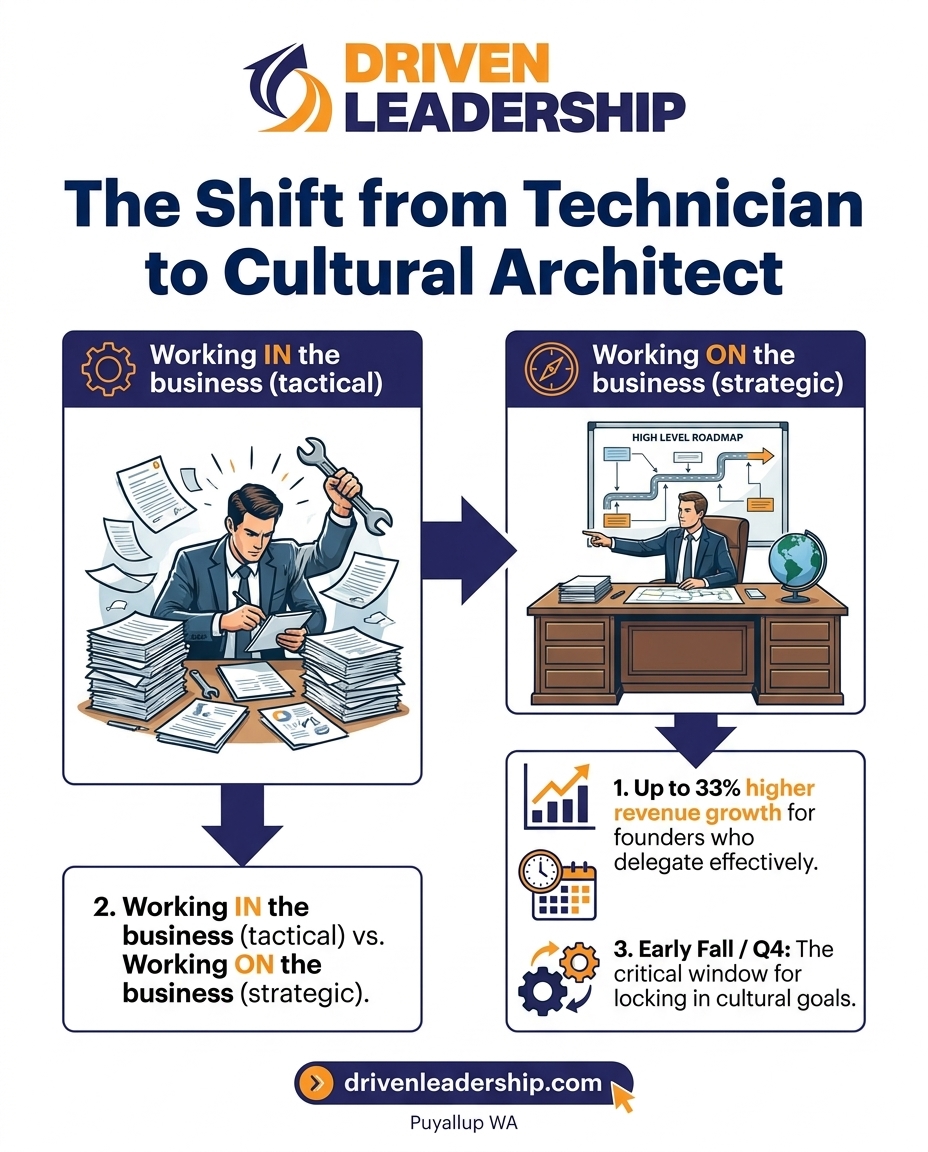
The data strongly supports the need for this transition. According to Gallup research, founders who effectively delegate and step out of daily operations can drive up to 33% higher revenue growth than those who refuse to let go. The necessity of building a strong leadership foundation that operates independently of the founder's daily input cannot be overstated. If your business relies on your physical presence to generate revenue, you do not own a business—you own a highly demanding job.
One pattern we see frequently involves partners who attempt to scale without establishing this foundation. For example, two partners who were chosen to help build a business together in 2020 reached a critical plateau. By the following spring, they realized their relentless operational hustle was no longer enough; they lacked the foundational leadership and communication skills required to scale further. By engaging in immersive leadership and management training, they gained a strong foundation to communicate effectively and lead their teams, rather than just executing tasks alongside them. This shift allowed them to break through their growth ceiling.
Furthermore, entering critical planning periods without a clear, unburdened strategic leader is a massive risk. If you are still buried in the daily weeds during early fall and Q4 strategic planning, your company will enter the new year reactive, disorganized, and vulnerable to market shifts.
Rising Above the Operational Fog: The Architect's View
The daily tactical grind creates an operational "fog" that obscures long-term vision and cultural health. In the Pacific Northwest, business climates can shift rapidly, much like our overcast weather. Working deep in the daily operational weeds is akin to navigating through a dense, low-hanging fog. You can only see the few feet directly in front of you—the next email, the next client complaint, the next broken process. To guide your company safely, you must rise above this fog to gain a clear, high-level strategic view of the organization's landscape.
Transitioning from a reactive operator to a proactive architect of the company environment is how you clear that fog. An architect does not pour the concrete or swing the hammer; they design the blueprints that ensure the structure can withstand the elements. For a founder, this means designing cultural frameworks that allow the team to navigate challenges independently.
Navigating the Daily Grind
Constant firefighting prevents systemic improvements. If you spend your entire week putting out fires, you never have the time to investigate who keeps handing out the matches. The danger of letting short-term emergencies dictate your long-term strategy is that you become entirely reactive. You lose the ability to innovate because all your energy is consumed by maintaining the status quo.
The quick fix: Stop rewarding firefighting. Instead, start rewarding fire prevention. When an employee solves a recurring issue by creating a new standard operating procedure, celebrate that systemic fix over a heroic, last-minute save.
Gaining the Architect's Perspective
Building systems and cultural norms is the true work of a leader. It is about creating an environment where top talent can thrive without constant direction. This requires a deep commitment to cultural development. When you step back, you finally have the bandwidth to ask the big questions: Are we aligned on our core values? Do our compensation structures incentivize the right behaviors? Are we prepared for early fall and Q4 strategic planning?
Seizing the Early Fall and Q4 Strategic Planning Window
The transition from technician to leader is always important, but the timing of when you make this shift can drastically impact your success. Early fall and Q4 represent the most critical window for organizational alignment. As the year winds down, the decisions you make—or fail to make—will dictate your trajectory for the next twelve months.
The impossibility of effective Q4 strategic planning if the founder is still buried in daily operations is a harsh reality. Strategy requires undisturbed time, deep reflection, and a comprehensive understanding of market trends. You cannot map out a twelve-month growth plan in fifteen-minute increments between client calls.
Why Timing Matters for Next Year's Success
There is a cascading effect of delayed strategic planning on Q1 performance. If you wait until January to figure out your goals, you will spend the first quarter just trying to communicate those goals to your team. By the time everyone is aligned, a quarter of the year is already gone.
Using this seasonal transition to lock in cultural and operational goals for the upcoming year sets the tone for the team before the new year begins. By stepping back now, you allocate dedicated time away from the desk to focus on the big picture. You demonstrate to your team that early fall and Q4 strategic planning is not just a corporate buzzword, but a dedicated season of preparation that ensures everyone's success.
Experiential Behavioral Change: Empowering Your Team to Execute
Stepping back is often misunderstood as a passive retreat. It is not about kicking your feet up or abandoning your team to figure things out on their own. At Driven Leadership, our core philosophy is that true leadership requires bold action and experiential behavioral change. We frame the act of "stepping back" as an active, courageous choice to empower your team, rather than a passive withdrawal.
The shift from doing the work to coaching the team to execute the vision requires a completely different skill set. You must foster an environment of high accountability and high trust. This means allowing your team to step out of their comfort zones, make calculated decisions, and learn from the outcomes through experiential learning.
Consider a situation from a recent spring where a management team noticed a distinct lack of confidence and effective communication from a key associate during critical meetings. Rather than stepping in and taking over the meetings—which would only reinforce the associate's hesitation—the leader encouraged them to attend an immersive, advanced leadership training program. Through that challenging, experiential environment, the associate gained the confidence to take initiative, improved their active listening skills, and completely transformed their presence in the boardroom. That is the power of empowering your team rather than doing the work for them.
Stepping Back Doesn't Mean Stepping Away
Maintaining presence and influence without micromanaging is an art form. You are transitioning from the chief problem solver to the chief question asker. When an employee brings you an issue, your default response should no longer be, "Here is how you fix it." Instead, it should be, "What do you think our best next step is?" This subtle behavioral shift is the cornerstone of leading an engaged culture. It proves that you trust their judgment, which in turn builds their confidence heading into early fall and Q4 strategic planning.
Mapping Your Transition from Technician to Cultural Architect
Understanding the theory of stepping back is one thing; executing the transition is another. If you are ready to move from a daily operator to a strategic architect, you need a clear, actionable framework. This transition does not happen overnight, but by following a structured approach, you can systematically remove yourself from the bottleneck.
1. Conduct an audit of daily tasks: Spend one entire week writing down every single task you perform, no matter how small. At the end of the week, categorize these tasks into three buckets: things only you can do, things someone else can do right now, and things someone else could do with a bit of training. Begin delegating the second bucket immediately.
2. Communicate the transition clearly: Your team needs to understand why your behavior is changing. Manage their expectations by explaining that you are stepping back to focus on early fall and Q4 strategic planning and to give them more autonomy. Transparency prevents them from misinterpreting your distance as disinterest.
3. Establish new metrics for personal leadership success: Stop measuring your day by emails sent or fires put out. Start measuring your success by how many decisions your team made without you, how many coaching conversations you held, and how deeply you focused on long-term strategy.
4. Commit to ongoing leadership development: You cannot expect your team to grow if you are not growing yourself. Cultivating the traits of a great leader requires continuous education, coaching, and a willingness to be challenged.
By mapping out these steps, you create a tangible path out of the daily weeds and into the visionary role your company desperately needs you to fill.
Frequently Asked Questions About Leadership Transitions
Why is it important for leaders to step back?
Stepping back is essential because a business cannot scale if every decision must pass through the founder. When leaders remove themselves from daily operations, they eliminate operational bottlenecks and empower their team to take ownership. This transition frees up the leader's bandwidth to focus on long-term vision, cultural health, and critical early fall and Q4 strategic planning.
How do you transition from operations to strategy?
You transition from operations to strategy by systematically delegating technical tasks and redefining your metrics of success. It requires conducting a thorough audit of your daily responsibilities and handing over execution to capable team members. Moving forward, your primary focus shifts from completing immediate tasks to building the systems, processes, and culture that support sustainable growth.
What happens when a leader is too involved in daily operations?
When a leader is too involved in daily operations, the organization suffers from stagnation, and the team experiences burnout and low morale. This micromanagement stifles employee development because team members are never trusted to solve problems independently. Ultimately, the company's growth hits a hard ceiling dictated by the founder's limited time and energy.
How do you transition from founder to CEO?
Transitioning from founder to CEO requires an experiential behavioral change where you stop acting as the primary technician and start acting as the cultural architect. It involves letting go of the "best technician" syndrome and embracing the role of a coach and visionary. A true CEO focuses on aligning the team, securing resources, and steering the company's overarching strategy.
How does Q4 strategic planning benefit from a founder stepping back?
Q4 strategic planning benefits immensely because a founder who has stepped back brings clarity, foresight, and unburdened mental energy to the table. Instead of being distracted by daily fires, the leader can objectively analyze market trends, assess cultural health, and set clear, ambitious goals. This dedicated focus ensures the company enters the new year proactive and fully aligned.
What is the difference between working ON the business and IN the business?
Working IN the business means executing the daily, tactical tasks required to deliver your product or service, such as answering customer emails or fixing equipment. Working ON the business means designing the overarching systems, leadership frameworks, and strategic goals that allow the company to operate without your constant intervention. Shifting to working ON the business is the ultimate catalyst for scaling.
Take the Next Step in Your Leadership Evolution
Stepping back from the daily grind is not a sign of weakness; it is the ultimate catalyst for business growth. By transitioning from a hands-on technician to a visionary cultural architect, you unlock your team's potential and secure your company's future. As you navigate early fall and Q4 strategic planning, remember that your business cannot outgrow your willingness to relinquish control. If you are ready to make this bold behavioral shift, our Executive Manager Program offers the clear, actionable framework you need to successfully transition out of daily technical tasks and step confidently into your role as a true leader.