
Transitioning Your Leadership Style from Summer Leniency to Fall Urgency

The September Wake-Up Call: Shifting from Summer Mode to Q4 Execution
Labor Day has passed, the calendar has turned, and transitioning your leadership style from summer leniency to fall urgency is the critical first step for executives preparing for Q4 execution. During the summer months, workplace culture naturally relaxes. Paid time off requests peak, Friday afternoons become quieter, and project timelines often stretch to accommodate vacation schedules. This seasonal breather is necessary for team morale, but it creates a distinct challenge when September arrives. Suddenly, executives face the immediate pressure to transition their teams back to high-urgency performance to hit aggressive year-end targets.
At Driven Leadership, a pattern we see often this time of year is executives facing a concrete problem: how to re-establish strict deadlines and elevated performance standards in September without causing team burnout or sparking a revolt. This is a critical decision point for any manager or executive. The shift must be strategically communicated as a business necessity, not an arbitrary crackdown. If you abruptly flip a switch from relaxed to demanding, you risk alienating the very people you rely on to execute your Q4 strategy. Instead, setting the stage for a phased approach to tightening the reins ensures your team understands the 'why' behind the shift and feels equipped to meet the challenge.
If you are looking for structured ways to guide your team through this pivot, exploring proven leadership training programs can provide the exact frameworks you need to navigate this seasonal transition smoothly.
The Cost of Lingering Leniency
In our experience coaching corporate teams, allowing summer habits to bleed into late September and October is a costly mistake. The September post-Labor Day Q4 prep period is your most valuable window for a reset. Every week that passes with relaxed standards is a week of lost momentum that you cannot recover in December. Recognizing this wake-up call is the first step; the next is understanding the psychological factors at play so you can lead your team through the transition effectively.
Understanding the Post-Labor Day Productivity Slump
The resistance you feel from your team when trying to increase urgency in early fall is not necessarily defiance. There is a documented drop in workplace productivity during late August, as the collective focus shifts to squeezing the last moments out of the summer season. When September arrives, teams often experience a hangover effect from this relaxed pace. Understanding this dynamic helps you approach the transition with strategy rather than frustration.
Here in Puyallup and throughout the Pacific Northwest, we find that the transition from relaxed, sunny summers to brisk, rainy autumns naturally drives people indoors. We encourage our clients to use this environmental shift as a powerful, tangible metaphor for shifting workplace energy. Just as we retreat indoors from the patio to prepare our homes for the colder months, corporate teams must shift their energy toward focused, heads-down urgency. The external environment signals that it is time to get serious, making it an ideal moment to reset internal expectations.
Leveraging the Fresh Start Effect: Researchers at the Wharton School have documented a behavioral phenomenon known as the "fresh start effect." This concept explains how temporal landmarks—like the beginning of a new season, a new month, or the post-Labor Day return to school and work routines—make it significantly easier for individuals to adopt new behaviors, reset their focus, and commit to strict goals. The first weeks of September serve as this critical landmark.
To visualize this shift, consider the stark differences between the two seasonal mindsets:
• Pacing & Deadlines — Summer Leniency Baseline: Flexible timelines accommodating rolling PTO — Fall Urgency Requirement: Hard deadlines tied directly to Q4 deliverables
• Communication — Summer Leniency Baseline: Casual, asynchronous updates — Fall Urgency Requirement: Direct, outcome-focused daily or weekly huddles
• Accountability — Summer Leniency Baseline: General progress tracking — Fall Urgency Requirement: Strict measurement against key performance indicators
• Focus Areas — Summer Leniency Baseline: Maintenance and long-term planning — Fall Urgency Requirement: Immediate execution and revenue generation
Because this resistance is a natural psychological response, your role is to use the September post-Labor Day Q4 prep window to deliberately guide your team across this gap. Framing the first weeks of the month as a deliberate managerial reset allows you to harness the fresh start effect rather than fighting against the lingering summer slump.
Running to the Roar: Confronting Slipping Standards Head-On
One of the most common hurdles we see in transitioning from summer to fall is the leader's own psychological hesitation. It feels uncomfortable to disrupt a positive, relaxed summer team culture. You might worry that enforcing stricter standards will make you the "bad guy" or damage the rapport you built over the warmer months. However, avoiding difficult conversations about slipping standards ultimately hurts the team. When expectations are unclear, confusion breeds resentment, and high performers become demotivated by the lack of accountability.
This is where our signature Driven Leadership 'Run to the Roar' methodology becomes essential. In nature, when a lion roars, the instinct is to run away, but running away often leads right into an ambush. Running to the roar means confronting the danger—or in this case, the discomfort of addressing slipping standards—head-on. By facing the reality of Q4 demands directly, you prevent the need for outdated, reactive "strongman" tactics later in the year when deadlines are missed.
The Impact of Courageous Leadership: One leader who attended our spring training program realized their life needed a positive change and a new daily drive. By participating in the program and stepping out of their comfort zone, they learned to face challenges directly. The outcome was profound: their life changed for the better, and they now "run to the roar" daily, tackling difficult conversations and high-stakes decisions with confidence.
Why Avoidance Backfires
Leaders who embrace this discomfort see transformative changes in team respect and output. When you avoid the roar, you implicitly endorse the summer slump. Your team watches your reactions closely. If they submit a project late in September and you say nothing, you have just established a new, lower baseline for Q4.
• Resentment among top performers: A-players want to win. When they see standards slipping without consequence, they lose faith in leadership.
• Compounded end-of-year stress: Work that is delayed in September becomes a crisis in November.
• Loss of strategic alignment: Without direct intervention, the team continues to operate on summer time while the market demands Q4 urgency.
Addressing the lack of urgency bravely and directly—during the September post-Labor Day Q4 prep period—demonstrates that you respect your team enough to tell them the truth about what the business requires.
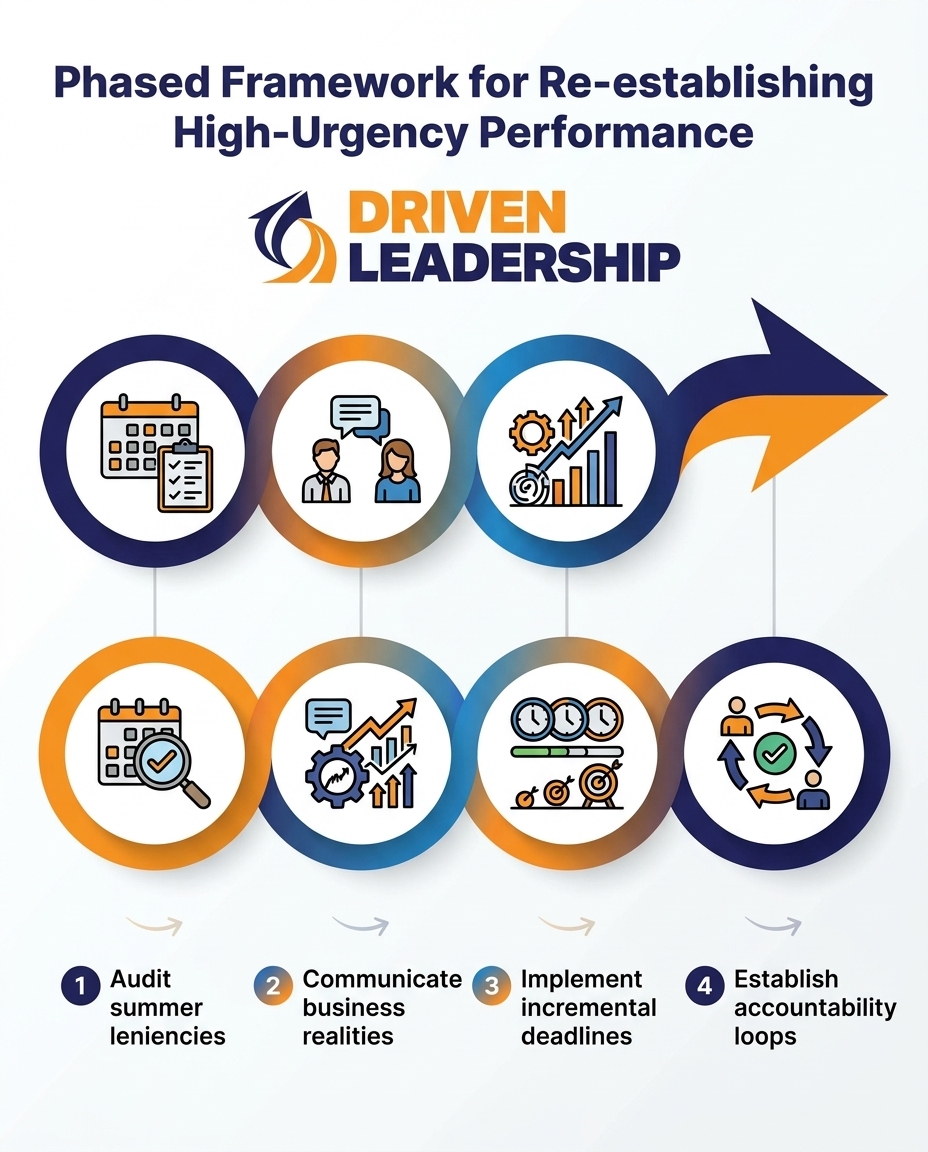
A Phased Framework for Re-establishing High-Urgency Performance
Tightening the reins without causing burnout requires a structured, step-by-step methodology. You cannot simply walk into the office on Tuesday morning and demand a 50% increase in output. When we help organizations improve team execution, we always recommend guiding the team through a deliberate transition.
Step 1: Audit Current Summer Leniencies
Before you can change behavior, you must identify exactly what has slipped. Take a critical look at your current operations. Have weekly meetings turned into casual chats? Are response times lagging? Identify the specific, non-negotiable Q4 standards that must be reinstated. Write them down. You cannot hold a team accountable to a vague feeling that they need to "work harder." You must define the exact behaviors that need to change.
Step 2: Communicate the 'Why' Behind the Shift
Once you know what needs to change, you must communicate the reasoning to your team. Frame the shift entirely around business realities. Explain the market demands, the specific Q4 targets, and why the current pace will not get the company across the finish line. When people understand the "why," they are far more likely to commit to the "what."
Step 3: Implement New Deadlines Incrementally
Avoid the temptation to overhaul every process overnight. If you change everything at once, you will trigger overwhelm and burnout. Instead, implement new deadlines incrementally. Start by tightening the parameters on a single critical project or reinstating strict start times for morning huddles. Once the team adapts to the first adjustment, introduce the next. This phased approach builds momentum and confidence.
Step 4: Establish Clear Accountability Loops
Setting a deadline is only half the battle; following up is where the culture shifts. Establish clear accountability loops to monitor the transition. If a deadline is missed, address it immediately using the 'Run to the Roar' approach. Consistent, predictable follow-up shows the team that the new standards are permanent, not just a passing phase.
Framing the Transition as a Business Necessity
The most important element of this framework is your messaging. Ensure the shift is perceived as a direct response to Q4 market demands. Avoid making the increased urgency feel like an arbitrary managerial demand. Use phrases like, "To hit our end-of-year targets, we need to adjust our pacing," rather than, "I need you all to start working faster." Depersonalizing the demand and attaching it to the company's survival and success fosters a sense of shared purpose.
Fostering Ownership Instead of Resorting to Micromanagement
As you increase the pressure, there is a significant risk of crossing the line from effective leadership into toxic micromanagement. Micromanagement occurs when a leader attempts to control every detail of the work, suffocating the team's autonomy. High-urgency accountability, on the other hand, focuses strictly on the outcomes and the deadlines, leaving the "how" up to the capable professionals you hired.
To prevent a team revolt, you must shift the burden of urgency from top-down enforcement to team ownership. For example, we recently worked with two partners who started a new business together in 2020 and realized they needed to build a strong foundation as leaders and communicators. After attending our specialized leadership programs, they gained the transformational tools needed to foster true ownership within their growing team, allowing their associates to take personal responsibility for their professional output.
If you want to build this kind of culture, focusing on organizational development is key. Empower your managers to guide their associates rather than dictating their every move. Highlight how passion and clear expectations from leadership facilitate this organic growth.
Signs You Are Managing Outcomes, Not Micro-Tasking:
• You ask for solutions, not just status updates: Instead of asking "Did you send the email?" you ask, "What is our strategy to close this account by Friday?"
• You set the destination, they map the route: You define the Q4 goal clearly, but allow the team to determine the daily workflow required to achieve it.
• You manage the exception, not the rule: You only step in to course-correct when a specific metric or deadline is missed, rather than hovering over routine tasks.
Provide strategies for leaders to step back once the new baseline is established. During the initial September post-Labor Day Q4 prep, you will need to be highly visible and hands-on. However, once the team demonstrates that they have internalized the new urgency, you must have the discipline to step back and let them execute.
Aligning the Seasonal Reset with Clear Q4 Goals
A behavioral shift will only stick if it is directly connected to tangible business objectives. If you ask your team to work with more urgency but fail to give them a clear target, they will quickly burn out from spinning their wheels. We advise our clients to solidify the transition by aligning the seasonal reset with explicit, measurable goals.
1. Translate end-of-year objectives into immediate September actions. Do not wait until October 1st to start Q4 work. Break down your ultimate year-end goals into specific tasks that must be completed this week. If the goal is a major product launch in November, the September action is finalizing the marketing copy. Make the distant goal immediate.
2. Utilize Gallup data principles for role clarity. Gallup research consistently shows that employees are most engaged when they know exactly what is expected of them. Ensure every single team member understands their specific role in Q4 success. Sit down with each associate and explicitly map their daily tasks to the company's broader objectives.
3. Create short-term milestones to build momentum. The autumn season is long, and year-end can feel far away. Establish two-week sprints or monthly mini-goals. Hitting these milestones early in the season builds confidence and proves to the team that the increased urgency is yielding real results.
4. Celebrate early wins to reinforce the new standards. When a team member successfully meets a tightened deadline or delivers a high-quality project under the new expectations, recognize it publicly. Celebrating early wins reinforces the value of the higher standards and shows the team that their hard work is noticed and appreciated.
By connecting the behavioral shift to real outcomes, you make the transition logical. If you need deeper strategies on aligning these specific targets, exploring methods for resetting Q4 goals for corporate teams can provide a roadmap for your upcoming quarterly planning sessions.
Solidifying Your Fall Leadership Strategy Before Q4 Begins
Resetting expectations deliberately in early fall is not just a management tactic; it is a vital strategy for ending the year strong. Transitioning your leadership style from summer leniency to fall urgency requires a careful balance of clear communication, phased implementation, and the courage to address slipping standards head-on.
By relying on a structured approach, you prevent team morale damage and avoid the pitfalls of micromanagement. You give your team the clarity and direction they need to succeed in the most demanding quarter of the year. If you find yourself struggling with this seasonal transition or want to refine your ability to hold your team accountable without alienating them, seeking out an advanced framework is the right next step. Consider exploring an executive manager program to build the skills necessary to lead your team confidently through Q4 and beyond.
Frequently Asked Questions
How do you motivate employees after summer vacation?
The short answer is to leverage the "fresh start effect" by framing the return as a new beginning. Acknowledge the rest they received during the summer, and clearly connect their daily tasks to exciting, high-stakes goals for the upcoming quarter. Providing short-term milestones and celebrating early wins helps rebuild their momentum naturally.
How do you prepare a corporate team for Q4?
Preparing a corporate team for Q4 requires auditing your current processes and removing any lingering summer leniencies. Communicate the business realities and market demands clearly so the team understands the 'why' behind the increased pace. Finally, establish strict accountability loops and map out specific, measurable goals for the final months of the year.
What is the fresh start effect in leadership?
The fresh start effect is a behavioral principle where people are more likely to take action towards a goal after temporal landmarks that represent new beginnings. In leadership, this means using dates like the start of a new month, the post-Labor Day return, or a new quarter as psychological resets to introduce new standards, tighter deadlines, and better habits.
How do you handle the post-summer slump at work?
Handling the post-summer slump requires addressing it directly rather than hoping it resolves on its own. Use our "Run to the Roar" methodology to confront slipping standards with clear, constructive conversations. Implement a phased framework to gradually tighten deadlines, ensuring the team rebuilds their focus without feeling overwhelmed.
How can leaders increase urgency without causing team burnout?
Leaders increase urgency safely by focusing on outcomes rather than micro-managing daily tasks. Implement new expectations incrementally rather than overhauling the entire workflow overnight. By empowering employees to take personal ownership of their work and providing clear expectations, leaders foster a high-performance culture that sustains energy rather than draining it.
What is the most effective way to communicate new Q4 deadlines to a relaxed team?
The most effective way is to frame the new deadlines as a direct response to business necessities and Q4 market demands, rather than an arbitrary managerial rule. Sit down with the team, explain the targets the company must hit by year-end, and show them exactly how the new deadlines are the logical path to achieving that shared success.