Why Our BOLD Training Challenges Who You Think You Are Professionally

The Hidden Cost of the Corporate Mask
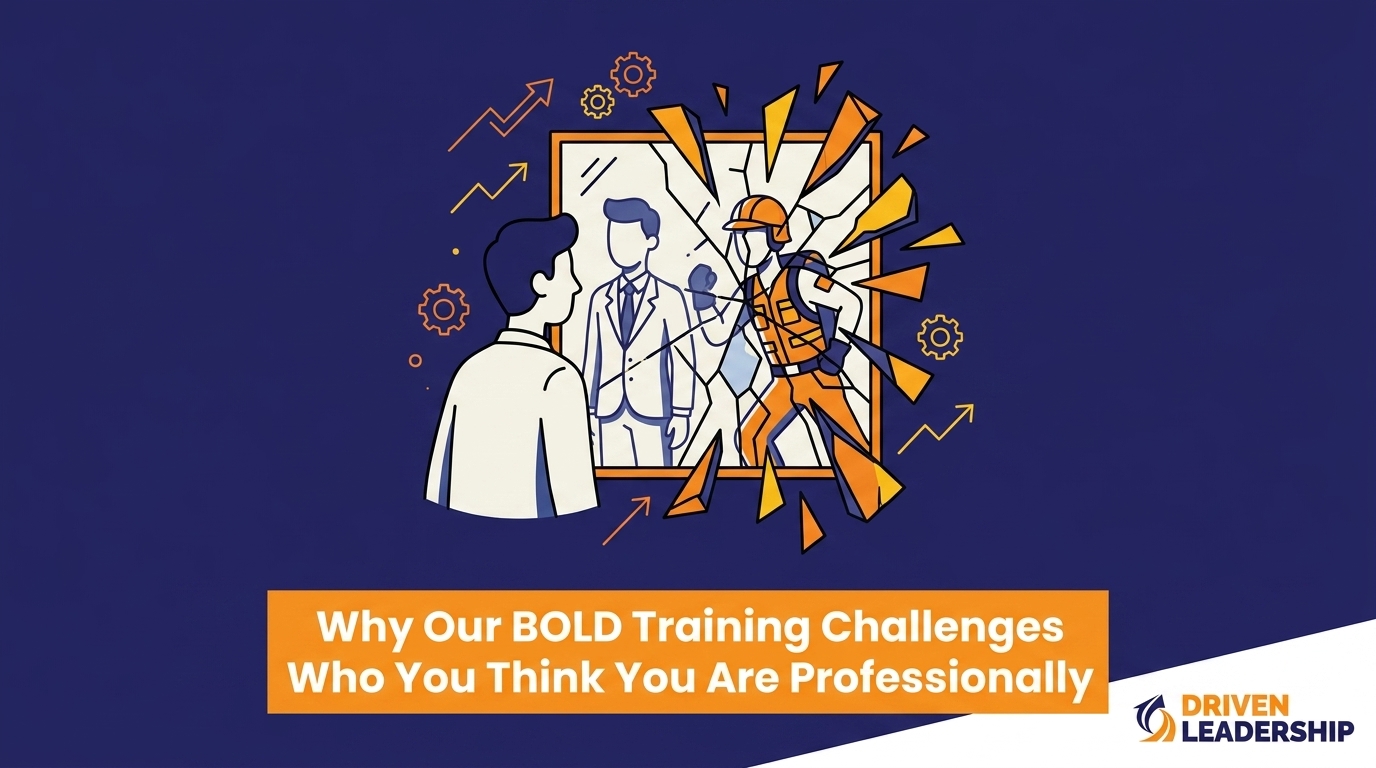
You are hitting your quarterly targets, but every interaction with your team feels rehearsed, and the exhaustion of maintaining your leadership persona is quietly burning you out. In our years of coaching executives at Driven Leadership, our team typically sees this pattern constantly. If you are wondering why our BOLD training challenges who you think you are professionally, the answer begins with this exact exhaustion. Many mid-to-senior professionals we work with spend years constructing a polished, "always-on" facade to project competence and authority. However, there comes a critical decision point in every successful career where you realize this protective armor is no longer an asset—it is an active barrier blocking genuine team trust and your own personal growth.
To begin breaking down these barriers, many professionals start by exploring foundational leadership trainings to understand where their gaps lie.
The concept of the "professional facade" is simple: it is the curated version of yourself that you bring to the office. It is the voice you use in board meetings, the neutral expressions you maintain during crises, and the careful distance you keep from your direct reports. While this mask may help you survive early management roles, the BOLD Training psychological framework reveals that maintaining it requires a massive amount of cognitive energy. When you are busy managing perceptions, you are not fully present to manage your people.
The Corporate Mask vs. Authentic Leadership
• Communication — The Corporate Mask: Rehearsed, guarded, and heavily filtered. — Authentic Leadership: Transparent, direct, and emotionally intelligent.
• Mistakes — The Corporate Mask: Hidden, deflected, or minimized to protect status. — Authentic Leadership: Owned openly and used as teaching moments.
• Team Dynamics — The Corporate Mask: Compliance-driven; team does what they are told. — Authentic Leadership: Trust-driven; team feels safe to innovate and challenge.
• Energy Levels — The Corporate Mask: Drained by the effort of playing a character. — Authentic Leadership: Sustained by genuine connection and alignment.
Breaking down this artificial identity is the necessary first step to true leadership development. You cannot build genuine influence on top of a fake foundation. The journey to becoming an impactful leader requires you to confront the very persona that got you the promotion in the first place.
Deconstructing the Psychology of the Professional Facade
To understand why this mask is so debilitating, we have to look at the psychological mechanics of why professionals build facades in the first place. In the corporate environment, this behavior is often referred to as "covering." According to Deloitte's widely cited Uncovering Talent study, a vast majority of professionals actively hide or downplay aspects of their true identity to fit into mainstream corporate culture. They cover their backgrounds, their struggles, and their genuine personalities out of fear that being "too real" will limit their upward mobility.
When our facilitators apply the BOLD Training psychological framework, we identify the root causes of this self-protection mechanism. Often, it stems from deep-seated imposter syndrome or a previous workplace trauma where vulnerability was punished rather than rewarded. Leaders learn to compartmentalize, creating a stark divide between their "work self" and their "true self."
• Appearance covering: Altering your natural presentation to blend into the executive mold.
• Affiliation covering: Avoiding behaviors or associations that might reveal your personal values or outside interests.
• Advocacy covering: Staying silent on issues you care deeply about to avoid being labeled as "difficult" or "disruptive."
• Association covering: Distancing yourself from certain team members to maintain an aura of executive detachment.
This creates what the Harvard Business Review terms the "authenticity paradox." Leaders try so hard to appear perfectly competent and unflappable that they end up appearing robotic, unapproachable, and untrustworthy. The psychological toll of maintaining two separate identities is immense. It leads to decision fatigue, emotional burnout, and a pervasive sense of isolation at the top.
The Illusion of the 'Always-On' Leader
Mid-to-senior leaders feel disproportionate pressure to never show weakness. There is an unspoken corporate myth that the higher you climb, the less human you are allowed to be. You are expected to have every answer, weather every storm without flinching, and project relentless optimism regardless of the reality on the ground.
However, modern psychological research proves the exact opposite is required for high-level execution. There is a direct, undeniable correlation between a leader's willingness to be vulnerable and the psychological safety of their team. High-performing teams do not follow flawless robots; they follow deeply human leaders who are self-aware enough to admit what they do not know. When you drop the illusion of being "always-on," you give your team permission to take calculated risks, speak the truth, and innovate without fear of retribution.
Why Genuine Leadership Requires Subtraction, Not Addition
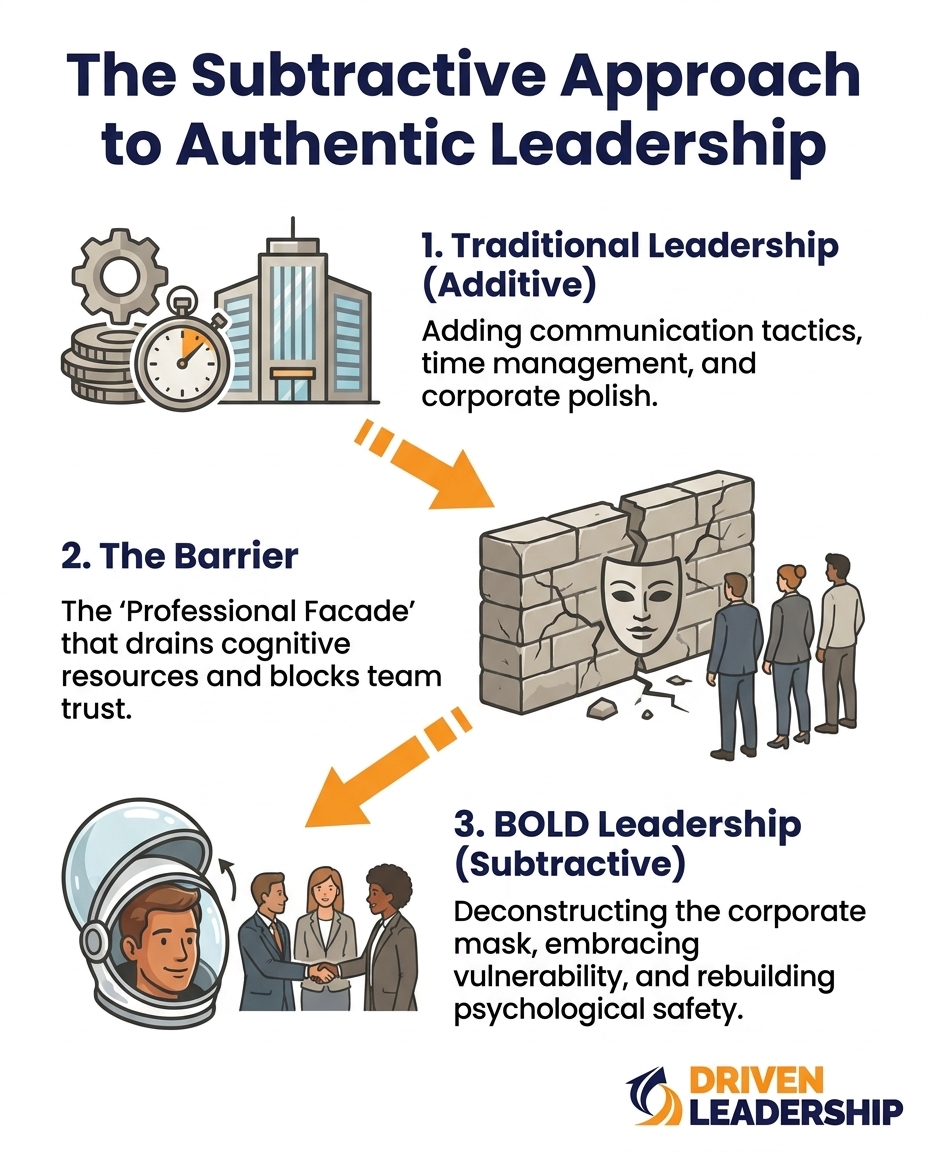
Most standard corporate seminars treat leadership development as a matter of addition. They give you a binder full of new time management techniques, conflict resolution scripts, and communication tactics. They ask you to stack these new skills on top of your existing professional persona. This is where our BOLD methodology at Driven Leadership is fundamentally different, particularly when professionals engage in an advanced leadership program.
The primary differentiator of the BOLD program is its unique psychological depth: it focuses on tearing down professional facades and challenging your personal identity rather than just teaching surface-level management tactics. We treat leadership development as an identity challenge, not a skill acquisition exercise. Genuine leadership requires a "subtractive" approach.
The Subtractive Process:
1. Identifying the Armor: Recognizing the specific behaviors, scripts, and emotional walls you use to keep people at a safe distance.
2. Deconstructing the Ego: Stripping away the need to always be the smartest person in the room and letting go of title-based authority.
3. Unlearning Corporate Habits: Actively stopping the polished, rehearsed responses that prevent authentic connection.
4. Rebuilding from Authenticity: Constructing a new leadership style based on your actual values, strengths, and human experiences.
Unlearning deeply ingrained corporate behaviors is vastly more difficult than memorizing new communication tactics. It requires you to let go of the very coping mechanisms that have kept you safe. But this subtractive process is the gateway to mastering advanced leadership concepts. Once the artificial armor is gone, you no longer have to waste energy defending your ego. You can finally focus all of your cognitive resources on executing your vision and elevating your people.
Navigating the Internal Storm of Unlearning
Acknowledge right now that deconstructing a long-held professional identity is an inherently uncomfortable process. It is supposed to be. When you strip away the mask, you are left feeling exposed and uncertain. This discomfort is not a sign that the process is failing; it is the exact mechanism of your growth.
Living and working in the Pacific Northwest, particularly leading our training sessions around the Puyallup region, gives our team a perfect metaphor for this experience. We are no strangers to extended, overcast, and rainy seasons. For weeks or months, the environment can feel heavy, relentless, and gloomy. But enduring that prolonged weather is what builds the deep, resilient root systems of the towering evergreens around us. Similarly, the transition from a polished manager to an authentic leader requires you to sit with sustained psychological discomfort. You have to endure your own internal overcast season.
Just as weathering the physical elements builds regional resilience, pushing through the "internal storm" of self-doubt builds unshakeable leadership confidence. When you stop running from the discomfort of vulnerability and learn to stand firm in it, you discover a strength that a corporate title could never provide.
The BOLD environment provides a safe, structured container for this turbulent but necessary internal work. It is a space where the storm is expected, guided, and ultimately leveraged by our coaches to help you break through to the other side. You are not left to navigate the psychological heavy lifting alone; the BOLD Training psychological framework ensures that the deconstruction serves a specific, empowering purpose.
Breaking Through Debilitating Professional Roadblocks
When you operate behind a facade, your unseen personal limitations and self-doubts inevitably manifest as professional roadblocks. You might find your team stalling on critical projects, or you might notice a distinct lack of innovation in your department. Often, leaders blame market conditions or personnel issues, failing to realize that their own lack of authentic connection is the true bottleneck to team execution.
A pattern we see often is when a professional reaches out to us facing intense personal and professional identity challenges, realizing they needed to 'level up' their approach. By committing to an intense, passionate development experience with our team, they emerged not just as a better manager, but as a fundamentally stronger person who embraced taking initiative. This is the breakthrough moment: when a leader stops hiding behind their title, stops deflecting blame, and starts leading with raw, unfiltered authenticity.
Overcoming these internal barriers directly translates into better alignment. When a leader is clear, grounded, and genuine, the team stops second-guessing the motives behind every directive. Communication becomes faster and more efficient because the subtext and office politics are stripped away. Once this foundational identity work is complete, the results are lasting. You do not revert to the mask because you have experienced the profound relief and effectiveness of leading without it.
From Stagnation to Taking Initiative
Dropping the facade naturally improves communication skills in ways that memorizing scripts never could. When you are no longer filtering every word through a lens of "how will this make me look," you speak with clarity and conviction.
• Passive Management: Waiting for consensus, avoiding tough conversations to maintain a "nice" persona, and letting small issues fester.
• Proactive Leadership: Addressing conflict head-on with empathy, making definitive calls, and owning the outcomes regardless of the optics.
This shift from passive management to proactive leadership transforms stagnant departments into dynamic, high-functioning units.
Realigning Your Leadership Identity for the Q3 Push
Timing matters when it comes to deep psychological development. As we navigate the late-summer transition through August and prepare for the back-to-school season, our team recognizes this as the ideal time for an internal leadership audit. As executives prepare to reset team expectations for the final push of the year, they must ensure their own internal alignment is flawless.
Another leader we worked with realized during a spring review that they needed to "wake up" and completely transform their personal and professional life. By stepping into this subtractive process with Driven Leadership, they forever changed their business trajectory, setting the stage for a much stronger second half of the year. Resetting team expectations requires absolute clarity and authenticity from the top. If you attempt to rally your team for Q4 using the same tired corporate talking points, they will tune you out.
Teams possess an incredible radar for authenticity. They can instantly sense when a leader is operating from a place of genuine conviction versus merely reciting a mandate from the board. If you want your team to give their absolute best during the most critical months of the year, you have to give them your absolute best—your real self.
The BOLD methodology serves as the catalyst for waking up professionally before these critical end-of-year challenges arrive. It provides the framework for building trust and cooperation through BOLD exercises, ensuring that when you ask your team to sprint toward Q4 goals, they follow you out of deep respect, not just obligation.
Common Questions About Authentic Leadership Development
What is a professional facade in leadership?
A professional facade is the artificial, highly curated persona a leader constructs to appear constantly competent, unflappable, and authoritative in the workplace. It acts as an emotional shield, designed to hide any perceived weaknesses, personal struggles, or gaps in knowledge. While it may provide short-term protection from criticism, maintaining this mask ultimately drains a leader's cognitive energy and prevents genuine, trust-based relationships with their team.
How does bold training challenge your professional identity?
The training challenges your professional identity by demanding that you strip away the corporate armor you have spent years building. Instead of teaching you additive skills like new management scripts, it uses the BOLD Training psychological framework to force a subtractive process. You are challenged to confront your imposter syndrome, drop your title-based ego, and lead from a place of raw, uncomfortable authenticity.
Why is authenticity required to build team trust?
Authenticity is required because human beings are hardwired to detect incongruence and insincerity. When a leader hides behind a polished mask, employees subconsciously recognize the emotional distance and respond by guarding themselves in return. Genuine trust and psychological safety can only be established when a leader proves they are willing to be vulnerable, admit mistakes, and communicate without corporate filters.
What is a corporate mask and why is it exhausting to maintain?
The corporate mask is the divide between a professional's true self and the character they play at the office to conform to executive expectations. It is exhausting to maintain because it requires constant, active self-monitoring—filtering every word, controlling every facial expression, and suppressing natural reactions. This continuous performance leads to severe emotional burnout and decision fatigue.
How do you break down professional barriers without oversharing?
Breaking down professional barriers is about transparency of thought and taking ownership of your shortcomings, not about treating your team as your therapist. You achieve this by openly admitting when you do not have the answer, asking for genuine feedback, and sharing the "why" behind your decisions. Vulnerability in leadership means being honest about your professional challenges and learning processes, maintaining appropriate boundaries while still being entirely human.
Why is vulnerability considered a competitive advantage in executive leadership?
Vulnerability is a competitive advantage because it is the fastest route to establishing psychological safety, which directly drives innovation and rapid problem-solving. Leaders who embrace vulnerability create environments where team members feel safe to pitch unconventional ideas and report failures early before they become crises. This level of agile, fearless execution is impossible to achieve in a rigid, facade-driven corporate culture.
Taking the First Step Toward Authentic Influence
True leadership satisfaction does not come from reinforcing your corporate mask; it comes from having the courage to tear it down. The exhaustion you feel at the end of the day is not just the workload—it is the heavy toll of playing a character instead of leading as yourself. Embracing the discomfort of the BOLD Training psychological framework is not just an exercise in self-improvement; it is a required step for genuine, sustainable professional growth.
For mid-to-senior professionals who feel stagnant despite their outward success, the path forward requires unlearning what you thought made you successful. By choosing to step into the internal storm, you can break through your debilitating professional roadblocks and build a foundation of absolute, unshakeable authenticity. If you are ready to stop managing perceptions and start leading people, our team is ready to help you explore how the BOLD training program can fundamentally transform your trajectory.