How Puyallup Businesses Are Using Advanced Leadership Programs to Retain Talent

The Late-Summer Talent Shift Impacting Puyallup Employers
If you are wondering how Puyallup businesses are using advanced leadership programs to retain talent, the answer usually becomes clear to our team right around the middle of August. At Driven Leadership, we have seen this late-summer back-to-school transition become a notorious period for career re-evaluation across the Pierce County and Puyallup WA business community. As summer winds down and families return to structured routines, professionals naturally begin to assess their work-life balance, their daily stress levels, and whether their current employer still aligns with their long-term career goals. You are suddenly faced with a stark decision point: do you accept this seasonal turnover as an unavoidable cost of doing business locally, or do you proactively invest in the structured development required to keep your best people anchored?
To combat this predictable exodus, we have found that establishing an Advanced Leadership Program within your organization is the most effective defensive strategy available. When top performers see a clear, tangible investment in their professional growth, their focus shifts from seeking outside opportunities to building their future right where they are.
The psychology of the seasonal shift: The August back-to-school transition is not just about schedule changes; it is a psychological reset. Employees who have spent the summer feeling undervalued, micromanaged, or stagnant will use this time to update their resumes. They look at the coming year and ask themselves if they want to spend another twelve months dealing with the same workplace frustrations. When local businesses fail to provide a structured pathway for advancement and skill-building, they unintentionally signal to their top talent that they have hit a ceiling. By recognizing this pattern, you can intercept the late-summer talent shift before it empties your management pipeline.
Most employers wait until a resignation letter is already on the desk to offer a counter-proposal. By that point, the psychological disconnect has already happened. The businesses that successfully navigate this seasonal transition are the ones that initiate leadership development conversations long before the end-of-summer restlessness sets in.
The Pierce County Commute Threat: Why Superficial Perks Aren't Enough
The Pacific Northwest economic climate is highly competitive, making local talent retention in Pierce County a critical priority against the relentless pull of Seattle and Tacoma. Puyallup's proximity to this massive metropolitan area creates a unique retention pressure cooker. Local employees are constantly tempted by the promise of higher-profile roles and different corporate environments just a short drive up the I-5 corridor. When an employee feels unsupported in their current role, a sixty-minute commute suddenly seems like a reasonable trade-off for a better career trajectory.
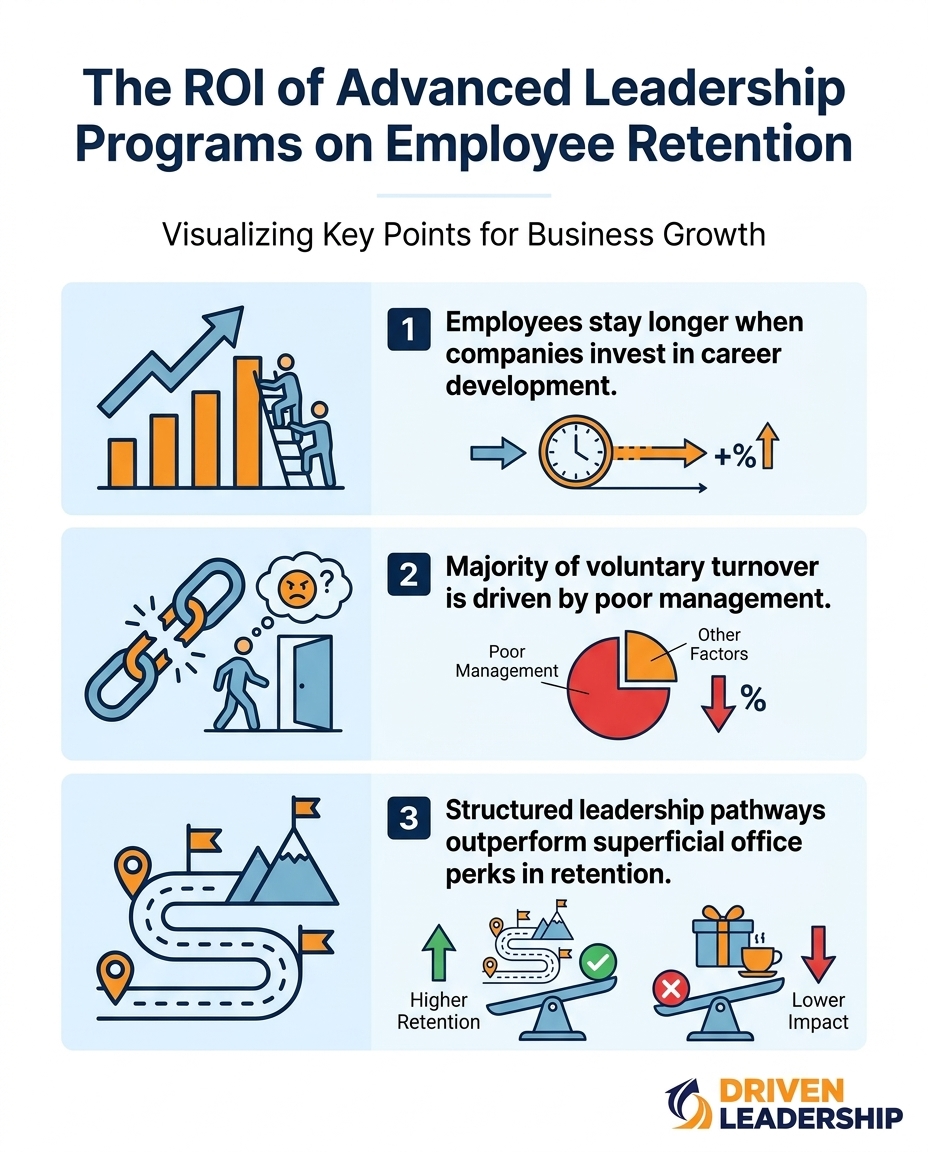
In our experience partnering with Puyallup employers, we find that many local companies try to fight this commute drain by offering generic office perks. They might introduce casual Fridays, upgrade the breakroom snacks, or offer flexible scheduling. While these are nice additions, they do not address the root cause of professional dissatisfaction. Data from the LinkedIn Workplace Learning Report consistently shows that employees stay significantly longer when companies actively invest in their learning and career development. Superficial perks wear off quickly; meaningful career pathways build lasting loyalty. If you want to keep your emerging leaders from looking north, we strongly recommend enrolling them in an advanced leadership course to prove that you take their future seriously.
Superficial Perks vs. Structured Development:
• Breakroom upgrades & casual dress — Employee Perception: A nice bonus, but does not improve daily job satisfaction or career growth. — Long-Term Impact on Turnover: Low impact. Does not prevent employees from taking calls from recruiters.
• Annual cost-of-living raises only — Employee Perception: Expected baseline compensation, not a reward for high performance. — Long-Term Impact on Turnover: Minimal impact. Competitors in Seattle-Tacoma can easily match or exceed.
• Advanced Leadership Training — Employee Perception: A serious, tangible investment in their personal and professional capabilities. — Long-Term Impact on Turnover: High impact. Creates deep organizational loyalty and a sense of internal ownership.
The True Cost of Employee Turnover
When an emerging leader leaves your Puyallup business, the damage extends far beyond an empty desk. The operational disruptions are immediate and severe. Projects stall, client relationships suffer, and the institutional knowledge that the employee carried walks right out the door. Furthermore, the remaining team members are forced to absorb the extra workload, which drastically increases their stress levels and makes them prime candidates for the next wave of resignations.
The constant cycle of rehiring drains local resources. You spend countless hours interviewing, onboarding, and training new staff, only to have them operate at a fraction of the efficiency of the person they replaced. This perpetual revolving door damages workplace morale, creating a cynical culture where employees expect high turnover as the norm. Building a defensive strategy based on robust organizational culture is the only sustainable way to stop this cycle.
How Structured Development Stops the Turnover Cycle
Leadership training is often misunderstood as a simple seminar on how to run better meetings. In reality, high-level methodologies like Driven Leadership's BOLD: Advanced Leadership program dive straight into the operational mechanics of human behavior, communication, and accountability. This structured approach creates engaged cultures that naturally repel turnover. When you teach a manager how to truly lead, you give them the tools to create an environment where their direct reports actually want to work.
Consider the real-world impact our team sees within the Pierce County / Puyallup WA business community. One local professional entered our training needing to improve their confidence, take initiative, and communicate better with their team. After attending our immersive BOLD: Advanced Leadership training program, they gained greater confidence, took charge more effectively, and drastically improved their communication and listening skills. This was not just an internal shift—the entire management team and their associates immediately noticed the transformation. When leaders communicate clearly and listen actively, the daily friction that drives employees to quit simply disappears.
This creates a powerful cascading effect. Mid-level manager engagement directly dictates frontline employee retention. If your managers are thriving, your entry-level staff will thrive. If you are serious about leading an engaged culture, you have to start by equipping the people at the helm with the right tools.
How Advanced Leadership Programs Specifically Reduce Employee Turnover:
1. Fostering Extreme Ownership: Structured programs teach leaders to take absolute responsibility for their team's outcomes, eliminating the culture of blame that frustrates top performers.
2. Improving Conflict Resolution: Instead of letting workplace tensions fester until an employee quits, trained leaders address and resolve interpersonal issues immediately and respectfully.
3. Creating Clear Expectations: Advanced training provides frameworks for setting transparent goals, ensuring that every team member knows exactly what success looks like and how to achieve it.
4. Building Emotional Intelligence: Leaders learn to recognize the signs of burnout and dissatisfaction early, allowing them to intervene before a resignation letter is drafted.
5. Empowering Decision-Making: By giving leaders the confidence to make critical calls, the entire organization moves faster, reducing the bureaucratic red tape that drives ambitious talent away.
Replacing 'Accidental Managers' with Intentional Leaders
One of the most common patterns our facilitators at Driven Leadership see during the late-summer back-to-school transition is the fallout from "accidental managers." These are your top salespeople, your fastest technicians, or your most reliable administrators who were promoted into management simply because they were good at their previous jobs. However, the skills required to close a sale or fix a complex problem are entirely different from the skills required to manage human beings. Promoting top performers without giving them the tools to succeed is a recipe for disaster.
Gallup data consistently indicates that the vast majority of voluntary turnover is driven by poor management, not base compensation. People do not leave bad companies; they leave bad bosses. When an accidental manager is overwhelmed, they often resort to micromanagement, poor communication, or avoiding conflict entirely. This creates a toxic environment for the team below them. The cost of actively disengaged managers is astronomical when you factor in the talent they drive away.
Structured programs challenge individuals to take ownership of their roles both personally and professionally. A recent participant came to our program needing to overcome debilitating personal and professional roadblocks that were hindering their effectiveness. By attending the training, they received the necessary support and a clear recipe for elevation. They ultimately achieved profound personal and professional growth, reaching new heights in their leadership capabilities. This is what intentional leadership looks like. It is about equipping your managers to handle the psychological and operational demands of leading a team, ensuring they become retention magnets rather than turnover catalysts.
The hidden costs of accidental management: When untrained managers struggle, they often hoard information, fail to delegate, and create bottlenecks. This frustrates ambitious employees who want to grow but feel stifled by a leader who cannot effectively distribute responsibility. By converting these accidental managers into intentional, highly trained leaders, you instantly improve the daily working conditions of every single person on their team.
Building a Local Culture That Repels Turnover
Leadership training must be viewed as an organizational development tool, not just an individual perk handed out to a select few. When you elevate the capabilities of your leadership team, you elevate the entire company. A culture built on accountability, clear communication, and mutual respect becomes a fortress against external recruitment efforts. When your Pierce County / Puyallup WA business community reputation becomes known for exceptional workplace culture, you stop chasing talent and start attracting it.
Empowering leaders to overcome their own debilitating roadblocks changes the atmosphere of the office. Another participant recently sought personal improvement and life change through our structured training. After participating in the BOLD program, they described the experience to us as a life-changing event, noting that they now have the tools and courage to "run to their roar" on a daily basis. When your managers operate with that level of clarity and enthusiasm, it is contagious. The entire team feels the shift in energy.
This strong internal culture makes external job offers far less appealing. Even if a competitor in Seattle offers a slightly higher base pay, an employee is highly unlikely to leave a supportive, well-managed environment where they feel respected and understood. They know that a longer commute and an unknown corporate culture are a massive risk compared to the stability and growth they experience under your roof. If you are focused on long-term organizational development, you are actively building a culture that naturally repels turnover, allowing you to survive the late-summer career re-evaluation period without losing your best people.
Frequently Asked Questions About Leadership and Retention
How does leadership development improve employee retention?
Leadership development improves retention by directly targeting the primary reason employees quit: poor management. When managers are trained in effective communication, conflict resolution, and emotional intelligence, they create a healthier, more supportive daily work environment. Employees feel heard, respected, and guided, which significantly increases their loyalty to the company and reduces their desire to seek employment elsewhere.
Why do companies struggle with employee retention in competitive markets?
Companies struggle with retention in competitive markets because they often rely on superficial perks instead of addressing core workplace culture. In areas with high demand for talent, employees have options and will not tolerate micromanagement, lack of clear expectations, or stagnant career growth. Businesses that fail to provide structured development pathways lose their top performers to competitors who promise better management and clearer opportunities for advancement.
What are the key components of an advanced leadership program?
An advanced leadership program goes beyond basic meeting management to focus on deep behavioral and operational changes. Key components typically include training on extreme accountability, advanced communication frameworks, effective conflict resolution, and emotional intelligence. These programs challenge participants to overcome personal roadblocks and develop a structured, intentional approach to guiding and inspiring their teams.
How can Puyallup businesses compete with Seattle-Tacoma employers for top talent?
We advise that Puyallup businesses can compete with larger metro employers by leveraging a superior local workplace culture that eliminates the desire for a long commute. While Seattle-Tacoma employers might offer different corporate environments, local businesses can win by providing exceptional, highly trained management and clear career development pathways. When employees feel deeply valued and expertly led locally, the appeal of a stressful highway commute quickly diminishes.
Why is the late-summer season a critical time for employee turnover?
The late-summer season is critical because it aligns with the back-to-school transition, triggering a natural period of life and career re-evaluation. As families return to structured routines, professionals often assess their work-life balance, their stress levels, and their long-term career satisfaction. If they are unhappy with their current management or lack of growth, this psychological reset often pushes them to finally update their resumes and seek new opportunities.
Secure Your Puyallup Team Before the Fall Transition
From what we see every day at Driven Leadership, the evidence is clear: investing in advanced leadership programs is the most sustainable, effective way to keep your best people from walking out the door. As the August / late-summer back-to-school transition prompts professionals to re-evaluate their careers, you cannot afford to rely on superficial perks or accidental management to hold your team together. A structured, intentional approach to leadership development transforms your managers into retention assets, building a localized culture that top talent simply does not want to leave. Do not wait for the resignation letters to start piling up on your desk. Take proactive steps today to explore structured development options and secure the future of your organization.