
End-of-Summer Leadership Tune-Ups: Preparing Your Executive Team for the Fall Push

Pivoting from Summer Lulls to Q4 High-Performance Execution
Late August signals a distinct shift in the business calendar, making End-of-Summer Leadership Tune-Ups: Preparing Your Executive Team for the Fall Push a high-priority initiative for proactive organizations. Across the Pacific Northwest, executive teams are returning from disjointed summer schedules, staggered PTO, and well-deserved vacations. While this downtime is necessary, it often leaves management groups with misaligned priorities just weeks before the high-demand autumn rush. Entering the critical Q4 push without a unified strategic front introduces significant operational risk.
A structured end-of-summer leadership audit serves as the bridge between summer relaxation and autumn execution. Instead of waiting for the seasonal transition to force your hand, conducting a proactive audit allows you to identify communication gaps, reset expectations, and ensure every leader is pulling in the same direction. To build this foundation, integrating an executive manager program helps realign leadership focus, while deploying immediate team execution strategies ensures your organization corrects course before the busy season begins.
Diagnosing the Pacific Northwest Summer Slump in Your Management Team
Workplace productivity typically drops by roughly 20% during the summer months. Vacations, relaxed schedules, and the natural desire to enjoy the short-lived Pacific Northwest sunshine create a distinct "summer slump." While individual employees may just slow their pace, when an executive team drifts out of sync, the ripple effects impact the entire organization. The shift in the local Puyallup and regional business climate demands an abrupt change in leadership pacing as late August rolls into September.
The transition from relaxed summer weather to a brisk, high-demand fall season requires both a psychological and operational pivot. Local businesses often see a sharp acceleration in B2B and consumer activity post-Labor Day. If your management team is still operating on a summer frequency, they will struggle to catch up. Identifying the subtle signs of this drift is the first step in diagnosing the problem.
Subtle Signs of Executive Misalignment
• Delayed decision-making: Approvals that took 24 hours in Q1 are suddenly taking a week because key stakeholders are out of the office or disconnected.
• Siloed operations: Departments stop sharing resources or updates, operating independently rather than as a cohesive unit.
• Meeting fatigue and silence: Leadership meetings become passive reporting sessions rather than active problem-solving arenas.
• Goal amnesia: The aggressive targets set in January feel distant, and leaders struggle to articulate how their current daily tasks connect to year-end objectives.
Framing this late-summer window as a proactive tune-up period shifts the narrative. You are not punishing the team for taking time off; you are actively recalibrating the engine so the vehicle can handle the steep climb of Q4.
Identifying Communication and Initiative Gaps Before September
Prolonged absences and staggered schedules do more than just delay projects—they erode active listening and cross-departmental communication. When leaders are constantly covering for one another or operating with a skeleton crew, survival mode takes over. Strategic conversations are replaced by transactional emails. By the time the late August back-to-school transition arrives, the muscle memory of effective, collaborative communication has often weakened.
One of the most dangerous byproducts of this disconnect is hesitation. As leaders return to full capacity, they may lack the initiative to speak up in meetings or challenge the status quo. Unaddressed communication roadblocks can quickly derail early fall project launches. For example, if the marketing director and operations manager haven't had a substantive conversation since June, a September campaign launch will likely face severe logistical bottlenecks.
The Operational Cost of Hesitation
Hesitation at the executive level cascades down the organizational chart. A typical pattern we see is that when leaders lose their confidence or voice, their direct reports also stall. In one real-world scenario, a local management team noticed a distinct lack of confidence, initiative, and effective communication skills among their leaders, which was negatively impacting both work output and personal dynamics. To correct this, they participated in immersive BOLD: Advanced Leadership training. The outcome was clear: the team gained confidence, took significantly more initiative, improved their active listening skills, and became noticeably more driven. Leaders must regain this level of confidence and find their voice before the heavy lifting of Q4 planning begins.
Executing a 5-Step End-of-Summer Leadership Audit
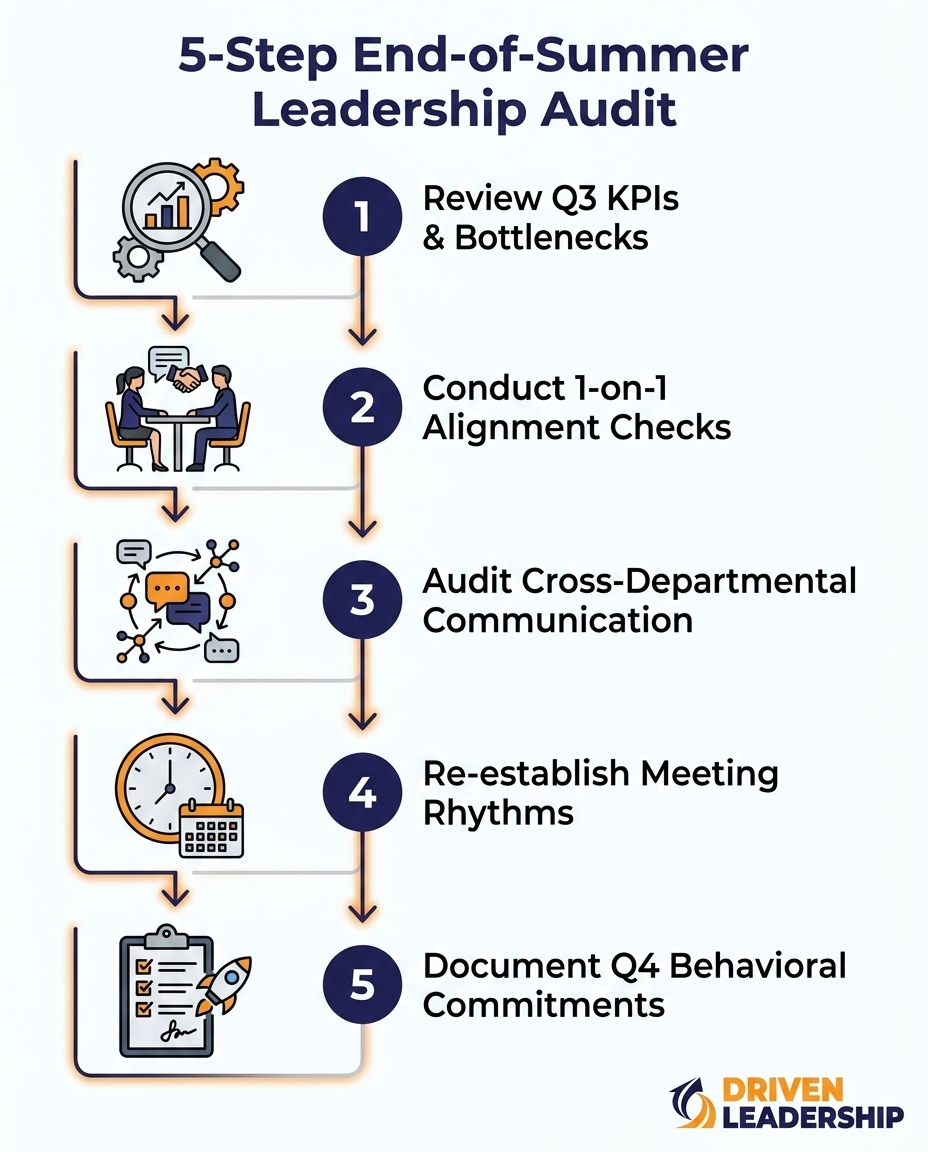
A successful transition into the fall requires more than a motivational speech; it requires a structured diagnostic process. Implementing a formal end-of-summer leadership audit provides the clarity needed to reset the team. This process should be completed in late August, utilizing the natural back-to-school transition as a psychological reset point for your executives.
1. Step 1: Review Q3 KPIs and identify operational bottlenecks. Start by looking at the hard data. Analyze your Q3 performance metrics to pinpoint exactly where summer absences caused delays. Did sales cycle times increase? Did customer response times drop? Identifying these bottlenecks allows you to focus the audit on the areas of the business that need immediate stabilization.
2. Step 2: Conduct 1-on-1 alignment checks. Group meetings are not the place to assess individual burnout or bandwidth. Schedule private alignment checks with each executive. Gauge their current focus, their understanding of the upcoming Q4 priorities, and any lingering roadblocks from the summer. This step ensures every leader is mentally prepared for the upcoming sprint.
3. Step 3: Audit cross-departmental communication channels. Evaluate how information is flowing between departments. Are teams relying too heavily on asynchronous messaging apps instead of having substantive conversations? Mandate a return to structured, face-to-face (or camera-on) communication for complex problem-solving to eliminate the friction caused by misread emails.
4. Step 4: Re-establish meeting rhythms and expectations. Summer often destroys the regular meeting cadence. Use this audit to reset the calendar. Cancel unproductive recurring meetings and establish a strict rhythm for the fall—such as a rigid weekly leadership pulse meeting and daily departmental huddles. Set the expectation that attendance and active participation are no longer optional.
5. Step 5: Document specific behavioral commitments. The audit must conclude with action. Require each leader to document two to three specific behavioral changes they commit to for the Q4 sprint. This might be "I will respond to cross-departmental requests within 4 hours" or "I will delegate routine reporting to focus on strategic execution."
Moving from Theoretical Goals to Measurable Q4 Accountability
A common pitfall during seasonal transitions is relying on theoretical "rah-rah" leadership advice. Motivation fades quickly under the pressure of the fall workload. To truly prepare your executive team, you must transition from abstract goals to measurable accountability. The focus must remain strictly on tangible behavioral changes and execution.
Companies that conduct quarterly leadership resets consistently see higher Q4 goal attainment. This is because they do not leave execution to chance. When you integrate formal frameworks into your operating system, you create a rigid structure that holds leaders accountable long after the initial audit is complete. For organizations looking to solidify this structure, EOS implementation provides the exact tools needed to maintain the momentum gained from your end-of-summer tune-up.
Tracking Accountability Metrics Weekly
Waiting for end-of-year reviews to assess performance is a recipe for missing your annual targets. Accountability must be tracked weekly. Establish a scorecard that tracks 5 to 15 leading indicators—numbers that predict future success rather than just reporting past results. Review this scorecard every single week with the leadership team. If a metric is off track, the responsible executive must own the issue and present a clear plan to resolve it. This relentless focus on weekly measurable data removes emotion from the equation and ensures that the commitments made during the leadership audit actually translate into Q4 results.
Rebuilding a Foundation of Trust for High-Stress Quarters
Even the best operational frameworks will collapse if the executive team lacks interpersonal trust. High-demand seasons require a deeper level of cooperation because the margin for error is significantly smaller. When the pressure spikes in November and December, leaders must trust that their peers will deliver on their promises without needing to be micromanaged.
Building this trust accelerates the post-summer realignment. When leaders take personal ownership of their roles and actively work to overcome their own professional roadblocks, the entire team benefits. We see this frequently in practice: another management group recognized they needed to take true ownership of their personal and professional lives to handle upcoming challenges. By participating in rigorous courses like BOLD and Leadership for Managers, they were challenged to take ownership and become the best versions of themselves. This kind of shared, challenging experience breaks down lingering resentments and builds a cohesive unit.
A strong communicative foundation prevents burnout during the winter rush. When trust is high, leaders can openly admit when they are overwhelmed and ask for help before a critical project fails. Exploring options for building trust and cooperation through training is a highly effective way to solidify these interpersonal dynamics before the busiest quarter of the year begins.
Aligning Departmental Goals with Q4 Revenue Pacing
Once your executive team is aligned on communication and accountability, the final step of the tune-up is connecting the audit directly to business outcomes. The results of the leadership audit must translate into actionable departmental targets that support historical Q4 revenue pacing. In the Puyallup and broader Pacific Northwest business climate, the final quarter often carries a disproportionate amount of the annual revenue burden.
Review your historical pacing requirements. If your organization typically needs to close 35% of its annual revenue in the final three months, every executive must understand their specific contribution to that financial goal. It is not just a sales objective; operations must be prepared to fulfill the volume, marketing must drive the late-season leads, and HR must ensure staffing levels are adequate.
• Operations manager lacks bandwidth — Departmental Action Required: Delegate daily reporting to mid-level staff — Impact on Q4 Revenue Pacing: Frees up 10 hours/week to focus on fulfillment speed
• Sales and Marketing are siloed — Departmental Action Required: Institute mandatory weekly alignment huddle — Impact on Q4 Revenue Pacing: Ensures promotional spend matches actual inventory
• Hesitation in decision-making — Departmental Action Required: Establish clear authority matrices for approvals — Impact on Q4 Revenue Pacing: Prevents delays in late-stage contract negotiations
• Unclear Q4 priorities — Departmental Action Required: Document and sign off on top 3 departmental goals — Impact on Q4 Revenue Pacing: Focuses all resources on high-margin revenue drivers
Establish a strict timeline for reviewing progress against these pacing requirements throughout the fall. By mapping the behavioral changes from the audit directly to the financial realities of the season, you ensure that your leadership tune-up delivers measurable return on investment.
Frequently Asked Questions About Seasonal Leadership Alignment
How do you align an executive team for Q4?
Start with a structured end-of-summer audit to identify where communication and processes broke down over the vacation months. Clarify individual bandwidth and map out cross-departmental dependencies so no team is operating in a silo. Finally, implement measurable weekly accountability pulses to ensure the alignment holds under pressure.
What should be included in a leadership audit?
A comprehensive leadership audit should begin with a review of previous quarter KPIs to locate operational bottlenecks. It must include an assessment of communication breakdowns and evaluate both meeting effectiveness and individual initiative. The process concludes by documenting specific behavioral commitments for the upcoming quarter.
How do you re-engage employees after summer?
Reset expectations clearly before September begins by holding a formal kickoff or alignment meeting. Ensure leadership is modeling high-performance behaviors, as employees will mimic the energy of the executive team. Connect their daily tasks directly to urgent year-end goals so they understand the immediate impact of their work.
What are the best Q4 planning strategies?
The most effective strategy is transitioning from theoretical goal-setting to strict operational frameworks that demand weekly accountability. Aligning departmental targets with historical revenue pacing ensures the entire company is supporting the financial goals. Fostering deep interpersonal trust is also required to handle the inevitable seasonal stress without fracturing the team.
Why is late August the ideal time for a corporate reset?
Late August precedes the operational bottlenecks of early fall, giving you a brief window to implement changes before volume spikes. It allows management time to correct communication gaps and rebuild trust before the high-stakes Q4 sprint begins. Furthermore, it capitalizes on the natural back-to-school psychological transition, making teams more receptive to new routines.
Equip Your Management Team for a Strong Year-End Finish
The late-summer transition is a defining moment for your business year. Allowing your executive team to drift into September with disjointed priorities and communication gaps is a risk you cannot afford. Proactive audits prevent Q4 crises by identifying operational bottlenecks and behavioral hesitation before they impact your revenue pacing. By taking the time to conduct a thorough review now, you build the trust and accountability required to navigate the busiest months of the year. Do not leave your year-end finish to chance; deploy proven team execution strategies today to secure a clear, actionable framework that resets team goals and drives measurable results.