What Exactly is an Accountability Action Plan?

Are Vague Promises Derailing Your Q4 Goals?
Are you wondering what exactly is an accountability action plan, and whether it can finally stop the cycle of missed deadlines and vague promises in your late-summer strategic meetings? You sit through hours of planning, everyone nods in agreement, and you leave feeling aligned. Yet, weeks later, critical projects remain stalled. "I thought you were handling that" becomes the default excuse. The concrete problem isn't a lack of effort; it is the acceptance of passive agreement over active ownership. The moment you decide to stop accepting "I'll try to get that done" and require a formal, written framework to track exactly who is doing what by when, your organization changes. This late-summer Q4 planning transition is the critical window where year-end momentum is either secured or lost.
In our experience working with leadership teams, mastering team execution often requires formalizing these commitments, which is exactly why our Engage Elevate Program focuses heavily on enforcing clear, measurable standards.
What Exactly is an Accountability Action Plan?
An accountability action plan is an explicit behavioral contract between a team member and the organization, detailing the precise, measurable outcome expected, the exact deadline, and the single person responsible for its completion. It is not merely a list of tasks or a loose collection of good intentions. Instead, it serves as a binding agreement that removes ambiguity and forces clarity. By formalizing these commitments, a team's culture shifts from passive participation to active, undeniable ownership.
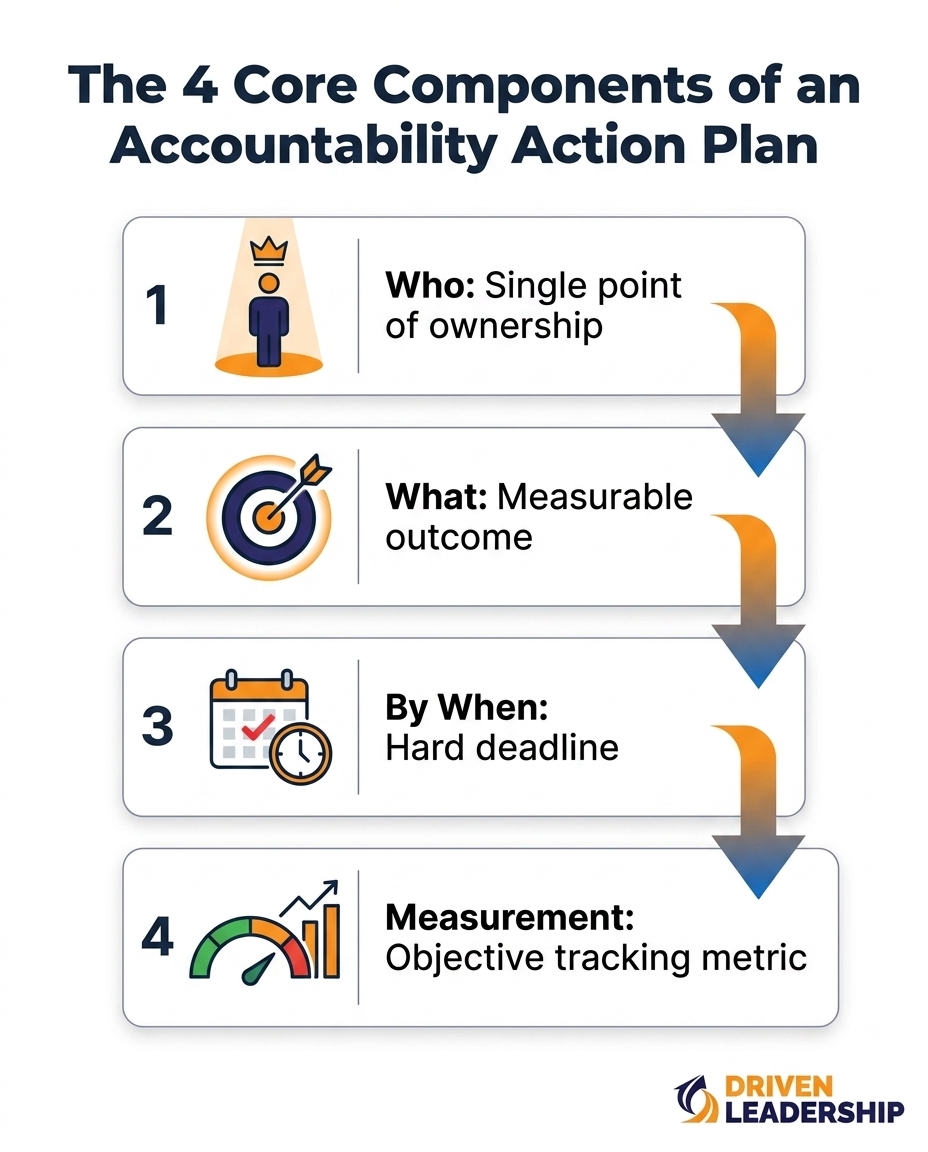
In our practice, we ground this definition in Driven Leadership's proprietary template framework. We avoid theoretical HR fluff in favor of a field-tested methodology that actually works in high-stakes environments. The core framework consists of four non-negotiable elements:
• Who: The single, designated individual who owns the outcome—never a department or a committee.
• What: The specific, measurable result that must be delivered, explicitly defined so there is no gray area.
• By When: A hard, date-bound deadline that leaves no room for "sometime next week" or "end of the month."
• Measurement: The objective tracking metric used to verify that the standard has been met.
Implementing this structure is the most effective method for breaking down barriers with an accountability action plan. It eliminates the bystander effect, ensuring that every strategic initiative has a name and a date attached to it.
Why Standard To-Do Lists Fail Leadership Teams
Most organizations try to manage complex strategic shifts with standard to-do lists. The inherent flaw in a to-do list is that it tracks activities, not outcomes. It lacks personal ownership, specific deadlines, and the psychological weight of a behavioral contract. When an item sits on a shared project board, it belongs to everyone, which ultimately means it belongs to no one. This dynamic breeds a culture of excuses, especially during the crucial late-summer Q4 planning transition when the pressure to perform is at its peak.
The psychological difference between being assigned a task and committing to a behavioral contract is profound. A task is something you do; a commitment is an outcome you own. We see this pattern frequently. One spring, an executive team we worked with noticed a distinct lack of confidence, failure to take charge, and poor communication in their meetings. They were relying on standard task lists that allowed everyone to hide behind group responsibility. After attending our BOLD Advanced Leadership training, their management team and associates noticed immediate changes. The training challenged them intensely, resulting in increased confidence, proactive leadership, and vastly improved communication that replaced passive list-making with actual ownership.
The data supports this shift. A well-known Dominican University of California study on goal setting demonstrated that written goals and formal action commitments increase the likelihood of achievement by over 40%. To understand why, look at the stark differences between the two approaches:
• Ownership — Standard To-Do List: Often assigned to a group or department — Accountability Action Plan: Assigned to a single, specific individual
• Focus — Standard To-Do List: Tracks daily activities and minor tasks — Accountability Action Plan: Tracks measurable business outcomes
• Deadlines — Standard To-Do List: Soft targets ("ASAP" or "Next Week") — Accountability Action Plan: Hard, unmovable dates and times
• Consequences — Standard To-Do List: Items roll over to the next week without discussion — Accountability Action Plan: Missed targets trigger immediate leadership review
The Core Components of a Functional Accountability Framework
To execute consistently, leaders need more than good intentions; they need a rigorous system. Driven Leadership's proprietary template framework is designed to eliminate ambiguity and force clarity at every level of the organization. Integrating this framework aligns perfectly with broader organizational systems, such as EOS implementation, providing the granular tracking necessary to achieve high-level vision.
Defining the 'Who' and 'What'
1. The 'Who' (Single Point of Ownership): The most critical failure point in any project is shared responsibility. If two people are responsible for a deliverable, no one is responsible. The 'Who' must be a single individual who possesses the authority, resources, and capability to drive the outcome. This person does not necessarily do all the work, but they own the final result and answer for its success or failure.
2. The 'What' (Measurable Outcome): Vague activities kill momentum. "Improve marketing" is an activity. "Deliver three new qualified leads per week from the manufacturing sector" is an outcome. The 'What' must be explicitly defined so that any outside observer can look at the result and definitively say whether it was achieved.
Establishing the 'By When' and 'Measurement'
3. The 'By When' (Hard Deadlines): A goal without a specific deadline is merely a suggestion. The 'By When' requires a hard date and, often, a specific time. "End of Q4" is too vague. "Friday, November 15th at 3:00 PM" establishes a clear boundary. This precision prevents the natural drift that occurs when deadlines are treated as soft targets.
4. The 'Measurement' (Objective Tracking Metrics): You cannot manage what you cannot measure. The measurement component defines exactly how success will be objectively tracked. Whether it is a percentage increase in sales, a specific number of units produced, or a completed document signed and filed, the metric must be undeniable and completely free of subjective interpretation.
Shifting Culture: From Passive Agreement to Active Ownership
A template is ultimately useless without a culture that embraces accountability. You can implement the most rigorous tracking system in the world, but if your team views it as a micromanagement tool rather than a standard of excellence, it will fail. The shift from passive agreement to active ownership requires confronting discomfort and having honest, sometimes difficult conversations about performance.
Leaders must model the behavior they expect from their teams. If the executive team routinely misses their own "By When" dates or offers excuses for falling short on their "What," the rest of the organization will immediately adopt the same relaxed standards. True accountability starts at the top. The late-summer Q4 planning transition is the perfect time to reset these cultural expectations, clearly defining what is acceptable and what is no longer tolerated as you push toward year-end goals.
This cultural shift is especially critical depending on your environment. For businesses operating in the Puyallup and greater Seattle area, clear, date-bound goals help maintain team momentum and focus during the darker, slower-paced Pacific Northwest winters. When natural energy levels dip and the days grow shorter, a rigorous, written framework keeps the team anchored to their commitments, preventing the seasonal slump that often derails Q4 execution.
Equipping Your Leaders to Enforce the Plan
There is a massive gap between having a written plan and actually holding people to it. Many managers excel at the planning phase but falter when it comes to enforcement. They avoid the necessary friction, fearing that holding someone accountable will damage the relationship or lead to turnover. However, the opposite is true: high performers crave clear expectations and resent environments where low performers are allowed to slide.
Enforcing Driven Leadership's proprietary template framework requires foundational leadership and communication skills to manage pushback effectively. Leaders must learn how to address missed deadlines objectively, focusing on the agreed-upon measurement rather than attacking the individual. This level of communication does not come naturally to most managers; it must be trained and practiced in environments that simulate real-world pressure.
Immersive training experiences provide the tools to enforce accountability without resorting to micromanagement. Another professional we worked with last spring realized they needed to take true ownership of their personal and professional life to lead effectively. They attended our BOLD training and Leadership for Managers courses. Through these immersive programs, they were challenged to become the best version of themselves, gaining the courage and the specific communication frameworks needed to hold their teams to a higher standard.
Frequently Asked Questions About Accountability Action Plans
What is an example of an accountability plan?
An example of an accountability plan is a specific, written agreement detailing that the Sales Director (Who) will secure three new enterprise client contracts (What) by Friday, November 15th at 5 PM (By When), measured by signed service agreements filed in the CRM (Measurement). This contrasts sharply with a vague, standard approach where a manager might simply say, "Marketing and Sales need to improve lead generation this quarter." The framework we use forces clarity. By assigning a single owner and an undeniable metric, the business eliminates the possibility of the Sales Director claiming they "tried their best" if the contracts are not signed. The expectation is concrete, and the outcome is binary: it was either achieved, or it was not.
How do you write an accountability action plan?
You write an accountability action plan by starting with the overarching strategic goal and breaking it down into actionable, assignable components using the Who/What/By When/Measurement matrix. First, define the exact outcome required to move the strategy forward. Next, identify the single individual who has the capacity and authority to own that outcome. Then, negotiate a realistic but firm deadline. Finally, agree on the objective metric that will prove the work is complete. In our experience working with leadership teams, the most critical step in writing the plan is the negotiation phase. The leader and the team member must look at the written document and verbally agree that the timeline is achievable and the measurement is fair, creating a true behavioral contract.
What is the difference between a to-do list and an accountability action plan?
The difference is that to-do lists track daily tasks and activities, while accountability action plans track behavioral commitments and measurable outcomes. A to-do list might include items like "call the vendor," "draft the report," or "email the client." These are necessary steps, but they do not guarantee a strategic result. An accountability plan focuses on the finish line: "Vendor contract renegotiated and signed to save 10% on materials by October 1st." Furthermore, accountability plans include specific measurement criteria and inherent consequences for missing the mark, whereas unchecked items on a to-do list simply roll over to the next day without any organizational impact or leadership review.
How do you hold a team accountable without micromanaging?
You hold a team accountable without micromanaging by focusing entirely on the agreed-upon measurement and outcome rather than dictating the daily process. When you use Driven Leadership's proprietary template framework, the "What" and "By When" are clearly established upfront. Once the behavioral contract is agreed upon, you step back and give the employee the autonomy to execute the work their way. The "By When" date serves as the natural check-in point. If they deliver the required metric on time, their process was successful. If they fail, the conversation focuses on why the outcome was missed, rather than scrutinizing every email they sent along the way. This builds trust while maintaining high standards.
What are the 4 pillars of accountability?
The four pillars of accountability conceptually include Responsibility, Empowerment, Measurement, and Consequences, which tie directly back to our template framework. Responsibility aligns with the 'Who'—ensuring one person owns the result. Empowerment requires giving that person the resources and authority to achieve the 'What'. Measurement is the objective tracking metric that removes emotion from the evaluation. Consequences involve the follow-through; if the 'By When' is missed, there must be a transparent leadership response. Without all four pillars functioning together, accountability becomes a hollow corporate buzzword rather than a driver of actual business results.
How often should an accountability action plan be reviewed?
An accountability action plan should be reviewed on a strict cadence, typically during weekly Level 10 (L10) meetings or monthly strategic reviews, to ensure the plan remains active and top-of-mind. The frequency depends on the timeline of the "By When" commitments. For fast-moving Q4 initiatives, weekly check-ins are essential to catch roadblocks before they cause a missed deadline. During these reviews, the leader simply asks for a status update on the specific metric: "Are we on track or off track to hit the target by Friday?" If the answer is off track, the team immediately pivots to problem-solving, ensuring that the accountability plan remains a living document rather than something filed away and forgotten.
Transform Your Team's Execution Strategy Today
The late-summer Q4 planning transition is the most critical window for your business. Entering this season with vague expectations and soft deadlines is a leading cause of project failure and team burnout. If you are tired of productive meetings that end without clear next steps, it is time to stop accepting "I'll try" and start demanding measurable results. Understanding what exactly is an accountability action plan is the first step toward building a culture of undeniable ownership. Implement this framework today, and explore our Engage Elevate Program to equip your leaders with the tools they need to drive deep organizational transformation.