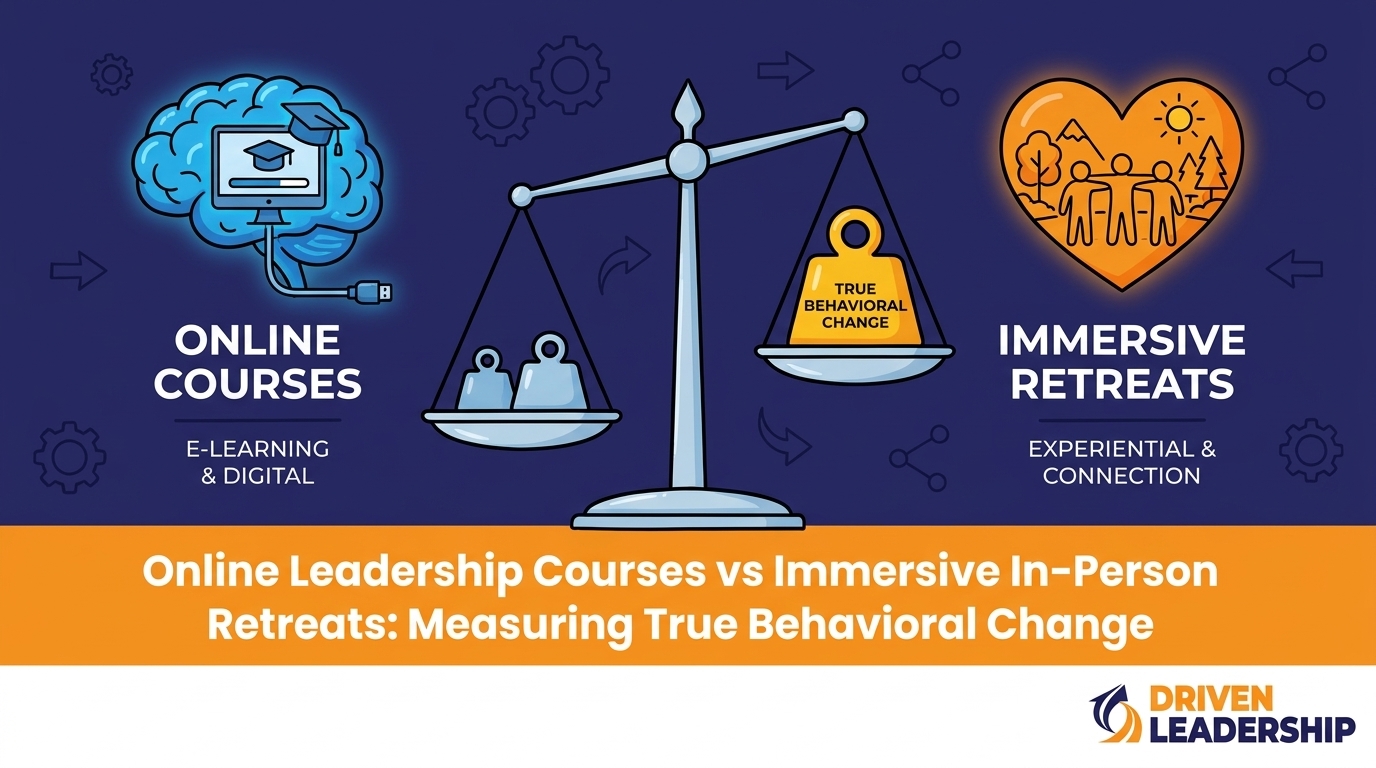
Online Leadership Courses vs Immersive In-Person Retreats

The Myth of the Quick Fix: Why Checking the Box Isn't Enough
A common misconception in corporate development is that choosing between online leadership courses vs immersive in-person retreats doesn't really matter, as long as your managers earn an online leadership certificate at the end. You might think that watching a few hours of video modules and passing a multiple-choice quiz will automatically translate to improved team performance on the floor. The reality is far more complex. HR directors and business owners frequently face deep skepticism when evaluating the true behavioral impact of standard training programs. They see high completion rates on digital dashboards, yet witness the exact same communication breakdowns and hesitation in the boardroom.
If you are looking for professional leadership trainings that actually move the needle, consider a BOLD immersive leadership retreat.
The core decision point for organizations preparing for the upcoming quarter comes down to this: do you want the high convenience of a passive course, or the intense, uncomfortable reality of an in-person retreat? Checking a box is easy. Changing how a manager reacts under extreme pressure requires a fundamentally different approach. When leaders only consume information passively, they rarely build the muscle memory required to execute those concepts when real-world challenges arise. To truly transform your organizational culture, you have to look beyond the quick fix and measure what actually changes after the training ends.
The Convenience Trap: What an Online Leadership Certificate Actually Accomplishes
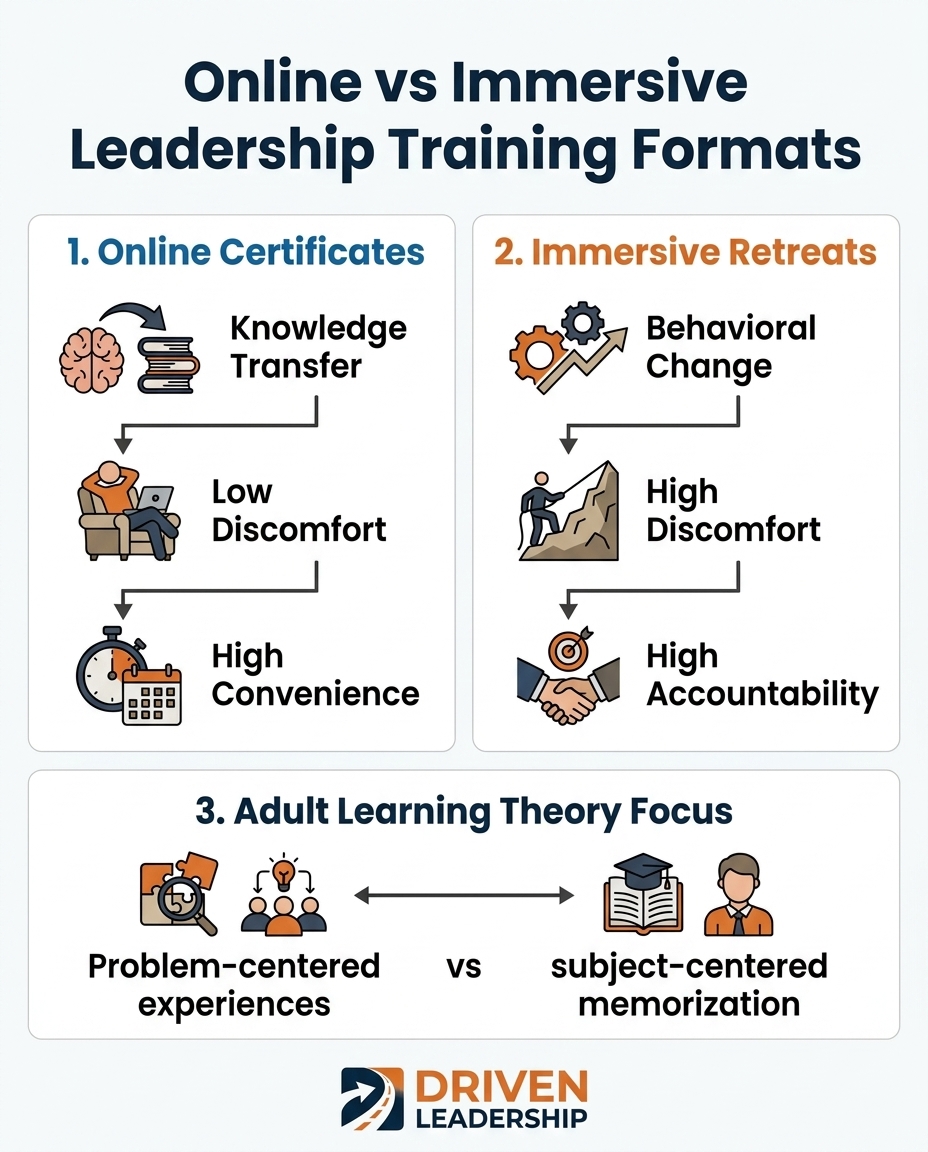
There is a distinct time and place for digital learning. An online leadership certificate is highly effective for foundational knowledge transfer. When you need to introduce core leadership concepts, establish a shared vocabulary across a large remote team, or review compliance frameworks, digital platforms excel. They offer undeniable appeal: high convenience, ultimate flexibility, and the ability to train dozens of managers without pulling them away from their daily operations.
Options like the Summit Online Academy serve as excellent starting points for baseline knowledge. However, they are only step one in the broader leadership journey. The limitation of digital learning is that passive consumption often falls victim to the Ebbinghaus Forgetting Curve. This psychological principle demonstrates that humans forget a massive percentage of new information within days if it is not immediately applied in realistic, high-stakes conditions.
• High completion rates: It is easy to track who clicked through a video, but impossible to track who internalized the message.
• Zero interpersonal friction: You cannot practice active listening or conflict resolution with a computer screen.
• Delayed application: Learning a concept on Tuesday and trying to apply it weeks later during a crisis usually results in defaulting to old habits.
• Comfort zone safety: Passive learning allows leaders to stay entirely within their comfort zones, avoiding the vulnerability required for real growth.
Knowledge Transfer vs. Application
You have to define the difference between memorizing a leadership framework and executing it under pressure. Knowledge transfer is simply the act of moving information from a screen into a manager's short-term memory. Application is the ability to recall that information, adapt it to a nuanced human interaction, and execute it flawlessly while dealing with stress, tight deadlines, and emotional team members.
Passive video-based formats lack the interpersonal friction required to test new skills. When a leader is sitting alone in their office drinking coffee, they feel completely in control. But leadership rarely happens in perfectly controlled environments. True leadership happens in the messy, unpredictable spaces between people. Until a manager is placed in a scenario where they must navigate that friction in real time, their online leadership certificate remains theoretical.
The Psychological Necessity of Discomfort in Leadership Training
To understand why behavioral change is so difficult, you have to look at the science of how adults actually learn. Adult Learning Theory, also known as Andragogy, emphasizes that adults learn best through direct, problem-centered experiences rather than subject-centered memorization. Adults bring years of established habits, biases, and defense mechanisms to the table. You cannot simply overwrite these established patterns by asking them to watch a presentation.
There is a psychological necessity for discomfort in leadership development. Behavioral change requires breaking established habits, which absolutely cannot happen in a completely safe, passive environment. When a leader feels comfortable, their brain runs on autopilot. They rely on the same communication styles and decision-making processes they have used for years. To forge new neural pathways and adopt new behaviors, the brain must be disrupted. It must encounter a situation that current habits cannot solve.
Contrast the passive safety of clicking through modules to earn an online leadership certificate with the pressure-tested reality of scenario-based learning. In an immersive environment, leaders are forced to make decisions with incomplete information, navigate team dynamics, and face the immediate consequences of their actions. This experiential learning increases retention and application rates significantly compared to lectures. When you attach a lesson to a strong emotional experience—even an uncomfortable one—the brain flags that information as vital for survival, ensuring it is remembered and utilized long after the training concludes.
Overcoming the Pacific Northwest Comfort Zone
Environmental factors play a massive role in how willing we are to step outside our routines. In the Seattle-Tacoma-Puyallup region, which averages over 150 rainy days per year, there is a natural, heavily ingrained psychological pull toward indoor, isolated, and comfortable work environments. When the weather outside is overcast and wet, the temptation to stay at your desk, turn on a space heater, and log into a virtual training session is incredibly strong.
However, giving into this environmental temptation by defaulting to an online course keeps leaders exactly where they are—in their comfort zones. The physical environment acts as an anchor to existing habits. When you sit in the same chair, look at the same monitor, and breathe the same air, your brain assumes it is business as usual. You are far less likely to challenge your own assumptions or take emotional risks when surrounded by the familiar comforts of your daily routine.
Breaking out of the daily geographic and environmental routine through an off-site retreat is a critical step in signaling a commitment to change. Leaving the rainy, familiar surroundings of the office forces leaders to physically and mentally disconnect from their daily distractions. The simple act of traveling to a new location, interacting with people face-to-face, and navigating an unfamiliar environment primes the mind for growth. It strips away the armor of the daily routine and forces leaders to show up fully present, ready to engage with the uncomfortable work of genuine self-improvement.
Immersive In-Person Retreats: Testing Real-Time Decision-Making
An immersive retreat is entirely different from a standard "lecture in a hotel room." Many corporate events label themselves as retreats, but they simply take the passive format of an online course and put it in a conference center. True immersive training strips away the PowerPoint presentations and drops leaders directly into scenario-based realities. These environments test true capabilities, emotional intelligence, and real-time decision-making under stress.
Driven Leadership's BOLD training serves as the premier example of an immersive environment that pushes leaders into uncomfortable, capability-testing scenarios. Intense, passion-driven training pushes leaders past cliché corporate exercises into profound personal and professional growth. Consider the experience of one participant who arrived at a winter retreat facing deep uncertainty about their personal potential and leadership capabilities. By participating fully in the program and stepping far out of their comfort zone, they emerged as a stronger person and a more decisive risk-taker, with lasting positive impacts on their team.
To achieve these kinds of results, immersive retreats utilize specific BOLD training exercises that build trust by forcing leaders to rely on one another in unpredictable situations. This process generally follows a structured path of disruption:
1. Isolation from the familiar: Removing daily operational distractions so the leader must focus entirely on the present moment and the team in front of them.
2. Introduction of unexpected variables: Presenting challenges that cannot be solved using standard operational procedures, forcing creative, on-the-fly problem solving.
3. Immediate peer feedback: Providing real-time reactions from team members, showing the leader exactly how their communication style impacts others.
4. Forced accountability: Requiring the leader to own the outcome of the scenario, whether it succeeds or fails, and extract the necessary lessons immediately.
5. Integration and reflection: Guiding the leader to connect the intense emotional experience back to their daily corporate responsibilities.
Side-by-Side Comparison: Knowledge Transfer vs. Behavioral Transformation
To make the best decision for your team, you need a clear, objective comparison framework. Evaluating ROI based on organizational goals means looking past the initial convenience and focusing on what the business actually needs to achieve. If your goal is simply to ensure everyone knows the updated compliance rules, a digital format works perfectly. If your goal is to fundamentally shift the culture, improve retention, and build a team that can handle severe operational stress, you need an entirely different tool.
Here is how the two formats stack up against one another across the most critical development criteria:
• Primary Outcome — Online Leadership Certificates: Baseline knowledge transfer and vocabulary building. — Immersive In-Person Retreats: Deep behavioral change and habit disruption.
• Convenience Level — Online Leadership Certificates: High. Can be completed anywhere, anytime. — Immersive In-Person Retreats: Low. Requires dedicated time away from daily operations.
• Discomfort Level — Online Leadership Certificates: Low. Completely safe, passive, and predictable. — Immersive In-Person Retreats: High. Emotionally and mentally challenging.
• Accountability — Online Leadership Certificates: Low. Relies on self-pacing and multiple-choice quizzes. — Immersive In-Person Retreats: High. Immediate peer feedback and real-time consequences.
• Best Used For — Online Leadership Certificates: Introducing concepts to large, distributed teams. — Immersive In-Person Retreats: Transforming key managers into highly capable leaders.
Summarizing this choice is straightforward: choose the digital format when you need to impart basic concepts efficiently. Choose the immersive format when you need to fundamentally shift culture, build deep trust, and elevate performance under pressure.
Preparing for Q4: Why the Fall Transition Demands Action
Timing your leadership development is just as crucial as choosing the right format. The August back-to-school transition is a critical period for corporate teams. It marks the psychological shift from relaxed summer operations to aggressive Q4 goal execution. As vacations end and the reality of year-end targets sets in, teams look to their managers for clear direction, emotional stability, and decisive action.
Combining virtual foundations with immersive, in-person experiences right at this seasonal juncture can build an incredibly strong leadership foundation for the end of the year. Preparing your managers now prevents burnout and poor decision-making during the high-stress holiday quarter. When you wait until November to address leadership gaps, it is already too late. The pressure is too high, and the time for training has passed.
Take the example of a leader who attended a spring retreat with a general desire for self-improvement. By fully engaging in the immersive environment, their life changed for the better, and they returned to work actively embracing challenges daily—adopting a "run to my roar" mentality. You need that exact mentality on your floor as you head into the final months of the year.
Frame the investment in an immersive retreat as a strategic Q4 accelerator rather than just a standard HR expense. When evaluating online leadership courses vs immersive in-person retreats, remember that true transformation requires stepping into the friction. Give your leaders the tools, the environment, and the necessary discomfort to grow, and you will see the behavioral changes that drive real organizational success.
Frequently Asked Questions
What is the difference between online leadership training and immersive retreats?
The primary difference lies in knowledge transfer versus behavioral application. Online leadership training is a passive format designed to introduce concepts, frameworks, and shared vocabulary through videos and quizzes. Immersive retreats drop leaders into scenario-based environments where they must apply those concepts under pressure. While online courses are highly convenient, retreats force the necessary discomfort required to actually change deeply ingrained habits.
How do immersive leadership retreats change behavior?
Immersive retreats change behavior by disrupting a leader's daily routine and placing them in unfamiliar, challenging scenarios. This taps into Adult Learning Theory, which shows that adults learn best through direct, problem-centered experiences. By removing the safety of a computer screen, retreats force leaders to make real-time decisions, navigate interpersonal friction, and receive immediate, unfiltered feedback from their peers. This intense emotional engagement creates lasting neural pathways that passive learning cannot replicate.
When should you choose an online leadership certificate over an in-person retreat?
You should choose an online leadership certificate when your primary goal is baseline knowledge transfer for a large or distributed team. If you need to quickly introduce a new compliance standard, establish a foundational leadership vocabulary, or provide flexible learning options for busy staff, digital formats are ideal. They serve as an excellent first step before moving key personnel into more intensive, application-based training environments.
Are in-person training sessions better than online courses?
In-person training sessions are significantly better when the goal is profound behavioral transformation, team cohesion, and testing emotional intelligence. Online courses excel at delivering information efficiently, but they cannot simulate the stress, nuance, and interpersonal dynamics of actual leadership. If you need your managers to improve how they handle conflict, make decisions under pressure, and build trust, the in-person, immersive format is required.
How do you measure the ROI of leadership training without using financial metrics?
You measure the ROI of leadership training by tracking observable shifts in team behavior, retention rates, and operational efficiency. Look for improvements in how quickly conflicts are resolved on the floor, the frequency of proactive decision-making, and a reduction in manager burnout during high-stress periods like Q4. True ROI is seen when a leader stops avoiding difficult conversations and starts taking complete ownership of their team's outcomes.
Can a combination of online and in-person leadership training work?
Yes, a blended approach is often the most strategic way to develop a leadership pipeline. You can use online courses to establish a baseline of knowledge, ensuring all managers understand your core frameworks and vocabulary. Once that foundation is built, you can transition your key leaders into an immersive, in-person retreat to pressure-test that knowledge, turning theoretical concepts into permanent behavioral habits.