
What We Learned Hosting BOLD Leadership Retreats at Wrightwood

The Invisible Barrier: Why Corporate Environments Stifle Executive Growth
Your executive team is sitting around the conference table, nodding along to another strategic initiative, but you can sense the hesitation in the room. The urgent emails are piling up, familiar office politics are in full swing, and genuine vulnerability feels like a massive professional risk. What we learned hosting BOLD Leadership Retreats at Wrightwood is that leaders rarely drop their corporate armor while standing on their home turf. The strategic decision to physically remove leadership teams from their standard environments is the first necessary step to achieving real breakthroughs. If you want to see a true transformation, you have to change the landscape entirely.
To understand how this transformation happens, exploring our BOLD leadership program and the impact of off-site leadership training reveals why a change of scenery is absolutely non-negotiable for executive growth.
The Psychology of the Corporate Armor
Executives naturally build defensive barriers when operating in familiar, high-stress corporate environments. These defenses are survival mechanisms developed over years of climbing the corporate ladder. When a leader sits in their usual chair, in their usual boardroom, surrounded by the usual power dynamics, their brain defaults to established patterns of behavior. They protect their territory, hide their weaknesses, and prioritize looking competent over being open to growth.
Through our BOLD Leadership Retreat facilitation, we see firsthand how daily office distractions make genuine vulnerability nearly impossible during standard training. You cannot ask a leader to deeply examine their flaws when their phone is buzzing with a crisis from the operations team. Experiential learning requires a blank slate.
The common barriers we see include:
• The Expertise Trap: Leaders feeling they must always have the right answer, preventing them from asking critical questions.
• Departmental Silos: Executives defending their specific division's interests rather than viewing the organization holistically.
• Performative Agreement: Nodding along to keep the peace during meetings, only to resist changes behind closed doors.
• Continuous Distraction: The inability to disconnect from day-to-day firefighting to focus on high-level strategic alignment.
Breaking these habits requires more than a compelling slide deck. It requires a physical disruption that signals to the brain that the old rules no longer apply.
Geographic Disruption: The Strategic Role of the Wrightwood Retreat Setting
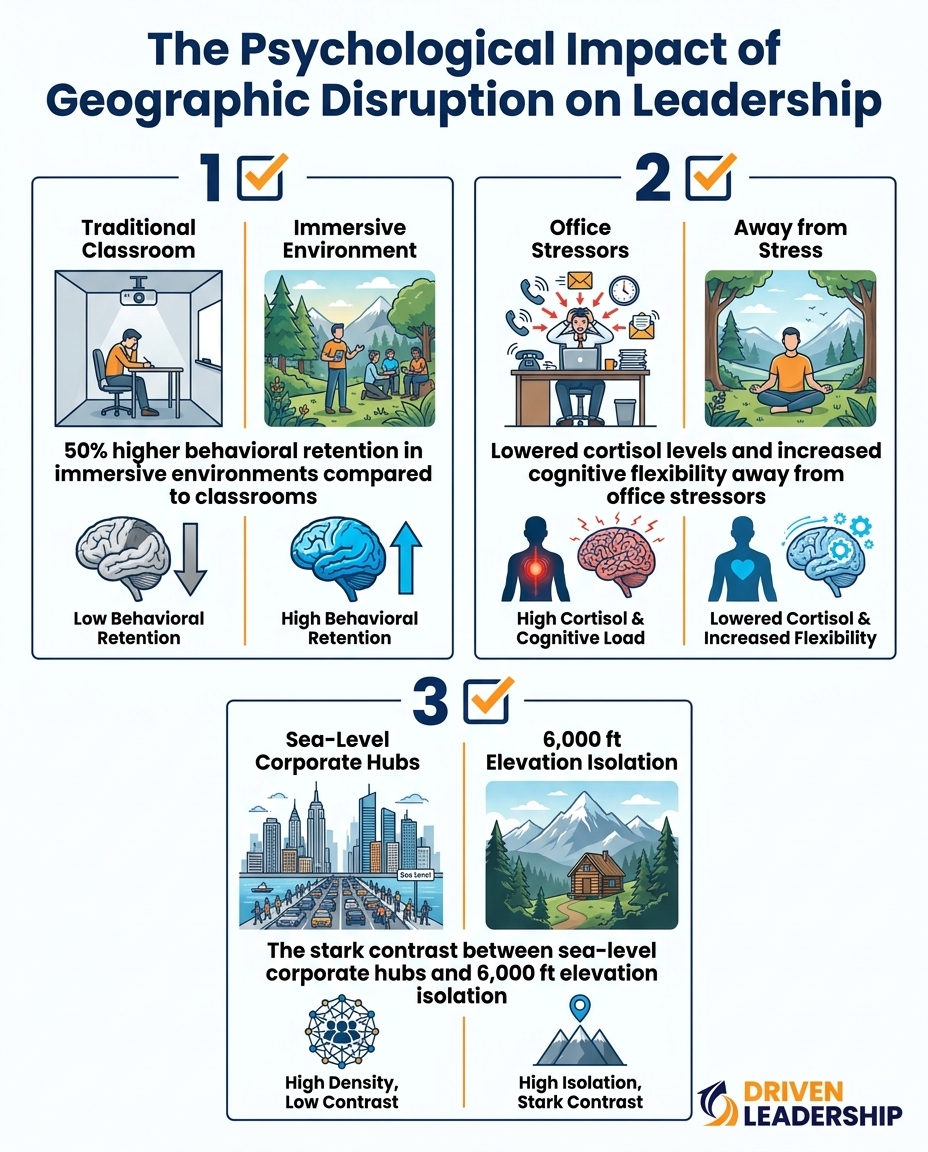
Physical relocation away from daily stressors is a highly effective, scientifically backed method for lowering cortisol levels and increasing cognitive flexibility. When leaders are stressed, their thinking becomes rigid. By changing the environment, we force the brain to adapt, opening the door to new perspectives and behavioral shifts.
The stark contrast of the San Gabriel Mountains serves as a literal and figurative departure from sea-level corporate hubs. With its physical isolation and stark mountain environment, the Wrightwood retreat setting provides a necessary contrast to the daily corporate office, naturally pulling executives out of their comfort zones. They are no longer the most powerful person in a glass corner office; they are part of a team navigating an unfamiliar, rugged landscape.
Forcing Reliance and Breaking Silos
Isolation forces executives to rely on one another, breaking down established silos. When cell service drops and the familiar safety nets of executive assistants and direct reports disappear, leaders have to communicate directly. First-hand observations reveal a dramatic shift in executive behavior when removed from familiar office dynamics. The posturing stops, and genuine human connection begins.
We saw this exact dynamic unfold during one summer session. An executive who had previously attended a session in 2020 arrived lacking the courage to pursue major professional development dreams. They felt stuck in their routine. Removed from their daily grind and immersed in the supportive yet challenging mountain environment, they experienced a massive shift. They gained the courage and confidence to pursue their goals, resulting in lasting positive impacts on their career, their spouse, and their personal life.
• High cortisol, constant digital interruptions — The Wrightwood Mountain Retreat: Lowered cortisol, forced digital disconnection
• Entrenched power dynamics and titles — The Wrightwood Mountain Retreat: Equal footing in an unfamiliar environment
• Focus on daily firefighting and metrics — The Wrightwood Mountain Retreat: Focus on long-term vision and behavioral shifts
• Comfortable, predictable, and guarded — The Wrightwood Mountain Retreat: Unpredictable, challenging, and vulnerable
Combating Executive Fatigue and the Mid-Year July Slump
Timing is a critical factor in leadership development. By the time the third quarter approaches, executive fatigue inevitably sets in. The aggressive push of Q1 and Q2 drains energy reserves, leading to stagnant decision-making and reduced team cohesion. We consistently see teams hit a wall during the peak summer months, a phenomenon we recognize as the mid-year July slump.
When leaders are exhausted, their emotional intelligence drops. They become reactive rather than proactive. A disruptive summer off-site effectively combats this slump by forcing a hard reset. Stepping into a completely different environment during peak summer provides the necessary jolt to re-energize teams who have been grinding away in air-conditioned boardrooms since January.
The Anatomy of Q3 Burnout
Burnout at the executive level rarely looks like someone sleeping at their desk. It looks like cynicism, delayed decision-making, and a lack of creative problem-solving. When the entire leadership team is experiencing this simultaneously, the entire organization slows down.
Signs your team needs a mid-year reset:
• Recycled Solutions: The team keeps applying old fixes to new problems because they lack the energy to innovate.
• Increased Friction: Minor disagreements between department heads escalate into major roadblocks.
• Strategic Drift: Meetings focus entirely on urgent tactical issues rather than the long-term vision set in Q1.
• Silence in the Room: Leaders stop challenging each other, preferring to just get through the meeting.
The momentum gained in the mountains sets the tone for a strong, unified second half of the year. Instead of limping into Q4, the leadership team returns with renewed clarity, ready to execute on end-of-year goals with the same vigor they had in January.
Behind the Scenes: How Environmental Disruption Fuels BOLD Training
The environment acts as a catalyst, but the curriculum does the heavy lifting. Executives are 50% more likely to retain behavioral changes when engaged in experiential, immersive learning environments. Driven Leadership's BOLD program relies on this immersive, experiential training where physical relocation and environmental disruption serve as mandatory catalysts for breaking down executive barriers. You cannot achieve these results in a hotel conference room down the street from your office.
Through our BOLD Leadership Retreat facilitation, we design the experience to force participants to confront their limitations and "run to their roar." Facilitating in an isolated setting removes the option to hide behind job titles, busywork, or administrative excuses. When a challenge is presented, the only way out is through.
Experiential Learning in Action
The curriculum is purposefully designed to push boundaries, resulting in lasting changes in self-perception and leadership capability. We do not lecture at leaders; we put them in situations where they must actually practice the BOLD training exercises that build trust.
We witnessed the power of this approach with one spring participant who arrived facing debilitating roadblocks. They were seeking a way to improve not just their company, but their personal life and career trajectory. By participating fully in the program, they received the support and the exact recipe for elevation they needed. They achieved significant personal and professional growth, completely overcoming the roadblocks that had previously paralyzed their decision-making. The environment stripped away their excuses, and the curriculum provided the tools to rebuild their confidence.
Translating Mountain Vulnerability into Organizational Development
A profound experience in the mountains is only valuable if it changes how the business operates back at home. The vulnerability achieved in the mountains must translate to psychological safety in the boardroom. When leaders break down their own barriers and learn to communicate authentically, it creates a massive ripple effect throughout the entire company structure.
The Wrightwood retreat setting acts as the crucible. Once the executive team learns how to operate with high trust and low friction in that environment, they establish a new baseline for what is acceptable behavior. They no longer tolerate the passive-aggressive communication or siloed thinking that previously plagued their meetings.
The Cascade Effect on the Broader Team
Improved communication and listening skills do not stop at the C-suite; they cascade down to management and associates. When a VP returns from a retreat and begins actively listening to their directors, those directors feel empowered. They, in turn, change how they manage their frontline employees.
How the retreat drives structural improvements:
• Faster Alignment: Because trust is higher, leaders spend less time second-guessing each other and more time executing.
• Safer Feedback Loops: Employees at all levels feel more comfortable bringing bad news to leadership before it becomes a crisis.
• Unified Messaging: The leadership team speaks with one voice, eliminating the confusion that happens when departments receive conflicting directives.
Ultimately, the retreat serves as the foundational reset for broader, long-term organizational development. It is not a standalone event; it is the launchpad for a healthier corporate culture.
From the Retreat to the Boardroom: Sustaining Team Execution
A retreat is only as valuable as the execution that follows it. It is easy to feel aligned when you are standing on a mountain; the real test is maintaining that alignment when you are back in the office facing a missed quarterly target or a supply chain crisis.
Leaders return with a unified vision, dramatically reducing friction in cross-departmental operations. The shared experience of overcoming challenges in an unfamiliar setting builds an unbreakable foundation of trust. When the VP of Sales and the VP of Operations have navigated a complex, high-stress scenario together during our BOLD Leadership Retreat facilitation, they are far less likely to point fingers when a project goes sideways back at the office.
Applying Off-Site Lessons to Daily Challenges
Maintaining the momentum requires applying the same assertiveness and risk-taking learned off-site to daily business challenges. The "run to your roar" mentality must become part of the company's operational DNA.
Strategies for sustaining the momentum:
1. Immediate Implementation: Within the first week of returning, the team must implement at least one major behavioral change agreed upon during the retreat.
2. Accountability Partnerships: Leaders pair up to hold each other accountable to the commitments made in the mountains, preventing a slide back into old habits.
3. Transparent Communication: The executive team shares their key takeaways and vulnerabilities with the broader company, modeling the behavior they expect to see.
When leadership teams commit to this level of sustained team execution, the ROI of the retreat becomes undeniable. The business moves faster, adapts quicker, and operates with a level of cohesion that competitors simply cannot match.
Ready to Challenge Your Leadership Team's Comfort Zone?
True leadership breakthroughs require physical disruption of the daily routine. The Wrightwood retreat setting is a necessary, strategic tool for growth, not just a scenic summer getaway. It provides the isolation, the challenge, and the blank slate required to strip away corporate armor. When you are ready to break down defensive barriers, address the mid-year slump, and achieve genuine vulnerability that transforms your entire organization, an immersive experience is the critical next step.
Frequently Asked Questions
Why are offsite leadership retreats more effective than in-office training?
Offsite leadership retreats are more effective because they physically remove executives from the distractions and ingrained power dynamics of their daily environment. In the office, leaders are constantly pulled into urgent firefighting, making it impossible to focus on deep behavioral changes. A new environment provides a blank slate, lowering defensive barriers and allowing for genuine vulnerability and high-level strategic alignment.
How does the physical environment impact executive training?
The physical environment directly impacts cognitive flexibility and stress levels. Moving from a high-stress, sea-level corporate hub to an isolated mountain setting naturally lowers cortisol, which opens the brain to new ways of thinking. The unfamiliar terrain forces leaders out of their comfort zones, requiring them to rely on each other and break down established departmental silos.
What makes a successful leadership retreat?
A successful leadership retreat requires a deliberate combination of geographic disruption, a challenging curriculum, and a commitment to vulnerability. It is not about trust falls or scenic vacations; it is about confronting limitations and practicing new behaviors in real-time. The most successful retreats also include a clear plan for translating those off-site breakthroughs into daily organizational execution.
Why do companies do executive offsites?
Companies invest in executive offsites to combat leadership fatigue, realign strategic vision, and resolve deep-seated team friction that cannot be addressed in a standard one-hour meeting. Especially during the mid-year July slump, an offsite serves as a vital reset button. It ensures the leadership team is unified, energized, and prepared to execute effectively for the remainder of the year.
What happens at a leadership training retreat?
At a rigorous leadership training retreat, executives participate in experiential learning scenarios that test their communication, trust, and decision-making under pressure. Facilitators guide the team through exercises that expose hidden barriers and defensive habits. The process is designed to be challenging, forcing leaders to confront their weaknesses and rebuild their confidence alongside their peers.
How does experiential leadership training work to break down corporate armor?
Experiential leadership training works by placing leaders in situations where their standard corporate coping mechanisms—like hiding behind a title or deflecting blame—no longer function. By engaging in active, physical, or highly immersive challenges, participants must communicate authentically to succeed. This forced authenticity strips away the corporate armor, leading to a profound increase in psychological safety.
