Why Seattle Executives Drive to Wrightwood for Immersive Leadership Development

The Hidden Cost of Staying Local for Late-Summer Strategic Planning
When clients ask our team at Driven Leadership why Seattle executives drive to Wrightwood for immersive leadership development, we point directly to the hidden costs of staying local for late-summer strategic planning. Your executive team is preparing for Q4, and the stakes for alignment have never been higher. Yet, trying to solve deep-rooted organizational issues while surrounded by the familiar downtown Seattle metro environment is a common trap. When leaders step into a local conference room, they bring their daily operational baggage with them. The physical proximity to the office subconsciously signals that they are still on the clock, ready to respond to the next urgent email or operational fire. This prevents the deep psychological disconnect required to break down defensive postures and rebuild genuine trust.
When evaluating leadership trainings for your executive team, you have to consider the role of the environment. True breakthrough requires more than just a catered lunch and a fresh whiteboard. It requires physical distance. In our experience guiding corporate teams, specialized leadership programs must use geographic isolation intentionally. By removing executives from their standard corporate habitat, you force a level of vulnerability and behavioral change that simply cannot happen in a high-rise downtown. The BOLD immersive leadership program serves as the ultimate solution for teams that need to break free from local distractions and fundamentally shift how they operate.
The Psychology of Geographic Isolation: Why Distance Matters
Distance is not just a logistical choice; it is a cognitive requirement for deep behavioral shifts. The contrast between the high-pressure, traffic-heavy downtown Seattle metro environment and the quiet, focused, isolated atmosphere of Wrightwood plays a direct role in how the brain processes information. When executives are removed from urban density and placed in a secluded natural setting—especially during the late-summer transition when end-of-season cooling offers a refreshing mental reset—their cognitive load drops significantly. This environment promotes clear, uncluttered thinking, allowing leaders to tackle complex strategic challenges without the background noise of city operations.
Breaking the Cognitive Tether to the Office
Proximity breeds distraction. Knowing the home office is just a few miles away prevents full mental presence. This phenomenon is known as the "tethering" effect. Even if phones are turned off, the subconscious pull of daily operational fires remains active when leaders are in familiar territory. They remain anchored to their established hierarchical roles and routine thought patterns.
• The proximity trap: Being physically close to headquarters keeps the brain in a reactive state.
• Unconscious monitoring: Leaders continue to mentally track ongoing projects and local logistics.
• Role entrenchment: Familiar settings reinforce existing team dynamics, making it harder to challenge the status quo.
Neuroplasticity and Unfamiliar Environments
Changing physical environments actively stimulates neuroplasticity. When the brain encounters unfamiliar surroundings, it is forced off autopilot. This biological response heightens awareness and improves creative problem-solving. By relocating to an isolated setting, you create a blank slate for strategic alignment. The brain becomes more receptive to new concepts, making immersive training significantly more effective than standard localized workshops.
The Failure Rate of the 'Downtown Conference Room' Retreat
A pattern we see often is organizations attempting to conduct late-summer strategic planning in local corporate venues, only to find that nothing actually changes when Monday morning rolls around. The typical local retreat features standard amenities, premium catered lunches, and comfortable seating, but it produces zero shift in team dynamics. Because the environment is so familiar, executives quickly fall back into established defensive postures.
The Problem: When hosting off-site training events too close to the home office, there is a powerful illusion of productivity. Teams might generate a list of goals, but the underlying communication barriers remain completely intact.
The Cause: Familiar corporate environments do not demand adaptation. They allow leaders to hide behind their standard professional armor. If a tough conversation arises, it is too easy for participants to emotionally check out or physically step away to "take an urgent call."
The Solution: There is a stark difference in strategic alignment between zero-distraction off-sites and on-site meetings. To achieve meaningful behavioral change, the environment must strip away the safety nets that allow leaders to avoid vulnerability.
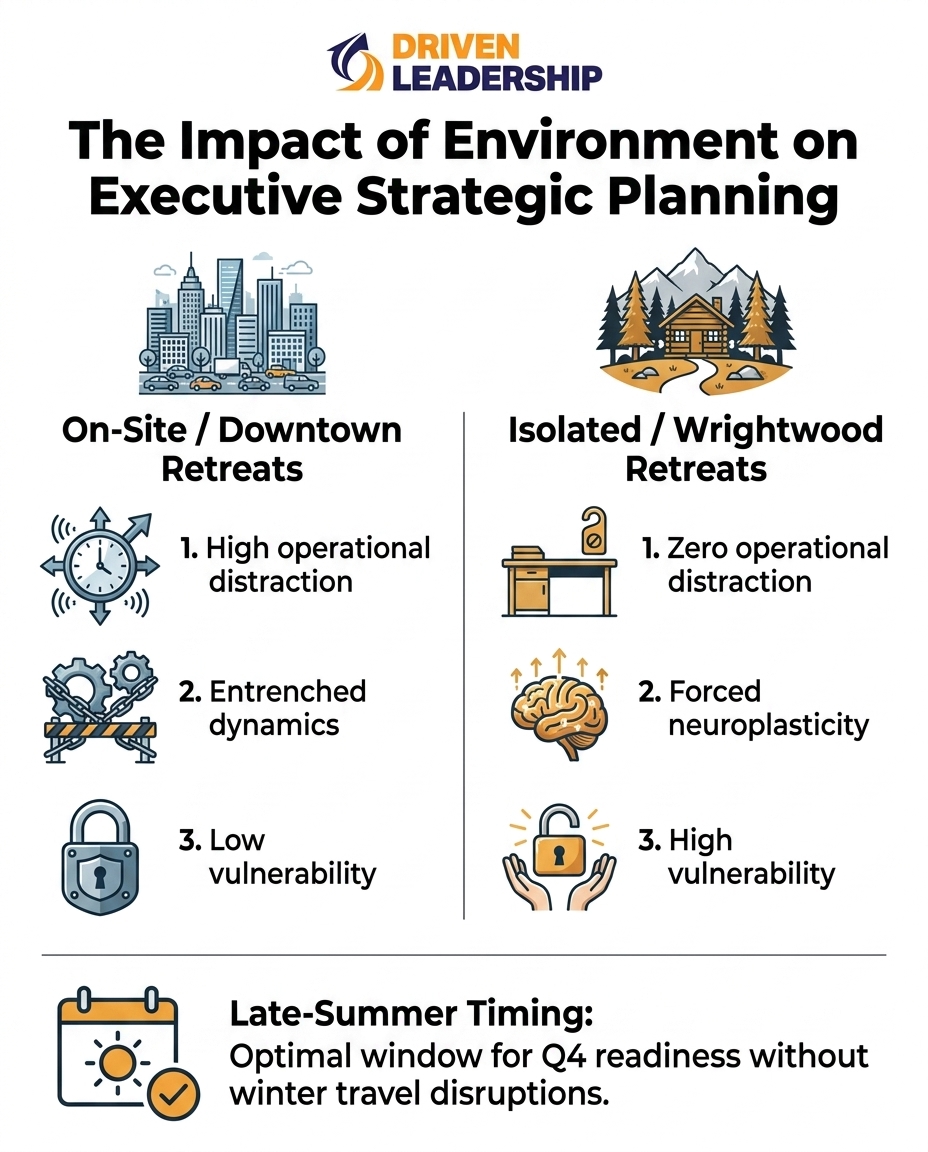
• Cognitive Load — Downtown Seattle Venue: High (traffic, familiar stressors, proximity to office) — Isolated Wrightwood Location: Low (nature, quiet, physical separation from routine)
• Team Dynamics — Downtown Seattle Venue: Entrenched hierarchical roles remain active — Isolated Wrightwood Location: Forced vulnerability levels the playing field
• Distraction Level — Downtown Seattle Venue: Constant pull of emails and local logistics — Isolated Wrightwood Location: Zero operational distractions; total immersion
• Strategic Outcome — Downtown Seattle Venue: Surface-level goal setting and minimal behavioral shift — Isolated Wrightwood Location: Deep behavioral change and unified Q4 alignment
The Journey to Vulnerability: What the Drive to Wrightwood Accomplishes
The physical act of traveling away from the city is the first critical step in the psychological disconnect. The drive itself acts as a physical boundary between "operational mode" and "growth mode." As the Seattle skyline fades in the rearview mirror, executives begin to shed the daily armor they wear in the boardroom. This transition is essential for the deep leadership work that follows.
Transitioning from Operational to Strategic Mindsets
During the transit to an isolated location, a significant mental shift occurs. Stripping away the comforts of the familiar corporate environment forces leaders to step out of their comfort zones. They must transition from being the "expert" in their local domain to becoming a student again. This forced humility is where profound personal realizations begin.
Real-world results validate this approach. One participant who attended a fully immersive session in 2020 found that the experience provided the courage and confidence to tackle goals that previously seemed unattainable. By committing to the isolated environment, they achieved lasting positive changes that elevated both their career trajectory and personal life long after the retreat ended. This is the exact outcome of building trust and cooperation through BOLD exercises—it requires leaders to first leave their safety nets behind.
Breaking Entrenched Dynamics with Rigorous Immersive Training
There is a massive difference between a standard "corporate vacation" and rigorous, transformative leadership development. Traditional retreats often rely on passive activities—golf outings, generic trust falls, or standard guest speakers. While these might offer a brief respite, we find they rarely address the root causes of executive misalignment. Geographic isolation must be paired with intensive programming to force genuine behavioral change.
At Driven Leadership, our team designed the BOLD training to explicitly use this geographic isolation as a catalyst. Physical removal from distractions allows for an intense, unbroken focus on active listening, confidence building, and taking initiative. When executives cannot retreat to their familiar corners, they are forced to engage.
Forcing Genuine Behavioral Change
Moving beyond surface-level communication requires a structured, demanding environment. When leaders are challenged in an unfamiliar setting, they must rebuild trust among their executive peers from the ground up. This process addresses the friction points that hold companies back.
Consider the experience of another leader who arrived at the program struggling with confidence, taking charge, and effective communication in meetings. By engaging fully in the immersive BOLD training—which required complete acceptance of the isolated program—they fostered a deep sense of esprit de corps with their peers. The outcome was a dramatic increase in proactive leadership and active listening, leading to highly positive changes back at work. These breakthroughs directly translate to improved team execution once the team returns to the home office.
Maximizing Q4 Readiness During Late-Summer Retreats
Timing is just as critical as location. Our team typically recommends late-summer strategic planning as the optimal window to finalize Q4 execution plans and lay the groundwork for next-year initiatives. By removing the executive team to an isolated environment in August or early September, you gain a massive strategic advantage before the back-to-school transition and fall rush consume everyone's schedule.
Building a strong foundation of leadership and communication in Q3 pays massive dividends during year-end pushes. When the pressure mounts in November and December, teams that have undergone immersive training rely on the trust and communication frameworks they built in isolation. Furthermore, traveling in late summer avoids the logistical nightmares of mid-winter weather disrupting executive schedules.
The combination of timing and intensive training creates a powerful launchpad. A recent participant who completed both the BOLD program and a virtual leadership course noted that this dual approach provided exactly what they needed. The isolated BOLD experience delivered the transformational foundation in leadership and communication, while the subsequent structured learning provided ongoing educational tools to sustain that growth.
Structuring the Return: Bringing Wrightwood Breakthroughs Back to Seattle
The true test of an immersive retreat is what happens when the team returns to the high-pressure downtown Seattle metro environment. Re-entry can be jarring. The inbox is still full, and the operational fires are still burning. Without a structured plan for the return, the vulnerability and trust built during isolation can quickly erode.
To maintain momentum, executive teams must implement specific strategies. The shared intensive experience of an isolated retreat creates a permanent behavioral anchor—a reference point the team can return to when conflicts arise. However, sustaining this requires deliberate follow-up communication frameworks.
• Establish re-entry protocols: Dedicate the first meeting back in Seattle strictly to integrating the retreat's strategic takeaways, forbidding operational updates for that hour.
• Implement peer accountability: Pair executives up to hold each other accountable to the behavioral commitments made during the retreat.
• Schedule structured follow-ups: Use structured, recurring check-ins to ensure the communication breakthroughs are being applied to current Q4 projects.
By treating the return as a critical phase of the BOLD immersive leadership program, companies ensure that the growth achieved in isolation becomes the new standard operating procedure in the city.
Elevate Your Leadership Team Beyond the Seattle Metro
True strategic alignment requires stepping out of the familiar. Attempting to overhaul team dynamics and finalize late-summer strategic planning within the same walls where daily friction occurs is an uphill battle. The physical drive to an isolated, focused environment strips away operational distractions and forces the neuroplasticity necessary for real growth.
If your executive team is relying on local venues for critical planning sessions, it is time to re-evaluate that approach. The psychological disconnect provided by geographic isolation is the catalyst for genuine vulnerability and lasting behavioral change. Elevate your leadership team by committing to an immersive off-site experience that challenges them, breaks entrenched habits, and fully prepares your organization for a dominant Q4.
Frequently Asked Questions
Why should executives go off-site for leadership development?
Going off-site physically removes leaders from daily operational distractions and the "tethering" effect of the home office. This separation lowers cognitive load and forces a psychological disconnect. Without the safety net of their familiar environment, executives are more open to vulnerability and genuine behavioral change.
What makes immersive leadership training effective?
Immersive training is effective because it combines geographic isolation with rigorous, structured programming that forces neuroplasticity. Instead of passive activities, it demands active engagement and challenges entrenched hierarchical roles. This environment rebuilds trust from the ground up, creating lasting shifts in how the team communicates.
How does environment affect strategic planning?
The physical environment directly impacts cognitive function and team dynamics during strategic planning. Familiar corporate settings reinforce existing defensive postures and keep the brain in a reactive, operational mode. Conversely, unfamiliar and isolated settings stimulate creative problem-solving and allow teams to focus entirely on long-term alignment.
Why is team building important for executives?
Executive team building is critical because misalignment at the top cascades down through the entire organization. When leaders lack trust or struggle with effective communication, it creates operational friction and slows down execution. Immersive team building breaks down these barriers, ensuring the leadership group operates as a unified front.
What is the ROI of an executive leadership retreat?
The return on investment from an executive retreat manifests in accelerated decision-making, reduced internal conflict, and stronger Q4 execution. By investing in a focused, isolated retreat, companies eliminate the hidden costs of poor communication and misaligned strategic goals. Teams return with a shared behavioral anchor that directly improves bottom-line performance.
How far is the ideal executive retreat from the home office?
The ideal retreat should be far enough away to make "dropping by the office" impossible, completely breaking the cognitive tether to daily operations. A drive of several hours into a distinct, isolated environment is typically required to signal a clear boundary between operational duties and strategic growth.