
How Pierce County Construction Firms Build Resilient Foremen

The Hidden Cost of Promoting Your Best Tradespeople
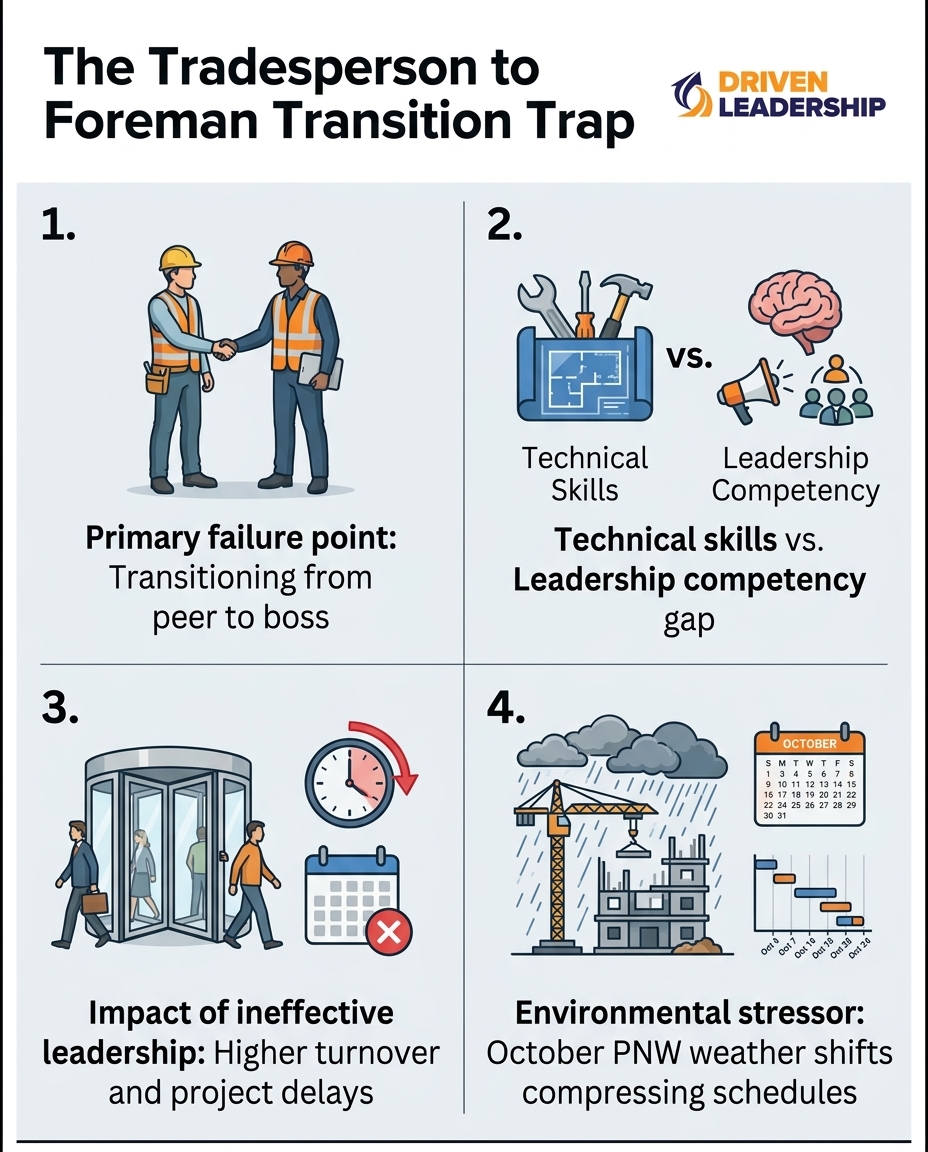
Your best carpenter or electrician just got promoted, but understanding how Pierce County construction firms build resilient foremen reveals a difficult truth we encounter constantly at Driven Leadership: technical mastery does not automatically equal leadership competency. You promote your most reliable hands because they know the blueprints inside and out, they never miss a day, and they produce flawless work. Yet, within weeks of handing them a crew, production slows down, mistakes multiply, and two of your most dependable laborers threaten to walk off the job. The problem is not their work ethic; it is the sudden, jarring shift from executing tasks to managing human beings.
To bridge this critical gap, intentional Leadership Trainings are required to turn excellent builders into excellent managers.
The Puget Sound region is experiencing a sustained construction boom, putting intense pressure on local firms to scale up quickly. When project pipelines overflow, owners are forced to promote rapidly to keep job sites moving. However, placing a highly skilled tradesperson into a managerial role without structured preparation often backfires. The very traits that made them an exceptional individual contributor—a hyper-focus on their own tools, an obsession with personal output, and a reliance on solitary problem-solving—become massive liabilities when they are suddenly responsible for a team of ten.
The hidden cost of this failure extends far beyond a few missed deadlines. When transitioning from skilled tradesperson to effective manager goes poorly, the entire job site suffers. Miscommunication leads to expensive rework. Frustration boils over into safety protocol violations. Crew turnover spikes because, as we often remind our clients, skilled laborers rarely quit their jobs; they quit their foremen. Without structured leadership development, construction firms are essentially taking their highest-producing asset off the tools and turning them into a bottleneck, jeopardizing both project profitability and long-term company growth.
Why the Transition from Skilled Tradesperson to Manager Breaks Down
The operational friction of moving from an individual contributor to a team leader is rooted in what we at Driven Leadership call the "technical mastery trap." New foremen naturally default to the skills that earned them their promotion. When a project falls behind, their instinct is to put their tool belt back on and work faster, rather than stepping back to assess why the crew is struggling. They attempt to out-work the problem instead of managing the people responsible for the work.
The Illusion of the 'Best Builder' Promotion
Technical excellence on a job site does not automatically translate to the emotional intelligence required to run a crew. Managing building materials is predictable; managing personalities is chaotic. The shift requires a completely new skill set that is rarely taught in apprenticeship programs. When a foreman relies solely on their reputation as the "best builder," they quickly lose the respect of a crew that needs clear direction, conflict resolution, and strategic foresight, not just another pair of hands.
• Executing specific trade tasks flawlessly — Leadership Skills (Foreman): Delegating tasks effectively based on crew strengths
• Focusing on personal daily output — Leadership Skills (Foreman): Planning week-long schedules and material logistics
• Solving mechanical or structural problems — Leadership Skills (Foreman): Resolving interpersonal conflicts and safety disputes
• Following directions from site supervisors — Leadership Skills (Foreman): Providing clear, authoritative directives to the crew
Recognizing the Early Signs of Leadership Struggle
The signs of a failing transition are usually visible long before a project goes completely off the rails. In our experience consulting with Puyallup construction firms, one major red flag is a new foreman avoiding difficult conversations with underperforming crew members. Rather than correcting poor behavior or sloppy work, the struggling manager will often just fix the mistake themselves after hours. This hoarding of complex tasks leads directly to severe burnout and micromanagement.
Ineffective field leadership directly drives higher turnover rates and compressed project schedules. If you want to stop this cycle, you must actively guide your newly promoted staff through the transition from individual contributor to team leader. When transitioning from skilled tradesperson to effective manager, the individual must learn that their new job is no longer to build the structure, but to build the team that builds the structure.
Navigating Crew Morale Through October Mid-Fall Weather Shifts
Leadership in a controlled environment is one thing; leadership in the mud is another entirely. In the Pacific Northwest, October mid-fall weather shifts bringing rain and mud to PNW job sites completely alter the dynamic of a construction project. Our team typically sees that the compounding effect of these seasonal changes on construction timelines and site safety cannot be overstated. What was a routine framing or foundation pour in July becomes a high-stress, hazardous operation in late October.
The Compounding Effect of Rain and Mud on Site Safety
Continuous rain, deep mud, and dropping temperatures actively degrade crew morale. Physical hazards increase exponentially as materials become slick and heavy equipment bogs down. This heightened physical danger leads directly to mental fatigue. Foremen must constantly balance rigorous safety protocols with the intense pressure from ownership to stay on schedule. When the weather turns miserable, the margin for error shrinks to zero, and the crew looks entirely to the foreman for their emotional cues.
Mastering Team Execution during these difficult months requires a foreman who can manage their own stress first. If the leader is visibly frustrated, complaining about the weather, or panicking over the schedule, that anxiety will instantly infect the entire crew.
Strategies for Maintaining Focus in Harsh Conditions
Managing weather-induced delays requires advanced communication, not just administrative schedule adjustments. Resilient foremen use specific strategies to keep the team motivated when conditions are harsh:
• Proactive expectation setting: Communicating exactly how weather delays will be handled before the shift starts, reducing mid-day confusion.
• Increased safety briefings: Taking extra time during morning huddles to specifically address the day's unique slip, trip, and fall hazards.
• Recognizing crew burnout: Spotting the signs of mental fatigue early and rotating tasks to keep workers engaged and alert.
• Maintaining a calm baseline: Projecting confidence and control, even when a sudden downpour forces a complete halt to the day's primary objective.
Overcoming the Psychological Friction of the Peer-to-Boss Shift
The most difficult hurdle for a newly promoted foreman is rarely the technical scope of the work; it is the internal, psychological challenge of taking charge in a high-stakes environment. Imposter syndrome often accompanies a rapid promotion in the field. Yesterday, they were complaining about management alongside the crew; today, they are management. This abrupt shift creates deep interpersonal friction that can paralyze a new leader if left unaddressed.
Establishing New Boundaries with Former Peers
Moving from "one of the crew" to the ultimate site authority requires a delicate balance. The challenge lies in holding former peers accountable without destroying long-standing working relationships. Seasoned tradespeople will frequently test the new dynamic, pushing back on directives or bypassing the new foreman entirely. When transitioning from skilled tradesperson to effective manager, the leader must establish clear, respectful boundaries immediately. Ignoring insubordination in the early days sets a precedent that is nearly impossible to reverse later in the project.
Building Confidence for Site Briefings
Transforming passive communication into clear, authoritative directives is essential for resolving site disputes quickly. Many new foremen struggle to command a room or a job site huddle. We recently worked with a local professional who struggled heavily with confidence and taking charge in meetings after a recent promotion. By participating in our immersive advanced leadership training program in the spring, they gained greater confidence and developed the active listening skills necessary to lead effectively.
Active listening is a critical tool for establishing authority respectfully. When a foreman truly listens to a crew member's safety concern or logistical complaint, validates it, and then makes a firm decision, they earn trust. Authority on a job site is not granted by a hard hat color; it is earned through consistent, fair, and confident communication.
Why Passive Management Theory Fails on the Job Site
Through our years of developing leaders, we've seen firsthand that traditional, classroom-style management theory often falls apart the moment it hits a live job site. Administrative checklists, corporate flowcharts, and theoretical role-playing do very little to prepare a new leader for a screaming subcontractor or a sudden concrete shortage. Pierce County and Puyallup active construction sites demand a level of grit and adaptability that cannot be learned by simply reading a manual.
Checklists Don't Change Behavior
Administrative skills—like filling out daily logs, tracking hours, and ordering materials—are necessary, but they are entirely insufficient for crew leadership. High-stakes environments expose the critical flaws in superficial management training. When a foreman is stressed, exhausted, and behind schedule, they will not consult a checklist; they will revert to their deepest behavioral habits. If those habits involve yelling, avoiding conflict, or hoarding work, the project will suffer.
The Power of Immersive Identity Shifts
This is where standard training ends and true development begins. Programs like BOLD Leadership Training focus on immersive, behavioral identity shifts rather than passive theory. Changing how a foreman views their role fundamentally requires rewiring their default reactions to stress and conflict.
Immersive training environments force leaders to confront their communication roadblocks head-on. By placing participants in experiential, high-pressure scenarios, they learn to regulate their emotions, communicate clearly under fire, and build lasting behavioral changes that actually withstand the pressures of a commercial build. Real resilience is built through this kind of experiential learning, ensuring the foreman's identity shifts permanently from "tradesperson" to "leader."
Building Long-Term Leadership Resilience in Pierce County
Investing in your foremen is not just about making daily operations smoother; it is about securing your firm's future in a highly competitive market. The sustained construction boom in Pierce County shows no signs of slowing down, and the firms that will dominate the next decade are those that possess scalable, resilient leadership in the field.
Aligning Leadership with Regional Demands
Meeting the expectations of high-profile Puget Sound projects requires a management team that can operate independently and strategically. You cannot scale your business if you, as the owner, are constantly driving to job sites to put out interpersonal fires. By elevating field managers into strategic thinkers, you create a self-sustaining culture of excellence.
Furthermore, resilient foremen are your best defense against margin erosion. They protect profit margins by drastically reducing rework, minimizing crew turnover, and efficiently managing weather-related downtime. In a tight local labor market, top talent wants to work for competent, fair, and organized leaders. Developing your foremen through programs like the Engage Elevate Program is a critical competitive advantage for retaining the best tradespeople in the region.
Measuring True Foreman Resilience
How do you know if your investment in leadership development is actually working on Pierce County and Puyallup active construction sites? At Driven Leadership, we recommend measuring it through observable behavioral and operational metrics:
1. Tracking crew retention rates: A resilient foreman keeps their team intact month after month, even during grueling project phases.
2. Monitoring safety compliance: Effective leaders enforce safety standards naturally, resulting in fewer near-misses and zero preventable incidents.
3. Evaluating independent conflict resolution: The best indicator of a successful transition is a drastic reduction in the number of petty disputes escalated to the owner's desk.
4. Assessing schedule adherence during adversity: Resilient foremen maintain forward momentum and crew morale even when external factors, like material delays or bad weather, attempt to derail the timeline.
Frequently Asked Questions About Construction Leadership Development
How do you transition from tradesman to foreman?
Transitioning requires an intentional shift from focusing on personal output to focusing on team facilitation. A new foreman must learn to delegate tasks, practice active listening, and communicate clearly rather than relying solely on their technical building skills.
What makes a good construction foreman in high-stakes environments?
A highly effective foreman remains calm under pressure and prioritizes clear communication over reactive frustration. They possess the emotional intelligence to manage diverse personalities, enforce safety standards rigorously, and keep the crew focused even when project timelines are compressed.
How do you train a new construction foreman effectively?
Effective training moves beyond administrative checklists and focuses on immersive, behavioral identity shifts. Providing experiential leadership development helps new managers rewire their default responses to conflict, building true emotional resilience for the job site.
What are the biggest challenges for new construction managers?
The most significant hurdle is the psychological friction of moving from a peer to a boss. New managers frequently struggle with imposter syndrome, holding former friends accountable, and avoiding the urge to micromanage or hoard complex tasks.
How does Pacific Northwest weather impact construction crew morale?
October mid-fall weather shifts bringing rain and mud to PNW job sites severely degrade crew morale by increasing physical hazards and mental fatigue. Foremen must proactively manage this stress through transparent communication, frequent safety adjustments, and maintaining a positive, steady baseline.
Equip Your Foremen to Lead Through Every Job Site Challenge
Technical mastery will always be the baseline requirement for a career in the trades, but true leadership demands intentional, continuous development. When you promote your best workers, you owe it to them—and to your bottom line—to provide the tools they need to manage people just as effectively as they manage materials.
Resilient foremen are the absolute key to navigating local weather challenges, maintaining high crew morale on Pierce County and Puyallup active construction sites, and protecting your project margins. Do not let your best builders fail as managers because they lacked the right psychological and communication frameworks. Equip your team with the immersive training required to create lasting behavioral shifts by exploring the Executive Manager Program today.
