
The Definitive Guide to How to Transition from Individual Contributor to Team Leader

Why the Transition from Individual Contributor to Team Leader Is One of the Hardest Career Shifts You'll Make
Learning how to transition from individual contributor to team leader is less a promotion and more a complete reinvention of how you define your value at work. The skills that made you exceptional at your job — your speed, your technical depth, your ability to execute — are not the same skills that will make you an effective leader.
Here is a quick overview of what the transition requires:
1. Shift your definition of success from personal output to team performance
2. Let go of hands-on work and build trust in your team's ability to deliver
3. Develop new skills — delegation, coaching, feedback, and difficult conversations
4. Adopt a servant leadership mindset that puts the team's growth ahead of your own comfort
5. Navigate the peer-to-manager dynamic with clarity and confidence
6. Build psychological safety so your team can do their best work
The numbers make the stakes clear. Up to 60% of new managers struggle or fail within their first two years, and 40% are rated as ineffective within just 18 months — most often because they never fully let go of their individual contributor identity. The biggest culprit is not incompetence. It is staying in execution mode when the job now demands that you lead.
This guide is built for anyone who is stepping into a leadership role — or preparing to — and wants a practical, honest roadmap for making the shift without burning out or losing their team's trust along the way.
Why Knowing How to Transition from Individual Contributor to Team Leader Requires a Mindset Shift
When we are individual contributors (ICs), our professional world is beautifully straightforward. We receive a task, we apply our specialized skills, and we deliver a tangible result. Our value is directly tied to our personal output. If we work harder, faster, or smarter, our personal metrics go up.
When we step into a team leader role, that equation breaks completely.
The biggest mindset shift required when moving from an IC to a manager is moving from self-leadership to servant-leadership. As a leader, your primary job is no longer to do the work; it is to make delivery possible, predictable, and healthy for everyone else. You must transition from being the "expert" who has all the answers to the "coach" who helps others find them.
This requires an intense identity shift. According to research from MIT Sloan, managers who explicitly name and embrace this identity shift return to full effectiveness roughly 50% faster than those who resist it and try to remain "super-ICs."
To navigate this successfully, we must understand the 7 Traits of a Great Leader. True leadership is about cultivating a multiplier effect. Instead of adding your single contribution to the pile, your job is to multiply the capabilities of everyone on your team.
In the modern workplace of 2026, this shift is more critical than ever. With larger spans of control — the average manager now oversees upwards of 12 direct reports — and AI tools automating routine administrative tasks, the premium on human coaching, empathy, and strategic direction has skyrocketed. To lead effectively today, you must understand the different Types of Leadership Styles That Transform Business Success and learn how to adapt your approach to the unique needs of your team.
Redefining Success and Overcoming the "Doer" Trap
The "Doer Trap" is the most common failure mode for first-time managers. Because we are comfortable with execution, we naturally default to it when stress levels rise.
Imagine an engineering manager who steps in to debug code because "it only takes me 20 minutes, whereas it takes my team member two hours." Or a marketing lead who rewrites an entire campaign draft because it does not match their personal writing style.
While these actions might solve a short-term bottleneck, they act as severe capability throttlers for the team. When you do the work for your team, you deny them the opportunity to learn, fail, and grow.
To overcome this, we must perform a regular time audit and ruthlessly identify our "comfort zone tasks." We need to shift our focus from short-term execution to long-term strategic direction. Cultivating Must Have Frontline Leadership Skills means learning to protect our calendars for high-leverage activities: 1:1s, removing blockers, giving feedback, and aligning team priorities with broader business goals.
How to Transition from Individual Contributor to Team Leader by Redefining Success
To successfully make the leap, we must explicitly redefine what a "win" looks like. The table below outlines how our daily focus, responsibilities, and metrics must change as we step into leadership:
• Primary Metric — Individual Contributor (IC): Personal output and task completion — Team Leader: Team performance, growth, and retention
• Daily Activity — Individual Contributor (IC): Direct execution and technical problem-solving — Team Leader: Coaching, strategic planning, and unblocking others
• Decision Scope — Individual Contributor (IC): Decisions affecting personal tasks — Team Leader: Decisions affecting team systems and workflows
• Communication Style — Individual Contributor (IC): Informational and peer-to-peer — Team Leader: Influential, strategic, and cross-functional
• Leverage Type — Individual Contributor (IC): Linear (your hours = your output) — Team Leader: Multiplier (your guidance = team's scaled output)
By shifting to team-performance metrics within our first year, we set our teams up for measurably higher performance. Success is no longer about how busy we are; it is about how independent and capable our team becomes.
Overcoming the Urge to Micromanage Former Peers
One of the most delicate challenges a new manager faces is leading people who were peers just yesterday. The authority dynamics change instantly, which can lead to discomfort, awkwardness, or even silent resentment.
To compensate for this discomfort, many new managers make one of two mistakes:
1. They over-correct into authoritarian micromanagement to "prove" they are in charge.
2. They pull back entirely, avoiding hard conversations and failing to hold people accountable because they want to remain "one of the team."
Both paths lead to failure. Leading former peers requires building trust through transparency, consistency, and psychological safety. We must establish clear boundaries while remaining deeply collaborative.
This is where structured programs like our Emerging Leadership Program make a massive difference. We teach new leaders how to establish their leadership voice naturally, without resorting to artificial authority or damaging peer relationships.
A Practical 90-Day Roadmap for New Leaders
You do not become a leader the day your title changes. True leadership is built through a consistent operating cadence and intentional habits developed over your first three months.
To make this transition predictable, we recommend a structured 90-day framework. This approach is a core element of our Leadership Training for Managers, designed to move you from a reactive state to proactive, strategic alignment.
Phase 1: The First 30 Days of How to Transition from Individual Contributor to Team Leader

Your goal in the first 30 days is simple: listen, learn, and gather context. Do not rush in and make sweeping structural changes. Your team has tribal knowledge, existing dynamics, and historical context that you need to understand first.
• Conduct a Listening Tour: Schedule dedicated 1:1 meetings with every team member. Ask open-ended questions like: "What is working well right now?", "What is our biggest bottleneck?", and "How can I best support you?"
• Assess Team Dynamics: Observe how information flows, where tasks get blocked, and who team members naturally turn to for guidance.
• Define Your Operating Cadence: Establish consistent weekly rhythms for 1:1s and team syncs. Let your team know that your primary goal in month one is to understand their world, not to disrupt it.
Phase 2: Days 31 to 60 – Aligning the Team and Setting Direction
Once you have gathered context, month two is about aligning the team and setting clear performance standards.
• Clarify Expectations: Clearly define what success looks like for each role. Do not leave room for ambiguity.
• Establish Team Tenets: Work with your team to define your core guiding principles. These act as tie-breakers for difficult decisions and align everyone around a shared mission.
• Map Out the "Not Doing" List: Protect your team's focus by explicitly identifying projects or tasks that do not align with current business priorities. This prevents silent overcommitment and burnout.
Phase 3: Days 61 to 90 – Coaching, Feedback, and Delegation
By month three, you should be fully stepping into your role as a multiplier through delegation and coaching.
• Delegate with Context: Stop assigning mere tasks. Start delegating true ownership. When handing off a project, explain the "why," define the quality bar, and establish clear checkpoints without taking away their control.
• Implement the Coaching Ladder: Instead of giving immediate answers when team members bring you problems, ask guiding questions: "What do you think is the best path forward?" or "What options have you considered?"
• Build Continuous Feedback Loops: Deliver specific, timely, and impact-connected feedback. Do not wait for annual reviews to have these conversations.
Developing these Frontline Leadership Skills early ensures that your team builds the capability to ship high-quality work without requiring your constant supervision.
Critical Skills to Master: Delegation, Feedback, and Conflict Resolution
Stepping into leadership means entering emotional intelligence. Your technical expertise might have earned you the promotion, but your soft skills will determine how long you stay there.
To build a high-performing culture, we must master three critical areas:
1. Active Listening: This is more than just hearing words. It is about capturing unsaid signals, gathering data points, and showing genuine curiosity. When we listen actively, we turn potentially adversarial conversations into collaborative, two-way problem-solving sessions.
2. The Situation-Behavior-Impact (SBI) Feedback Framework: When giving feedback, avoid vague statements like "You need to communicate better." Instead, use the SBI model:
— Situation: "During yesterday's client presentation..."
— Behavior: "...you interrupted the client twice while they were sharing their concerns."
— Impact: "...this made them hesitant to share the rest of their feedback, which delayed our alignment."
3. Handling Difficult Conversations: Approach hard discussions with empathy and data. State your intentions clearly at the outset, remain balanced with your emotions, and focus on collaborative solutions rather than assigning blame.
Investing in Leadership Development and Coaching is the most effective way to build these conversational muscles. Through our Leadership Development Training, we provide leaders with the safe environments and real-world frameworks needed to practice these skills before they face high-stakes situations in their business.
Frequently Asked Questions About Transitioning to Leadership
How long does the transition from IC to manager typically take?
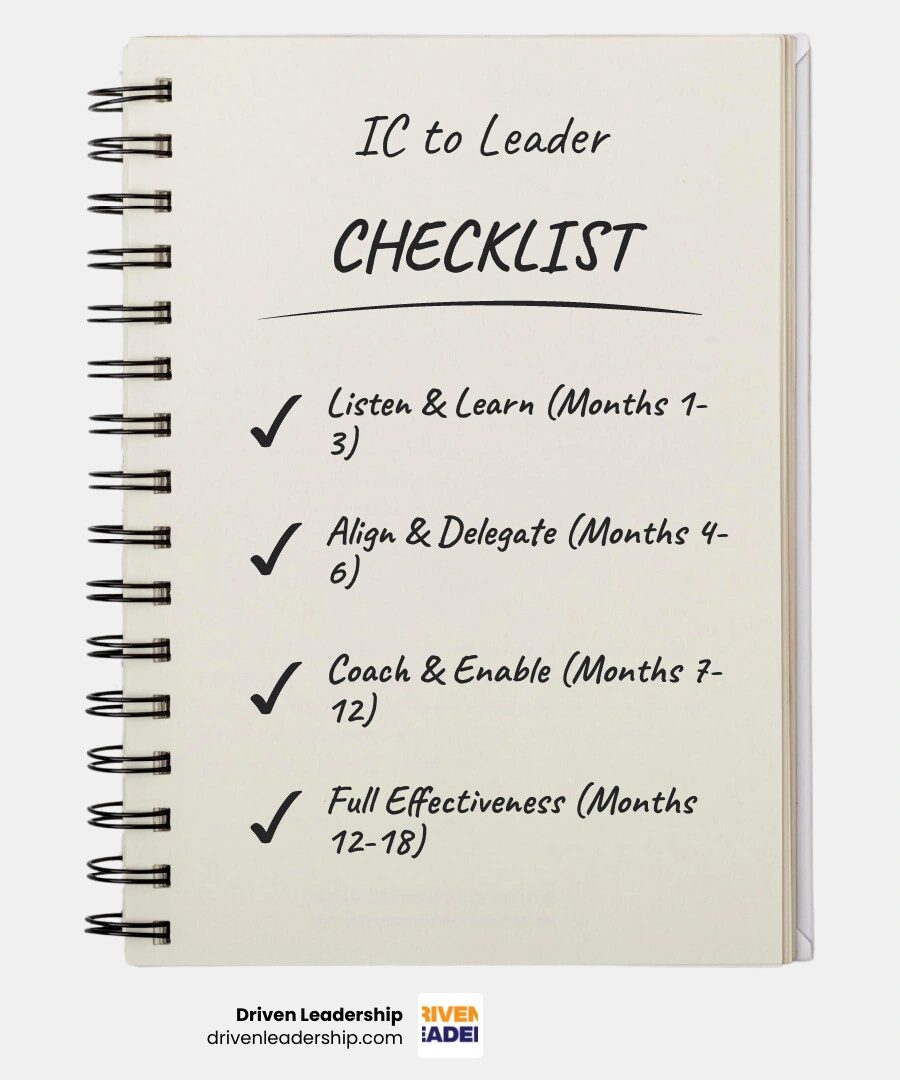
For most people, the full transition takes 12 to 18 months. The first three months are often chaotic as you adjust to your new routine. Between months four and nine, you will likely hit the hardest stretch as you navigate the "in-between" space of letting go of your old identity. Real confidence and operating rhythm typically click around the one-year mark.
What is the biggest mistake new managers make?
The single biggest mistake is failing to let go of hands-on execution (staying in IC mode). When leaders stay busy doing the work themselves, they fail to coach their team, miss strategic risks, and eventually burn out from trying to do two full-time jobs at once.
How do I handle leading my former peers?
Start by having open, honest, and individual conversations with them. Acknowledge the shift in the dynamic, explicitly state your commitment to supporting their professional growth, and establish clear, objective performance standards that apply to everyone equally.
Conclusion
Transitioning from an individual contributor to a team leader is a profound professional transformation. It requires you to step away from the comfort of direct execution and step into the challenging, highly rewarding work of developing people and systems.
At Driven Leadership, we specialize in helping organizations and new managers navigate this exact leap. Operating across California, Washington, Nashville TN, and SoCal, we deliver immersive training programs designed to create measurable, lasting behavioral change that directly improves business performance.
If you or your organization are ready to support your new leaders with proven, practical development, explore our Leader Management Course today. Let us help you turn your top individual contributors into the high-performing, multiplier leaders your business needs to thrive.