
In-Depth Guide to Conflict Management Training for Leaders and Teams

Why Conflict Management Training for Leaders and Teams Is a Business Priority in 2026
Conflict management training for leaders and teams is a structured learning process that equips managers and employees with the skills to handle workplace disagreements constructively — before they damage performance, morale, or culture.
Here's what it covers at a glance:
• What it is: Practical training that builds skills like active listening, emotional regulation, and structured mediation
• Who it's for: Managers, team leaders, HR professionals, and anyone responsible for team performance
• Core outcomes: Reduced escalation, stronger communication, higher trust, and measurable productivity gains
• Delivery formats: In-person workshops, virtual sessions, hybrid programs, and self-paced learning
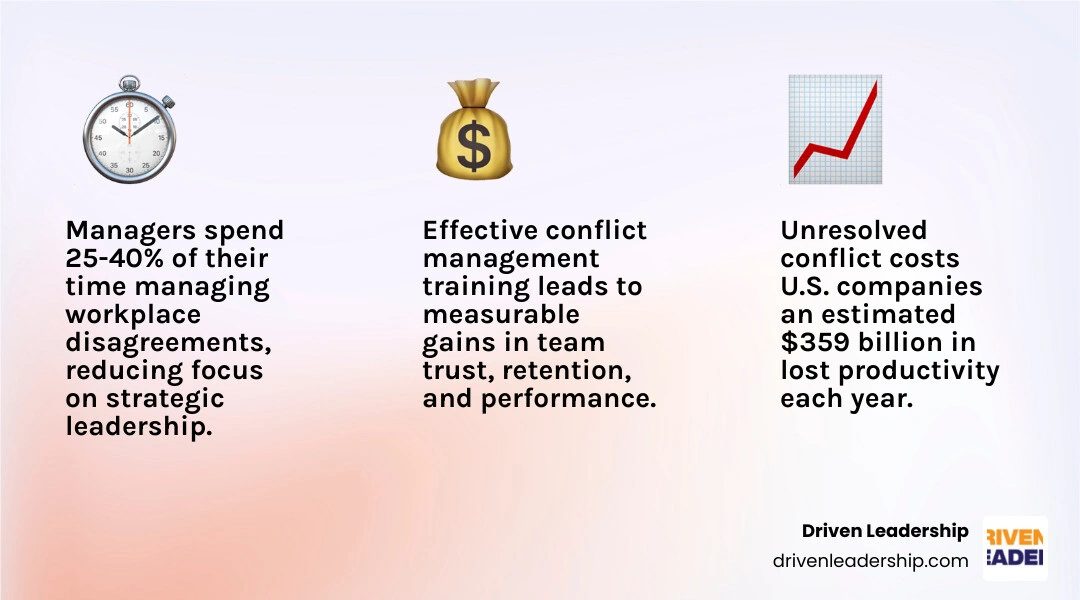
• Why it matters now: Managers spend an average of 25–40% of their time dealing with workplace conflict, costing U.S. companies an estimated $359 billion in lost productivity every year
Most workplace conflict doesn't start with a blowup. It starts quietly — a misread email, a missed expectation, two people pulling in different directions. Left alone, that friction compounds. Teams slow down. Good people disengage. Managers get stuck playing referee instead of leading.
The hard truth is that avoiding conflict doesn't make it go away. It just makes it more expensive. And for mid-level managers already stretched thin, not having a clear framework for navigating disagreement can make every difficult conversation feel like a risk.
That's exactly where conflict management training changes the equation. Instead of hoping tension resolves itself, leaders learn to address it directly — and turn it into a driver of better decisions, stronger relationships, and real business results.
Conflict management training for leaders and teams word guide:
• how to manage conflict in a leadership team
• what are the five conflict management styles and when to use each
Conflict Resolution vs. Conflict Management: Key Differences
While people often use the terms "conflict resolution" and "conflict management" interchangeably, they represent two fundamentally different approaches to handling tension. Understanding the distinction is vital for any organization looking to build a sustainable, high-performing culture.
Conflict resolution is a reactive, episodic approach. It focuses on ending a specific dispute, finding an immediate compromise, and moving past the issue. It is a "fix-it" mentality that treats conflict as a problem to be solved and eliminated.
Conflict management, on the other hand, is a proactive, systemic approach. It views conflict as an inevitable and potentially healthy part of working together. Instead of trying to eliminate all disagreements, conflict management builds long-term systems and behavioral competencies. It seeks to leverage "constructive discontent" to spark innovation, challenge poor assumptions, and build deeper trust.
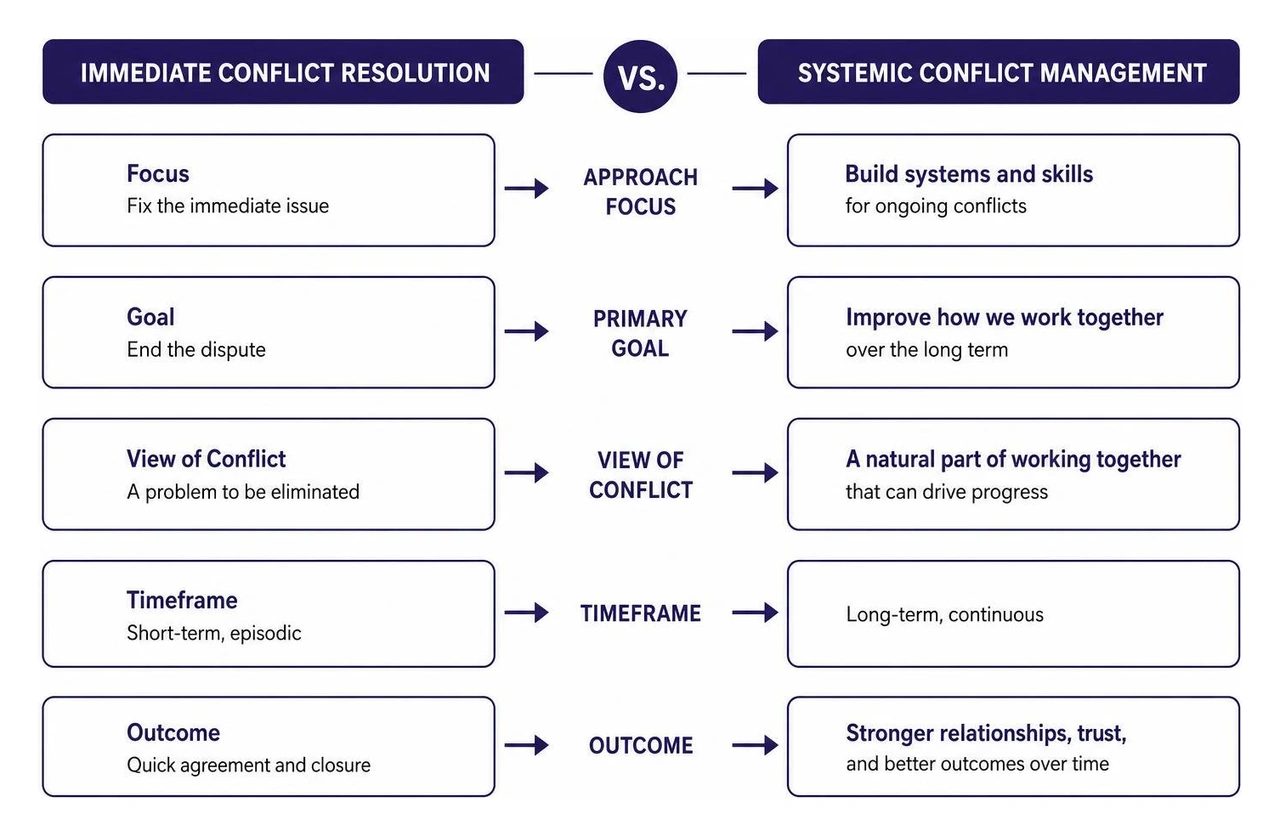
• Primary Goal — Conflict Resolution: Resolve immediate disputes and reach a final agreement. — Conflict Management: Manage ongoing tension and minimize negative outcomes.
• View of Conflict — Conflict Resolution: A disruptive problem that needs to be eliminated. — Conflict Management: A neutral, inevitable force that can drive progress.
• Timeframe — Conflict Resolution: Short-term and episodic. — Conflict Management: Long-term and continuous.
• Focus Area — Conflict Resolution: The surface-level issue or argument. — Conflict Management: Root causes, communication systems, and team dynamics.
• Target Outcome — Conflict Resolution: Compromise, settlement, or mediation of a single event. — Conflict Management: Sustainable team norms, behavior change, and psychological safety.
By shifting your team's focus from merely extinguishing fires to managing the climate, you can prevent minor communication breakdowns from turning into costly, toxic disputes. To learn more about navigating these waters, check out our guide on Navigating Conflict Resolution: Strategies for Maintaining Harmony and Productivity.
Core Skills Developed in Conflict Management Training for Leaders and Teams

Effective conflict management is not an innate personality trait; it is a behavioral discipline that can be learned, practiced, and mastered. When organizations invest in comprehensive training, they equip their people with a robust toolkit of interpersonal competencies.
At the heart of this training is the development of self-awareness and emotional intelligence. Leaders and teams learn to identify their personal conflict triggers—those specific phrases, behaviors, or situations that cause them to react defensively. By recognizing these triggers early, individuals can pause, regulate their emotional responses, and choose a constructive path forward rather than reacting on impulse.
A cornerstone of this skill-building is learning what are the five conflict management styles and when to use each. Using the industry-standard TKI Assessment, participants learn whether their default tendency is to compete, collaborate, compromise, avoid, or accommodate. Training helps individuals move beyond their default style to strategically select the approach that best fits the situation.
Essential Competencies of Conflict Management Training for Leaders and Teams
To build a truly conflict-resilient organization, leaders must develop specific behavioral competencies that allow them to guide their teams through high-stakes situations:
• Self-Regulation and Composure: The ability to remain calm under fire, control emotional responses, and focus on objective facts rather than personal feelings.
• Active Listening and Reframing: Moving beyond simply hearing words to understanding the underlying emotions and intentions, then restating them neutrally to ensure clarity.
• De-escalation Techniques: Utilizing verbal and non-verbal cues to lower the emotional temperature of a room, allowing parties to transition from defensive posturing to collaborative problem-solving.
• Navigating Difficult Conversations: Having the courage and structure to address sensitive issues directly, honestly, and respectfully, without resorting to passive-aggressive behaviors or avoidance.
• Stress Management: Developing personal and collective coping mechanisms to absorb the natural tension of business decision-making without burning out.
For organizations looking to build these exact capabilities in their management tier, exploring targeted Conflict Resolution Training for Leaders is a critical step toward creating a highly aligned leadership team.
Practical Tools in Conflict Management Training for Leaders and Teams
Beyond high-level competencies, participants walk away with concrete, step-by-step tools they can apply immediately on the job. One of the most powerful is the four-stage interest-based process:
1. Separate the People from the Problem: Focus on the objective business challenge rather than personal attacks or character judgments.
2. Focus on Interests, Not Positions: Look past what people say they want (their position) to discover why they want it (their underlying interest or need).
3. Generate Win-Win Options: Brainstorm creative solutions that address the core needs of all involved parties, rather than settling for a lazy compromise.
4. Establish Objective Criteria: Agree on fair, measurable standards to evaluate potential solutions and track progress over time.
By focusing on underlying needs rather than surface-level demands, teams can find innovative solutions that actually strengthen mutual respect and trust. For a deeper dive into these frameworks, read our article on the Conflict Management Training Course: Essential Strategies for Leaders.
The Role of Psychological Safety in Managing Team Tension
You cannot have constructive conflict without a foundation of psychological safety. Coined by Harvard Business School professor Amy Edmondson, psychological safety is the shared belief that a team is safe for interpersonal risk-taking. It means team members feel secure enough to speak up, challenge ideas, admit mistakes, and propose unconventional solutions without fear of humiliation, retaliation, or marginalization.
When psychological safety is low, conflict doesn't disappear; it simply goes underground. It morphs into a toxic mix of silent resentment, passive-aggressive emails, backchannel gossip, and compliance without alignment. This silence is incredibly expensive, leading to slow decision-making, missed risks, and a lack of real commitment.
In contrast, high-performing teams intentionally cultivate psychological safety to turn tension into trust. By establishing clear team norms and rituals—such as feedback loops, post-mortems, and structured brainstorming sessions—leaders create a container where disagreement is welcomed as a sign of engagement and respect.
When people know their dignity is protected, they stop defending their egos and start collaborating on the best path forward. If you are noticing unspoken tension or a lack of candor in your executive ranks, our guide on how to manage conflict in a leadership team offers actionable strategies to rebuild trust from the top down.
Designing and Delivering a Tailored Training Program
There is no one-size-fits-all solution for conflict training. Every organization has its own unique landscape, shaped by industry demands, team structures, and company history. A tech startup in California faces different communication hurdles than a fast-growing nonprofit in Nashville, TN, or an executive team in Washington.
To make training stick, we must first assess where the friction points lie. Do your teams suffer from "the slow broil" (unspoken, lingering tension) or "the big bang" (sudden, explosive arguments)? Are conflicts primarily task-based, relational, or structural?
Once we understand the landscape, we can design a program using the most effective delivery formats:
• In-Person Immersive Workshops: Ideal for deep trust-building, real-time roleplays, and intensive leadership retreats.
• Virtual Interactive Training: Perfect for remote or distributed teams, combining live online instruction with interactive breakout rooms.
• Hybrid Delivery: A blended approach that combines self-paced digital modules with live, facilitator-led application sessions.
• Case Studies and Simulations: Immersing participants in realistic business scenarios to practice de-escalation, mediation, and active listening in a low-stakes environment.
By tailoring the content to reflect the real-world scenarios your managers face daily, the training moves from a theoretical exercise to a practical survival guide. For those interested in learning how to facilitate these conversations internally, understanding the mechanics of Understanding Conflict Resolution Mediation Training can provide your HR and leadership teams with a powerful framework for in-house dispute resolution.
Measuring ROI and Sustaining a Culture of Constructive Conflict
An investment in corporate training must deliver measurable, lasting behavioral change—not just a temporary spark of inspiration. To ensure your program delivers a strong return on investment, organizations should track key performance indicators (KPIs) before and after implementation:
• Managerial Time Saved: Track the percentage of time managers spend refereeing interpersonal disputes (which typically drops significantly post-training).
• Employee Retention and Turnover: Monitor changes in turnover rates, particularly in departments previously flagged for high conflict or low morale.
• Productivity and Speed to Market: Measure project delivery timelines and the speed of decision-making as team alignment improves.
• Systemic Conflict Resolution: Track whether disputes are being resolved at the lowest level possible, rather than escalating to HR or executive intervention.
• Behavioral Change via Assessments: Utilize tools like a post-training Thomas Kilmann Assessment to measure shifts in how individuals approach and handle disagreements.
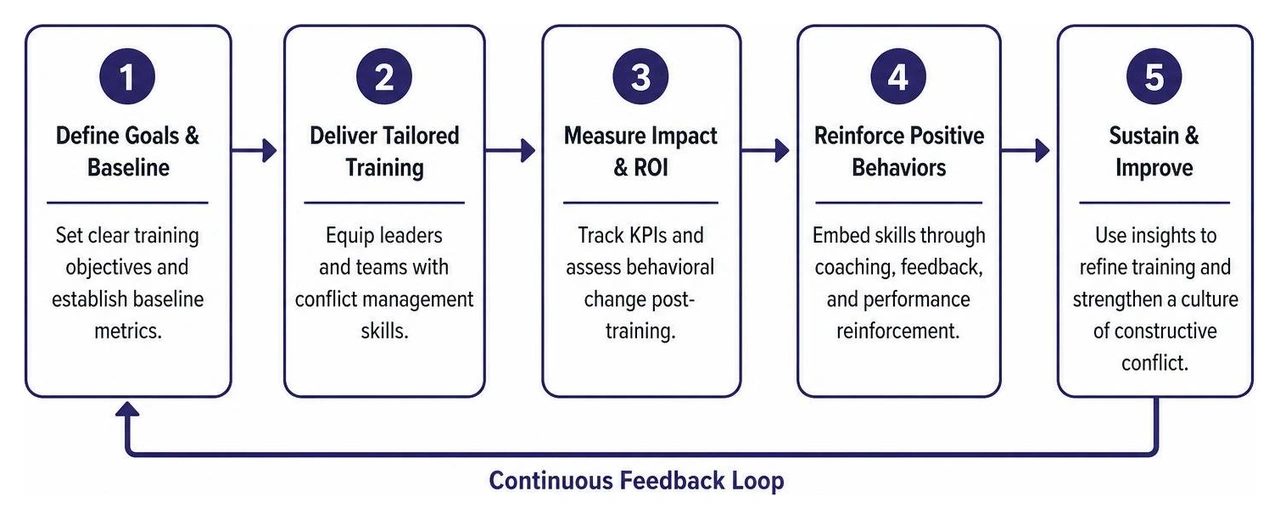
Sustaining these skills over the long haul requires ongoing reinforcement. It means integrating conflict competencies into performance reviews, modeling healthy disagreement at the executive level, and providing continuous learning opportunities. When conflict competency becomes part of your organizational infrastructure, you stop managing disputes reactively and start leading a culture of healthy, productive collaboration.
Frequently Asked Questions about Workplace Conflict
What is the difference between healthy and destructive conflict?
Healthy conflict focuses on ideas, processes, and tasks. It is characterized by active listening, curiosity, and a shared goal of finding the best solution, serving as an innovation driver. Destructive conflict is personal, emotional, and relational. It involves personal attacks, defensive posturing, and communication breakdowns that erode team cohesion and damage trust.
How do you diagnose the root cause of team conflict?
Diagnosing conflict requires looking past surface-level arguments to analyze the underlying conflict typology. Leaders can use diagnostic tools, one-on-one interviews, and relationship network analysis to determine if the tension stems from unclear roles, competing priorities, structural misalignments, or personality clashes. To help your team identify their default conflict tendencies, you can start by taking our Free Thomas Kilmann Assessment.
How can remote and hybrid teams manage conflict effectively?
Remote and hybrid environments often amplify misunderstandings due to the lack of non-verbal cues and physical distance. To manage conflict effectively, remote teams must establish clear digital communication guidelines, set explicit expectations around availability and response times, and create deliberate team rituals that foster psychological safety. Utilizing structured frameworks, such as our specialized TKI Conflict Training, can give distributed teams a shared language to navigate disagreements productively across time zones.
Conclusion
At Driven Leadership, we believe that workplace conflict is not a design flaw—it is an inevitable byproduct of passionate, diverse people working together toward ambitious goals. The differentiator between high-performing organizations and struggling ones is not the absence of tension, but the capacity of their leaders and teams to manage it constructively.
Our immersive leadership development programs and customized workshops are designed to deliver measurable, lasting behavioral change that directly improves business performance. Whether you are operating in California, Washington, or Nashville, TN, we are here to help you transform workplace friction into your greatest competitive advantage.
Ready to equip your workforce with the tools to lead through tension and build lasting trust? Explore our comprehensive Conflict Management Training Course and take the first step toward a more aligned, productive, and resilient culture.