
How to Manage Conflict in a Leadership Team in 5 Simple Steps

Why Conflict in a Leadership Team Is More Costly Than You Think
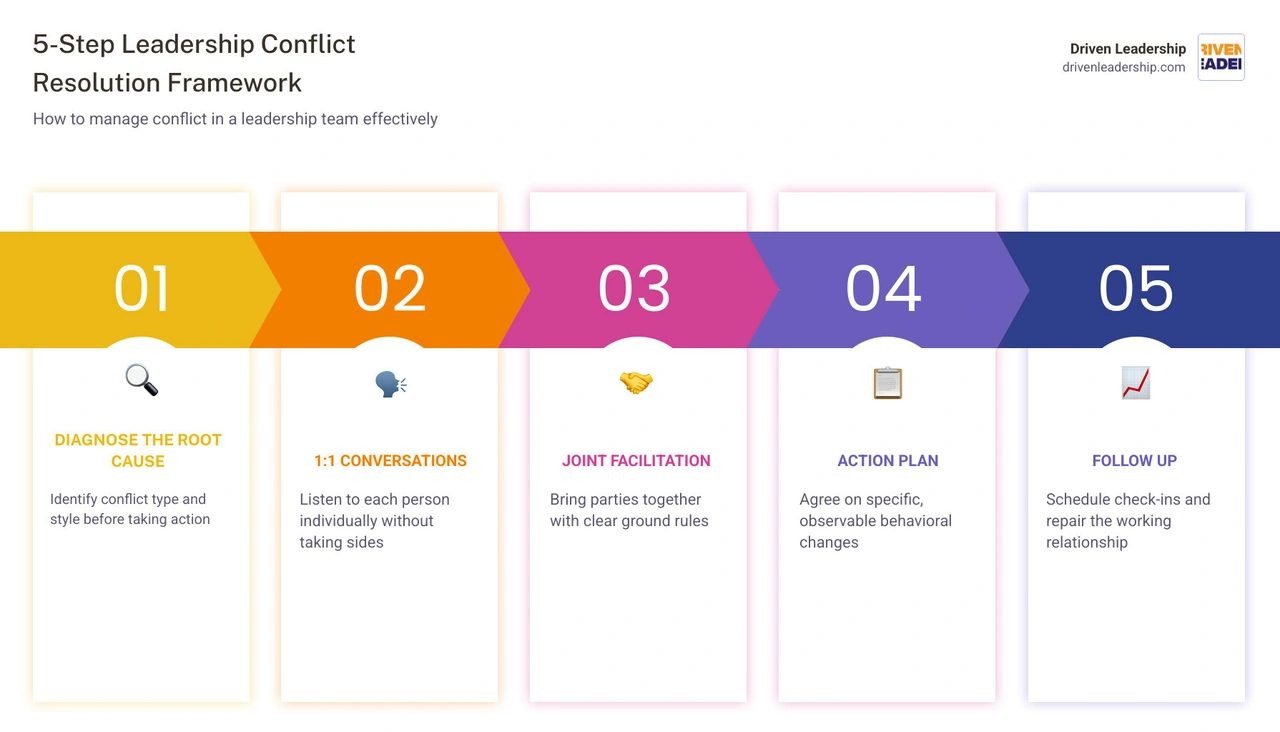
Knowing how to manage conflict in a leadership team is one of the most critical — and most overlooked — skills a leader can develop. Here is a quick overview of the 5-step framework this guide covers:
1. Diagnose the root cause — identify what type of conflict you are dealing with before acting
2. Conduct separate 1:1 conversations — listen to each person individually without taking sides
3. Facilitate a joint conversation — bring both parties together with clear ground rules
4. Co-create an action plan — agree on specific, observable behavioral changes with accountability
5. Follow up and rebuild cohesion — schedule check-ins and repair the working relationship over time
Conflict on a leadership team is not just uncomfortable — it is expensive. U.S. companies lose an estimated $359 billion in productivity every year because of workplace conflict. Managers already spend up to 40% of their time dealing with it. When conflict sits at the leadership level, the cost multiplies fast: strategic decisions stall, culture erodes, and the tension ripples down through every team below.
The hard truth is that most leadership teams are not short on talent. They are short on the tools to work through disagreement without it turning personal. Personality clashes, communication breakdowns, and competing priorities are all normal parts of leading a business — but left unaddressed, they quietly destroy trust, alignment, and performance.
The good news? Conflict handled well does not just clear the air. Research shows that teams who manage conflict effectively are 1.5 times more likely to hit their goals. Leaders who receive conflict resolution training see a 50% drop in team turnover. Managing conflict is not about avoiding hard conversations — it is about learning how to have them well.
This guide gives you a clear, practical framework to do exactly that.
Why Leadership Team Conflict Occurs (and Why It Matters)
To understand how to manage conflict in a leadership team, we first have to look at why it happens. Leadership teams are naturally prone to friction. They are made up of strong personalities, high-achieving individuals, and leaders representing distinct departments with competing priorities. A head of sales wants rapid growth and custom solutions; a head of operations wants standardized processes and cost control. This structural friction is inevitable.
At a deeper level, workplace conflict is driven by several predictable factors:
• Personality Clashes: Different communication preferences, risk tolerances, and work styles.
• Communication Breakdowns: Assumptions, misaligned expectations, or a lack of transparent feedback.
• Opposing Objectives: Departments pulling in different directions due to siloed goals.
To make sense of these dynamics, we can look to neuroscience and social psychology. Dr. David Rock’s SCARF model explains that our brains treat social threats (like a challenge to our authority or a perceived unfairness) the exact same way they treat physical threats. SCARF stands for:
• Status: Our relative importance to others.
• Certainty: Our ability to predict the future.
• Autonomy: Our sense of control over events.
• Relatedness: How safe we feel with others.
• Fairness: Our perception of fair exchanges.
When a leadership meeting turns tense, a team member's SCARF threats are often triggered. This triggers an amygdala hijack—the brain's emotional center takes over before the rational prefrontal cortex can process the situation. As a result, rational debate shuts down, and defensive behaviors take over.
Understanding the difference between the types of conflict on your team is crucial for choosing the right path forward:
• Task Conflict — Focus: What we are doing (goals, strategies, decisions) — Impact on Team: Can drive innovation, pressure-test ideas, and prevent groupthink if managed well. — Management Goal: Keep it productive; prevent it from turning personal.
• Process Conflict — Focus: How we are doing it (workflows, responsibilities, execution) — Impact on Team: Can improve efficiency, but unclear roles quickly breed resentment. — Management Goal: Clarify accountability and define clear operational boundaries.
• Relationship Conflict — Focus: Who is doing it (personalities, values, personal attacks) — Impact on Team: Highly destructive; poisons team culture, erodes trust, and tanks productivity. — Management Goal: Intervene quickly; redirect focus back to behaviors and shared goals.
When we ignore these distinctions, we allow healthy debate to degrade into personal rivalry. If you want to build a team capable of navigating these pressures, investing in structured Conflict Management training is the most direct path to sustainable behavioral change.
Why Learning How to Manage Conflict in a Leadership Team is Essential
When executive friction is swept under the rug, it creates a toxic trickle-down effect. If the VP of Marketing and the VP of Sales are quietly at war, their respective departments will stop collaborating. Information is hoarded, projects stall, and the entire organization feels the strain.
Conversely, when we establish psychological safety—the belief that one can speak up, share ideas, and admit mistakes without fear of negative consequences—healthy conflict becomes a competitive advantage. It allows executive teams to pressure-test strategic assumptions, innovate rapidly, and execute plans with absolute alignment.
Without a structured approach, leaders default to avoiding tension or forcing their way through it, both of which destroy trust. Providing targeted Conflict Resolution Training for Leaders ensures your executive team has the emotional intelligence and practical tools to handle high-stakes disagreements constructively.
How to Manage Conflict in a Leadership Team: The 5-Step Framework

Resolving executive conflict requires moving away from standard, passive advice. As a leader or facilitator, you cannot simply tell two conflicting executives to "work it out." You need a repeatable, structured framework that de-escalates emotions, uncovers root issues, and establishes objective behavioral changes.
Our 5-step framework is designed to move teams from defensive posturing to cooperative resolution. This approach is built on the principles of cooperative conflict management, which focuses on shared interests rather than winning individual arguments. By learning these skills, you can turn a destructive dispute into an opportunity for team growth. For a deeper dive into these methods, explore our Conflict Management Training Course Essential Strategies for Leaders.
Step 1: Diagnose the Root Cause and Conflict Style
Before taking action, you must understand what is actually driving the disagreement. Is it a true clash of values, a structural role overlap, or simply a misunderstanding?
We also need to recognize how each leader naturally reacts to tension. The Thomas-Kilmann Conflict Mode Instrument (TKI) identifies five distinct conflict styles based on two dimensions: assertiveness (focusing on individual concerns) and cooperativeness (focusing on others' concerns).
1. Competing: Highly assertive, low cooperation. Useful for quick, decisive action but highly damaging to relationships if overused.
2. Collaborating: Highly assertive, highly cooperative. The gold standard for complex issues, though it requires significant time and trust.
3. Compromising: Moderate assertiveness and cooperation. Finds a middle ground quickly, but can leave both parties partially unsatisfied.
4. Avoiding: Low assertiveness, low cooperation. Useful for cooling-off periods, but allows core issues to fester.
5. Accommodating: Low assertiveness, highly cooperative. Keeps the peace short-term but breeds quiet resentment.
Using the Thomas Kilmann Assessment with your leadership team provides a shared language. It allows leaders to step back and say, "I realize I'm defaulting to a competing style here because I feel my autonomy is threatened," rather than reacting defensively. Introducing specialized [TKI conflict training] can help your leaders consciously choose the right style for the situation at hand.
Step 2: Conduct Separate 1:1 Conversations
Never bring two conflicting executive team members into a room together without speaking to them individually first. These separate 1:1 sessions serve three vital purposes:
1. They allow each leader to vent their frustrations safely, reducing emotional volatility before the joint meeting.
2. They give you a chance to practice active listening and demonstrate empathy, building trust with both parties.
3. They help you identify where perspectives align and where they diverge.
During these conversations, you must actively prevent triangulation. Triangulation occurs when a team member tries to recruit you as an ally against the other person. If a leader says, "You agree that their behavior is completely unprofessional, right?" you must remain neutral.
Use neutral, objective framing:
"I hear that this situation has been incredibly frustrating for you. My goal is to remain a neutral partner to both of you so we can find a path forward. I want to understand your perspective, and then I will speak with them to understand theirs."
If you are facilitating this in the Pacific Northwest, bringing in external support through Conflict Resolution Training Seattle WA can help you master these delicate pre-mediation conversations.
Step 3: Facilitate the Joint Conversation
Once you have diagnosed the issue and prepared both parties, it is time to bring them together. Your role here is not to act as a judge who decides who is right or wrong; your role is to act as a neutral facilitator who manages the process.
Start by establishing clear ground rules for the discussion:
• Speak only from your own perspective (use "I" statements instead of "you" accusations).
• No interrupting or talking over one another.
• Focus strictly on specific, observable behaviors, not character judgments.
• Maintain curiosity—ask questions to understand, not to defend.
During the meeting, guide the conversation from positions to interests. A position is what they say they want ("I need daily progress reports from operations"); an interest is the underlying need driving that demand ("I need certainty that our client delivery dates are on track").
When someone lowers their guard and admits a mistake or expresses a vulnerability, slow the conversation down. Protect that vulnerable moment. Acknowledge it, validate it, and allow it to build empathy between the two leaders. For practical scripts and facilitation frameworks, refer to our guide on Navigating Conflict Resolution Strategies for Maintaining Harmony and Productivity.
Step 4: Co-Create a Clear Action Plan
A conflict is not resolved just because people feel better at the end of a meeting. True resolution requires a concrete, documented action plan that outlines specific, observable behavioral changes and clear role boundaries.
Do not write the plan for them. Have the leaders co-create the solutions so they feel a sense of ownership. Ask targeted questions:
• "What specific behavior do you need to see from each other over the next 30 days to rebuild trust?"
• "If a miscommunication occurs next week, how will you address it directly with each other before escalating it?"
• "How will we measure whether this new workflow is successful?"
Document the agreed-upon actions, assign clear owners, and set firm deadlines. This step ensures absolute role clarity and accountability, transforming emotional breakthroughs into lasting operational changes. To build these action-planning skills across your entire leadership team, consider enrolling them in a Conflict Management Training Course.
Step 5: Follow Up and Rebuild Cohesion
The final, and most frequently missed, step is structured follow-up. Old habits die hard, and under pressure, leaders will naturally slide back into their default conflict styles.
Schedule formal check-ins at the two-week and six-week marks. Use these meetings to review the action plan and ask:
• "How have our agreements been working in practice?"
• "Where have we experienced friction, and how did we handle it?"
• "What adjustments do we need to make to our plan?"
If backsliding occurs, address it within 48 hours. Do not let small boundary violations go unnoticed, or the trust you built will quickly evaporate. Over time, these consistent follow-ups repair the working relationship, restore team passion, and strengthen overall cohesion. Immersive training, such as the TKI Live Conflict Management Workshops Driven Leadership offers, provides the exact behavioral tools needed to make these resolutions stick long-term.
Adapting Conflict Management for Remote and Hybrid Teams
Managing conflict in a leadership team becomes significantly more complicated when your executives are working remotely or in a hybrid setup. Without the natural physical touchpoints of an office, small misunderstandings can quickly escalate into full-blown disputes.
The primary driver of remote conflict is text-based communication. Email, Slack, and text messages completely strip away tone of voice, facial expressions, and body language. A brief, direct message like "We need to talk about this project" can easily be interpreted as aggressive or micro-managing by a stressed colleague.
To combat this, remote leaders must establish a simple rule: never use text-based channels to resolve a disagreement. The moment a Slack thread or email exchange shows signs of tension, immediately move the conversation to a video call or an in-person meeting.
Furthermore, remote environments can lead to a culture of micromanagement and distrust. When leaders cannot physically see their teams working, they may demand excessive status reports, which triggers autonomy threats. To prevent this, focus on outcomes and results rather than activity tracking, and ensure your schedules and workflows are completely transparent. If you want to equip your broader organization with these virtual collaboration skills, we offer specialized training in Conflict Management for Employees.
Best Practices on How to Manage Conflict in a Leadership Team Remotely
To keep remote and hybrid leadership teams aligned, implement these proactive strategies:
• Explicit Communication Expectations: Define which channels should be used for which types of communication. Establish clear response-time expectations to reduce anxiety and uncertainty.
• Structured Connections: Dedicate the first 5-10 minutes of video meetings to informal connection. Rebuilding the human element of work fosters relatedness and empathy.
• Cooling-Off Periods with Reflection: If a virtual meeting becomes heated, do not force an immediate resolution. Pause the meeting, allow a 24-hour cooling-off period, and ask both parties to write down their thoughts and desired outcomes before reconvening.
If you are managing a distributed team across California, accessing localized programs like Conflict Resolution Training Anaheim CA can help your regional leaders master these virtual mediation dynamics.
The Role of Emotional Intelligence in Preventing Leadership Friction
While having a framework to resolve active disputes is essential, the ultimate goal is to build a team that prevents destructive conflict from happening in the first place. This requires a high level of emotional intelligence (EQ).
Emotional intelligence in a leadership context consists of four core pillars:
1. Self-Awareness: Recognizing your own emotional triggers, strengths, and default conflict styles.
2. Self-Regulation: Controlling impulsive reactions and managing your emotions under pressure.
3. Social Awareness: Reading the emotional climate of the team and understanding others' perspectives.
4. Relationship Management: Inspiring others, managing change, and resolving conflicts constructively.
When leaders possess high EQ, they create a positive team emotional climate. Instead of reacting defensively to a strategic challenge, they pause, self-regulate, and respond with curiosity. This emotional maturity fosters team passion, encourages open dialogue, and keeps task conflict productive.
A great way to jumpstart this self-awareness on your team is to have each leader take a TKI Assessment. Understanding their personal profiles allows leaders to recognize their emotional patterns in real-time, helping them shift from reactive defensiveness to proactive collaboration.
Frequently Asked Questions
What is the best way to handle a personality clash on an executive team?
A personality clash occurs when two leaders simply do not click or have fundamentally different ways of viewing the world. You cannot force two people to become best friends, and trying to do so will only backfire.
Instead, focus entirely on establishing objective behavioral standards. Sit down with both leaders and define what professional collaboration looks like in practice. Agree on clear communication protocols, explicitly define their roles to prevent turf wars, and hold them both accountable to the same team agreements. If you need local expert guidance to navigate these deep-seated interpersonal dynamics, we offer tailored Conflict Resolution Training Los Angeles CA to help your Southern California executive teams align.
How do you know when to facilitate vs. arbitrate a leadership dispute?
As a rule of thumb, you should always try to facilitate first. Facilitation focuses on process; you guide the conversation, but the conflicting parties are responsible for finding the solution. This builds their conflict resolution skills and leads to genuine commitment.
You should only step in to arbitrate—where you make the final decision for them—when the conflict has reached a complete standstill, strategic execution is stalled, or a quick decision is critical for the business. That arbitration only secures compliance, not true commitment. To learn when and how to apply these different approaches, consider exploring Understanding Conflict Resolution Mediation Training.
How can we prevent remote communication from escalating into conflict?
Preventing virtual conflict starts with setting explicit expectations. Require video cameras to be on during strategic discussions so team members can read facial expressions. Establish a "one-touch" rule: if a written conversation goes back and forth more than twice without resolution, pick up the phone or launch a Zoom call. Finally, encourage your remote leaders to assume positive intent in every written message they receive. For teams based in Southern California, our Conflict Resolution Training Long Beach CA provides practical workshops to build these healthy remote communication habits.
Conclusion: Transform Conflict into Your Team's Greatest Strength
Learning how to manage conflict in a leadership team is not about eliminating disagreement. A team with zero visible conflict is often a team suffering from artificial harmony, where people are too afraid to speak the truth. True leadership success lies in building a team that knows how to disagree constructively, debate passionately, and align completely once a decision is made.
At Driven Leadership, we specialize in helping executive teams build these exact capabilities. Through our immersive training programs, hands-on workshops, and EOS (Entrepreneurial Operating System) implementation, we deliver measurable, lasting behavioral change that directly improves business performance. We do not just offer short-term inspiration; we provide your leaders with the practical tools and emotional intelligence they need to lead through any challenge.
Are you ready to stop managing the fallout of executive friction and start building a high-performing, aligned leadership team? Explore our comprehensive Conflict Management Training Course today, and let us help you turn your team's friction into fuel for growth.
