
The Complete Guide to How Behavioral Assessment Training Reduces Workplace Conflict

Why Workplace Conflict Is Costing Your Organization More Than You Think
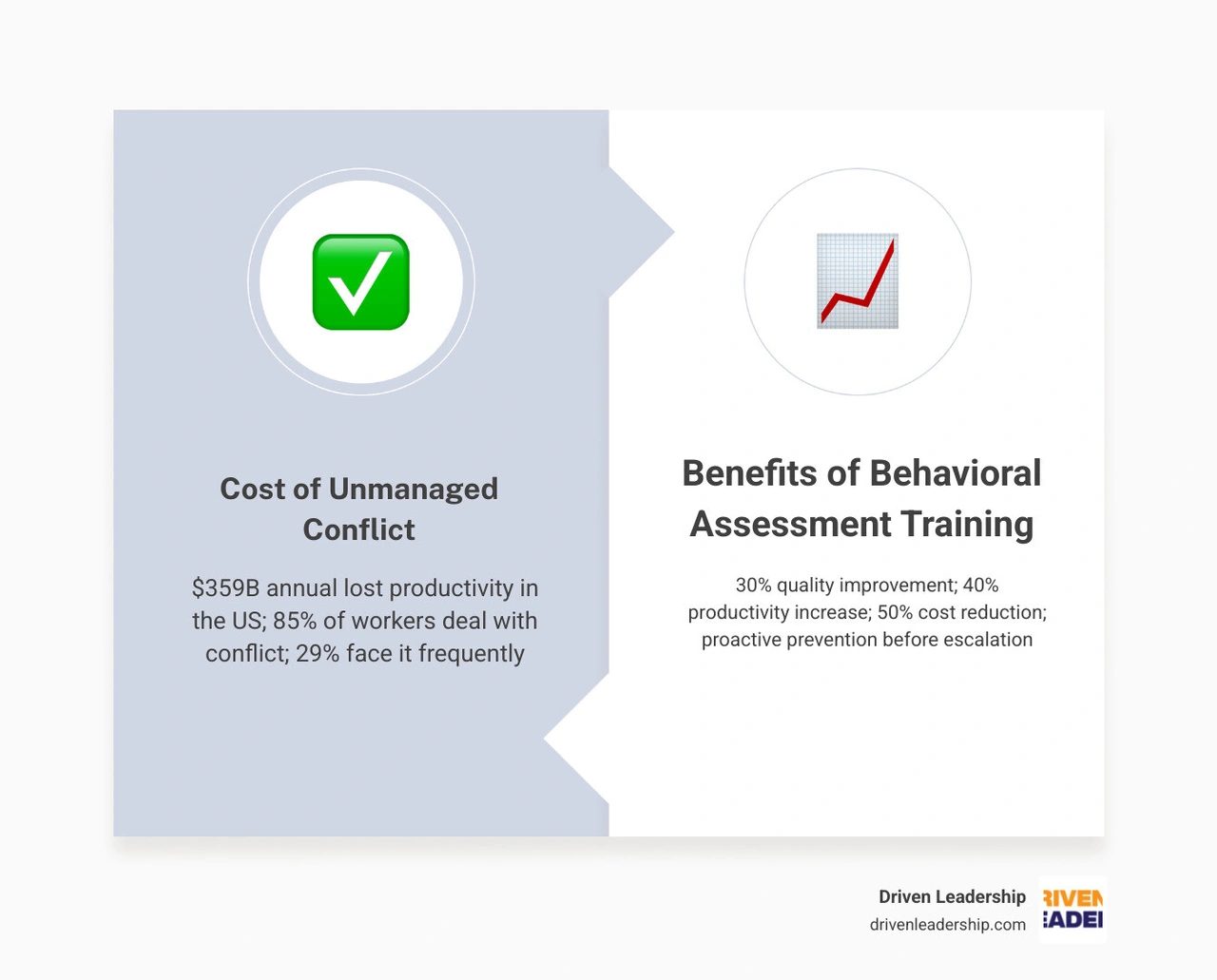
Understanding how behavioral assessment training reduces workplace conflict starts with an honest look at what unmanaged conflict actually costs. According to research involving 5,000 full-time employees across nine countries, 85% of workers deal with conflict at work to some degree — and 29% face it frequently or always. The financial toll is staggering: lost time due to workplace conflict has been calculated at $359 billion annually in the United States alone.
For mid-level managers and business owners, that number isn't abstract. It shows up as missed deadlines, disengaged teams, high turnover, and the slow erosion of a culture you've worked hard to build.
Here's the core answer:
Behavioral assessment training reduces workplace conflict by:
1. Identifying individual behavioral patterns before they trigger team friction
2. Building self-awareness so employees recognize their own conflict triggers (called "hot buttons")
3. Teaching communication skills tailored to how different people process and respond
4. Shifting teams from reactive conflict management to proactive prevention
5. Giving leaders objective behavioral data to address tension before it escalates
6. Reinforcing skills through structured practice, leading to measurable improvements in productivity, satisfaction, and team cohesion
Unlike traditional conflict resolution — which steps in after a dispute has already formed — behavioral assessment training works upstream. It helps people understand why friction happens in the first place, so they can stop the slow burn before it becomes a blowup.
Research backs this up. One study found that improved communication practices led to a 30% improvement in quality, nearly a 40% increase in productivity, and close to a 50% decrease in costs within an IT group. Another showed that targeted communication training produced a 10% improvement in employees' willingness to confront difficult issues — with ripple effects on customer satisfaction and team performance.
The difference between organizations that struggle with ongoing conflict and those that navigate it well often comes down to one thing: whether they've given their people the skills and self-awareness to handle disagreement constructively.
That's exactly what behavioral assessment training is designed to do.
Basic how behavioral assessment training reduces workplace conflict vocab:
• disc assessment vs other communication style tools comparison
• what is a disc assessment and how does it improve communication
Understanding How Behavioral Assessment Training Reduces Workplace Conflict
To understand how behavioral assessment training reduces workplace conflict, we must first look at how traditional approaches fall short. Most organizations rely on reactive conflict resolution. When a dispute flares up, HR steps in to mediate, or managers scramble to patch things over. While valuable, this reactive model only addresses the symptoms of conflict, not the root causes.

Behavioral assessment training represents a fundamental shift. Instead of waiting for a crisis, we use objective behavioral data to map how people naturally think, communicate, and react under pressure. This approach builds a foundation of mutual understanding before friction ever has a chance to ignite.
When teams lack this behavioral clarity, small misunderstandings quickly spiral. In fact, research shows that negative workplace interactions affect an employee's mood five times more strongly than positive encounters. When left unaddressed, these negative moments accumulate, turning minor differences into toxic environments. By integrating behavioral assessments into your training, you give your team a shared language to navigate differences neutrally, shifting the focus from personal blame to objective behavioral styles.
To explore how these foundational concepts translate into formal mediation, you can read our deep dive into Understanding Conflict Resolution Mediation Training.
The Science Behind How Behavioral Assessment Training Reduces Workplace Conflict
At its core, behavioral assessment training is grounded in behavioral science and the psychology of self-awareness. It moves teams away from assumptions ("She is being difficult on purpose") and toward cognitive reappraisal ("She has a high-compliance behavioral style and needs more data before making a decision").
This shift in perspective is crucial for understanding What Are the Five Conflict Management Styles and When to Use Each. People typically respond to conflict in one of five ways: avoiding, accommodating, competing, compromising, or collaborating.
Behavioral assessments reveal which style an employee naturally defaults to, especially under stress. For example, a highly dominant, competitive communicator might run roughshod over an accommodating team member without realizing it. Behavioral training teaches both individuals to recognize these defaults, regulate their emotional responses, and consciously choose the style that best suits the situation.
Proactive Prevention: How Behavioral Assessment Training Reduces Workplace Conflict Before Escalation
Conflict in the workplace rarely starts with a massive, dramatic explosion. Instead, it begins as a "slow broil" — subtle communication breakdowns, unexpressed frustrations, and misaligned expectations that simmer over time.
Behavioral assessment training acts as an early warning system. By identifying each employee’s unique "hot buttons" (emotional triggers) and communication preferences, we can catch and resolve friction points before they escalate.
For instance, if a manager knows that a direct report values high autonomy and clear, brief communication, they can adjust their feedback style to prevent the employee from feeling micromanaged. This proactive alignment is essential for Navigating Conflict Resolution Strategies for Maintaining Harmony and Productivity across all levels of your organization.
Key Behavioral Assessment Tools for Resolving Team Tension
Not all assessment tools are created equal. To successfully reduce workplace conflict, you need tools that offer deep, actionable insights into both observable behaviors and internal motivators.
• Innermetrix DISC — Core Methodology: Measures observable behavior (Dominance, Influence, Steadiness, Compliance) — Primary Use Case in Conflict Reduction: Improving daily communication and identifying team friction points — Key Benefit: Easy to understand; provides an instant shared vocabulary for teams
• Innermetrix Values (Values Index) — Core Methodology: Identifies internal motivators and drivers — Primary Use Case in Conflict Reduction: Resolving deep-seated misalignments in priorities and decision-making — Key Benefit: Explains the "why" behind an employee's actions and behaviors
• Conflict Dynamics Profile (CDP) — Core Methodology: Measures active/passive and constructive/destructive responses to conflict — Primary Use Case in Conflict Reduction: Pinpointing specific emotional "hot buttons" and behavioral triggers — Key Benefit: Focuses specifically on conflict behaviors and emotional regulation
Using these tools systematically allows organizations to map team dynamics, locate hidden friction points, and build targeted development plans. Understanding these profiles is the first step toward unlocking better team collaboration, as detailed in our guide on What Is a DISC Assessment and How Does It Improve Communication.
Innermetrix and DISC Profiles
At Driven Leadership, we frequently utilize the Innermetrix DISC assessment because of its precision and depth. Unlike basic personality tests, the Innermetrix DISC profile doesn't just label an employee; it provides a comprehensive map of how they behave, how they communicate, and how they prefer to be managed.
When teams understand each other's DISC profiles, "personality clashes" lose their power. A classic clash between a "D" (Dominant) profile and a highly detail-oriented "C" (Compliant) profile is reframed as a simple difference in communication pacing. The "D" learns to provide the necessary details, while the "C" learns to deliver high-level summaries first.
To see how this works in practice, explore how to resolve Personality Conflicts Use Innermetrix DISC and how to leverage Innermetrix DISC Profiles Team Communication for long-term harmony.
Overcoming Team Blind Spots
Every team has blind spots — shared behavioral tendencies or communication gaps that no one notices because everyone is participating in them. For example, a leadership team composed entirely of high-influence, profiles might suffer from a collective lack of follow-through, leading to frustration and conflict with the operational teams tasked with executing their ideas.
By utilizing behavioral assessments, we can run team diagnostics to reveal these hidden patterns. This process is one of the Top 5 Ways Innermetrix DISC Assessment Reveals Team Blind Spots. When a team can see its collective blind spots on a map, they can put structured processes in place to balance their communication.
If you are evaluating different options for your organization, you can review our DISC Assessment vs Other Communication Style Tools Comparison to find the right fit for your team.
Implementing Behavioral Assessments to Improve Team Dynamics
Implementing behavioral assessment training requires a structured, intentional strategy. Simply sending a PDF report to your employees and hoping for the best won't create lasting change.
To drive real results, the assessment must be paired with interactive, behavioral skills training. This involves instruction, modeling, practice, and feedback. By practicing difficult conversations in a safe, low-risk environment, employees build the confidence and muscle memory needed to apply these skills when real-world tension arises.
For organizations looking to build these capabilities, starting with leadership is paramount. Learn more about our approach to Conflict Resolution Training for Leaders.
Training for Leaders and Executives
Leadership sets the tone for how conflict is handled across the entire organization. When executives and managers avoid tough conversations or rely on top-down authority to force compliance, they inadvertently model destructive conflict habits for their teams.
That is why we integrate behavioral assessments directly into our leadership programs. By Analyzing Leadership Styles with Innermetrix, leaders gain deep insight into their own management defaults. They learn how to adapt their style to support, motivate, and guide employees with different behavioral profiles.
This training is a core pillar of our Conflict Management Training Course Essential Strategies for Leaders. When leaders possess these skills, they can guide their teams through high-stakes decisions without letting healthy debate devolve into personal disputes. For a deeper look at aligning your executive team, read our guide on How to Manage Conflict in a Leadership Team.
Overcoming Implementation Challenges
While the benefits of behavioral assessment training are clear, organizations often face a few common hurdles during implementation:
• Lack of Employee Buy-In: Employees may worry that assessments will be used to label them or influence performance reviews. Our Solution: Position the training as an investment in their professional development and emphasize that there are no "good" or "bad" profiles.
• Lack of Psychological Safety: If employees don't feel safe expressing their true thoughts, they won't apply their new communication skills. Our Solution: Establish clear ground rules for workshops, ensuring all discussions are kept constructive and confidential.
• The "One-and-Done" Trap: Training is often treated as a single event, leading to skill fade over time. Our Solution: Build ongoing feedback loops, integrate behavioral concepts into regular team meetings, and establish clear behavioral metrics to track progress.
Frequently Asked Questions about Behavioral Assessment Training
What is the difference between conflict resolution and behavioral assessment training?
Traditional conflict resolution training is primarily reactive. It focuses on mediation, negotiation, and de-escalation techniques to resolve active disputes.
Behavioral assessment training is proactive. It uses objective behavioral data to help employees understand themselves and others before conflict starts. While conflict resolution teaches you how to put out a fire, behavioral assessment training teaches you how to manage the fuel and oxygen so a destructive fire never starts in the first place.
How do behavioral assessments measure emotional triggers?
Advanced tools like the Conflict Dynamics Profile (CDP) measure specific emotional triggers, often referred to as "hot buttons." These are behaviors in others that are highly likely to provoke an emotional reaction in us (such as micro-managing, untrustworthiness, or abrasive behavior).
By identifying these hot buttons, employees can practice cognitive reappraisal and physiological grounding techniques, allowing them to stay calm and rational during difficult conversations rather than slipping into a defensive or aggressive state.
What measurable outcomes can organizations expect?
Organizations that implement structured behavioral assessment training typically see significant, measurable improvements, including:
• Reduced Turnover: A healthier, more supportive work environment directly correlates with higher employee retention.
• Higher Productivity: Teams spend less time navigating interpersonal friction and more time executing their goals.
• Improved Communication Quality: Teams experience fewer misunderstandings and resolve issues much faster. For example, an IT group utilizing structured communication practices achieved a 30% improvement in quality, a 40% increase in productivity, and a nearly 50% decrease in costs.
Conclusion: Building a Conflict-Competent Culture with Driven Leadership
Workplace conflict doesn't have to be a constant drain on your organization's time, energy, and bottom line. By equipping your team with self-awareness, clear communication frameworks, and objective behavioral data, you can transform conflict from a destructive force into a catalyst for innovation and growth.
At Driven Leadership, we specialize in delivering deep, lasting behavioral change that improves business performance. Serving organizations across Washington, California, Nashville, TN, and Southern California, we help leadership teams and organizations build healthy, high-performing cultures through immersive training, workshops, and EOS implementation.
Ready to uncover your team's blind spots and build a conflict-competent culture? Schedule an Innermetrix DISC Assessment with Driven Leadership today.