
Everything You Need to Know About DISC Assessment

Why Understanding What Is a DISC Assessment and How Does It Improve Communication Can Transform Your Team
If you've ever wondered what is a DISC assessment and how does it improve communication, here's the short answer:
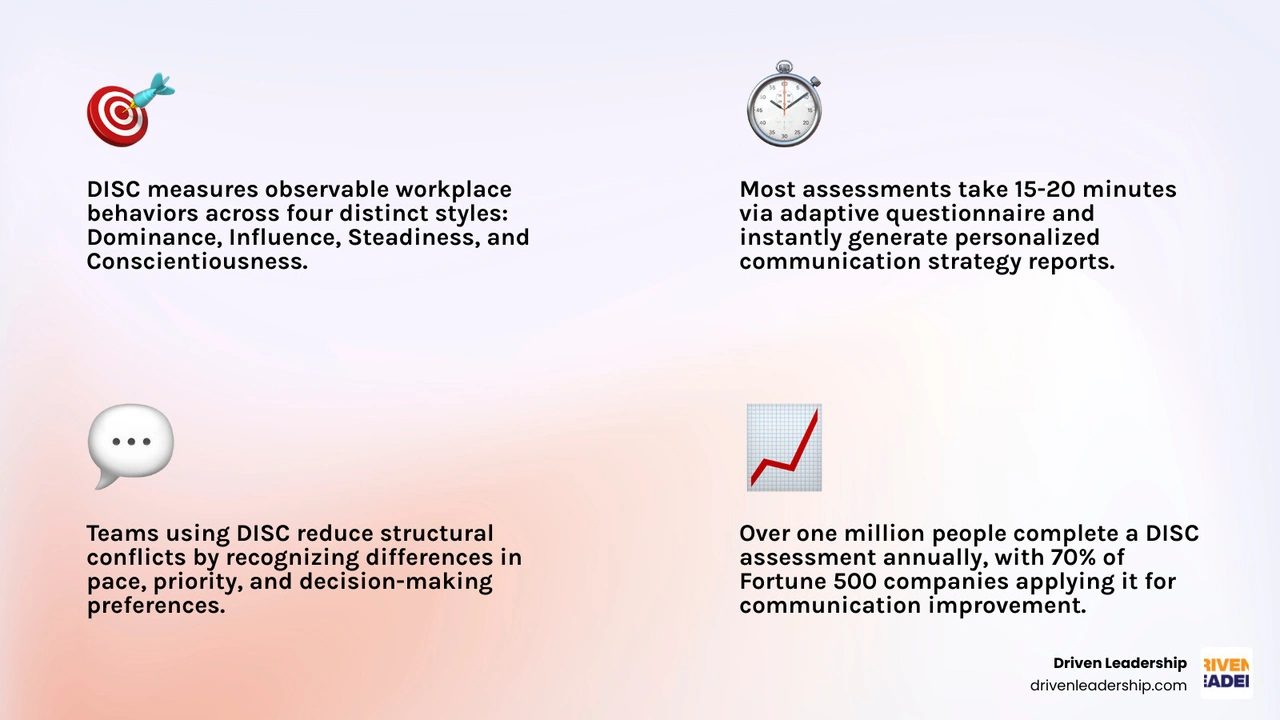
DISC is a behavioral assessment tool that measures how people tend to act, communicate, and respond at work. It groups behavioral tendencies into four styles — Dominance, Influence, Steadiness, and Conscientiousness. By helping you and your team understand these styles, DISC gives everyone a shared language to communicate more clearly, reduce friction, and work together more effectively.
Quick overview:
• What it measures: Observable behavioral tendencies and communication preferences — not intelligence or values
• How it works: A short questionnaire (typically 15–20 minutes) produces a personalized report covering your style, motivators, stressors, and communication strategies
• The four styles: Dominance (D), Influence (I), Steadiness (S), Conscientiousness (C)
• How it improves communication: It helps you recognize why others respond differently than you do — and shows you how to adapt your approach to connect more effectively
• Who uses it: Over a million people take a DISC assessment every year, and roughly 70% of Fortune 500 companies use some version of it
Most team tension doesn't come from bad intentions. It comes from people assuming everyone thinks, prioritizes, and communicates the same way they do. As one expert put it, conflicts often aren't personal — they're structural, rooted in differences in pace and priority rather than anyone being difficult.
DISC doesn't just tell you who you are. It helps you understand why your colleague goes quiet in meetings, why your manager seems blunt, or why a team member keeps asking for more details before moving forward. That understanding is where real communication improvement begins.
What Is a DISC Assessment and How Does It Improve Communication?
To understand how this tool changes the way we talk and work with one another, we must first look at what the acronym stands for. DISC represents four primary behavioral styles:
• Dominance
• Influence
• Steadiness
• Conscientiousness (sometimes referred to as Compliance or Caution)
The foundation of the DISC model dates back to 1928, when psychologist William Moulton Marston published Emotions of Normal People. Marston was a fascinating figure—not only did he lay the groundwork for modern behavioral profiling, but he also created the early lie detector prototype and created the iconic comic book character Wonder Woman! Marston theorized that people express their emotions and behaviors through four distinct types, based on how they perceive themselves in relation to their environment.
Crucially, DISC does not measure your intelligence, mental health, values, or technical competence. Instead, it focuses entirely on observable behavioral tendencies. It highlights how you respond to challenges, how you influence others, how you pace your day-to-day work, and how you respond to rules and procedures.
When we understand these patterns, we unlock a powerful way to bridge communication gaps. Rather than guessing why a colleague seems impatient or why another needs three days to analyze a spreadsheet, we can look at their behavior objectively. Using Innermetrix DISC Profiles & Team Communication strategies, teams can shift away from personal judgment ("She's just being difficult") and move toward objective, constructive dialogue ("She has a high C style and needs accurate data to move forward confidently").
How the DISC Assessment Works and What It Measures
Modern DISC assessments have come a long way since Marston's paper-and-pencil days. Today, the process is quick, intuitive, and highly accurate.
Most assessments utilize computerized adaptive testing (CAT). When you take the assessment, you are presented with a series of workplace scenarios or word associations. As you respond, the system adjusts subsequent questions based on your previous answers. This ensures a highly personalized and accurate result in a short amount of time—usually taking only 15 to 20 minutes.
Once completed, the assessment generates a comprehensive profile report (often up to 20 pages or more) that maps out your unique behavioral footprint. Because very few people are just one single style, the report places you on a behavioral spectrum, illustrating how you blend these four traits in different situations.
The magic of this process lies in its ability to build profound self-awareness. It acts as a mirror, showing you:
• Your natural communication preferences under normal circumstances.
• How your behavior shifts when you are under pressure or facing tight deadlines.
• Your primary professional motivators and energy drains.
• The exact environments in which you are most likely to thrive.
By combining this baseline self-awareness with a deeper tool like the Innermetrix Leadership Assessment, professionals and executives can identify not just how they behave, but how their default leadership approaches land with the rest of the team.
The Four Core DISC Personality Styles Explained
No individual is a single, isolated letter. We are all a unique blend of all four styles. However, most of us have one or two dominant styles that dictate our default behaviors. To understand the behavioral spectrum, it helps to look at how these four quadrants compare:
• Dominance (D) — Primary Focus: Tasks & Results — Pace: Fast & Decisive — Major Strengths: Problem-solving, directness, driving progress — Communication Preference: Bullet points, high-level summaries, bottom line
• Influence (I) — Primary Focus: People & Relationships — Pace: Fast & Spontaneous — Major Strengths: Enthusiasm, persuasion, team cohesion — Communication Preference: Engaging, verbal, positive, story-driven
• Steadiness (S) — Primary Focus: Relationships & Process — Pace: Deliberate & Consistent — Major Strengths: Loyalty, active listening, supporting others — Communication Preference: Quiet, collaborative, step-by-step, patient
• Conscientiousness (C) — Primary Focus: Tasks & Systems — Pace: Deliberate & Analytical — Major Strengths: Accuracy, detail-oriented, high quality — Communication Preference: Written, data-backed, precise, structured
Dominance (D): The Direct Achievers
People with a high "D" style are motivated by solving problems and getting immediate results. They are competitive, direct, and strong-willed.
• Pace and Priority: They operate at a very fast pace and prioritize tasks over personal relationships in the workplace.
• Communication Style: High D's speak one-directionally. They express opinions as facts, have short concentration spans for small talk, and may interrupt when they feel a conversation is moving too slowly.
• How to talk to them: Be concise, focused, and results-oriented. Skip the fluff, present the "what" rather than a prolonged "why," and focus on solutions rather than obstacles.
Influence (I): The Enthusiastic Communicators
High "I" individuals are energetic, optimistic, and highly social. They love collaborating and are motivated by social recognition and team harmony.
• Pace and Priority: Like D's, they move at a fast, spontaneous pace, but they prioritize people and relationships above everything else.
• Communication Style: They are highly animated, tell personal stories, and are open about their feelings. However, they can get distracted easily and may stray from the core topic if not anchored.
• How to talk to them: Maintain a warm, friendly, and positive atmosphere. Allow them time to express themselves, focus on the big picture, and put key details in writing as a follow-up.
Steadiness (S): The Dependable Supporters
High "S" personalities are calm, patient, and incredibly reliable. They value stability, security, and a harmonious working environment.
• Pace and Priority: They prefer a deliberate, steady pace and prioritize relationships and team consensus.
• Communication Style: They are excellent, empathetic listeners. However, because they dislike conflict, they may nod in agreement during a meeting simply to acknowledge they hear you—even if they privately disagree.
• How to talk to them: Slow down your delivery. Ask specific, open-ended questions to draw out their thoughts, provide logical precedents for changes, and give them time to think before demanding a decision.
Conscientiousness (C): The Analytical Thinkers
High "C" individuals are analytical, systematic, and deeply value accuracy and quality. They want to ensure things are done correctly the first time.
• Pace and Priority: They work at a deliberate, careful pace and prioritize tasks, systems, and logic.
• Communication Style: They are naturally reserved and prefer written communication (like detailed emails) over spontaneous verbal debates. They ask highly specific questions and study the details thoroughly.
• How to talk to them: Be prepared with data, facts, and supporting materials. Answer their questions calmly, avoid over-promising, and give them the space to analyze the details without rushing them.
What Is a DISC Assessment and How Does It Improve Communication in Teams?
When an entire team takes a DISC assessment, the collective dynamic changes. It creates a shared, neutral language that removes the emotional sting from workplace friction.
Instead of an employee feeling targeted by a manager's blunt email, they can recognize, "Ah, my manager is a high D. This isn't personal; they are just focusing on the bottom line." Conversely, a manager can realize, "My S-style employee isn't resisting this change; they just need a bit of time to process the new workflow."
By mapping these styles across a group, leaders can easily identify structural gaps. Utilizing the Top 5 Ways Innermetrix DISC Assessment Reveals Team Blind Spots framework helps teams discover where they might be over-indexing on certain behaviors (like having too many C-styles and suffering from "analysis paralysis," or too many D-styles clashing over control).
Adapting Your Style to Improve Interpersonal Connections
The ultimate goal of DISC is not to pigeonhole people or give them an excuse for poor behavior ("That's just my high D style, get over it!"). Instead, the true power of DISC lies in style flexing—your ability to temporarily adapt your natural communication style to meet the needs of the person you are speaking with.
This requires active listening and situational awareness. For instance:
• If a high-D leader is presenting a new strategy to a team of high-C analytical thinkers, they must slow down and provide the data trail.
• If an analytical high-C team member needs approval from an action-oriented high-D executive, they should lead with the recommendation and bottom-line impact, keeping the background data in an appendix.
This kind of behavioral agility is the hallmark of modern leadership. By Analyzing Leadership Styles with Innermetrix, leaders learn to flex their communication to inspire, support, or direct their direct reports based on what those individuals need to succeed.
Resolving Workplace Conflicts and Reducing Tension
Most workplace conflicts do not stem from personality clashes; they stem from differences in pace and priority.
• Pace conflicts happen when a style (D or I) wants to make quick decisions, while a deliberate style (S or C) wants to slow down and gather more information.
• Priority conflicts happen when task-oriented styles (D or C) focus strictly on results and data, while relationship-oriented styles (I or S) focus on team morale and personal impact.
By using DISC, teams can see these clashes for what they really are: structural differences in how people process the world. When conflict does arise, combining DISC insights with a structured approach like the Thomas Kilmann Assessment (which measures conflict-handling modes) allows teams to navigate disagreements productively.
In fact, organizations that implement DISC consistently report dramatic drops in friction. Case studies show that teams using these tools experience a 30% drop in internal conflict reports simply because they have the language to work through misunderstandings before they escalate. Learn more about how to resolve these issues in our guide on how to handle Personality Conflicts? Use Innermetrix DISC dynamics.
The Business Benefits of Implementing DISC Assessments
Bringing behavioral intelligence into your business is not just a feel-good exercise; it delivers a clear, measurable return on investment. Here are the primary benefits companies experience when integrating DISC:
1. Smoother Project Delivery: Miscommunication is one of the leading causes of project delays. When team members understand how to delegate tasks, share updates, and request feedback in ways that match their colleagues' styles, efficiency skyrockets. Businesses regularly see a 20% decrease in project delays after implementing DISC tools.
2. Effective Employee Onboarding: Starting a new job is stressful. By utilizing DISC assessments during onboarding, managers can instantly understand how to train, motivate, and give feedback to a new hire from day one, saving time and reducing early turnover.
3. Boosted Team Morale: When people feel understood and respected for their natural strengths, psychological safety increases. Teams can intentionally align tasks to behavioral strengths—letting high C's handle precise data analysis, while high I's manage client relationships. You can dive deeper into this in our article on how to Enhance Team Morale with DISC Insights.
Limitations of DISC and Best Practices for Responsible Use
While DISC is an incredibly powerful tool, it must be used responsibly. It is not a clinical diagnostic tool, an IQ test, or a predictor of professional competence.
Here are the golden rules for using DISC in your organization:
• Avoid Labeling People: Do not use DISC to pigeonhole team members (e.g., "Oh, don't invite Bob to the brainstorming session; he's a C, so he won't have any creative ideas"). Everyone is a blend of all four styles and is capable of operating outside their comfort zone.
• Do Not Use It as a Sole Hiring Filter: While DISC is fantastic for understanding how a candidate might fit into a team's dynamic, it should never be used as a pass/fail test for recruitment. It does not measure job skills, ethics, or experience.
• Prioritize Psychological Safety: Taking an assessment requires a degree of vulnerability. Ensure your team knows there are no "good" or "bad" DISC profiles—every style is highly valuable and necessary for a high-performing team.
Understanding What Is a DISC Assessment and How Does It Improve Communication Responsibly
To get the most out of DISC, it should never be treated as a "one-off" workshop. True behavioral change requires ongoing practice, professional coaching, and continuous development.
At Driven Leadership, we believe in looking at the whole person. While DISC is an exceptional tool for understanding how a person behaves, combining it with professional coaching helps individuals understand why they make certain decisions and what internal motivators drive them. This holistic approach ensures that the insights gained from the assessment translate into permanent, positive habits in the workplace.
Frequently Asked Questions about DISC Assessments
How long does a DISC assessment take to complete?
Most modern online DISC assessments take between 15 to 20 minutes to complete. Because they use computerized adaptive testing, the questionnaires are streamlined and highly efficient, providing you with an in-depth, personalized report immediately after completion.
Can an individual's DISC style change over time?
Yes. While your core behavioral tendencies tend to remain relatively stable throughout your adult life, your DISC style can adapt based on significant life experiences, changes in your professional environment, or intentional personal growth. Many people find their "adapted" style (how they behave at work) shifts to meet the demands of a new role, even if their "natural" style remains the same.
How does DISC differ from other personality tests?
Unlike assessments like the Myers-Briggs Type Indicator (MBTI) or the Enneagram, which measure internal psychological types, preferences, and deep motivations, DISC focuses strictly on observable, situational behavior. Because it is simple, practical, and easy to memorize, it is highly actionable for day-to-day workplace communication.
Conclusion
Understanding what is a DISC assessment and how does it improve communication is the first step toward building a highly cohesive, high-performing team. By revealing our natural behavioral tendencies and teaching us how to flex our communication styles, DISC turns daily friction into productive collaboration.
At Driven Leadership, we serve executives and teams across Washington, California, SoCal, and Nashville, TN. Our mission is to deliver measurable, lasting behavioral change that directly improves your business performance—not just short-term inspiration.
If you are ready to stop guessing why communication is breaking down and start building a culture of trust and high performance, we are here to help.
Unlock your team's potential with the Innermetrix DISC Assessment today, and let’s build a stronger, more aligned organization together.
