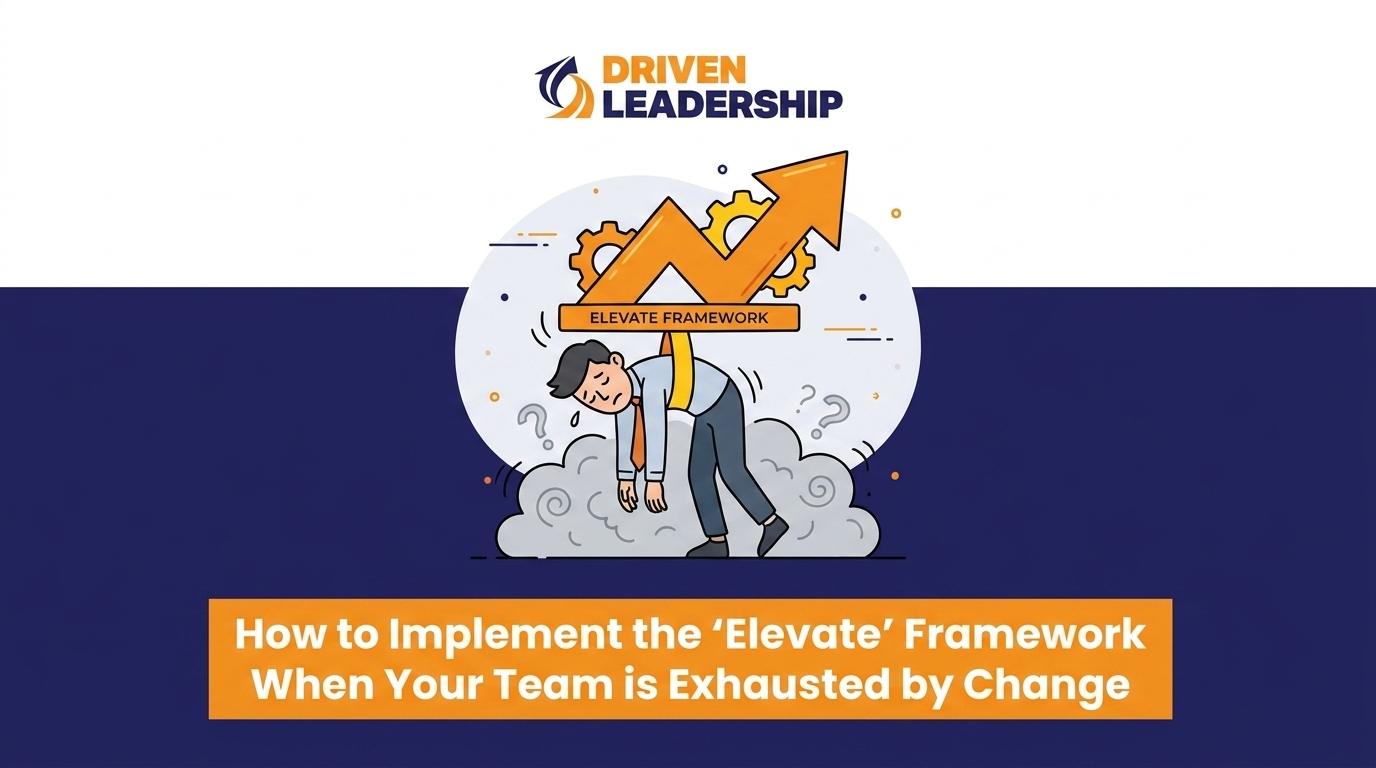
How to Implement the 'Elevate' Framework When Your Team is Exhausted

Why the Phrase '"Let's Talk About the E of Elevate" Leadership Framework' Triggers Team Anxiety
Are you wondering exactly how to implement the 'Elevate' framework when your team is exhausted by constant operational shifts and seasonal stress? How does your staff react to new corporate initiatives when they are already stretched incredibly thin? For most organizations, introducing the "let's talk about the e of elevate" leadership framework can initially sound like just another mountain of administrative work to an already overwhelmed workforce. When employees hear that a new framework is coming, their immediate assumption is that they will have to attend more meetings, fill out more trackers, and sacrifice the little deep-work time they have left.
The concrete problem facing managers today is figuring out how to roll out a robust framework without exacerbating the natural August / Q3 back-to-school transition fatigue. During this time of year, personal schedules are chaotic, and professional demands are peaking. If you introduce a new leadership initiative as a massive corporate overhaul, it will fail before it even begins. The secret to success lies in pacing the rollout. When approached correctly, this framework serves as a vital relief mechanism rather than an administrative burden. By integrating these concepts into your existing leadership trainings, you can begin to ease the pressure on your staff rather than adding to it.
Recognizing the Subtle Signs of Change Fatigue in Late Summer
Before you can attempt to implement any new operational framework, you must first establish a baseline understanding of what workplace exhaustion actually looks like. There is a distinct difference between typical end-of-the-week tiredness and deep-seated change fatigue and burnout. End-of-week tiredness is cured by a quiet weekend; change fatigue is a chronic state of emotional depletion where employees feel that no matter how hard they work, the goalposts keep moving. During the late summer, scheduling conflicts and personal stress compound this workplace exhaustion, leaving teams with zero bandwidth for new theoretical concepts.
This exhaustion is often heavily influenced by regional and seasonal factors. For example, the impending transition into the long, gray Pacific Northwest winter frequently triggers anticipatory seasonal fatigue. As daylight hours begin to noticeably decrease in the late summer months, employees often experience a subtle but profound drop in baseline energy, making empathetic pacing absolutely critical. Burnt-out employees will often show passive resistance to new ideas, completely misinterpreting your well-intentioned relief mechanisms as extra tasks.
• Reaction to New Ideas — Typical Tiredness: Mild hesitation but eventual willingness to try. — Deep-Seated Change Fatigue: Immediate cynicism and assumption of failure.
• Communication Style — Typical Tiredness: Slower responses at the end of the day. — Deep-Seated Change Fatigue: Avoiding non-urgent communication entirely.
• Problem Solving — Typical Tiredness: Asking for help or clarification. — Deep-Seated Change Fatigue: Apathy; letting minor issues turn into major failures.
What does passive resistance look like?
Passive resistance is often quiet, making it difficult for leaders to spot until productivity has already tanked. If you are preparing to introduce your team to the Engage Elevate Program, you must first clear the hurdles of passive resistance. Look for these distinct warning signs:
• Delayed responses: Team members consistently ignore or delay replying to non-urgent communication and internal memos.
• Meeting cynicism: A noticeable uptick in eye-rolling, heavy sighing, or outright cynicism during team meetings regarding process improvements.
• Increased absenteeism: A sudden spike in sick days, last-minute PTO requests, or "camera-off" behavior during virtual calls.
• Malicious compliance: Doing exactly what is asked to the letter, knowing it will fail, rather than proactively offering a better solution.
Stripping Away the Theoretical: Focusing on Micro-Habits
Massive operational overhauls consistently fail when teams lack the bandwidth to absorb them. When your staff is suffering from change fatigue and burnout, handing them a fifty-page manual on the 'E of Elevate' framework will only trigger a defensive response. Instead, you must strip away the theoretical jargon and focus entirely on actionable, low-effort behavioral shifts. Break down the core concepts into daily micro-habits that require absolutely minimal effort to execute. The goal is to focus on removing existing administrative friction rather than adding new compliance trackers to their daily to-do lists.
This approach aligns perfectly with Driven Leadership's core philosophy: focusing purely on practical, real-world behavioral changes that require low effort for high impact, completely avoiding the theoretical administrative burdens that drag teams down. Small, consistent actions build trust. When you prove that a framework is there to help rather than hinder, defenses lower.
When professionals hit debilitating personal and professional roadblocks, they need practical, immediate solutions. Participants who have completed challenging, non-cliché corporate training frequently report that stepping away from theoretical jargon and embracing real-world behavioral changes is exactly what helped them grow significantly and emerge as highly effective leaders. They didn't need another textbook; they needed a clear, friction-free path forward.
Step-by-Step: Phasing the Rollout for Maximum Relief
To successfully bypass your team's natural defenses, you need a highly systematic approach. When carrying the weight of team burnout and stress, leaders must act as a shield, pacing the introduction of new concepts so they feel like a natural evolution rather than a forced mandate. This is especially true during the chaotic August / Q3 back-to-school transition, when external stressors are already demanding your team's attention.
When individuals are tasked with taking ownership of their professional lives, the delivery method is critical. Participants who have completed comprehensive management courses consistently note that experiencing passionate instruction that challenges them to take genuine ownership—rather than just checking corporate boxes—is what ultimately transforms their performance. Here is the exact phased approach to achieve that buy-in:
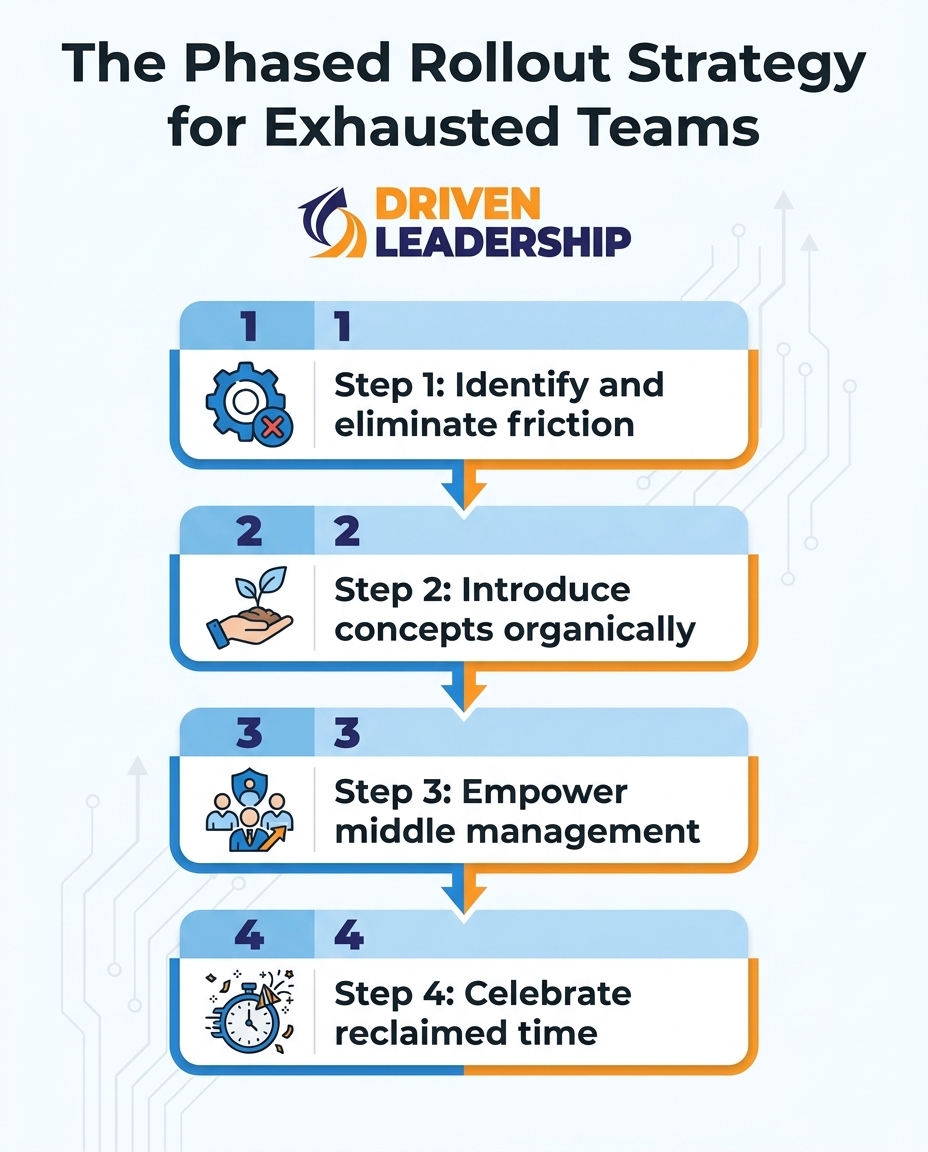
1. Identify and eliminate one immediate friction point: Before introducing any new terminology, find one broken process in the team's daily workflow. Whether it is an unnecessary daily reporting email or a redundant approval step, eliminate it completely. Prove that you are there to remove obstacles.
2. Introduce concepts organically: Once that friction point is resolved, introduce the framework concepts naturally as the methodology behind the solution. Frame it as, "We used this principle to eliminate that bottleneck, and we are going to use it to find more time in your week."
3. Empower middle management: Middle managers are the linchpin of any rollout. Empower them to model the new behaviors without requiring them to submit formal progress reports. Let them lead by example rather than by mandate.
4. Celebrate reclaimed time: When a micro-habit successfully reduces stress or saves time, celebrate it loudly. Reinforcing the framework's value through the lens of reclaimed time is the fastest way to turn skeptics into advocates.
Sustaining Momentum Without Adding Meetings
The most common pitfall of any framework implementation is the dreaded follow-up meeting. When teams are experiencing change fatigue and burnout, adding a weekly "framework check-in" to their calendar is a surefire way to kill momentum. Sustaining behavioral change requires integration, not addition. You must avoid scheduling new meetings at all costs; instead, integrate the core concepts into the 1-on-1s and daily huddles that already exist on the calendar.
Leverage asynchronous communication to highlight successes and reinforce behavioral shifts. A quick message in a team chat channel celebrating a successfully applied micro-habit carries far more weight than a mandatory hour-long review session. Encourage peer-to-peer recognition based on the newly established habits. When team members start recognizing each other for reducing friction, the framework becomes self-sustaining. For leaders looking to master these integration techniques, an executive manager program can provide the necessary tools to monitor workload capacity and ensure the new habits are genuinely saving time.
In-Depth Answers: Navigating How to Implement the 'Elevate' Framework When Your Team is Exhausted
When dealing with change fatigue and burnout, leadership requires precision. The mechanics of introducing the E of Elevate concepts must be handled delicately to ensure the team feels supported rather than smothered. Below are detailed answers to the most pressing questions leaders face when navigating this exact scenario.
How do you implement a new framework with a burnt-out team?
Start by solving an existing problem rather than announcing a new initiative. When a team is burnt out, their tolerance for corporate announcements is zero. You must pace the rollout in micro-phases that require absolutely zero extra administrative work from the staff. By fixing a broken workflow first and then explaining the framework behind the fix, you build immediate credibility and demonstrate that the new system is designed to provide relief.
How do you introduce the E of Elevate concepts?
Focus strictly on the behavioral shifts that directly reduce daily friction. The theoretical background of the framework can wait until the team has recovered their bandwidth. Executives and managers must model the behaviors at the highest level before asking the team to adopt them. If leadership is not actively demonstrating the micro-habits, the team will immediately recognize the initiative as hypocritical and reject it.
What are the signs of change fatigue in the workplace?
A collapse in willingness to support enterprise change is the primary indicator. You will notice increased absenteeism, a lack of voluntary participation in meetings, and passive resistance to new ideas. Employees suffering from change fatigue often exhibit a "wait it out" mentality, assuming that if they ignore the new initiative long enough, leadership will eventually forget about it and move on to the next trend.
How can we motivate employees during the late-summer transition?
Acknowledge the external stressors of the season and provide immediate, low-effort wins that improve their daily workflow. The late-summer pivot brings massive personal scheduling shifts that drain professional energy. Motivation during this period does not come from grand speeches; it comes from leaders actively removing roadblocks and proving that they respect the team's limited capacity. If you need structured guidance on navigating these seasonal shifts, exploring an advanced leadership program can equip you with the right strategies.
Shift Your Team From Burnout to Buy-In
Successful implementation of any new initiative relies entirely on empathy, careful pacing, and highly practical application. When your staff is weighed down by change fatigue and burnout, forcing a massive theoretical rollout will only fracture trust. Reiterate to your management team that the ultimate goal of this framework is to provide tangible relief, not to launch another exhausting corporate initiative. The focus must remain on micro-habits that eliminate friction and reclaim lost time.
If you are struggling to find the right rhythm for your organization, do not hesitate to seek expert guidance on pacing your specific rollout. When you finally master how to implement the 'Elevate' framework when your team is exhausted, you transform a period of high anxiety into an opportunity for profound organizational growth. A practical, phased step-by-step guide that acknowledges team burnout and provides immediate, low-effort wins is exactly what your team needs to shift from deep skepticism to genuine buy-in.
Frequently Asked Questions
How do you implement a new framework with a burnt-out team?
Start by solving an existing problem rather than announcing a new initiative. Burnt-out teams cannot process massive overhauls, so you must pace the rollout in micro-phases. Ensure that these initial phases require zero extra administrative work from the staff. By proving that the framework removes obstacles, you naturally build the buy-in necessary for deeper implementation later.
How do you introduce the E of Elevate concepts?
Focus on the behavioral shifts that directly reduce daily friction. Strip away the complex terminology and introduce the concepts as simple, actionable micro-habits. It is absolutely critical that executives model these behaviors first before asking the wider team to adopt them. When leadership leads by example, the team is far more likely to embrace the change.
What are the signs of change fatigue in the workplace?
A collapse in willingness to support enterprise change is the most glaring sign. This manifests as increased absenteeism, a lack of proactive problem-solving, and passive resistance to new ideas. When employees stop asking questions during rollout meetings and simply stare at the screen, change fatigue has likely set in.
How can we motivate employees during the late-summer transition?
Acknowledge the external stressors of the season and provide immediate, low-effort wins that improve their daily workflow. The transition out of summer often brings chaotic personal schedules that drain workplace energy. Motivation during this time comes from leaders actively removing unnecessary tasks and respecting the team's diminished bandwidth.
Does the 'Elevate' framework require extensive administrative tracking?
No, the framework is designed to reduce administrative friction, not create it. When implemented correctly, it relies on simple behavioral shifts rather than complex compliance trackers. The goal is to integrate these habits into existing workflows and 1-on-1 meetings, ensuring that no extra paperwork is added to the team's plate.
How long does it take for micro-habits to reduce daily team friction?
Teams typically begin to feel the relief of reduced friction within the first two weeks of consistent application. Because micro-habits are designed to be low-effort, they can be deployed immediately to solve minor workflow bottlenecks. As these small wins accumulate, the compounding effect significantly lowers overall team stress within the first month.