How the Innermetrix Index Identifies Hidden Leadership Bottlenecks

Are Hidden Behavioral Gaps Sabotaging Your Team's Performance?
Are you noticing unexplained friction, miscommunication, or burnout among your leadership team? Understanding exactly how the Innermetrix Index identifies hidden leadership bottlenecks is the first step toward resolving these deep-seated operational issues. At Driven Leadership, our team typically sees that leadership bottlenecks often stem from invisible behavioral misalignment, not a lack of technical skill or dedication. When we consult with highly capable managers in the Puyallup area who suddenly struggle to lead effectively, the root cause is rarely their baseline competency. Instead, it is usually a conflict between who they naturally are and who they feel they must be to survive in their current role.
As businesses navigate the late summer Q3 transition, this becomes a critical period to identify these behavioral issues before the high-stakes Q4 strategic push begins. If your leadership team is already exhausted by August, pushing them harder in October will only accelerate burnout. The Innermetrix assessment serves as the objective diagnostic tool needed to uncover these hidden operational roadblocks before they impact your bottom line. By measuring the unseen forces driving your team's behavior, you can stop guessing about why certain departments are stalling.
To build a stronger foundation and prevent these issues from recurring, integrating effective organizational development strategies is an essential next step for any growing company.
The Invisible Drain: What Causes Leadership Friction?
Leadership friction is the operational slowdown caused when leaders are forced to operate consistently outside of their natural strengths. Just as thick Pacific Northwest fog obscures the landscape and forces Puyallup commuters to slow to a crawl, hidden behavioral gaps obscure team performance. In our experience working with local executive teams, a pattern we see often is that everything slows down, communication becomes strained, and visibility drops until the right diagnostic tool clears the air.
The Exhaustion of the False Persona
Forcing a false workplace persona drains an immense amount of physiological and psychological energy. When a naturally introverted, detail-oriented leader is forced into a highly social, rapid-fire decision-making role, they do not simply fail—they adapt. However, this adaptation requires constant mental translation. They must suppress their natural instincts and consciously project an expected behavior. This continuous effort is exhausting. By mid-afternoon, the energy required to maintain this mask leaves them depleted, resulting in decision fatigue and a sharp drop in emotional intelligence.
How Friction Manifests in Daily Operations
This invisible energy drain rarely looks like an overt breakdown. Instead, we frequently observe it manifesting in subtle, damaging ways across an organization:
• Poor decision-making: Exhausted leaders rely on safe, reactive choices rather than proactive strategy.
• Lack of initiative: When adapting takes all a leader's energy, there is nothing left for innovation or forward momentum.
• Team-wide miscommunication: A stressed leader often reverts to short, clipped, or confusing communication, leaving their team without clear direction.
• Avoidance behavior: Leaders may begin avoiding necessary confrontations or difficult conversations because they lack the emotional bandwidth to handle them.
Real-World Impact on Development
This dynamic is why the Innermetrix natural vs. adapted behavior gap is such a vital metric to track. For example, it is common for our team to see a professional struggling with a lack of confidence, diminished initiative, and poor communication skills. When organizations address this by sending that individual to an immersive BOLD Advanced Leadership training program, the outcome shifts dramatically. The individual gains increased confidence, begins taking proactive initiative, and develops significantly improved communication and listening skills simply because they learned to align their natural strengths with their daily responsibilities.
Understanding the Innermetrix Natural vs. Adapted Behavior Gap
To effectively resolve leadership friction, you must understand the core mechanics of the Innermetrix natural vs. adapted behavior gap. This gap is not a theoretical concept; it is a measurable, scientific indicator of how much stress a leader is currently enduring in their role.
Defining the Two Behavioral Profiles
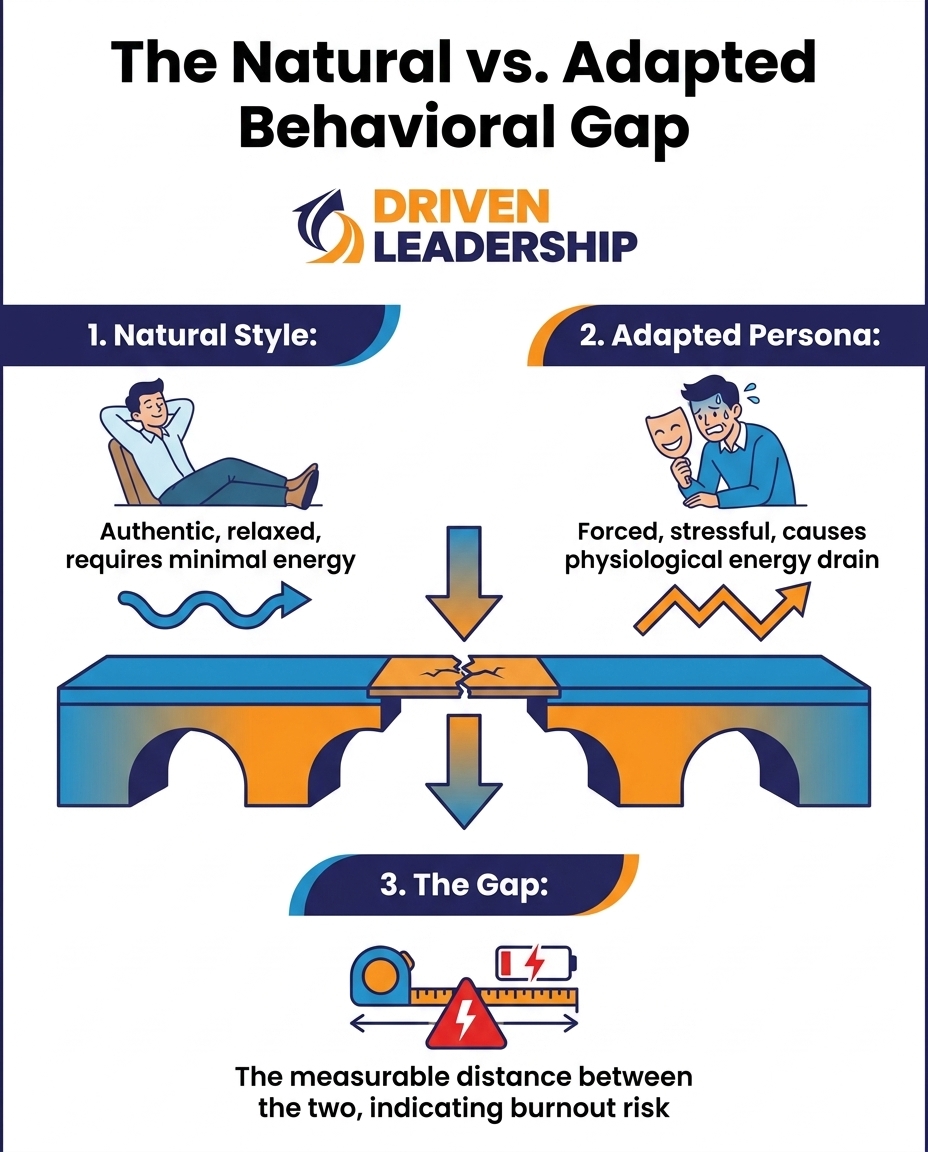
Every professional operates with two distinct behavioral profiles. The natural behavioral style is how a leader acts when they are completely relaxed, authentic, and free from external pressure. This is their default setting. Operating in this zone requires almost zero additional mental energy. The adapted persona is the behavior a leader feels forced to exhibit to survive, succeed, or meet the perceived demands of their current environment. It is a coping mechanism.
The Mechanics of the Gap
The Innermetrix Index objectively measures the distance between these two profiles. When the natural style and the adapted persona are closely aligned, the leader is operating in their zone of genius. When the distance between them is vast, the leader is at high risk for burnout. A significant gap between these scores is a scientifically validated indicator of impending workplace stress.
• Energy Required — Natural Behavioral Style: Minimal; self-sustaining and effortless. — Adapted Workplace Persona: High; drains mental and physical stamina.
• Stress Level — Natural Behavioral Style: Low; allows for clear, calm decision-making. — Adapted Workplace Persona: High; leads to reactive, defensive choices.
• Sustainability — Natural Behavioral Style: Long-term; supports career longevity. — Adapted Workplace Persona: Short-term; inevitable path to burnout.
• Authenticity — Natural Behavioral Style: Genuine; builds deep trust with teams. — Adapted Workplace Persona: Forced; can appear inconsistent to peers.
By quantifying this distance, organizations can intervene before a top performer resigns out of sheer exhaustion. If you want to understand why our experts recommend this methodology over older, more simplistic models, you can explore the differences between the Innermetrix DISC Assessment vs Standard Personality Tests.
How the Advanced Insights Profile Measures the Gap
To accurately capture the Innermetrix natural vs. adapted behavior gap, the assessment cannot rely on a single data point. Human behavior is too complex to be categorized by a simple four-letter acronym. Instead, the assessment combines three distinct scientific measurements to provide a complete, multidimensional picture of a leader's capabilities and current stress levels.
1. The DISC Index: Measuring the "How"
Based on William Moulton Marston's foundational theory, the DISC index measures the "how" of human behavior. It looks at how a leader prefers to solve problems, interact with others, pace their workflow, and follow procedures. This is the layer where the natural vs. adapted gap is most visible. By measuring both the natural DISC state and the adapted DISC state, the assessment instantly highlights where a leader is stretching themselves too thin. For instance, if a leader naturally prefers a slow, steady pace but is adapting to a high-urgency, chaotic environment, the DISC index will flag this massive behavioral stretch.
2. The Values Index: Measuring the "Why"
While DISC shows how a person behaves, the Values index measures the "why." It uncovers the core motivators driving the leader. What actually gets them out of bed in the morning? Is it a drive for return on investment, a desire for knowledge, a need for authority, or a passion for helping others? When a leader's core values do not align with the company's reward structure, motivation plummets. A leader who values deep theoretical knowledge will quickly burn out in a role that only rewards rapid, surface-level financial transactions.
3. The Attributes Index: Measuring the "What"
The Attributes index measures the "what"—the actual cognitive thinking and decision-making skills of the individual. It evaluates how clearly a leader understands the world around them and how clearly they understand themselves. This science identifies blind spots in judgment, empathy, and systemic thinking. It answers the question of whether a leader has the cognitive capacity to handle the complexities of their specific role.
Triangulating the Data
Showcasing how triangulating these three sciences prevents the assessment from being a superficial personality test is crucial. A standard test might tell you a leader is "outgoing." The Advanced Insights profile tells you that the leader is naturally outgoing (DISC), driven by a desire to lead others (Values), but currently lacks the systemic thinking required to organize a large team (Attributes). Ensuring your HR team and executive coaches understand how to interpret this data is vital, which is why Advanced Insights Training is highly recommended for organizations looking to scale.
Clearing the Fog: Removing Guesswork from Leadership Development
When leadership bottlenecks appear, the instinct for many companies is to throw generic training at the problem. However, trying to fix leadership friction with standard seminars that don't address behavioral misalignment is like trying to fix a broken engine with a fresh coat of paint. It completely misses the root cause.
The Danger of Generic Solutions
Generic training assumes that all leaders learn, process, and execute in the same way. When a leader is already exhausted from maintaining an adapted persona, forcing them into a one-size-fits-all training program only adds to their cognitive load. They don't need to learn a new management theory; they need to understand why their current environment is draining them. At Driven Leadership, our team utilizes the science-backed Innermetrix assessment to objectively measure the gap between natural abilities and adapted workplace personas, removing the guesswork from leadership development.
Realigning Roles to Fit Natural Strengths
Objective measurement allows organizations to realign roles to fit natural strengths rather than forcing adapted behaviors. When you identify the Innermetrix natural vs. adapted behavior gap, you can make structural adjustments. Perhaps a highly analytical manager is currently bogged down by daily team conflict resolution. By shifting those mediation duties to a leader whose natural strengths lie in interpersonal communication, both leaders immediately become more efficient, and the operational bottleneck dissolves.
Overcoming Debilitating Roadblocks
This targeted approach helps leaders overcome previously debilitating professional roadblocks. Another common pattern our team sees involves leaders dealing with deep uncertainty about their personal and professional identity, knowing they need to elevate their performance but lacking direction. When these individuals participate in a challenging, targeted leadership experience, they are pushed to grow, ultimately emerging as stronger, more capable people. They learn to acknowledge their natural strengths and stop apologizing for them. This level of growth, often facilitated by an Advanced Leadership Program, results in a massive increase in confidence, clearer communication, and significantly improved team efficiency.
Frequently Asked Questions About the Innermetrix Assessment
What does the innermetrix disc assessment measure?
The innermetrix disc assessment measures the "how" of human behavior, specifically looking at how an individual solves problems, interacts with others, paces their work, and follows rules. It uniquely identifies both a person's natural behavioral style and the adapted workplace persona they use to navigate their current environment.
What is the difference between natural and adapted behavior in leadership?
Natural behavior is a leader's authentic, relaxed state that requires minimal mental energy to maintain. Adapted behavior is a forced persona used to meet perceived environmental demands. While adapting is sometimes necessary, maintaining an adapted persona long-term causes severe physiological and psychological energy drain.
How do behavioral assessments identify hidden bottlenecks?
Behavioral assessments identify hidden bottlenecks by quantifying the exact gap between a leader's natural and adapted styles. Large gaps indicate areas where leaders are struggling against their own instincts, which slows down operational efficiency, impairs decision-making, and creates friction within the team.
Why is the Innermetrix Index more effective than standard personality tests?
The Innermetrix Index is more effective because it combines three distinct sciences: DISC (behavior), Values (motivation), and Attributes (cognitive decision-making). Instead of merely categorizing personality traits, it measures objective behavioral gaps and provides actionable data to resolve workplace friction.
How does uncovering behavioral gaps prevent leadership burnout?
Uncovering these gaps allows organizations to proactively realign daily responsibilities with a leader's natural strengths. By eliminating the exhausting psychological cost of maintaining a false persona, leaders regain their energy, focus, and passion, entirely preventing the cycle of burnout.
Resolve Leadership Friction Before Q4
Leadership bottlenecks are rarely a symptom of a lack of effort, dedication, or technical skill. More often than not, they are the direct result of severe behavioral misalignment. When leaders are forced to adapt too far from their natural strengths, the resulting friction slows down your entire organization.
As you move through the late summer Q3 transition, now is the ideal time to clear the air. Waiting until the pressure of Q4 hits will only magnify the stress your team is already experiencing. It is time to stop guessing about why your leaders are struggling and start measuring the root causes with a scientifically validated tool. Uncovering the data is the only way to make informed, structural changes that last.
Take the guesswork out of your organizational growth. Schedule an evaluation and discover your team's true potential with the Innermetrix Leadership Assessment today.