
A Comprehensive Guide to Leadership Program ROI

Is an Intense Leadership Program Worth It for Business Leaders?
Is an intense leadership program worth it for business leaders? For most mid-to-senior leaders dealing with team misalignment, stalled growth, or a widening gap between where they are and where they need to be — the answer is yes, and the data backs it up.
Here is a quick summary before we go deeper:
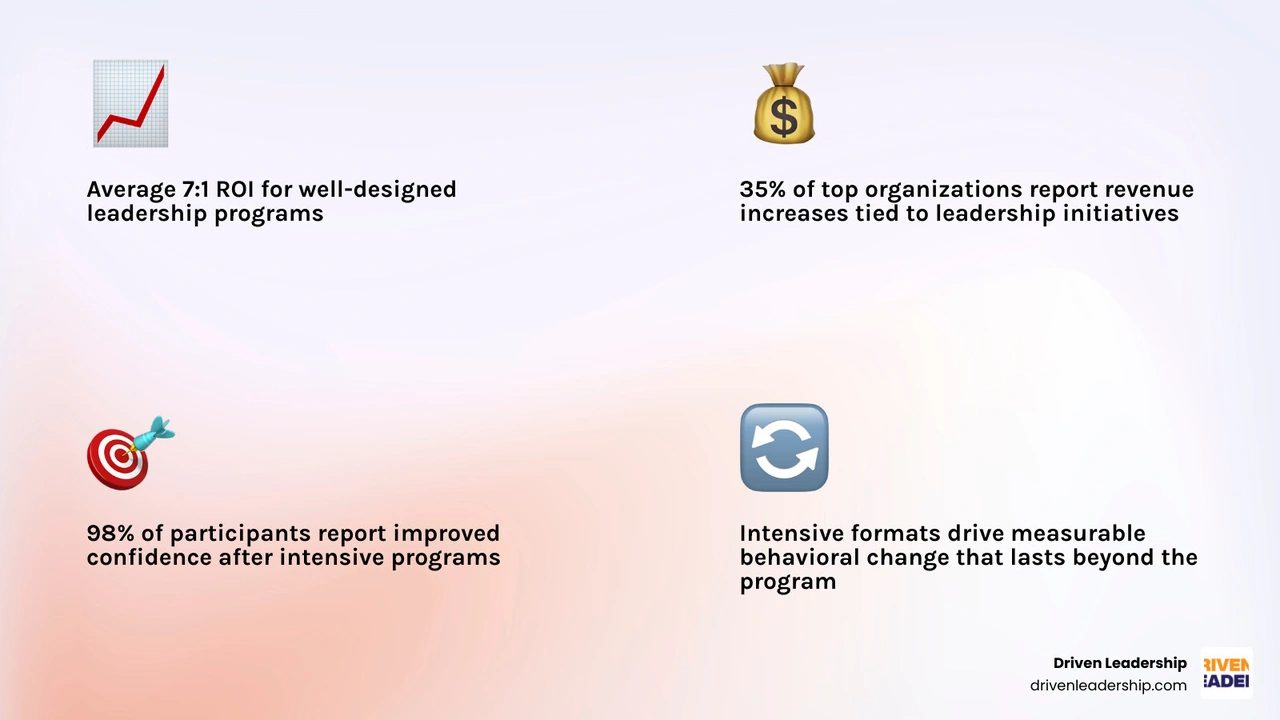
• ROI is measurable: Well-designed leadership programs deliver an average 7:1 return on investment, according to research cited by Harvard Business Review.
• Revenue impact is real: 35% of the most successful organizations report measurable revenue increases directly tied to their leadership initiatives.
• Confidence improves fast: Across thousands of program participants, 98% reported improved confidence in their ability to lead after completing an intensive program.
• Behavioral change sticks: Unlike one-day workshops, intensive formats are specifically designed to shift how leaders think, communicate, and make decisions — not just what they know.
• Career outcomes follow: Graduates of intensive programs regularly report promotions, stronger team performance, and better organizational results within 1-2 years of completing training.
The challenge most leaders face is not a lack of ambition — it is a gap between knowing what good leadership looks like and actually doing it under pressure. Intensive programs are built to close exactly that gap, using immersive formats, peer cohorts, and structured feedback to drive real behavioral change.
If you are weighing whether the time and commitment are justified, this guide breaks down the costs, outcomes, and key factors to help you decide with confidence.
Key is an intense leadership program worth it for business leaders vocabulary:
• how immersive leadership training is different from a standard workshop
• what is an advanced leadership immersive program
What is an Intensive Leadership Program and How Does It Differ from Traditional Training?
To understand whether these programs are worth the investment, we first have to define what they actually are. Many business leaders confuse intensive, immersive programs with standard professional development workshops or ongoing executive coaching. However, the format, environment, and psychological approach are fundamentally different.
A standard corporate workshop is typically passive. Leaders sit in a conference room, listen to lectures, review slide decks, and perhaps participate in a few basic role-playing scenarios. These events are highly informative, but they rarely result in lasting behavioral change. When leaders return to their offices in California, Washington, or Nashville, the daily grind takes over, and the binder of notes sits on a shelf collecting dust.
In contrast, learning what is an advanced leadership immersive program reveals a highly active, psychologically engaging environment. These programs are designed to strip away the distractions of daily operations and place leaders in a "crucible" environment where they must confront their blind spots in real time.
Here is how they differ from other traditional formats:
• Duration and Depth: While traditional workshops last a day or two, intensive programs pack months of executive-level development into a highly concentrated timeframe (often four to five days in person, or structured hybrid formats spanning several weeks).
• The Psychological Approach: Standard training focuses on transferring knowledge (the "how-to" of management). Immersive training focuses on transformational behavioral change. It forces you to look at your personal work values, how you manage pressure, and how you show up for your team.
• Feedback Loops: Traditional programs rarely offer objective feedback. Intensive programs utilize comprehensive 360-degree assessments, peer-to-peer coaching, and live simulation feedback. You learn exactly how you are perceived by others—which can be a stark wake-up call for senior executives.
Understanding how immersive leadership training is different from a standard workshop is critical because the mechanics of how we learn behavior require more than just intellectual agreement. True leadership is not about what you know; it is about how you behave when the stakes are high.
Is an Intense Leadership Program Worth It for Business Leaders?
When evaluating if a premium leadership experience is worth the commitment, we must look at the hard numbers and real-world outcomes. The investment is not just financial; it also requires taking valuable time away from running your business.
The data shows that the return on investment is exceptionally high. Industry research reveals that well-designed leadership programs deliver an average 7:1 return on investment. Furthermore, 35% of the most successful organizations report direct, measurable revenue increases that they can attribute back to their leadership training initiatives.
These metrics are not just abstract corporate statistics. In real-world applications, the impact on business performance is immediate and compounding:
1. Direct Profitability Increases: In verified case studies of short-duration executive intensives, participants have seen dramatic bottom-line improvements. For example, one consulting firm owner recorded a 170% increase in firm profits within two years of attending an intensive, attributing the progress directly to the strategic and behavioral shifts made during the program.
2. Mitigating the "Leadership Shock" of Transitions: Moving from a functional manager (like a VP of Sales or Head of Engineering) to an enterprise-wide business leader is one of the most common career-ending transitions. Leaders often experience isolation, complexity, and "leadership shock." Intensive programs act as a bridge, preparing executives for full P&L responsibility and enterprise strategy.
3. Preventing Costly Turnover: A single bad hire or a toxic executive can cost an organization hundreds of thousands of dollars in lost productivity and cultural damage. Immersive training helps leaders build high-performing, resilient teams, dramatically reducing turnover at the senior level.
To read more about how these shifts translate to organizational success, explore the advantages of enrolling in an executive leadership program.
Evaluating the Core Competencies: What Do Immersive Programs Actually Teach?
If intensive programs are not just teaching basic business frameworks like accounting or marketing, what are they actually doing? The focus of an advanced immersive experience is to develop the complex, adaptive competencies required of modern C-suite and senior leaders.
As we navigate the business landscape of 2026, the skills required to lead are rapidly shifting. Traditional management is no longer enough. Today's organizations require balanced leaders who can navigate constant disruption, build trust across remote environments, and make rapid decisions under pressure.
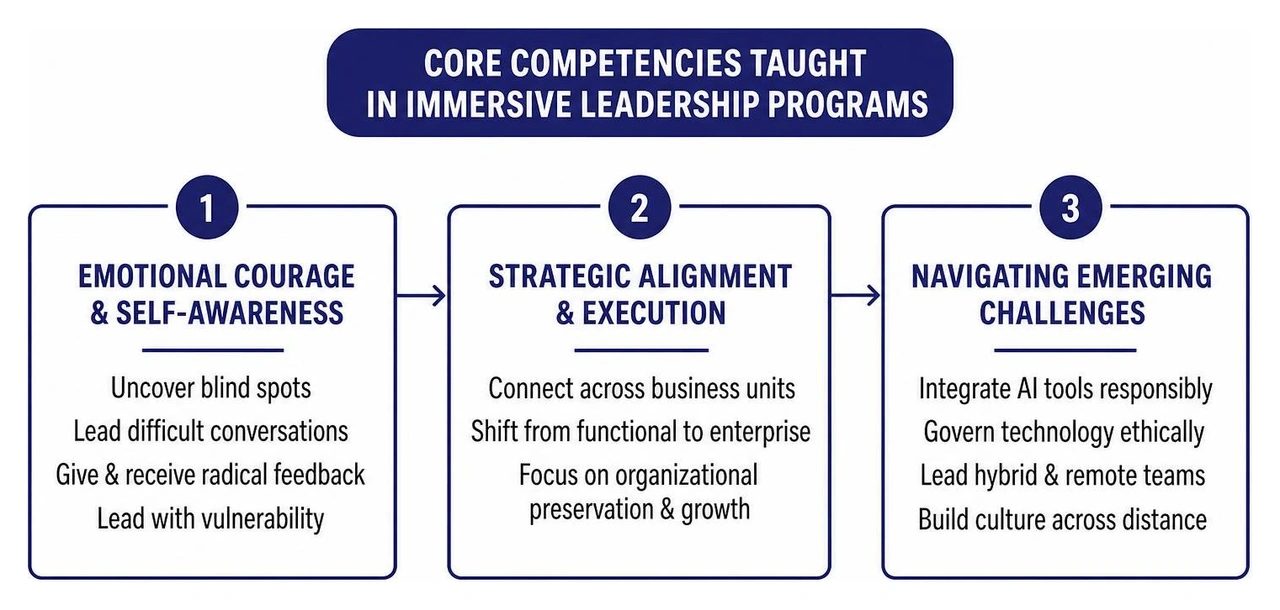
An elite intensive program targets several core competencies:
• Emotional Courage and Self-Awareness: Leaders must learn to uncover and eliminate their blind spots. This means developing the emotional courage to have difficult conversations, give and receive radical feedback, and lead with vulnerability.
• Strategic Alignment and Execution: Knowing how to connect the dots across multiple business units is essential. Programs teach leaders how to move away from running their previous functional areas and instead focus on overall organizational preservation and growth.
• Navigating Emerging Challenges (AI & Remote Leadership): Modern intensives address the integration of AI tools, responsible technology governance, and managing hybrid or fully remote workforces. Leaders learn how to maintain strong organizational cultures when teams are physically distributed across hubs like Southern California, Washington, or Nashville.
• Change Management and Organizational Transformation: Leaders are taught how to dismantle defensive organizational habits and rebuild cultures of trust, resilience, and high performance.
For a deeper look into how these modern challenges are addressed through progressive development methodologies, check out our guide on exploring innovative approaches to leadership training.
The Power of the Cohort: Why Peer Networks Matter
One of the most overlooked aspects of an intensive leadership program is the peer cohort. At a certain level of executive leadership, you cannot easily find unbiased, high-level feedback within your own organization. It can feel incredibly isolating at the top.
The cohort model brings together a diverse group of high-performing leaders from completely different industries. A tech executive from Seattle, a logistics director from Southern California, and a healthcare VP from Nashville might find themselves in the same small group.
This cross-industry diversity provides several unique advantages:
• Unbiased Perspectives: Because your peers in the program do not work for your company or your industry, they have no political agenda. They can tell you the hard truths about your leadership style that your direct reports or board members might hesitate to share.
• Shared Challenges, Different Solutions: You quickly realize that whether you run a chemical plant or a software startup, the human challenges of leadership—building trust, managing conflict, and driving performance—are exactly the same. You get to see how other industries solve the same problems you are facing.
• Lifelong Professional Relationships: The intensity of these programs creates deep, family-like bonds. Many graduates find that their cohort becomes a lifelong personal board of advisors, providing confidential counsel long after the program ends.
How to Measure and Demonstrate the Long-Term Impact of Leadership Training
One of the primary reasons organizations hesitate to invest in high-end leadership development is the difficulty of measuring the results. How do you prove that a four-day intensive in California led to better quarterly performance six months later?
To justify the investment, organizations must move away from simple post-program satisfaction surveys (often called "smile sheets") and look at deep behavioral and business metrics.
• Participant Reaction — Short-Term (Immediate): High energy, inspiration, positive feedback on the facilitators. — Long-Term (6-12 Months): Sustained commitment to personal growth and self-awareness.
• Behavioral Change — Short-Term (Immediate): Clear understanding of personal blind spots and leadership style. — Long-Term (6-12 Months): Measurable improvement in 360-degree feedback from direct reports and peers.
• Team Performance — Short-Term (Immediate): Initial attempts to implement new communication frameworks. — Long-Term (6-12 Months): Lower employee turnover, higher engagement scores, and faster project execution.
• Business Impact — Short-Term (Immediate): Alignment on strategic priorities and organizational goals. — Long-Term (6-12 Months): Measurable revenue growth, improved profit margins, and successful change initiatives.
To establish a true picture of success, we recommend taking a baseline measurement before the program begins. This involves conducting 360-degree feedback assessments and identifying specific key performance indicators (KPIs) you want to move. Following the program, schedule formal evaluations at the three-month and six-month marks to track how those behaviors have shifted.
For a comprehensive breakdown of how to build a measurement framework for your organization, read our expert articles on how to measure the return on investment of leadership development and the real-world impact of leadership development training.
Potential Drawbacks and How to Choose the Right Program
While the benefits of intensive leadership programs are clear, they are not a silver bullet for every leadership challenge. It is important to understand their limitations and potential drawbacks before making a decision.
• The Risk of "Leadership Shock": Returning to a demanding work environment after a highly emotional, high-energy program can be jarring. Without a structured plan for integration, leaders can easily slip back into old habits within a few weeks.
• Time and Resource Commitment: Taking a senior executive completely offline for several days or weeks puts pressure on the remaining team. The organization must be stable enough to handle the leader's temporary absence.
• One Size Does Not Fit All: A program designed for emerging managers will not provide value to a seasoned executive transitioning to a C-suite role.
To avoid these pitfalls, you must carefully evaluate programs based on your specific career stage and organizational needs. Look closely at the faculty's real-world experience, the depth of the curriculum, and the ongoing support structures provided after the intensive ends.
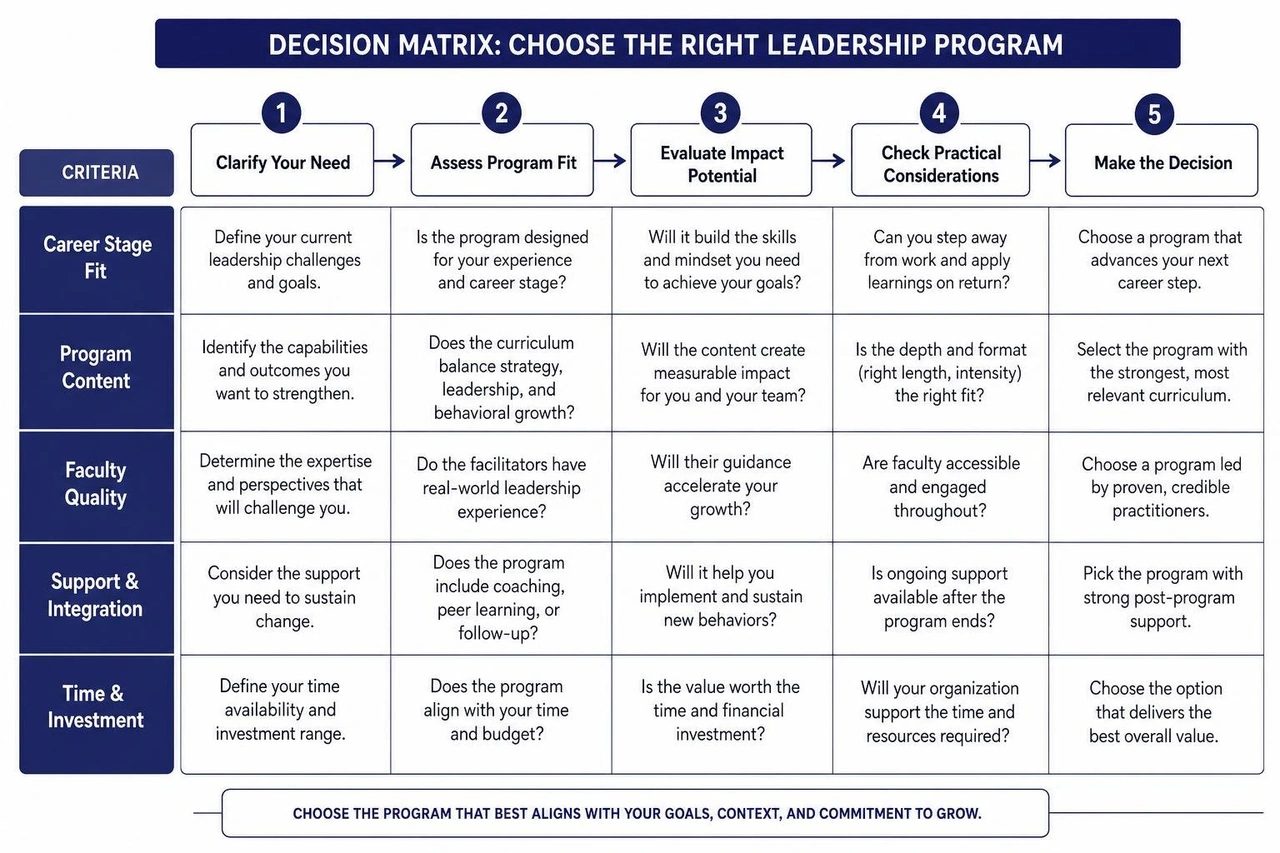
When comparing options, ask yourself: Does this program align with my immediate career goals? Does it offer the right balance of strategic frameworks and deep personal behavioral work?
To guide your decision-making process, explore our resources on which advanced leadership course best fits your career goals and how to select the right advanced leadership course.
Frequently Asked Questions about Executive Development
Is an intense leadership program worth it for business leaders facing organizational change?
Yes. During periods of rapid organizational change, merger integration, or digital transformation, leaders are under immense pressure. An intensive program provides the tools to manage change effectively, communicate across levels, and build high-performing teams. More importantly, it improves leadership confidence—which is critical because a team's confidence rarely exceeds the confidence of its leader.
Is an intense leadership program worth it for business leaders transitioning to the C-suite?
Absolutely. The transition from functional leader to enterprise-wide executive is one of the most difficult shifts in a professional career. It requires moving from tactical, department-specific thinking to global, enterprise-wide strategy. An intensive program helps leaders shift their core work values, manage the isolation of senior roles, and develop the executive presence required to lead at the highest level.
How do organizations justify the investment in external executive programs?
Organizations justify the investment by looking at the cost of the alternative: executive failure, high team turnover, and strategic misalignment. When you consider that a well-designed program delivers an average 7:1 ROI and that 35% of top organizations see direct revenue increases, the cost of developing your internal talent pipeline is significantly lower than the cost of hiring external executives to replace struggling leaders.
Conclusion
Is an intense leadership program worth it for business leaders? If you are looking for generic inspiration or a few quick management tips, a short workshop or a business book is a much better fit. But if you are ready to do the deep, transformative work required to close your leadership gaps, eliminate blind spots, and drive measurable business performance, an intensive program is one of the most valuable investments you can make.
At Driven Leadership, we specialize in delivering immersive training programs that create lasting, measurable behavioral change for executives and teams across Washington, California, and Nashville. We don't focus on short-term inspiration; we focus on the practical, daily behavioral shifts that improve overall business performance.
Ready to take the next step in your professional development? Explore our flagship advanced leadership program or learn more about our comprehensive executive leadership program to start your transformation today.