
All About How Immersive Leadership Training Differs From Workshops

Why the Difference Between Immersive Leadership Training and a Standard Workshop Actually Matters
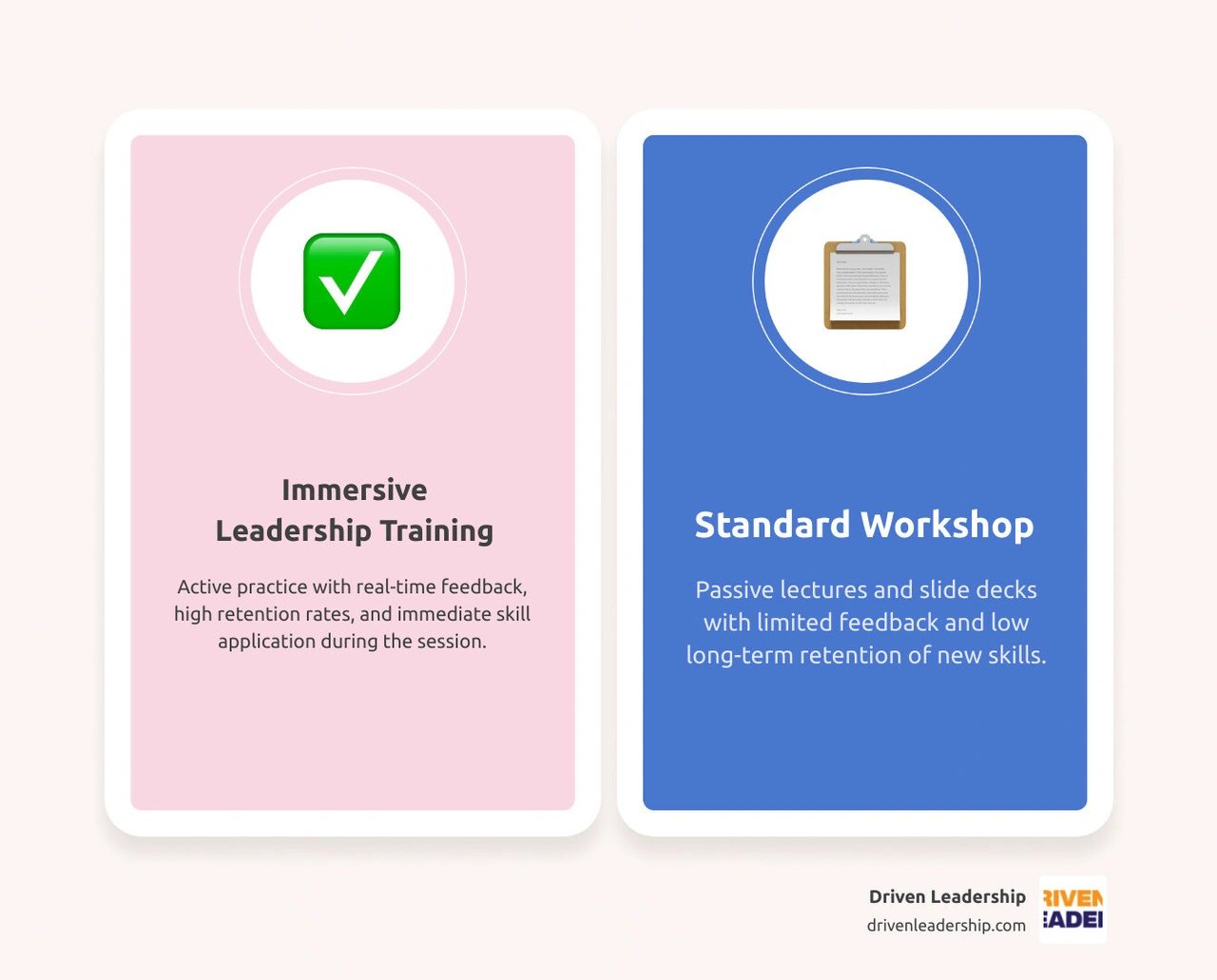
Understanding how immersive leadership training is different from a standard workshop comes down to one core distinction: one asks you to listen, the other asks you to do.
Here is a quick breakdown:
• Learning style — Immersive Leadership Training: Active, experiential, practice-based — Standard Workshop: Passive, lecture-based
• Skill application — Immersive Leadership Training: During the program, in real scenarios — Standard Workshop: Expected after the program ends
• Feedback — Immersive Leadership Training: Real-time, specific, behavioral — Standard Workshop: Minimal or end-of-session only
• Retention — Immersive Leadership Training: Up to 75% higher long-term retention — Standard Workshop: Around 20% long-term retention
• Networking — Immersive Leadership Training: Deep cohort bonds built over time — Standard Workshop: Surface-level connections
• Best for — Immersive Leadership Training: Behavior change, high-stakes skills — Standard Workshop: Information transfer, awareness
If you are a manager or business owner dealing with team conflict, poor communication, or stalled growth, you have probably sat through a workshop that felt useful in the room but changed nothing on Monday morning. That gap between knowing what good leadership looks like and actually doing it under pressure is exactly where most standard training falls short.
Immersive programs are built differently. Instead of presenting ideas and sending you home, they put you inside realistic scenarios where you practice the hardest parts of leadership before they happen in real life. The research backs this up: studies comparing immersive and traditional formats consistently show greater knowledge gains, stronger skill acquisition, and more meaningful behavior change when leaders learn by doing rather than by listening.
This article walks through exactly how these two formats compare, what the evidence shows, and how to decide which approach your organization actually needs.
Understanding How Immersive Leadership Training Is Different From a Standard Workshop

When we look at the landscape of professional development in 2026, the term "training" gets thrown around to cover everything from a 30-minute slide presentation to a multi-day retreat. However, when we dive into how immersive leadership training is different from a standard workshop, the fundamental difference lies in format, delivery, and the integration of deliberate practice.
A standard workshop is typically built around a presentation model. An instructor stands at the front of a room—or shares their screen on a video call—and walks through theoretical concepts, frameworks, and case studies. While there might be occasional breakout groups or a brief Q&A session, the flow of information is primarily one-way. You are consuming information.
Immersive training, on the other hand, shifts the entire burden of activity onto the participant. In our Leadership Training Programs, we design environments where you cannot remain a passive observer. Instead of hearing about a framework for managing conflict, you are placed directly into a realistic, high-pressure simulation where a direct report is pushing back on a performance review.
This structure relies on deliberate practice—a highly focused, repetitive method of training where you perform a specific task, receive immediate feedback on your execution, and immediately try again. In a standard workshop, you might hear a great tip and think, "I should try that sometime." In an immersive environment, you practice that tip five times in a row until the words feel natural coming out of your mouth.
The Core Mechanics of Immersive Learning
To understand why this approach works so well, we have to look under the hood at the core mechanics of immersive learning. These programs utilize a mix of advanced simulations, structured role-playing, and sometimes even virtual reality or AI-driven avatars to mimic the real-world challenges leaders face daily.
This isn't just about playing games; it is about creating a "flight simulator" for human interaction. Just as a pilot logs hundreds of hours in a simulator before flying a commercial jet, leaders need a safe space to practice high-stakes conversations. Through targeted Leadership Development Training, participants can experiment with different communication styles, make mistakes, and see the immediate consequences of their choices without risking employee morale, client relationships, or their personal credibility.
Why Standard Workshops Rely on Passive Delivery
Standard workshops are highly popular because they are easy to organize and scale. You book a conference room in Los Angeles, San Diego, or Nashville, put together a slide deck, and invite fifty managers to sit in rows for four hours.
The issue is that this passive delivery model ignores how the adult brain actually retains information. When we sit and listen to lectures, our brains process the information as abstract data. We might take great notes, but without immediate, hands-on application, that data quickly fades. This passive model creates a massive retention deficit, meaning that within a few days of leaving the workshop, most participants have forgotten up to 80% of what they supposedly "learned."
Bridging the Knowing-Doing Gap in Leadership Development
The single biggest frustration for executives investing in professional development is the "knowing-doing gap." This is the frustrating space between a leader understanding a concept intellectually and actually executing it on the job.
• Primary Activity — Standard Workshop: Listening, taking notes, discussing theories — Immersive Leadership Training: Rehearsing conversations, navigating live simulations
• Failure Consequences — Standard Workshop: Low engagement, but no real-time testing — Immersive Leadership Training: Safe failures that yield immediate learning
• Feedback Loop — Standard Workshop: Delayed or non-existent — Immersive Leadership Training: Real-time, peer-to-peer, and expert-led
• Skill Consolidation — Standard Workshop: Left to the individual to try on the job — Immersive Leadership Training: Built directly into the program structure
Most managers can easily pass a written test on how to deliver constructive feedback. They know they should use "I" statements, focus on specific behaviors, and remain calm. Yet, when they are sitting across the desk from a defensive employee in a real office in Southern California or Nashville, that intellectual knowledge evaporates, and they fall back on old, comfortable habits.
Immersive training bridges this gap through behavioral rehearsal. By forcing you to practice the actual behaviors in real-time, it builds muscle memory. We design our Executive Leadership Program to push leaders past the point of intellectual agreement and into physical, verbal execution. You don't just agree that empathy is important; you practice active listening while a simulated counterpart is actively venting their frustration.
How Immersive Leadership Training Is Different From a Standard Workshop for Skill Retention
The statistics surrounding skill retention paint a incredibly clear picture. According to a landmark PwC study on immersive learning, participants in immersive training programs completed their sessions up to four times faster than classroom learners and felt 275% more confident to apply their new skills afterward.
Furthermore, data shows that traditional classroom workshops yield a long-term retention rate of only about 20%. Immersive learning, by contrast, boosts long-term retention up to 75% or higher. This massive leap occurs because the brain experiences simulated scenarios as real memories rather than abstract concepts.
When you participate in comprehensive Leadership Development and Coaching, your brain registers the simulated conversations as actual experiences, making it vastly easier to recall and deploy those skills when a similar situation arises in your actual workplace.
Overcoming the Safety Problem in High-Stakes Conversations
Why don't leaders practice these skills on the job? Because the stakes are simply too high. If a manager tries a new, unpolished conflict-resolution technique with an actual employee and it goes poorly, they risk damaging a critical working relationship.
This is what we call the "safety problem." Leaders default to what is safe and familiar—even if it is ineffective—because they cannot afford to fail in real life.
Immersive training solves this by establishing absolute psychological safety. In programs like our Bold Training, we create an environment where failing is not only allowed; it is celebrated as a crucial step in the learning process. If you deliver a piece of feedback poorly in a simulation, we hit the pause button. We analyze what went wrong, adjust the approach, and let you rewind the tape and try again immediately. This pressure-free rehearsal space is something a standard workshop simply cannot provide.
Fostering Emotional Intelligence and Self-Awareness
Being a great leader requires much more than memorizing management frameworks; it requires deep self-awareness, high emotional intelligence (EQ), and the ability to adapt your style to the person standing in front of you.
While a standard workshop can define emotional intelligence and show you a list of EQ traits, it cannot make you feel the emotional weight of a tense situation. Immersive training, however, acts as a mirror. When you are placed inside a simulated challenge, your real habits, blind spots, and defense mechanisms naturally rise to the surface.
Through our specialized Leadership Coaching Programs, we help leaders observe their own physiological and emotional reactions under pressure. Do you start talking faster when someone challenges you? Do you shut down and avoid eye contact when a conversation gets emotional? Recognizing these patterns in real-time is the first step toward true emotional intelligence and adaptability.
How Immersive Leadership Training Is Different From a Standard Workshop for Behavioral Change
True, lasting behavior change requires more than just inspiration; it requires a deep understanding of your current impact on others. This is why personalized feedback is a cornerstone of immersive training.
Unlike standard workshops where feedback is rare or limited to a generic end-of-day survey, immersive programs weave feedback into every single exercise. This often includes utilizing detailed 360 assessments, peer-to-peer evaluations, and direct coaching from expert facilitators.
When you learn to look at your behavior through the eyes of others, you can make precise, targeted adjustments. This process is highly detailed in our guide on Exploring Leadership Coaching Programs, which highlights how combining personal coaching with immersive practice accelerates a leader's professional growth.
Building Stronger Professional Networks and Cohort Connections
Another massive differentiator of immersive training is the depth of the professional relationships built during the program. Because participants are working together to solve complex, high-pressure challenges, they build an incredibly tight-knit cohort.
In a standard workshop, networking is often limited to exchanging business cards during a coffee break. In an immersive environment, you are collaborating, reflecting, and failing forward together. This shared vulnerability builds deep professional bonds and an ongoing support network of peers who can offer advice and perspective long after the training ends.
This collaborative, trust-building experience is a core element of The Advantage, where leaders learn to build cohesive, high-performing teams by first experiencing that deep cohesion themselves.
Deciding Between Immersive Programs and Standard Workshops
As a business owner, executive, or L&D director in California, Washington, or Tennessee, you have to be strategic about where you invest your training budget. Immersive training is a significant investment of both time and resources, and it is important to understand when it is absolutely necessary versus when a standard workshop will suffice.
To make this decision easier, we recommend evaluating your goals against this simple framework:
• Is the goal information transfer or behavioral change? If you just need your team to understand a new company policy or a basic compliance update, a standard workshop is perfectly fine. If you need your team to change how they communicate, resolve conflicts, or lead projects, you need an immersive program.
• What are the stakes of failure? If your managers are stepping into highly critical roles where poor leadership could lead to high turnover, lost clients, or cultural toxicity, the investment in immersive training is highly justified.
• Are you navigating major organizational change? During mergers, rapid scaling, or major strategic pivots, leaders must adapt quickly. Immersive programs prepare them for these dynamic environments in ways a slide deck never could.
Investing in the right level of development is critical, and understanding how Leadership Development Makes a Difference can help you align your training strategy with your long-term business goals.
When a Standard Workshop Suffers but Suffices
Let's be fair: standard workshops have their place. If you have a very short timeline, a limited budget, or simply need to deliver baseline information to a massive group of people all at once, a workshop is a practical tool.
It is a great format for introducing high-level concepts, sharing industry updates, or aligning a large team on basic terminology. Just keep your expectations realistic—do not expect a two-hour lecture to magically transform a struggling manager into a visionary leader.
When to Invest in Full-Immersion Learning
You should invest in full-immersion learning when you are looking for real, measurable behavioral change that directly impacts business performance. This is particularly true for high-stakes leadership transitions—such as moving an individual contributor into a management role, or preparing a director for an executive seat.
It is also the ideal choice when you are trying to drive a deep culture shift across your entire organization. When you need your leadership team to operate with absolute alignment, trust, and flawless execution, our Advanced Leadership Course provides the intensive, experiential environment required to make those changes stick.
Frequently Asked Questions About Immersive Leadership Training
What are the main limitations of immersive leadership training?
While highly effective, immersive leadership training does require a higher upfront commitment of time and energy from your team. Because these programs rely on active participation, small group simulations, and personalized coaching, they cannot be easily scaled to hundreds of people simultaneously in a single room. Cohort sizes are typically kept small to ensure every participant gets sufficient practice time and feedback. Additionally, participants must be willing to step out of their comfort zones and engage in active self-reflection, which can be mentally and emotionally demanding.
Can immersive training be delivered effectively in a virtual format?
Yes, absolutely. Research shows that virtual immersive programs can produce statistically significant knowledge and ability gains that are comparable to—and in some specific sessions, even higher than—traditional in-person workshops. By utilizing highly interactive virtual simulation platforms, structured breakout rooms, and collaborative tools, remote teams can experience deep behavioral rehearsal.
However, it is worth noting that participant feedback consistently shows a strong preference for in-person immersive experiences, especially when it comes to building long-term professional networks and developing deep peer connections post-program.
How do organizations measure the ROI of immersive programs?
Unlike standard workshops where success is often measured by simple "smile sheets" (participant satisfaction surveys), the ROI of immersive programs is measured through actual behavioral change and business outcomes. Organizations track metrics such as:
• Reductions in employee turnover within a trained manager's department.
• Improved scores on 360-degree leadership assessments and employee engagement surveys.
• Faster project delivery timelines and fewer unresolved team conflicts.
• Increased confidence and task comfort ratings among newly promoted leaders.
Conclusion
At Driven Leadership, we believe that leadership is not a set of theories to be memorized—it is a practical skill that must be practiced, refined, and mastered under pressure. While standard workshops are useful for sharing basic information, they simply cannot bridge the gap between knowing what to do and actually doing it when the stakes are high.
If you are ready to move past short-term inspiration and invest in training that delivers lasting behavioral change and measurable business performance, we are here to help. Whether your team is based in California, Washington, or Nashville, our experiential programs are designed to build the confident, adaptable, and highly self-aware leaders your organization needs to thrive.
Are you ready to transform your leadership team? Explore our Advanced Leadership Program today and discover the power of true, full-immersion learning.