Managing the Late-Summer Slump: Keeping Remote Teams Engaged

When Fleeting Summer Weather Meets the Fall Transition
As the calendar turns toward the late-August back-to-school transition, Managing the Late-Summer Slump: Keeping Remote Teams Engaged becomes the most critical priority for business leaders watching their team's responsiveness slowly fade. At Driven Leadership, our team typically fields a surge of calls this time of year from executives noticing a noticeable dip in remote workforce productivity. The final weeks of summer create a predictable bottleneck. Out-of-office replies stack up, project timelines stretch, and the daily communication cadence begins to fracture. You are likely feeling the specific tension between end-of-season distractions and the impending need for structured, reliable routines as the fourth quarter approaches.
This is the moment where leaders face a clear decision point. You can either rely on generic motivational pep talks and hope the team naturally regains its focus, or you can implement structured accountability frameworks that bridge the gap without resorting to micromanagement. Targeted programs structurally guide teams through this operational shift, resetting expectations before the high-performance demands of autumn arrive.
To help your leaders navigate this shift and build lasting operational habits, consider enrolling them in a structured Virtual Management Academy.
Understanding the Unique Distractions of the Pacific Northwest Summer
Historical workplace studies consistently show that productivity can drop by up to 20% during the summer months. However, the context of your specific location heavily influences how this slump manifests. In our years of coaching organizations locally here in Puyallup and the greater Pacific Northwest, we consistently see that July and August offer the most reliable sunny weather of the entire year. This creates an intense, predictable urgency for outdoor recreation before the fall rains return. Remote workers in this region are often balancing their professional responsibilities with a deeply ingrained cultural push to maximize every fleeting hour of sunshine.
Simultaneously, the sudden shift in household schedules heavily disrupts daily routines for working parents. The late-August back-to-school transition forces remote employees to completely reorganize their working hours, childcare logistics, and daily focus blocks. When you combine regional weather urgency with massive household schedule disruptions, you get a perfect storm for communication bottlenecks and missed deadlines.
These geographic and seasonal realities highlight exactly why relying on willpower is a losing strategy. Leaders must recognize that their teams are facing intense competing priorities. Connecting these regional realities to your management approach is the first step in developing an effective accountability framework for the peak-summer slump.
Reframing the Slump: An Operational Shift, Not a Motivational Failure
The Problem: Many organizations attempt to fix late-summer communication lags by deploying HR-driven morale boosters. They schedule virtual happy hours, implement "Summer Fridays," or send out enthusiastic company-wide emails. While well-intentioned, these tactics rarely solve the underlying issue of missed deadlines and fractured focus.
The Cause: The core misstep is treating the late-August back-to-school transition as a failure of team willpower or motivation. In reality, the late-summer slump is a predictable operational transition. Remote teams lose their rhythm because their underlying daily structures have been disrupted by seasonal changes, not because they suddenly stop caring about their work.
The Solution: Clear accountability frameworks increase remote team goal achievement by aligning daily tasks with measurable outcomes. At Driven Leadership, our core philosophy centers on this exact distinction: in our experience facilitating countless team transformations, we've found that actionable accountability frameworks and measurable behavioral change vastly outperform theoretical motivational advice. Behavioral change management is the superior approach to managing remote teams during transitions. It provides the guardrails employees need to navigate personal schedule disruptions while maintaining professional output.
• Motivational (Traditional) — Focus Area: Morale boosters, virtual events, pep talks — Typical Result During Late Summer: Temporary mood lift, ongoing missed deadlines
• Operational (Structured) — Focus Area: Daily outcomes, behavioral change management — Typical Result During Late Summer: Consistent execution, clear expectations
• Micromanagement — Focus Area: Constant status checks, tracking active hours — Typical Result During Late Summer: High burnout, loss of trust and autonomy
Structuring Your Late-Summer Accountability Action Plan
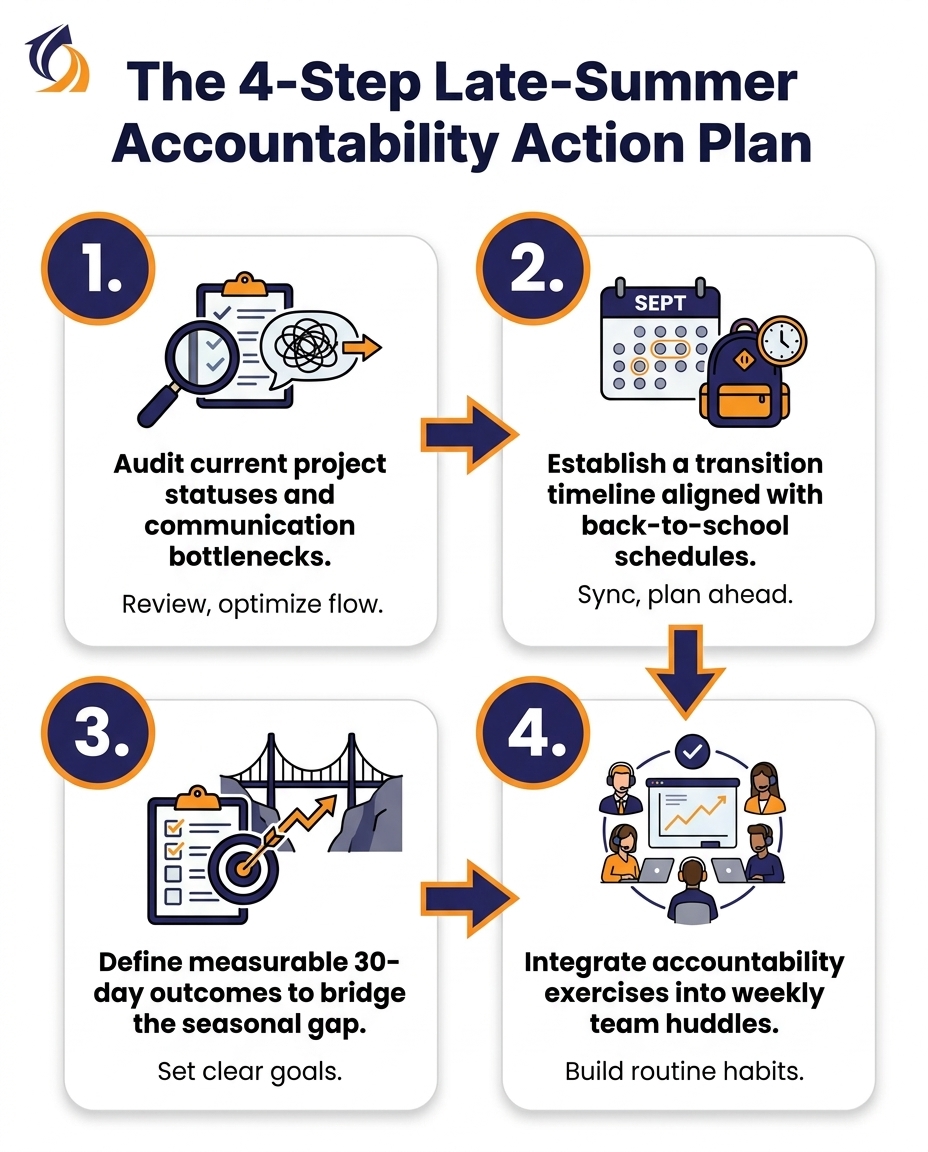
Building a framework to guide your team through the late-August back-to-school transition requires a methodical approach. A pattern we see often at Driven Leadership is that leaders hesitate to implement structure for fear of micromanaging. However, you must build an accountability action plan that resets expectations for the fall without stifling the autonomy that remote workers value. Follow these core steps to structure your transition strategy.
1. Audit current project statuses: Begin by identifying exactly where communication bottlenecks have formed over the summer. Look for projects that have stalled in the "waiting on review" phase or tasks that have been pushed back multiple times.
2. Establish a clear transition timeline: Align your operational reset with the back-to-school transition. Use this natural calendar shift to formally reset core working hours, expected response times, and daily availability.
3. Define measurable 30-day outcomes: Bridge the gap between summer laxity and fall structure by breaking long-term projects into strict 30-day deliverables. This creates immediate urgency.
4. Communicate transparently: Roll out the accountability action plan by explaining the "why" behind it. Ensure the team understands that team execution remains the primary focus, and the new structure is designed to support them, not police them.
Setting Clear 30-Day Transition Goals
Focusing on short-term milestones is the most effective way to rebuild team momentum. When you set clear 30-day transition goals, you use the upcoming seasonal shift as a natural deadline for project resets. This prevents the overwhelming feeling of tackling massive Q4 objectives before the team has regained its daily rhythm.
The value of structured timelines is evident in real-world leadership development. For example, when a recent participant seeking leadership development beyond typical corporate training completed our BOLD leadership experience last winter, they challenged their personal and professional identity in a highly structured environment. They achieved a level of growth that sustained their focus through the entire year—proving that rigorous frameworks outlast seasonal distractions.
Effective Accountability Exercises to Re-Engage Remote Teams
Once your overarching plan is in place, you need specific, actionable exercises that managers can implement immediately. We recommend these specific exercises because they drive behavioral change and improve remote engagement by replacing vague expectations with concrete daily actions. Especially in Puyallup and the greater Pacific Northwest, where the temptation to log off early is high, these routines keep teams anchored.
• Daily Outcome Huddles: Replace generic, rambling status updates with rapid 10-minute outcome huddles. Each team member states one specific, measurable outcome they will achieve by the end of the day. This shifts the focus from "what I am working on" to "what I am completing."
• Peer-to-Peer Check-ins: Distribute accountability across the team rather than relying solely on the manager. Pair team members up twice a week to review each other's progress. This builds cross-functional trust and reduces the manager's burden.
• The Friction Audit: Conduct a dedicated exercise to identify what remote work processes broke down during the summer months. Ask the team: "What tool, meeting, or process is currently slowing you down?" Document the friction points and systematically eliminate them.
• Weekly Meeting Integration: Integrate these accountability exercises directly into your existing weekly team meetings. Normalizing the new structure prevents it from feeling like a temporary HR initiative and cements it as the new standard operating procedure.
Bridging the Gap: Preparing Your Team Culture for Autumn
Tactical accountability exercises are necessary for immediate stabilization, but leaders must eventually synthesize these operational tactics into a broader cultural strategy. Transitioning the conversation from immediate task accountability to leading an engaged culture ensures your team is fully prepared for the high-performance fall season.
Resetting expectations now prevents burnout and confusion when major Q4 initiatives launch. If you wait until October to demand higher output, you will shock a system that is still operating on a relaxed late-August back-to-school transition schedule. Gentle, structured guidance back into a high-performance rhythm is the key to sustainable output.
Leaders must actively model the behavior they want to see. If you expect your team to adhere to core hours and structured communication, you must demonstrate that same focus. During one of our recent Driven Leadership spring cohorts, two partners realized they needed to build a stronger business foundation as leaders and communicators. By attending both the in-person advanced training and the virtual program for managers, they gained a transformational experience that provided the exact tools needed to navigate seasonal shifts with confidence and model true accountability for their staff.
Common Questions About Managing Remote Teams in Late Summer
How do you keep remote employees engaged in the summer?
Keeping remote employees engaged requires replacing vague motivational tactics with clear, structured expectations. By implementing daily outcome huddles and 30-day transition goals, you give employees a clear target to hit. Acknowledging the late-August back-to-school transition and offering structured flexibility allows them to manage personal disruptions without dropping professional responsibilities. Engagement rises when employees feel supported by a reliable operational framework.
What is the summer slump at work?
The summer slump is a predictable operational transition where workplace productivity drops—often by up to 20%—due to seasonal distractions, shifting household schedules, and communication bottlenecks. It is most prominent during the late-August back-to-school transition when daily routines are heavily disrupted. Recognizing it as a structural issue rather than a failure of motivation helps leaders address it effectively.
How do you maintain accountability in a remote team?
Maintaining accountability remotely means shifting your focus from tracking active hours to measuring specific outcomes. Leaders should utilize peer-to-peer check-ins and transparent 30-day goals to ensure everyone understands their deliverables. When you build an environment based on behavioral change management, accountability becomes a shared team value rather than a top-down policing effort.
How do you motivate a team during the summer months?
Motivation during the summer months comes from clarity and achievable milestones, not just virtual happy hours. Break large, intimidating projects into smaller, 30-day deliverables so the team can experience frequent wins. When employees clearly understand how their daily tasks contribute to the larger goal, their internal motivation naturally increases, even amid seasonal distractions.
What should be included in an accountability action plan template?
A strong accountability action plan template should include a project audit section, a clear transition timeline, defined 30-day measurable outcomes, and a list of specific accountability exercises. It must also outline core working hours and expected communication response times. Having these elements documented transparently ensures the entire team is aligned as they move into the fall season.
Regaining Momentum for the Rest of the Year
Surviving the late-summer slump requires a commitment to structure, not just a reliance on motivation. As the late-August back-to-school transition reshapes your team's daily routines, implementing clear accountability frameworks is the definitive key to keeping remote employees engaged during the final weeks of summer. By replacing generic pep talks with measurable daily outcomes and structural support, you gently guide your workforce back into a high-performance rhythm.
Leaders who recognize this seasonal shift as an operational challenge rather than a failure of willpower will always outpace their competition. If you are ready to solidify these behavioral changes and equip your leadership team with advanced, actionable tools, explore our Engage Elevate Program today.
