Transforming Personal Life Through Professional Leadership Development

The Late-Summer Squeeze: When Workplace Burnout Meets Family Chaos
Transforming personal life through professional leadership development might sound like a purely academic concept until you find yourself staring at your laptop at 5:30 p.m., trying to clear one last email while your phone buzzes with urgent questions about dinner, soccer practice, and school supplies. You are exhausted, your patience is thin, and the lines between your office responsibilities and your household duties have completely blurred. At Driven Leadership, we see this overwhelming friction peak for many professionals every year as demanding work schedules collide head-on with the August back-to-school transition. When you are struggling to manage workplace stress, that tension does not stay at the office—it follows you home on your evening commute down Meridian Avenue.
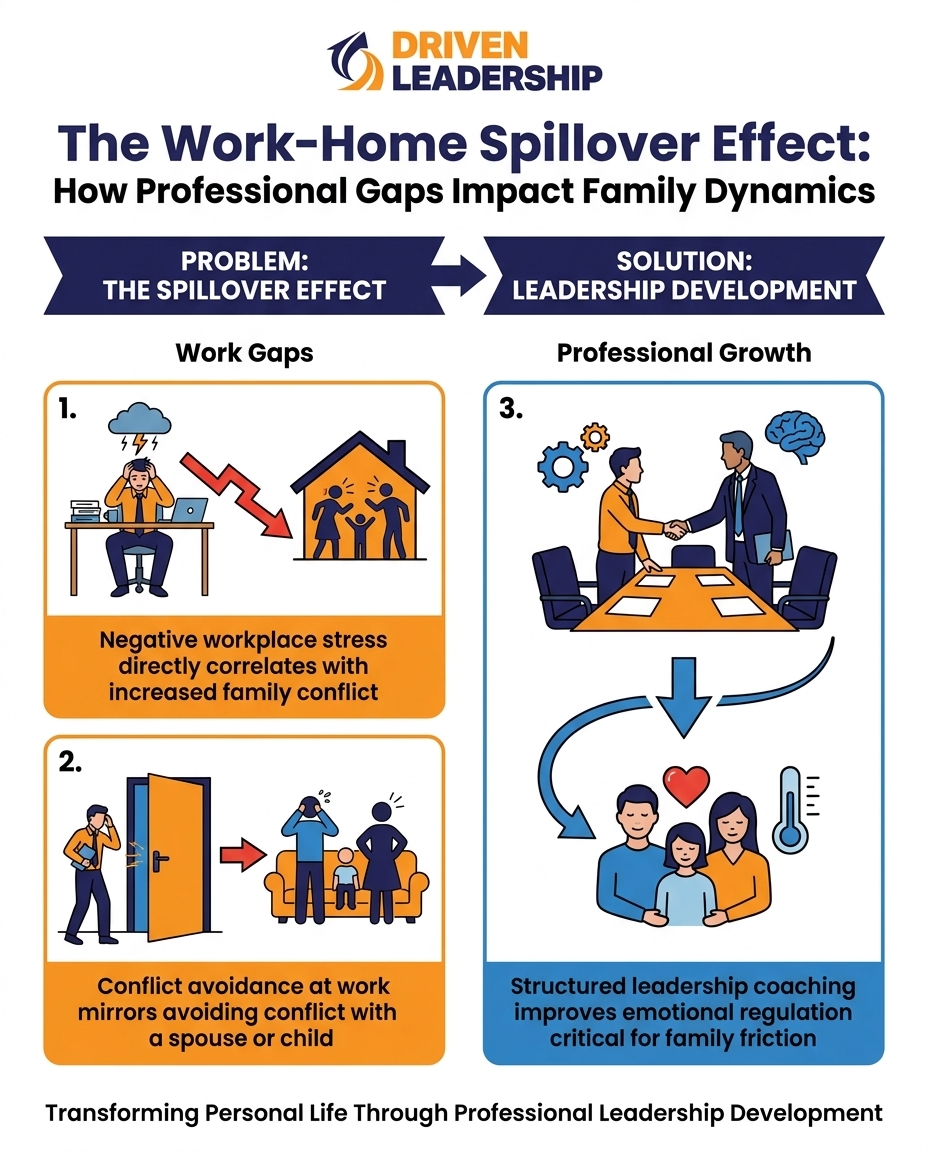
If you want to stop this cycle, investing in personal development with our coaching team is the most effective first step you can take. The tension you feel is known as the "work-family spillover effect." It occurs when unresolved stress, poor communication habits, and a lack of boundaries in the workplace directly correlate with increased conflict and chaos at home. You might think you need a better calendar app or a new chore chart to manage your family, but the truth goes much deeper. The core thesis we teach is simple: the exact same leadership frameworks used to manage high-performing workplace teams are the specific tools you need to resolve chaotic family dynamics.
During the late-summer 2026 back-to-school transition, the logistical demands on a household skyrocket. Schedules change, new routines must be established, and everyone's stress levels run a little higher. If you are already running on empty because you cannot delegate effectively at work, you will have no bandwidth left to help your family navigate this seasonal shift. By learning how to lead effectively in a professional setting, you inadvertently train yourself to show up as a calmer, more present, and more capable partner and parent.
The Core Overlap: Why Professional Communication Gaps Mirror Home Friction
The problem: Many professionals believe that their work persona and their home persona are two completely separate identities. However, in our years of coaching Puyallup executives, we've found that the psychological crossover between your professional and personal environments is undeniable. The behavioral gaps that cause friction in the boardroom are identical to the gaps causing friction in your living room. If you avoid difficult conversations with a colleague who is dropping the ball on a Q3 project, you are highly likely to avoid necessary, challenging conversations with a spouse or a teenager.
The cause: This overlap happens because human behavior is driven by ingrained habits, not by location. A failure to delegate tasks at work inevitably leads to professional burnout. That burnout drains your mental and emotional reserves, translating directly into a lack of energy and presence when you walk through your front door. According to data from a recent 2025 American Psychological Association (APA) study, work-related stress spillover is a primary driver of household arguments. When you spend a 40-plus hour workweek suppressing frustration because you lack the tools to address it constructively, that pressure eventually finds a release valve—usually directed at the people you love most.
The solution: To fix the home dynamic, you must address the root behavioral habits. This is where structured training, such as our Advanced Leadership Program, bridges the gap. By learning how to communicate clearly, set expectations, and hold others accountable in a professional setting, you build the exact muscle memory required to foster a healthy, cooperative environment at home.
Identifying the Root Cause of the Spillover
It is crucial to recognize that the inability to hold firm boundaries is a behavioral habit, not just a situational workplace issue. You cannot expect to be a passive communicator at work and suddenly transform into a clear, decisive leader the moment you pull into your driveway. To understand this dynamic, our facilitators often map specific workplace dysfunctions to their direct household equivalents.
• Micromanaging a team member's project — Household Equivalent: Hovering over a child's homework or chores — The Root Behavioral Cause: A lack of trust and an inability to delegate effectively.
• Avoiding a difficult performance review — Household Equivalent: Giving the silent treatment to a spouse — The Root Behavioral Cause: Fear of conflict and poor emotional regulation.
• Saying "yes" to every extra assignment — Household Equivalent: Overcommitting the family to weekend events — The Root Behavioral Cause: People-pleasing and a failure to set healthy boundaries.
• Failing to listen to employee feedback — Household Equivalent: Dismissing a family member's daily struggles — The Root Behavioral Cause: Lack of active listening and empathetic engagement.
Setting Boundaries: A Dual-Purpose Tool for the Office and the Living Room
Boundary setting is often misunderstood as building walls to keep people out. In reality, a healthy boundary in a leadership context is about establishing clear expectations and predictable responses. It is a foundational skill that simultaneously improves professional respect and family harmony. When you know exactly what is expected of you—and what you expect of others—anxiety plummets and cooperation rises.
Practicing boundary-setting through our structured BOLD leadership training program empowers individuals to protect their personal time fiercely. Real-world results show how transformative this can be. One professional who attended our immersive summer 2025 program found that the results lasted for years, fundamentally shifting their career trajectory and their spouse's daily life because they gained the courage to tackle goals they had previously only dreamed about. By learning to say "no" to unnecessary corporate distractions, they reclaimed 5 to 10 hours a week to be fully present at home.
Establishing these boundaries reduces logistical stress during demanding family periods, particularly during the late-summer back-to-school transition. When you have a framework for communicating your limits, you stop overpromising. You learn to leave work at work, both physically and mentally, which is the greatest gift you can give your household.
Translating Office Boundaries to Household Logistics
How do you actually take a corporate boundary and apply it to your living room? We consistently advise our clients to use leadership techniques to clearly communicate their bandwidth to family members while establishing "off-the-clock" mental habits.
• The "Hard Stop" Rule: Just as you might set a hard stop for a rambling meeting, set a hard stop for checking work emails at home. Communicate this boundary clearly to your team and your family.
• Clear Delegation: In the office, you assign tasks based on capacity. At home, use the same clear, respectful communication to divide household chores. Do not expect your partner to read your mind.
• Bandwidth Check-Ins: Leaders regularly ask their teams about their current workload. Apply this to your family. A simple weekly check-in about everyone's stress levels prevents major blow-ups.
• Mental Transition Zones: Use your 20-minute commute to mentally transition from "manager mode" to "parent/partner mode." This ensures true presence during family time.
Emotional Regulation: Navigating Conflict Without the Chaos
Conflict is inevitable, whether you are dealing with a frustrated client or a frustrated toddler. However, chaos is optional. The difference between a productive disagreement and a damaging argument comes down to emotional intelligence and regulation. Our leadership coaching fundamentally improves emotional regulation, which is a critical skill for navigating family friction without causing lasting damage.
Insights from the Harvard Business Review consistently highlight that emotional intelligence—specifically self-awareness and self-regulation—is the defining characteristic of effective leaders. When you learn to manage your own emotional state under pressure, you de-escalate situations rather than adding fuel to the fire. During our spring 2026 session, one local Pierce County participant focused intensely on improving their confidence and taking charge of their reactions. The management team quickly noticed the proactive shift, but more importantly, the enhanced communication and listening skills created an immediate, positive impact on their family dynamic.
If you want to master emotional regulation and apply it to your home life, we recommend following these core leadership tenets:
1. Recognize Your Physiological Triggers: Before you lose your temper, your body gives you warning signs—a tight chest, shallow breathing, or a clenched jaw. Recognize these signs as a cue to step back, rather than a cue to attack.
2. Implement the Leadership Pause: When a child disobeys or a spouse criticizes, your default reaction might be defensive anger. A trained leader takes a deliberate 3-second pause before responding, moving the reaction from the emotional center of the brain to the logical center.
3. Practice Active Listening: Most people listen just enough to formulate their counter-argument. Active listening requires you to focus entirely on understanding the other person's perspective. This building trust and cooperation technique instantly defuses tension because the other person feels heard.
4. Address the Behavior, Not the Character: In a professional setting, you critique the project, not the employee. At home, critique the specific action (e.g., "leaving the dishes out is frustrating") rather than attacking the person (e.g., "you are so lazy").
5. Seek Collaborative Solutions: Instead of dictating a fix, ask questions. "How can we solve this together?" shifts the dynamic from a battle of wills to a team effort.
Moving Past Corporate Jargon to Deep Behavioral Change
There is a massive difference between attending a superficial 60-minute corporate time-management webinar and engaging in a program that fosters genuine personal transformation. Standard corporate training often focuses on acronyms, flowcharts, and surface-level efficiency hacks. These might help you organize your inbox, but they will not help you rebuild trust with a frustrated partner or patiently guide a struggling child.
True leadership development requires challenging your deepest assumptions and stepping far out of your comfort zone over a sustained period. It demands that you look at your own flaws, your communication blind spots, and your defensive habits. A professional seeking to take ownership of their personal and professional life attended our spring 2026 course and found exactly this. Encouraged by passionate instruction, they were challenged to take extreme ownership of their actions and step out of their comfort zone to become the best version of themselves, rather than just learning a new corporate framework.
This highlights our team's unique focus at Driven Leadership on deep, behavioral change that consistently yields real-world improvements in participants' family lives, rather than just workplace ROI. When individuals take true ownership of their professional lives over our 12-week behavioral change timeline, they organically become better spouses, parents, and friends. They stop playing the victim to their circumstances and start living epically, bringing a renewed sense of purpose and calm to their households.
Finding Clarity Through the Fog: Building Resilience for the Months Ahead
As the late-summer back-to-school transition settles, the reality of the coming months sets in. For our clients here in the Pacific Northwest, the transition into the greyer seasons serves as a powerful metaphor for entering periods of high stress or uncertainty at work and home. Just as the morning Puyallup Valley fog can obscure the road ahead, daily logistical chaos and overlapping responsibilities can cloud your judgment and drain your energy.
Applying structured leadership frameworks helps professionals find clarity through the fog of daily life. When you have a system for prioritizing Q4 corporate goals alongside family needs, and managing emotional responses, you are no longer driving blind. You have a navigational compass that works regardless of the external weather or internal stress.
Building mental resilience is vital to maintaining positive family dynamics during demanding seasons. Resilience is not about ignoring stress; it is about having the tools to process it efficiently so it does not fester. By viewing your personal life through the lens of professional leadership, you equip yourself to handle the grey seasons with grace, ensuring that your home remains a sanctuary rather than a second battleground.
Frequently Asked Questions About Leadership Coaching and Home Life
How does leadership development affect personal life?
In our coaching experience, leadership development profoundly impacts your personal life by fundamentally changing how you communicate, manage stress, and set boundaries. When you learn to regulate your emotions and listen actively in a corporate setting, those newly formed habits naturally carry over to your interactions with your spouse and children. Instead of reacting defensively to household chaos, you learn to approach family challenges with patience, clarity, and a problem-solving mindset.
Can leadership skills be used in everyday life?
Yes, leadership skills are incredibly practical for everyday life. Skills such as time management, conflict resolution, active listening, and clear delegation are just as critical for running a busy household as they are for managing a corporate department. Every time you negotiate a curfew with a teenager or divide household chores with a partner, you are actively utilizing core leadership techniques we teach in our workshops.
What is the connection between personal and professional development?
The connection is rooted in human behavior; you bring the same mind and emotional habits to both environments. Professional development that focuses on deep behavioral change—like improving empathy and accountability—automatically spurs personal growth. You cannot become a highly self-aware, emotionally regulated executive without simultaneously becoming a more present and understanding family member.
How do professional leadership skills improve family dynamics?
Professional leadership skills improve family dynamics by replacing emotional reactivity with structured, respectful communication. When a parent uses leadership tools to clearly state expectations and consistently follow through without anger, children feel more secure. Furthermore, when spouses use active listening and collaborative problem-solving, marital friction decreases significantly, often saving hours of exhausting arguments.
Why is boundary setting important in personal and professional development?
Boundary setting is essential because it protects your mental bandwidth and prevents burnout in both arenas. Professionally, boundaries ensure you are not overwhelmed by tasks outside your scope, allowing you to perform at your best. Personally, setting boundaries around your time and energy ensures you have the capacity to be fully present and engaged with your loved ones when you are off the clock.
How quickly can improved communication at work impact relationships at home?
We often see the impact almost immediately once new habits are put into practice. The moment you replace a defensive reaction with a "leadership pause" and active listening, the tension in a household argument diffuses. While deep behavioral change takes a 12-week timeline or longer to permanently solidify, the initial de-escalation techniques learned in leadership training provide instant relief to strained family relationships.
Taking the First Step Toward Better Leadership at Work and Home
Fixing your professional communication and boundaries almost always resolves personal dynamic issues simultaneously. The exhaustion and friction you feel during demanding seasons like August 2026 are not signs that you are failing; they are simply indicators that your current behavioral toolkit is no longer sufficient for the demands of your life. The habits that cause you to avoid conflict or micromanage projects at the office are the exact same habits causing stress in your living room.
It is time to view leadership development as an essential investment in your overall quality of life, not just a stepping stone for your career. By committing to deep, behavioral change, you equip yourself to handle both boardroom pressures and household chaos with calm authority. Our team at Driven Leadership invites you to explore how structured leadership frameworks can transform your daily reality, helping you become the resilient, present, and effective person your family—and your team—truly needs.