
Why We Push Executives Past Their Comfort Zone at Our Wrightwood Retreats

The Hidden Cost of Corporate Facades in Executive Leadership
Your executive team is sitting around a polished conference table, nodding in agreement, but the real issues remain entirely unspoken. When you ask why we push executives past their comfort zone at our Wrightwood retreats, it comes down to this hidden cost: the deeply entrenched corporate facades that prevent genuine team alignment. Leaders often arrive at our programs carrying layers of psychological armor. They have spent years building defensive mechanisms designed to protect their status, hide their vulnerabilities, and project absolute certainty. While this armor might help them survive the daily corporate grind, it actively blocks the vulnerability required for authentic, high-level problem-solving.
Over our years of facilitating executive breakthroughs at Driven Leadership, our team typically sees that passive presentations and standard whiteboard sessions completely fail to break through these barriers. When leaders remain in their comfort zones, they rely on rehearsed responses and standard corporate jargon. They manage optics instead of addressing root dysfunctions. To achieve a radical shift in methodology, we must introduce deliberate disorientation right from the start. By intentionally stripping away these protective layers, we force executives to engage with one another as human beings rather than as job titles.
Whether you are planning a mid-fall October off-site or a late-year summit, breaking down these walls requires a fundamentally different approach to executive development. For teams ready to move beyond surface-level harmony and tackle real organizational challenges, our leadership trainings provide the intentional friction necessary to drive permanent behavioral change.
Why the Boardroom Fails to Foster True Alignment
Traditional corporate retreats often coddle executives with luxury, which inadvertently reinforces the exact hierarchies and silos that organizations are trying to dismantle. When a retreat consists of catered lunches, plush seating, and perfectly scheduled breakout sessions, leaders remain entirely comfortable. The problem with this comfort is that predictability is the enemy of growth. When leaders know exactly what to expect on the agenda, they remain guarded, relying on their established corporate personas to navigate the day.
In our experience working with leadership teams from Puyallup to Seattle, a pattern we see often is that a highly controlled environment allows executives to lean on their titles rather than their authentic leadership skills. Consider the stark contrast between the predictable, 68-degree climate-controlled environments of a corporate office and an unpredictable, rugged mountain setting. In a standard boardroom, the CEO sits at the head of the table, and the communication flows exactly as it always does. The environment dictates the behavior. To achieve lasting behavioral shifts, leaders must be removed from the physical spaces that enable their defensive habits.
At Driven Leadership, we intentionally avoid the luxury pampering found in standard executive workshops. We replace it with an environment that demands raw vulnerability. When you remove the safety net of high-end amenities and predictable schedules, executives are forced to adapt in real-time. This disruption is not arbitrary; it is a calculated mechanism to level the playing field.
• Physical Environment — Traditional Corporate Retreats: Climate-controlled boardrooms and luxury resorts. — BOLD Immersive Retreats: Rugged, unpredictable mountain settings.
• Primary Focus — Traditional Corporate Retreats: Passive listening and theoretical whiteboard sessions. — BOLD Immersive Retreats: Active problem-solving and experiential friction.
• Comfort Level — Traditional Corporate Retreats: High predictability; coddles existing hierarchies. — BOLD Immersive Retreats: Intentional disorientation; strips away corporate titles.
• End Outcome — Traditional Corporate Retreats: Temporary motivation that fades back at the office. — BOLD Immersive Retreats: Permanent behavioral shifts and authentic team trust.
The Psychology of Intentional Friction
To understand our methodology, you have to look at the psychological mechanics of human performance. Growth does not happen in a state of complete relaxation, nor does it happen in a state of sheer panic. It happens in the narrow space between the two. By introducing controlled disorientation, we force the brain to abandon rote corporate responses and engage in active, completely present problem-solving.
This concept is rooted in established behavioral science, specifically the balance between stress and performance. When our team designs these programs, we carefully calibrate this friction to ensure breakthroughs rather than breakdowns. We recommend intentional disruption because we are not creating stress for the sake of stress; we are creating a specific type of constructive friction that demands collaboration. If you want to see how these mechanics play out in real-world scenarios, exploring bold training exercises that build team trust reveals exactly how discomfort acts as a catalyst for unity.
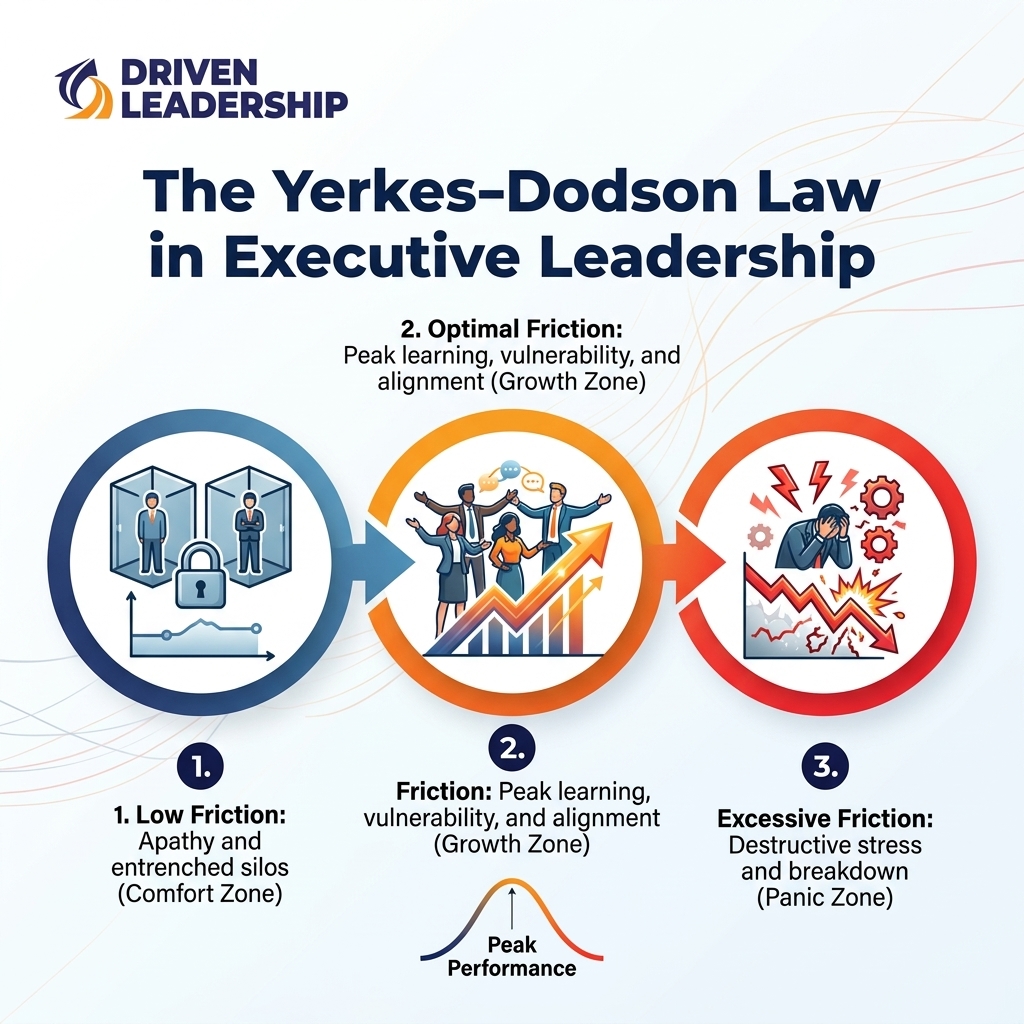
Breaking Down the Yerkes-Dodson Law for Leaders
The Yerkes-Dodson Law demonstrates that a specific level of stress and arousal is required for optimal learning and behavioral change. Here is how it applies to executive leadership:
• The Comfort Zone (Low Friction): Apathy and entrenched silos thrive here. Leaders are relaxed, but they are not learning. Innovation stagnates because there is no pressure to adapt.
• The Growth Zone (Optimal Friction): This is where we operate. Peak learning, vulnerability, and alignment occur when leaders are challenged just beyond their current capabilities.
• The Panic Zone (Excessive Friction): Destructive stress and breakdown. If the friction is too high without psychological safety, leaders shut down and revert to self-preservation.
Our facilitators are experts at keeping executives squarely in the Growth Zone. We know that zero friction equals zero growth, which is why we actively disrupt the status quo.
Creating Psychological Safety Amidst Discomfort
Friction only works when it is built on an absolute foundation of trust. Pushing leaders past their breaking point without a safety net causes resentment, not growth. In our experience, creating psychological safety does not mean making people comfortable; it means making it safe to fail, safe to look foolish, and safe to ask for help.
Our facilitators maintain strict boundaries while simultaneously pushing limits. We establish clear rules of engagement before the disorientation begins. When an executive struggles with a challenge in the mountains, they know they will not be mocked or penalized. Instead, they learn that their team has their back. This realization—that it is safe to drop the facade—is the exact moment the defensive mechanisms shatter.
Stripping Away Titles in the Rugged Wrightwood Environment
The physical environment acts as the very first mechanism of intentional friction, immediately challenging participants' expectations upon arrival. When executives step into the rugged terrain of Wrightwood, the corporate rulebook is thrown out the window. Navigating an unfamiliar, rigorous setting forces these leaders to rely entirely on their peers rather than their corporate authority. You cannot delegate a physical or environmental challenge to a subordinate; you have to face it alongside your team.
The isolation of the mountains intentionally removes daily distractions. There are no urgent emails to check, no assistants to manage schedules, and no back-to-back Zoom calls to hide behind. The crisp, unpredictable mid-fall October weather in Wrightwood strips away the predictability of a corporate office, adding a natural layer of environmental friction that demands complete presence and absolute commitment to the process.
Our facilitation team sees the real-world impact of this environment constantly. During a recent mid-fall October retreat, an executive arrived at our program lacking confidence and struggling to take charge during critical meetings. By removing the corporate safety net and placing them in our immersive, unpredictable environment, they were forced into active communication. The outcome was a profound shift—they gained the confidence to take charge when needed and fundamentally improved how they communicated with their team. Stepping into this rigorous program with no prior knowledge forces self-realization and risk-taking that a boardroom simply cannot replicate.
Moving from Disorientation to Authentic Team Trust
Once the corporate facade shatters, genuine communication and active listening can finally take root. The initial shock of the environment and the intentional friction serve a distinct purpose: they clear the slate. When leaders can no longer rely on their titles to command respect, they must earn it through collaboration, empathy, and decisive action.
The transition from individual discomfort to collective problem-solving is the core of our methodology. We introduce multiple unexpected challenges throughout the retreat to prevent leaders from re-establishing their defensive walls. Every time they think they have figured out the pattern, the paradigm shifts again. This constant requirement to adapt fosters significant personal and professional growth that goes far beyond generic team-building exercises like trust falls or personality tests. For teams looking to institutionalize this level of trust, our advanced leadership program builds upon these exact foundational breakthroughs.
The Moment of Vulnerability
Recognizing when the ego drops is a critical skill for our facilitators. It usually happens after a particularly challenging exercise where the team has failed multiple times. Frustration peaks, the typical dominant voices run out of ideas, and suddenly, the quietest person in the room offers a solution. Facilitating this raw, honest dialogue among peers is where the real work begins. When leaders admit they do not have all the answers, true alignment becomes possible.
Rebuilding Through Shared Adversity
Using the shared experience of overcoming friction to forge unbreakable trust is highly effective. Our facilitators saw this clearly during another crisp fall retreat when two leaders came to us needing to build a strong foundation as business partners. Through a transformational event and guided challenges, they successfully built their business together with vastly enhanced leadership and communication skills. By establishing new, healthier communication patterns under pressure, teams learn how to navigate conflict constructively rather than destructively.
Translating Mountain Breakthroughs to Daily Execution
The ultimate goal of intentional friction is not just to provide a memorable weekend in the mountains; it is to create permanent behavioral shifts in the workplace. A common problem with traditional retreats is the "post-retreat high"—everyone feels great on Monday, but by Thursday, the old silos and dysfunctions have completely returned. This happens because the retreat did not fundamentally alter how the team executes under pressure.
The vulnerability practiced in the mountains must translate directly to breaking down silos in executive teams back home. When a team has navigated severe disorientation together, they develop a shared language for addressing conflict. They no longer shy away from difficult conversations because they have already proven they can survive them. Equipping leaders with the tools to maintain this new level of authenticity during high-stakes corporate decisions is the final, most crucial step of the process.
To ensure that the temporary discomfort yields long-term alignment and execution, we focus on integration. Here is how teams carry the momentum forward:
1. Establishing new operational rhythms: Replacing outdated meeting structures with the active-listening protocols learned during the retreat.
2. Calling out defensive behaviors: Empowering team members to respectfully identify when a peer is reverting to their corporate facade.
3. Maintaining psychological safety: Continuing to reward vulnerability and risk-taking in daily operations, not just during off-sites.
4. Aligning on shared goals: Using the deep trust built in the mountains to drive unified corporate strategies.
When you implement these practices, the breakthroughs achieved in Wrightwood become standard operating procedure. For organizations ready to refine this process, integrating team execution strategies ensures that the momentum never stalls.
Frequently Asked Questions About Immersive Executive Retreats
Why is stepping out of your comfort zone important for leaders?
Stepping out of your comfort zone is important because growth and innovation cannot occur in a state of predictability. When leaders remain comfortable, they rely on outdated habits and defensive mechanisms to manage their teams. Pushing past these boundaries forces active problem-solving, exposes blind spots, and builds the resilience necessary to navigate complex corporate challenges. Ultimately, it transforms a stagnant manager into an adaptable, forward-thinking leader.
What actually happens at a disorientation-focused executive retreat?
At a disorientation-focused retreat, participants are deliberately removed from their predictable corporate environments and placed into unpredictable, challenging scenarios. Facilitators use intentional friction—such as physical challenges, shifting rules, and stripped-away titles—to break down corporate facades. This process forces executives to communicate authentically, rely on their peers, and solve problems without the safety net of their usual authority or resources.
How do you break down silos in executive teams effectively?
You break down silos by forcing cross-functional leaders to rely on one another in high-stakes, unfamiliar situations. When executives are placed in an environment where their individual titles hold no weight, they must collaborate to succeed. This shared adversity shatters the "us versus them" mentality, replacing departmental rivalries with a unified, company-first mindset that translates directly back to the boardroom.
How do immersive retreats build lasting trust?
Immersive retreats build lasting trust by creating an environment of psychological safety where vulnerability is required for success. When leaders see their peers struggle, ask for help, and overcome obstacles together, it humanizes the executive team. This shared experience of facing and overcoming intentional friction creates a deep, enduring bond that standard trust-building exercises simply cannot replicate.
Is intentional friction safe for all personality types on an executive team?
Yes, intentional friction is safe for all personality types when it is expertly calibrated and facilitated. Professional guides monitor the stress levels of the group, ensuring that participants stay within the "Growth Zone" and do not slip into the "Panic Zone." The goal is to challenge each individual relative to their own baseline, ensuring that introverts, extroverts, and varying leadership styles all experience breakthroughs without being overwhelmed.
Embrace the Discomfort That Drives Permanent Leadership Growth
Temporary discomfort is the necessary catalyst for permanent leadership growth and authentic team alignment. The corporate facades that executives carry into the boardroom are actively holding your organization back from reaching its full potential. By understanding the psychology behind intentional friction and the Yerkes-Dodson Law, leaders can confidently step out of their predictable routines and embrace the challenges that forge real unity.
Our methodology strips away these defensive layers, utilizing the rugged environment of Wrightwood to force genuine communication and collaborative problem-solving. If your executive team is ready to stop managing optics and start driving real results, it is time to disrupt the status quo. Explore how our BOLD advanced leadership retreat can strip away the facades and build a stronger, more unified executive team.
